SUBSCRIBE TO OUR FREE NEWSLETTER
Daily news & progressive opinion—funded by the people, not the corporations—delivered straight to your inbox.
5
#000000
#FFFFFF
To donate by check, phone, or other method, see our More Ways to Give page.
Daily news & progressive opinion—funded by the people, not the corporations—delivered straight to your inbox.
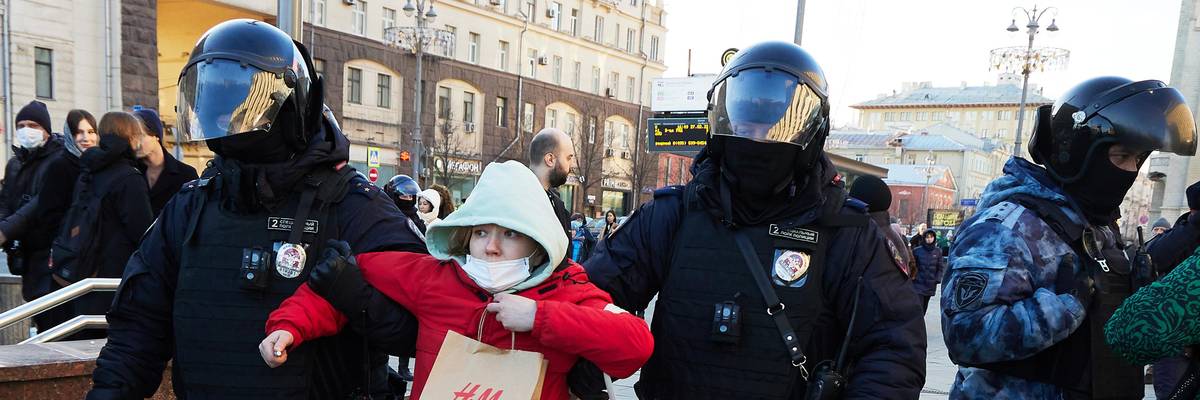
Police officers detain a woman during a protest against Russia's invasion of Ukraine at Pushkinskaya square on February 27, 2022 in Moscow, Russia. (Photo: Oleg Nikishin/Getty Images)
One month ago, the Ukrainian Ministry of Culture, supported by several individuals from the Ukrainian art world, called for sanctions to limit the Russian presence in the international cultural space. The call not only includes "all projects which involve the Russian Federation, including projects implemented with Russian money" but would also ban all Russians from taking part in international competitions, exhibitions, forums, and other cultural events. In short, everyone should "stop covering Russian culture in the media."
Many extremely brave anonymous citizens are taking part in anti-regime demonstrations across the Russian Federation.
Somewhat in contradiction with all these demands, the authors of the call conclude: "Art has always remained at the forefront of humanitarian values. We strongly believe that culture cannot be subservient to political propaganda, instead it should be utilized for developing critical thinking and promoting dialogue." But how to promote a dialog when even the Russian artists prone to critical thinking--in the past as well as now--have been reduced to nothing more than their Russianness?
The Vilnius International Film Festival answered the call and decided to remove all Russian films from its program, regardless of the directors' stances on the war and Russian President Vladimir Putin. The Festival's chief executive officer Algirdas Ramaska said that "we felt that this wasn't the right time to celebrate, or to promote, Russian filmmakers, Russian cinema, Russian culture." Journalist and film critic Daria Badior agreed: "I think Russian culture in general should be put on hold...even if some voices are acting independently and not being funded by the state, they are still articulating the imperial stances on Ukraine."
But other voices in the art world disagree. Heleen Gerritsen, head of goEast, a Central and Eastern European film festival, argues that "if we want Russian imperial ambitions in Central and Eastern Europe to stop, we will also have to support the opposition inside of Russia." Bulgarian film critic Mariana Hristova, who worries that cultural boycotts will harm artists more than the state, thinks a complete boycott unfair and insists that films and their authors should be evaluated on a case-by-case basis and presented within an adequate context. "There are so many Russian filmmakers who are opposing Putin's regime and were even personally oppressed," she points out, "those ones are suffering as well and they need support too, instead of being silence."
Even before Vilnius Film Festival decision, a festival in Glasgow withdrew two Russian films from its 2022 programme, though the director of one of the blacklisted movies, Lado Kvataniya, clearly denounced the war. The European Broadcasting Union announced that Russia would not be allowed to attend this year's Eurovision Song Contest. The Cannes Film Festival is trying not to be exclusive. It will not accommodate Russian official delegations or individuals linked to the Kremlin, but organizers didn't rule out accepting films from Russia.
Also trying to distinguish between "good" and "bad" Russians, the Venice Biennale announced a ban on anyone linked to the Russian government but will welcome those who oppose the current regime in Russia: "La Biennale di Venezia will not shut its doors to those who defend freedom of expression and demonstrate against the despicable and unacceptable decision to attack a sovereign state and its defenceless people." The Russian Pavilion at the Biennale's International Art Exhibition had already closed after its artists and curator pulled out in protest against Russia's actions in Ukraine.
It is understandable to ban Kremlin supporters, Putin's servants, propaganda workers, and the like. But many extremely brave anonymous citizens are taking part in anti-regime demonstrations across the Russian Federation. A manifesto signed by 11 prominent activists including Lev Ponomaryov, Oleg Orlov, and Svetlana Gannushkina has announced the creation of a new anti-war council of Russian human rights. An anti-war petition launched by Kommersant on the first day of the Russian invasion collected at least 100 journalists' signatures including employees from RBC, Novaya Gazeta (whose editor-in-chief Dmitry Muratov is the 2021 Nobel Peace Prize winner), Dozhd, and Ekho Moskvy, as well as state-run media TASS and RT, and is now joined by 30 other media outlets. An open letter criticizing the Russian invasion of Ukraine has been signed by more than 7,000 prominent Russian scientists. Likewise, more than 17,000 Russian artists and art professionals have signed an open letter with the message: "No to war!" Leading Russian rapper Oxxxymiron cancelled a concert in protest, saying on his Instagram account (followed by 2.2 million people) that he was against the war. Outstanding Russian directors from Moscow's Meyerhold Centre, Mayakovsky Theatre, and Stanislavski Theatre have left their posts because of the war. And the list goes on...
These individuals should be celebrated, not banned.
Elsewhere, the exclusion of Russians, regardless of their position on the war, leaves much to be desired when it comes to imagination, respect, memory, and common sense. One German restaurant (and one in Portugal) decided not to serve Russian guests. Russian shops have been vandalized. An Italian University tried to cancel its course on Dostoevsky. As Brendan O'Neill writes in The Spectator:
Russian art and booze and even cats are being cancelled by western institutions keen to signal their anger over Ukraine. The UK tour of the Russian State Ballet of Siberia has been axed, as if pirouettes were propaganda, as if sublime dancing by Russian people might pollute the hearts and minds of British audiences. Some UK venues have cancelled performances by the Russian State Opera, even though "Russian State Opera" is just a "brand name"--it is in fact part of a UK company that brings together graduates of arts institutions in Russia and former Soviet countries.
It is a mystery how all these people persecuted by Putin (and his predecessors) could so easily be proclaimed persona non grata in the eyes of those they saw as their natural allies.
The same applies to those historic figures of Russian culture who, being dead, cannot explain their position on the current war. Applying the same broad brush of boycott, the commissars of the cultural sphere would conclude that their deceased status doesn't render them innocent. Andrei Rublev, one of the most prominent Russian icon painters during the Middle Ages, is suspect because the Russian Orthodox Church canonized him as a saint in 1988. The filmmaker Andrei Tarkovsky, who made a celebrated film about Andrei Rublev, is also problematic because he is on a Russian postal stamp from 2007. Tolstoy served the Russian state as a young artillery officer during the Crimean War. Crimea! The Wagner Group would surely love that fact if they'd ever heard of Tolstoy.
And how about Aleksandr Solzhenitsyn? Surely, he was a dissident and did his part in revealing the Gulag's horrors. We know that he spat on Stalin and spent eight years in the prison camp. In 1970, he won the Nobel Prize in Literature "for the ethical force with which he has pursued the indispensable traditions of Russian literature." But he also turned against the West in his old age and, in 2006, accused NATO of expanding eastward and trying to bring Russia under its control. He met Vladimir Putin and apparently liked him. A contradictory personality doesn't make him a less remarkable writer. Authors are not angels, especially not the good ones wherever they are born.
According to the definition of "Russian" as "bad guy," even the dissident Alexei Navalny would have a hard time seeking refuge in the West if ever released from Putin's prison. It would indeed be a challenge to explain how his rejection could help the thousands of victims of the Kremlin's war in Ukraine.
Dear Common Dreams reader, It’s been nearly 30 years since I co-founded Common Dreams with my late wife, Lina Newhouser. We had the radical notion that journalism should serve the public good, not corporate profits. It was clear to us from the outset what it would take to build such a project. No paid advertisements. No corporate sponsors. No millionaire publisher telling us what to think or do. Many people said we wouldn't last a year, but we proved those doubters wrong. Together with a tremendous team of journalists and dedicated staff, we built an independent media outlet free from the constraints of profits and corporate control. Our mission has always been simple: To inform. To inspire. To ignite change for the common good. Building Common Dreams was not easy. Our survival was never guaranteed. When you take on the most powerful forces—Wall Street greed, fossil fuel industry destruction, Big Tech lobbyists, and uber-rich oligarchs who have spent billions upon billions rigging the economy and democracy in their favor—the only bulwark you have is supporters who believe in your work. But here’s the urgent message from me today. It's never been this bad out there. And it's never been this hard to keep us going. At the very moment Common Dreams is most needed, the threats we face are intensifying. We need your support now more than ever. We don't accept corporate advertising and never will. We don't have a paywall because we don't think people should be blocked from critical news based on their ability to pay. Everything we do is funded by the donations of readers like you. When everyone does the little they can afford, we are strong. But if that support retreats or dries up, so do we. Will you donate now to make sure Common Dreams not only survives but thrives? —Craig Brown, Co-founder |
One month ago, the Ukrainian Ministry of Culture, supported by several individuals from the Ukrainian art world, called for sanctions to limit the Russian presence in the international cultural space. The call not only includes "all projects which involve the Russian Federation, including projects implemented with Russian money" but would also ban all Russians from taking part in international competitions, exhibitions, forums, and other cultural events. In short, everyone should "stop covering Russian culture in the media."
Many extremely brave anonymous citizens are taking part in anti-regime demonstrations across the Russian Federation.
Somewhat in contradiction with all these demands, the authors of the call conclude: "Art has always remained at the forefront of humanitarian values. We strongly believe that culture cannot be subservient to political propaganda, instead it should be utilized for developing critical thinking and promoting dialogue." But how to promote a dialog when even the Russian artists prone to critical thinking--in the past as well as now--have been reduced to nothing more than their Russianness?
The Vilnius International Film Festival answered the call and decided to remove all Russian films from its program, regardless of the directors' stances on the war and Russian President Vladimir Putin. The Festival's chief executive officer Algirdas Ramaska said that "we felt that this wasn't the right time to celebrate, or to promote, Russian filmmakers, Russian cinema, Russian culture." Journalist and film critic Daria Badior agreed: "I think Russian culture in general should be put on hold...even if some voices are acting independently and not being funded by the state, they are still articulating the imperial stances on Ukraine."
But other voices in the art world disagree. Heleen Gerritsen, head of goEast, a Central and Eastern European film festival, argues that "if we want Russian imperial ambitions in Central and Eastern Europe to stop, we will also have to support the opposition inside of Russia." Bulgarian film critic Mariana Hristova, who worries that cultural boycotts will harm artists more than the state, thinks a complete boycott unfair and insists that films and their authors should be evaluated on a case-by-case basis and presented within an adequate context. "There are so many Russian filmmakers who are opposing Putin's regime and were even personally oppressed," she points out, "those ones are suffering as well and they need support too, instead of being silence."
Even before Vilnius Film Festival decision, a festival in Glasgow withdrew two Russian films from its 2022 programme, though the director of one of the blacklisted movies, Lado Kvataniya, clearly denounced the war. The European Broadcasting Union announced that Russia would not be allowed to attend this year's Eurovision Song Contest. The Cannes Film Festival is trying not to be exclusive. It will not accommodate Russian official delegations or individuals linked to the Kremlin, but organizers didn't rule out accepting films from Russia.
Also trying to distinguish between "good" and "bad" Russians, the Venice Biennale announced a ban on anyone linked to the Russian government but will welcome those who oppose the current regime in Russia: "La Biennale di Venezia will not shut its doors to those who defend freedom of expression and demonstrate against the despicable and unacceptable decision to attack a sovereign state and its defenceless people." The Russian Pavilion at the Biennale's International Art Exhibition had already closed after its artists and curator pulled out in protest against Russia's actions in Ukraine.
It is understandable to ban Kremlin supporters, Putin's servants, propaganda workers, and the like. But many extremely brave anonymous citizens are taking part in anti-regime demonstrations across the Russian Federation. A manifesto signed by 11 prominent activists including Lev Ponomaryov, Oleg Orlov, and Svetlana Gannushkina has announced the creation of a new anti-war council of Russian human rights. An anti-war petition launched by Kommersant on the first day of the Russian invasion collected at least 100 journalists' signatures including employees from RBC, Novaya Gazeta (whose editor-in-chief Dmitry Muratov is the 2021 Nobel Peace Prize winner), Dozhd, and Ekho Moskvy, as well as state-run media TASS and RT, and is now joined by 30 other media outlets. An open letter criticizing the Russian invasion of Ukraine has been signed by more than 7,000 prominent Russian scientists. Likewise, more than 17,000 Russian artists and art professionals have signed an open letter with the message: "No to war!" Leading Russian rapper Oxxxymiron cancelled a concert in protest, saying on his Instagram account (followed by 2.2 million people) that he was against the war. Outstanding Russian directors from Moscow's Meyerhold Centre, Mayakovsky Theatre, and Stanislavski Theatre have left their posts because of the war. And the list goes on...
These individuals should be celebrated, not banned.
Elsewhere, the exclusion of Russians, regardless of their position on the war, leaves much to be desired when it comes to imagination, respect, memory, and common sense. One German restaurant (and one in Portugal) decided not to serve Russian guests. Russian shops have been vandalized. An Italian University tried to cancel its course on Dostoevsky. As Brendan O'Neill writes in The Spectator:
Russian art and booze and even cats are being cancelled by western institutions keen to signal their anger over Ukraine. The UK tour of the Russian State Ballet of Siberia has been axed, as if pirouettes were propaganda, as if sublime dancing by Russian people might pollute the hearts and minds of British audiences. Some UK venues have cancelled performances by the Russian State Opera, even though "Russian State Opera" is just a "brand name"--it is in fact part of a UK company that brings together graduates of arts institutions in Russia and former Soviet countries.
It is a mystery how all these people persecuted by Putin (and his predecessors) could so easily be proclaimed persona non grata in the eyes of those they saw as their natural allies.
The same applies to those historic figures of Russian culture who, being dead, cannot explain their position on the current war. Applying the same broad brush of boycott, the commissars of the cultural sphere would conclude that their deceased status doesn't render them innocent. Andrei Rublev, one of the most prominent Russian icon painters during the Middle Ages, is suspect because the Russian Orthodox Church canonized him as a saint in 1988. The filmmaker Andrei Tarkovsky, who made a celebrated film about Andrei Rublev, is also problematic because he is on a Russian postal stamp from 2007. Tolstoy served the Russian state as a young artillery officer during the Crimean War. Crimea! The Wagner Group would surely love that fact if they'd ever heard of Tolstoy.
And how about Aleksandr Solzhenitsyn? Surely, he was a dissident and did his part in revealing the Gulag's horrors. We know that he spat on Stalin and spent eight years in the prison camp. In 1970, he won the Nobel Prize in Literature "for the ethical force with which he has pursued the indispensable traditions of Russian literature." But he also turned against the West in his old age and, in 2006, accused NATO of expanding eastward and trying to bring Russia under its control. He met Vladimir Putin and apparently liked him. A contradictory personality doesn't make him a less remarkable writer. Authors are not angels, especially not the good ones wherever they are born.
According to the definition of "Russian" as "bad guy," even the dissident Alexei Navalny would have a hard time seeking refuge in the West if ever released from Putin's prison. It would indeed be a challenge to explain how his rejection could help the thousands of victims of the Kremlin's war in Ukraine.
One month ago, the Ukrainian Ministry of Culture, supported by several individuals from the Ukrainian art world, called for sanctions to limit the Russian presence in the international cultural space. The call not only includes "all projects which involve the Russian Federation, including projects implemented with Russian money" but would also ban all Russians from taking part in international competitions, exhibitions, forums, and other cultural events. In short, everyone should "stop covering Russian culture in the media."
Many extremely brave anonymous citizens are taking part in anti-regime demonstrations across the Russian Federation.
Somewhat in contradiction with all these demands, the authors of the call conclude: "Art has always remained at the forefront of humanitarian values. We strongly believe that culture cannot be subservient to political propaganda, instead it should be utilized for developing critical thinking and promoting dialogue." But how to promote a dialog when even the Russian artists prone to critical thinking--in the past as well as now--have been reduced to nothing more than their Russianness?
The Vilnius International Film Festival answered the call and decided to remove all Russian films from its program, regardless of the directors' stances on the war and Russian President Vladimir Putin. The Festival's chief executive officer Algirdas Ramaska said that "we felt that this wasn't the right time to celebrate, or to promote, Russian filmmakers, Russian cinema, Russian culture." Journalist and film critic Daria Badior agreed: "I think Russian culture in general should be put on hold...even if some voices are acting independently and not being funded by the state, they are still articulating the imperial stances on Ukraine."
But other voices in the art world disagree. Heleen Gerritsen, head of goEast, a Central and Eastern European film festival, argues that "if we want Russian imperial ambitions in Central and Eastern Europe to stop, we will also have to support the opposition inside of Russia." Bulgarian film critic Mariana Hristova, who worries that cultural boycotts will harm artists more than the state, thinks a complete boycott unfair and insists that films and their authors should be evaluated on a case-by-case basis and presented within an adequate context. "There are so many Russian filmmakers who are opposing Putin's regime and were even personally oppressed," she points out, "those ones are suffering as well and they need support too, instead of being silence."
Even before Vilnius Film Festival decision, a festival in Glasgow withdrew two Russian films from its 2022 programme, though the director of one of the blacklisted movies, Lado Kvataniya, clearly denounced the war. The European Broadcasting Union announced that Russia would not be allowed to attend this year's Eurovision Song Contest. The Cannes Film Festival is trying not to be exclusive. It will not accommodate Russian official delegations or individuals linked to the Kremlin, but organizers didn't rule out accepting films from Russia.
Also trying to distinguish between "good" and "bad" Russians, the Venice Biennale announced a ban on anyone linked to the Russian government but will welcome those who oppose the current regime in Russia: "La Biennale di Venezia will not shut its doors to those who defend freedom of expression and demonstrate against the despicable and unacceptable decision to attack a sovereign state and its defenceless people." The Russian Pavilion at the Biennale's International Art Exhibition had already closed after its artists and curator pulled out in protest against Russia's actions in Ukraine.
It is understandable to ban Kremlin supporters, Putin's servants, propaganda workers, and the like. But many extremely brave anonymous citizens are taking part in anti-regime demonstrations across the Russian Federation. A manifesto signed by 11 prominent activists including Lev Ponomaryov, Oleg Orlov, and Svetlana Gannushkina has announced the creation of a new anti-war council of Russian human rights. An anti-war petition launched by Kommersant on the first day of the Russian invasion collected at least 100 journalists' signatures including employees from RBC, Novaya Gazeta (whose editor-in-chief Dmitry Muratov is the 2021 Nobel Peace Prize winner), Dozhd, and Ekho Moskvy, as well as state-run media TASS and RT, and is now joined by 30 other media outlets. An open letter criticizing the Russian invasion of Ukraine has been signed by more than 7,000 prominent Russian scientists. Likewise, more than 17,000 Russian artists and art professionals have signed an open letter with the message: "No to war!" Leading Russian rapper Oxxxymiron cancelled a concert in protest, saying on his Instagram account (followed by 2.2 million people) that he was against the war. Outstanding Russian directors from Moscow's Meyerhold Centre, Mayakovsky Theatre, and Stanislavski Theatre have left their posts because of the war. And the list goes on...
These individuals should be celebrated, not banned.
Elsewhere, the exclusion of Russians, regardless of their position on the war, leaves much to be desired when it comes to imagination, respect, memory, and common sense. One German restaurant (and one in Portugal) decided not to serve Russian guests. Russian shops have been vandalized. An Italian University tried to cancel its course on Dostoevsky. As Brendan O'Neill writes in The Spectator:
Russian art and booze and even cats are being cancelled by western institutions keen to signal their anger over Ukraine. The UK tour of the Russian State Ballet of Siberia has been axed, as if pirouettes were propaganda, as if sublime dancing by Russian people might pollute the hearts and minds of British audiences. Some UK venues have cancelled performances by the Russian State Opera, even though "Russian State Opera" is just a "brand name"--it is in fact part of a UK company that brings together graduates of arts institutions in Russia and former Soviet countries.
It is a mystery how all these people persecuted by Putin (and his predecessors) could so easily be proclaimed persona non grata in the eyes of those they saw as their natural allies.
The same applies to those historic figures of Russian culture who, being dead, cannot explain their position on the current war. Applying the same broad brush of boycott, the commissars of the cultural sphere would conclude that their deceased status doesn't render them innocent. Andrei Rublev, one of the most prominent Russian icon painters during the Middle Ages, is suspect because the Russian Orthodox Church canonized him as a saint in 1988. The filmmaker Andrei Tarkovsky, who made a celebrated film about Andrei Rublev, is also problematic because he is on a Russian postal stamp from 2007. Tolstoy served the Russian state as a young artillery officer during the Crimean War. Crimea! The Wagner Group would surely love that fact if they'd ever heard of Tolstoy.
And how about Aleksandr Solzhenitsyn? Surely, he was a dissident and did his part in revealing the Gulag's horrors. We know that he spat on Stalin and spent eight years in the prison camp. In 1970, he won the Nobel Prize in Literature "for the ethical force with which he has pursued the indispensable traditions of Russian literature." But he also turned against the West in his old age and, in 2006, accused NATO of expanding eastward and trying to bring Russia under its control. He met Vladimir Putin and apparently liked him. A contradictory personality doesn't make him a less remarkable writer. Authors are not angels, especially not the good ones wherever they are born.
According to the definition of "Russian" as "bad guy," even the dissident Alexei Navalny would have a hard time seeking refuge in the West if ever released from Putin's prison. It would indeed be a challenge to explain how his rejection could help the thousands of victims of the Kremlin's war in Ukraine.