SUBSCRIBE TO OUR FREE NEWSLETTER
Daily news & progressive opinion—funded by the people, not the corporations—delivered straight to your inbox.
5
#000000
#FFFFFF
To donate by check, phone, or other method, see our More Ways to Give page.
Daily news & progressive opinion—funded by the people, not the corporations—delivered straight to your inbox.
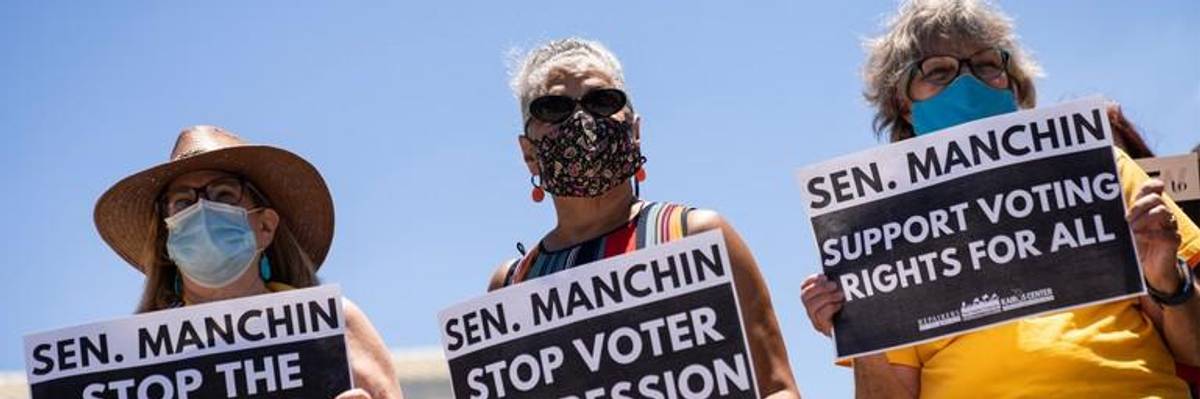
Activists rally against Sen. Mitch McConnell (R-Ky.) and Sen. Joe Manchin (D-W.V), calling on them to eliminate the legislative filibuster and pass the For the People Act outside the Supreme Court on June 23, 2021 in Washington, D.C. (Photo: Drew Angerer/Getty Images)
2021 has been a very difficult year for the country, starting with the devastating impact of the coronavirus.
Nevertheless, we should also recognize our good fortune this year when the effort of a demagogic, lawless former President to pull off a political coup was averted.
"The Freedom to Vote Act and the John Lewis Voting Rights Advancement Act must be enacted into law."
But, while that autocratic, habitually lying President is out of the White House, his Big Lie lives on and we continue to face perhaps the greatest threat to our democracy since the Civil War.
To put it simply: Republican officeholders in the states, backed by Republican Senators in Washington, are in the process of destroying our system of free and fair elections and imposing irreparable damage on our democracy for their own purely political advantage.
Trump's blatant Big Lie that the 2020 presidential election was stolen from him, repeated incessantly ever since, has been the cover for Republican state officeholders to pass legislation to set the stage for rigging and stealing future elections, starting with the 2022 midterms.
These Republican attacks include denying millions of eligible citizens the ability to vote, gerrymandering congressional districts, empowering partisan election officials to reject election results, and harassing election workers, all backed by Senate Republicans whose filibusters are blocking legislation that would protect against these anti-democratic actions.
The state voter suppression laws are aimed at reducing votes cast by Black, brown, and other minorities, the disabled, and urban voters. Ultimately, they are intended to eliminate votes for Democrats and tilt elections to Republican candidates.
These efforts can be stopped, however, by enacting the Freedom to Vote Act and the John Lewis Voting Rights Advancement Act.
The Freedom to Vote Act, a revised voting rights bill engineered by Senator Joe Manchin (D-WV), would override state voter suppression laws by enacting fair voting rules for federal elections, and would combat state election subversion laws by providing ways to prevent the rigging of federal elections. The John Lewis Voting Rights Advancement Act would prevent new voter discrimination laws from taking effect in certain states and local jurisdictions.
The House versions of these bills passed earlier this year. The bills are sponsored in the Senate by 50 Senators, including all 48 Democrats and two Independents.
The bills have not yet been considered by the Senate, however, because of Republican filibusters and the fact that two Democratic Senators, Manchin and Kyrsten Sinema (AZ), have not agreed to changing the current rules which require 60 votes to end a filibuster.
Ironically, these same two Senators voted earlier this month to create an exception to the 60-vote filibuster requirement which allowed an increase in the debt ceiling to pass by a simple majority vote.
Senator Manchin said earlier this year that "inaction is not an option" on voting rights legislation.
Last Sunday, Senator Manchin addressed voting rights in a Fox News interview saying that "voting is the bedrock of democracy." He confirmed that he is working on rules changes to "make the Senate work rather than the deadlock we have right now."
On Monday, Senate Majority Leader Chuck Schumer (D-NY) made clear that a showdown is coming when the Senate returns on January 3. He intends to bring the voting rights bills, and rules changes to consider and act on them, to the Senate floor in January.
Senator Schumer said that if Republicans continue to filibuster the voting rights bills "the Senate will then consider changes to any rules which prevent us from debating and reaching final conclusion on important legislation."
In other words, while Senator Schumer wants Senator Manchin to reach an agreement soon on rules changes, he is going to bring rules changes to the Senate floor even if Manchin doesn't.
Senator Manchin will have to decide if he is prepared to block his own legislation and deny millions of citizens the ability to vote, by protecting the filibuster rules even though they have been changed in the past, including under the leadership of his mentor, Senator Robert C. Byrd (D-WV). In fact, there have been more than 160 exceptions made to the filibuster rules since 1969 that have allowed measures to pass by a simple majority vote.
Senator Sinema will also have to decide whether she is prepared to block legislation that she herself has sponsored and that is essential to protect and preserve our democracy.
It's not too late to save our democracy. The Freedom to Vote Act and the John Lewis Voting Rights Advancement Act must be enacted into law.
Dear Common Dreams reader, It’s been nearly 30 years since I co-founded Common Dreams with my late wife, Lina Newhouser. We had the radical notion that journalism should serve the public good, not corporate profits. It was clear to us from the outset what it would take to build such a project. No paid advertisements. No corporate sponsors. No millionaire publisher telling us what to think or do. Many people said we wouldn't last a year, but we proved those doubters wrong. Together with a tremendous team of journalists and dedicated staff, we built an independent media outlet free from the constraints of profits and corporate control. Our mission has always been simple: To inform. To inspire. To ignite change for the common good. Building Common Dreams was not easy. Our survival was never guaranteed. When you take on the most powerful forces—Wall Street greed, fossil fuel industry destruction, Big Tech lobbyists, and uber-rich oligarchs who have spent billions upon billions rigging the economy and democracy in their favor—the only bulwark you have is supporters who believe in your work. But here’s the urgent message from me today. It's never been this bad out there. And it's never been this hard to keep us going. At the very moment Common Dreams is most needed, the threats we face are intensifying. We need your support now more than ever. We don't accept corporate advertising and never will. We don't have a paywall because we don't think people should be blocked from critical news based on their ability to pay. Everything we do is funded by the donations of readers like you. When everyone does the little they can afford, we are strong. But if that support retreats or dries up, so do we. Will you donate now to make sure Common Dreams not only survives but thrives? —Craig Brown, Co-founder |
2021 has been a very difficult year for the country, starting with the devastating impact of the coronavirus.
Nevertheless, we should also recognize our good fortune this year when the effort of a demagogic, lawless former President to pull off a political coup was averted.
"The Freedom to Vote Act and the John Lewis Voting Rights Advancement Act must be enacted into law."
But, while that autocratic, habitually lying President is out of the White House, his Big Lie lives on and we continue to face perhaps the greatest threat to our democracy since the Civil War.
To put it simply: Republican officeholders in the states, backed by Republican Senators in Washington, are in the process of destroying our system of free and fair elections and imposing irreparable damage on our democracy for their own purely political advantage.
Trump's blatant Big Lie that the 2020 presidential election was stolen from him, repeated incessantly ever since, has been the cover for Republican state officeholders to pass legislation to set the stage for rigging and stealing future elections, starting with the 2022 midterms.
These Republican attacks include denying millions of eligible citizens the ability to vote, gerrymandering congressional districts, empowering partisan election officials to reject election results, and harassing election workers, all backed by Senate Republicans whose filibusters are blocking legislation that would protect against these anti-democratic actions.
The state voter suppression laws are aimed at reducing votes cast by Black, brown, and other minorities, the disabled, and urban voters. Ultimately, they are intended to eliminate votes for Democrats and tilt elections to Republican candidates.
These efforts can be stopped, however, by enacting the Freedom to Vote Act and the John Lewis Voting Rights Advancement Act.
The Freedom to Vote Act, a revised voting rights bill engineered by Senator Joe Manchin (D-WV), would override state voter suppression laws by enacting fair voting rules for federal elections, and would combat state election subversion laws by providing ways to prevent the rigging of federal elections. The John Lewis Voting Rights Advancement Act would prevent new voter discrimination laws from taking effect in certain states and local jurisdictions.
The House versions of these bills passed earlier this year. The bills are sponsored in the Senate by 50 Senators, including all 48 Democrats and two Independents.
The bills have not yet been considered by the Senate, however, because of Republican filibusters and the fact that two Democratic Senators, Manchin and Kyrsten Sinema (AZ), have not agreed to changing the current rules which require 60 votes to end a filibuster.
Ironically, these same two Senators voted earlier this month to create an exception to the 60-vote filibuster requirement which allowed an increase in the debt ceiling to pass by a simple majority vote.
Senator Manchin said earlier this year that "inaction is not an option" on voting rights legislation.
Last Sunday, Senator Manchin addressed voting rights in a Fox News interview saying that "voting is the bedrock of democracy." He confirmed that he is working on rules changes to "make the Senate work rather than the deadlock we have right now."
On Monday, Senate Majority Leader Chuck Schumer (D-NY) made clear that a showdown is coming when the Senate returns on January 3. He intends to bring the voting rights bills, and rules changes to consider and act on them, to the Senate floor in January.
Senator Schumer said that if Republicans continue to filibuster the voting rights bills "the Senate will then consider changes to any rules which prevent us from debating and reaching final conclusion on important legislation."
In other words, while Senator Schumer wants Senator Manchin to reach an agreement soon on rules changes, he is going to bring rules changes to the Senate floor even if Manchin doesn't.
Senator Manchin will have to decide if he is prepared to block his own legislation and deny millions of citizens the ability to vote, by protecting the filibuster rules even though they have been changed in the past, including under the leadership of his mentor, Senator Robert C. Byrd (D-WV). In fact, there have been more than 160 exceptions made to the filibuster rules since 1969 that have allowed measures to pass by a simple majority vote.
Senator Sinema will also have to decide whether she is prepared to block legislation that she herself has sponsored and that is essential to protect and preserve our democracy.
It's not too late to save our democracy. The Freedom to Vote Act and the John Lewis Voting Rights Advancement Act must be enacted into law.
2021 has been a very difficult year for the country, starting with the devastating impact of the coronavirus.
Nevertheless, we should also recognize our good fortune this year when the effort of a demagogic, lawless former President to pull off a political coup was averted.
"The Freedom to Vote Act and the John Lewis Voting Rights Advancement Act must be enacted into law."
But, while that autocratic, habitually lying President is out of the White House, his Big Lie lives on and we continue to face perhaps the greatest threat to our democracy since the Civil War.
To put it simply: Republican officeholders in the states, backed by Republican Senators in Washington, are in the process of destroying our system of free and fair elections and imposing irreparable damage on our democracy for their own purely political advantage.
Trump's blatant Big Lie that the 2020 presidential election was stolen from him, repeated incessantly ever since, has been the cover for Republican state officeholders to pass legislation to set the stage for rigging and stealing future elections, starting with the 2022 midterms.
These Republican attacks include denying millions of eligible citizens the ability to vote, gerrymandering congressional districts, empowering partisan election officials to reject election results, and harassing election workers, all backed by Senate Republicans whose filibusters are blocking legislation that would protect against these anti-democratic actions.
The state voter suppression laws are aimed at reducing votes cast by Black, brown, and other minorities, the disabled, and urban voters. Ultimately, they are intended to eliminate votes for Democrats and tilt elections to Republican candidates.
These efforts can be stopped, however, by enacting the Freedom to Vote Act and the John Lewis Voting Rights Advancement Act.
The Freedom to Vote Act, a revised voting rights bill engineered by Senator Joe Manchin (D-WV), would override state voter suppression laws by enacting fair voting rules for federal elections, and would combat state election subversion laws by providing ways to prevent the rigging of federal elections. The John Lewis Voting Rights Advancement Act would prevent new voter discrimination laws from taking effect in certain states and local jurisdictions.
The House versions of these bills passed earlier this year. The bills are sponsored in the Senate by 50 Senators, including all 48 Democrats and two Independents.
The bills have not yet been considered by the Senate, however, because of Republican filibusters and the fact that two Democratic Senators, Manchin and Kyrsten Sinema (AZ), have not agreed to changing the current rules which require 60 votes to end a filibuster.
Ironically, these same two Senators voted earlier this month to create an exception to the 60-vote filibuster requirement which allowed an increase in the debt ceiling to pass by a simple majority vote.
Senator Manchin said earlier this year that "inaction is not an option" on voting rights legislation.
Last Sunday, Senator Manchin addressed voting rights in a Fox News interview saying that "voting is the bedrock of democracy." He confirmed that he is working on rules changes to "make the Senate work rather than the deadlock we have right now."
On Monday, Senate Majority Leader Chuck Schumer (D-NY) made clear that a showdown is coming when the Senate returns on January 3. He intends to bring the voting rights bills, and rules changes to consider and act on them, to the Senate floor in January.
Senator Schumer said that if Republicans continue to filibuster the voting rights bills "the Senate will then consider changes to any rules which prevent us from debating and reaching final conclusion on important legislation."
In other words, while Senator Schumer wants Senator Manchin to reach an agreement soon on rules changes, he is going to bring rules changes to the Senate floor even if Manchin doesn't.
Senator Manchin will have to decide if he is prepared to block his own legislation and deny millions of citizens the ability to vote, by protecting the filibuster rules even though they have been changed in the past, including under the leadership of his mentor, Senator Robert C. Byrd (D-WV). In fact, there have been more than 160 exceptions made to the filibuster rules since 1969 that have allowed measures to pass by a simple majority vote.
Senator Sinema will also have to decide whether she is prepared to block legislation that she herself has sponsored and that is essential to protect and preserve our democracy.
It's not too late to save our democracy. The Freedom to Vote Act and the John Lewis Voting Rights Advancement Act must be enacted into law.