SUBSCRIBE TO OUR FREE NEWSLETTER
Daily news & progressive opinion—funded by the people, not the corporations—delivered straight to your inbox.
5
#000000
#FFFFFF
To donate by check, phone, or other method, see our More Ways to Give page.
Daily news & progressive opinion—funded by the people, not the corporations—delivered straight to your inbox.
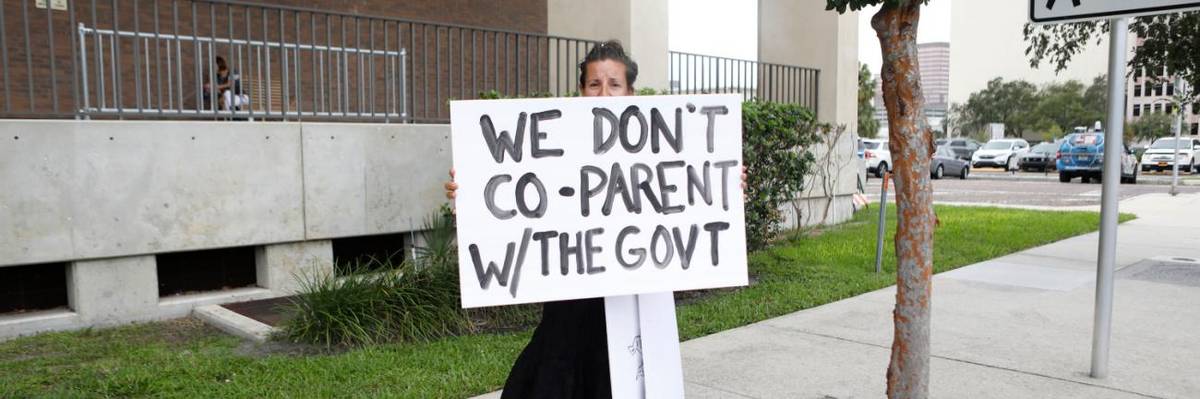
Families protest any potential mask mandates before the Hillsborough County Schools Board meeting held at the district office on July 27, 2021 in Tampa, Florida. (Photo: Octavio Jones/Getty Images)
School board meetings have been in the news lately, with parents and community members taking aim at board members and the policies they're trying to implement.
Frightening incidents have taken place at school board meetings in Florida, Texas, Michigan, and Wisconsin, among others, with angry citizens shouting and using Nazi salutes in the face of mask mandates, and some even sending death threats to board members over decisions with which they disagree.
In Minnesota, assault charges were recently filed against Thomas W. Kahlbaugh, a forty-seven-year-old man who attacked a fellow attendee at the Chaska school district's school board meeting in the suburbs of Minneapolis for supporting school mask mandates.
The furor against mask mandates, of course, has risen alongside readily stoked anger over other flashpoints such as critical race theory and the rights of transgender students.
Such incidents are usually heartbreaking, sometimes ridiculous, and often carefully preplanned. Jordan Hopkins, a writer based in Pennsylvania, documented the ties between these explosive school board protests and well-funded rightwing organizations for the news website Unicorn Riot.
Hopkins provides historical context for this latest attack on public education, which is, in fact, what these supposedly grassroots protests are really about.
"Egged on by a cadre of rightwing influencers," Hopkins writes, "concerned parents from across the rightwing spectrum have flocked to local school board meetings in order to protest a new round of public health restrictions."
The furor against mask mandates, of course, has risen alongside readily stoked anger over other flashpoints such as critical race theory and the rights of transgender students.
But this outrage is nothing new, Hopkins reminds us. In the early 1990s, conservative activists nabbed school board seats in thousands of elections across the country, under the direction of charismatic leaders including Ralph Reed of the Christian Coalition.
Laurel Shaper Walters's 1993 article about this phenomenon sounds as if it could have been written today, as it notes the ways in which local school board elections--if not meetings--had become a key battleground for activists outraged over the lack of prayer in school, or the distribution of condoms to high school students.
"Parents and taxpayers are demanding a voice in the process" in the realm of public education, Reed told Shaper Walters in 1993. The echoes of this demand can be heard across the United States today, with savvy conservative activists and organizations breathing new life into this old strategy--with determined and well-funded fervor.
Hopkins's Unicorn Riot article argues that today's vitriolic and occasionally violent school board confrontations make more sense when we take time to understand the dark-money forces that are propping them up.
The first group Hopkins mentions is the benign-sounding Council for National Policy (CNP), which he names as "one of the most active and powerful nonprofits in the country." CNP has millions of dollars in its arsenal, thanks to what writer Anne Nelson has said is the group's ability to connect "the manpower and media of the Christian right with the finances of Western plutocrats and the strategy of rightwing Republican political operatives."
CNP is tied to notorious rightwing outfits such as ALEC (the American Legislative Exchange Council) and the Wisconsin-based Bradley Foundation. The Bradley Foundation helped finance the supposedly grassroots uprising against COVID-19 restrictions and mask mandates that took place throughout 2020, according to an analysis from the Center for Media and Democracy.
During the Trump Administration, CNP put out its own education reform plan which outlined its hope that someday, all public schools would cease to exist so that all children could receive a Christian-centered education, ideally at home. This was also in line with the views of Trump's divisive Secretary of Education, billionaire Betsy DeVos.
Most school board members are part-time elected officials who must slog through countless meetings and voluminous reports before facing the public once or twice per month, usually for very minimal compensation; they are no match for the kind of violence-prone tactics we've seen at board meetings of late, nor should they be.
It is tempting to view the toolkits and activist training camps being put together by groups such as the Citizens for Renewing America as something of a joke, since they are loaded with pearl-clutching, fear-mongering messages about the threat posed by public education in the United States.
But this is not a joke. Members of the Proud Boys are showing up to school board meetings across the country. This is extremism; this is hate. As Hopkins points out, "These conflicts attract more violent elements of the far-right, which often put students, teachers, and school board members at risk."
What's also at risk is the viability of our democracy and the public education system that can either support, uphold, and strengthen it, or be destroyed through the carefully orchestrated, deep-pocketed campaign we are now witnessing.
Dear Common Dreams reader, It’s been nearly 30 years since I co-founded Common Dreams with my late wife, Lina Newhouser. We had the radical notion that journalism should serve the public good, not corporate profits. It was clear to us from the outset what it would take to build such a project. No paid advertisements. No corporate sponsors. No millionaire publisher telling us what to think or do. Many people said we wouldn't last a year, but we proved those doubters wrong. Together with a tremendous team of journalists and dedicated staff, we built an independent media outlet free from the constraints of profits and corporate control. Our mission has always been simple: To inform. To inspire. To ignite change for the common good. Building Common Dreams was not easy. Our survival was never guaranteed. When you take on the most powerful forces—Wall Street greed, fossil fuel industry destruction, Big Tech lobbyists, and uber-rich oligarchs who have spent billions upon billions rigging the economy and democracy in their favor—the only bulwark you have is supporters who believe in your work. But here’s the urgent message from me today. It's never been this bad out there. And it's never been this hard to keep us going. At the very moment Common Dreams is most needed, the threats we face are intensifying. We need your support now more than ever. We don't accept corporate advertising and never will. We don't have a paywall because we don't think people should be blocked from critical news based on their ability to pay. Everything we do is funded by the donations of readers like you. When everyone does the little they can afford, we are strong. But if that support retreats or dries up, so do we. Will you donate now to make sure Common Dreams not only survives but thrives? —Craig Brown, Co-founder |
School board meetings have been in the news lately, with parents and community members taking aim at board members and the policies they're trying to implement.
Frightening incidents have taken place at school board meetings in Florida, Texas, Michigan, and Wisconsin, among others, with angry citizens shouting and using Nazi salutes in the face of mask mandates, and some even sending death threats to board members over decisions with which they disagree.
In Minnesota, assault charges were recently filed against Thomas W. Kahlbaugh, a forty-seven-year-old man who attacked a fellow attendee at the Chaska school district's school board meeting in the suburbs of Minneapolis for supporting school mask mandates.
The furor against mask mandates, of course, has risen alongside readily stoked anger over other flashpoints such as critical race theory and the rights of transgender students.
Such incidents are usually heartbreaking, sometimes ridiculous, and often carefully preplanned. Jordan Hopkins, a writer based in Pennsylvania, documented the ties between these explosive school board protests and well-funded rightwing organizations for the news website Unicorn Riot.
Hopkins provides historical context for this latest attack on public education, which is, in fact, what these supposedly grassroots protests are really about.
"Egged on by a cadre of rightwing influencers," Hopkins writes, "concerned parents from across the rightwing spectrum have flocked to local school board meetings in order to protest a new round of public health restrictions."
The furor against mask mandates, of course, has risen alongside readily stoked anger over other flashpoints such as critical race theory and the rights of transgender students.
But this outrage is nothing new, Hopkins reminds us. In the early 1990s, conservative activists nabbed school board seats in thousands of elections across the country, under the direction of charismatic leaders including Ralph Reed of the Christian Coalition.
Laurel Shaper Walters's 1993 article about this phenomenon sounds as if it could have been written today, as it notes the ways in which local school board elections--if not meetings--had become a key battleground for activists outraged over the lack of prayer in school, or the distribution of condoms to high school students.
"Parents and taxpayers are demanding a voice in the process" in the realm of public education, Reed told Shaper Walters in 1993. The echoes of this demand can be heard across the United States today, with savvy conservative activists and organizations breathing new life into this old strategy--with determined and well-funded fervor.
Hopkins's Unicorn Riot article argues that today's vitriolic and occasionally violent school board confrontations make more sense when we take time to understand the dark-money forces that are propping them up.
The first group Hopkins mentions is the benign-sounding Council for National Policy (CNP), which he names as "one of the most active and powerful nonprofits in the country." CNP has millions of dollars in its arsenal, thanks to what writer Anne Nelson has said is the group's ability to connect "the manpower and media of the Christian right with the finances of Western plutocrats and the strategy of rightwing Republican political operatives."
CNP is tied to notorious rightwing outfits such as ALEC (the American Legislative Exchange Council) and the Wisconsin-based Bradley Foundation. The Bradley Foundation helped finance the supposedly grassroots uprising against COVID-19 restrictions and mask mandates that took place throughout 2020, according to an analysis from the Center for Media and Democracy.
During the Trump Administration, CNP put out its own education reform plan which outlined its hope that someday, all public schools would cease to exist so that all children could receive a Christian-centered education, ideally at home. This was also in line with the views of Trump's divisive Secretary of Education, billionaire Betsy DeVos.
Most school board members are part-time elected officials who must slog through countless meetings and voluminous reports before facing the public once or twice per month, usually for very minimal compensation; they are no match for the kind of violence-prone tactics we've seen at board meetings of late, nor should they be.
It is tempting to view the toolkits and activist training camps being put together by groups such as the Citizens for Renewing America as something of a joke, since they are loaded with pearl-clutching, fear-mongering messages about the threat posed by public education in the United States.
But this is not a joke. Members of the Proud Boys are showing up to school board meetings across the country. This is extremism; this is hate. As Hopkins points out, "These conflicts attract more violent elements of the far-right, which often put students, teachers, and school board members at risk."
What's also at risk is the viability of our democracy and the public education system that can either support, uphold, and strengthen it, or be destroyed through the carefully orchestrated, deep-pocketed campaign we are now witnessing.
School board meetings have been in the news lately, with parents and community members taking aim at board members and the policies they're trying to implement.
Frightening incidents have taken place at school board meetings in Florida, Texas, Michigan, and Wisconsin, among others, with angry citizens shouting and using Nazi salutes in the face of mask mandates, and some even sending death threats to board members over decisions with which they disagree.
In Minnesota, assault charges were recently filed against Thomas W. Kahlbaugh, a forty-seven-year-old man who attacked a fellow attendee at the Chaska school district's school board meeting in the suburbs of Minneapolis for supporting school mask mandates.
The furor against mask mandates, of course, has risen alongside readily stoked anger over other flashpoints such as critical race theory and the rights of transgender students.
Such incidents are usually heartbreaking, sometimes ridiculous, and often carefully preplanned. Jordan Hopkins, a writer based in Pennsylvania, documented the ties between these explosive school board protests and well-funded rightwing organizations for the news website Unicorn Riot.
Hopkins provides historical context for this latest attack on public education, which is, in fact, what these supposedly grassroots protests are really about.
"Egged on by a cadre of rightwing influencers," Hopkins writes, "concerned parents from across the rightwing spectrum have flocked to local school board meetings in order to protest a new round of public health restrictions."
The furor against mask mandates, of course, has risen alongside readily stoked anger over other flashpoints such as critical race theory and the rights of transgender students.
But this outrage is nothing new, Hopkins reminds us. In the early 1990s, conservative activists nabbed school board seats in thousands of elections across the country, under the direction of charismatic leaders including Ralph Reed of the Christian Coalition.
Laurel Shaper Walters's 1993 article about this phenomenon sounds as if it could have been written today, as it notes the ways in which local school board elections--if not meetings--had become a key battleground for activists outraged over the lack of prayer in school, or the distribution of condoms to high school students.
"Parents and taxpayers are demanding a voice in the process" in the realm of public education, Reed told Shaper Walters in 1993. The echoes of this demand can be heard across the United States today, with savvy conservative activists and organizations breathing new life into this old strategy--with determined and well-funded fervor.
Hopkins's Unicorn Riot article argues that today's vitriolic and occasionally violent school board confrontations make more sense when we take time to understand the dark-money forces that are propping them up.
The first group Hopkins mentions is the benign-sounding Council for National Policy (CNP), which he names as "one of the most active and powerful nonprofits in the country." CNP has millions of dollars in its arsenal, thanks to what writer Anne Nelson has said is the group's ability to connect "the manpower and media of the Christian right with the finances of Western plutocrats and the strategy of rightwing Republican political operatives."
CNP is tied to notorious rightwing outfits such as ALEC (the American Legislative Exchange Council) and the Wisconsin-based Bradley Foundation. The Bradley Foundation helped finance the supposedly grassroots uprising against COVID-19 restrictions and mask mandates that took place throughout 2020, according to an analysis from the Center for Media and Democracy.
During the Trump Administration, CNP put out its own education reform plan which outlined its hope that someday, all public schools would cease to exist so that all children could receive a Christian-centered education, ideally at home. This was also in line with the views of Trump's divisive Secretary of Education, billionaire Betsy DeVos.
Most school board members are part-time elected officials who must slog through countless meetings and voluminous reports before facing the public once or twice per month, usually for very minimal compensation; they are no match for the kind of violence-prone tactics we've seen at board meetings of late, nor should they be.
It is tempting to view the toolkits and activist training camps being put together by groups such as the Citizens for Renewing America as something of a joke, since they are loaded with pearl-clutching, fear-mongering messages about the threat posed by public education in the United States.
But this is not a joke. Members of the Proud Boys are showing up to school board meetings across the country. This is extremism; this is hate. As Hopkins points out, "These conflicts attract more violent elements of the far-right, which often put students, teachers, and school board members at risk."
What's also at risk is the viability of our democracy and the public education system that can either support, uphold, and strengthen it, or be destroyed through the carefully orchestrated, deep-pocketed campaign we are now witnessing.