SUBSCRIBE TO OUR FREE NEWSLETTER
Daily news & progressive opinion—funded by the people, not the corporations—delivered straight to your inbox.
5
#000000
#FFFFFF
To donate by check, phone, or other method, see our More Ways to Give page.
Daily news & progressive opinion—funded by the people, not the corporations—delivered straight to your inbox.
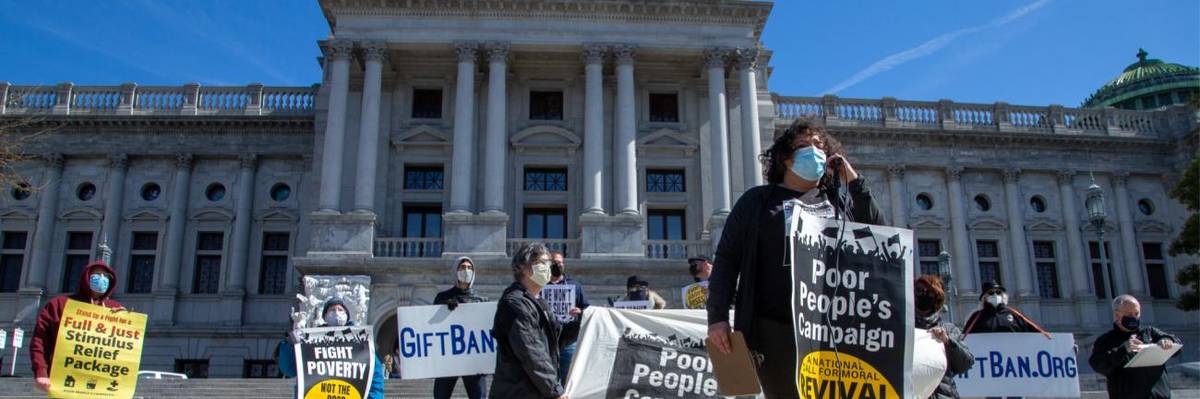
Nijmie Dzurinko, co-chair of the Pennsylvania Poor People's Campaign speaks on the steps of the Pennsylvania State Capitol during a press conference. (Photo: Paul Weaver/SOPA Images/LightRocket via Getty Images)
Amidst partisan haggling over President Biden's infrastructure proposal, the Poor People's Campaign joined progressive House members on Capitol Hill on Thursday to lay out a comprehensive moral vision for the nation.
"It's unforgiveable that 250,000 people die every year in this country from poverty and inequality," said Rep. Barbara Lee (D-Calif.) during a press conference to unveil a sweeping Congressional resolution for a "Third Reconstruction."
The resolution's title draws on the transformational history of the First Reconstruction following the Civil War and the Second Reconstruction of the 20th century civil rights movement -- two periods during which multi-racial coalitions achieved significant strides towards racial and economic justice.
Rep. Pramila Jayapal (D-Wash.), Chair of the 95-member Congressional Progressive Caucus, stressed that a new era of transformational change will require new policy choices.
"We allow poverty to continue when the richest 130,000 Americans have as much wealth as the bottom 117 million, when 55 of the largest corporations paid not one dollar in taxes last year, when we let our health system to be focused on profits -- not patients," Jayapal said.
Lee and Jayapal were flanked by six other Progressive Caucus members and Poor People's Campaign co-chairs Rev. Dr. William Barber II and Rev. Dr. Liz Theoharis.
"What is the cost of inequality?" asked Barber, pointing out that billionaire wealth has increased by more than $1.3 trillion during the pandemic while millions have fallen into poverty. "This is a moral issue, rooted in the moral commitments of our Constitution. The first thing we had to do is establish justice, promote the general welfare, and to ensure equal protection under the law."
The Congressional resolution lays out a roadmap for achieving those lofty goals.
A long list of proposed economic policies focus on eradicating poverty and sharply reducing racial and economic inequality. They include a federal jobs program to build up climate resilient public infrastructure, universal health care and paid leave, raising the minimum wage to a living wage, and guaranteeing the right to form and join unions.
The resolution also calls for bold action to address the inter-connected injustices of systemic racism, ecological devastation, and militarism. Proposals include expanding voting rights, comprehensive and just immigration reform, and guaranteeing Native and Indigenous rights.
While not directly addressing President Biden's proposals, the Third Reconstruction resolution goes beyond the administration's commitments to date in several key areas.
For example, to secure resources for public investment, the resolution calls for redirecting 10 percent of the military budget and generating revenue by fully repealing the 2017 corporate tax rate cut and introducing new taxes on wealth and Wall Street trading.
Several members who spoke at the press conference described the ravages of poverty and inequality in their Congressional districts.
"In San Diego County, we have Fortune 500 companies and mansions on the beach," said first-term Rep. Sara Jacobs. "But we also have 40 percent of children living in poverty -- and that was before the pandemic."
A self-described "Millennial," Jacobs said her generation is ready to move beyond modest reforms to reimagine and rebuild American society for the future. She called on others like her who are "privileged to have benefited from the system as it is" to support movements like the Poor People's Campaign that center those hardest hit by unfair and discriminatory policies.
Over the last three years, the Campaign has developed a network across 45 states that includes over 2,000 faith leaders and 300 partner organizations. In addition to pushing the Third Reconstruction resolution, the group is organizing a National Poor People's and Low-Wage Workers Assembly on June 21 that will be accessible online and in person in Raleigh, North Carolina. This will kick off a year-long nationwide campaign leading up to an in-person Mass Poor Peoples and Low-Wage Workers Assembly and Moral March on Washington in June 2022.
For those who will inevitably raise questions about how the Congressional resolution, if fully enacted, would impact the deficit, Barber was ready with answers.
"There is no scarcity of resources," Barber said. "There is no scarcity of solutions. What we have in this country and have had for far too long is a scarcity of moral fusion social conscience. And it ends now with us -- with this movement. We will see the birthing of a Third Reconstruction."
Dear Common Dreams reader, It’s been nearly 30 years since I co-founded Common Dreams with my late wife, Lina Newhouser. We had the radical notion that journalism should serve the public good, not corporate profits. It was clear to us from the outset what it would take to build such a project. No paid advertisements. No corporate sponsors. No millionaire publisher telling us what to think or do. Many people said we wouldn't last a year, but we proved those doubters wrong. Together with a tremendous team of journalists and dedicated staff, we built an independent media outlet free from the constraints of profits and corporate control. Our mission has always been simple: To inform. To inspire. To ignite change for the common good. Building Common Dreams was not easy. Our survival was never guaranteed. When you take on the most powerful forces—Wall Street greed, fossil fuel industry destruction, Big Tech lobbyists, and uber-rich oligarchs who have spent billions upon billions rigging the economy and democracy in their favor—the only bulwark you have is supporters who believe in your work. But here’s the urgent message from me today. It's never been this bad out there. And it's never been this hard to keep us going. At the very moment Common Dreams is most needed, the threats we face are intensifying. We need your support now more than ever. We don't accept corporate advertising and never will. We don't have a paywall because we don't think people should be blocked from critical news based on their ability to pay. Everything we do is funded by the donations of readers like you. When everyone does the little they can afford, we are strong. But if that support retreats or dries up, so do we. Will you donate now to make sure Common Dreams not only survives but thrives? —Craig Brown, Co-founder |
Amidst partisan haggling over President Biden's infrastructure proposal, the Poor People's Campaign joined progressive House members on Capitol Hill on Thursday to lay out a comprehensive moral vision for the nation.
"It's unforgiveable that 250,000 people die every year in this country from poverty and inequality," said Rep. Barbara Lee (D-Calif.) during a press conference to unveil a sweeping Congressional resolution for a "Third Reconstruction."
The resolution's title draws on the transformational history of the First Reconstruction following the Civil War and the Second Reconstruction of the 20th century civil rights movement -- two periods during which multi-racial coalitions achieved significant strides towards racial and economic justice.
Rep. Pramila Jayapal (D-Wash.), Chair of the 95-member Congressional Progressive Caucus, stressed that a new era of transformational change will require new policy choices.
"We allow poverty to continue when the richest 130,000 Americans have as much wealth as the bottom 117 million, when 55 of the largest corporations paid not one dollar in taxes last year, when we let our health system to be focused on profits -- not patients," Jayapal said.
Lee and Jayapal were flanked by six other Progressive Caucus members and Poor People's Campaign co-chairs Rev. Dr. William Barber II and Rev. Dr. Liz Theoharis.
"What is the cost of inequality?" asked Barber, pointing out that billionaire wealth has increased by more than $1.3 trillion during the pandemic while millions have fallen into poverty. "This is a moral issue, rooted in the moral commitments of our Constitution. The first thing we had to do is establish justice, promote the general welfare, and to ensure equal protection under the law."
The Congressional resolution lays out a roadmap for achieving those lofty goals.
A long list of proposed economic policies focus on eradicating poverty and sharply reducing racial and economic inequality. They include a federal jobs program to build up climate resilient public infrastructure, universal health care and paid leave, raising the minimum wage to a living wage, and guaranteeing the right to form and join unions.
The resolution also calls for bold action to address the inter-connected injustices of systemic racism, ecological devastation, and militarism. Proposals include expanding voting rights, comprehensive and just immigration reform, and guaranteeing Native and Indigenous rights.
While not directly addressing President Biden's proposals, the Third Reconstruction resolution goes beyond the administration's commitments to date in several key areas.
For example, to secure resources for public investment, the resolution calls for redirecting 10 percent of the military budget and generating revenue by fully repealing the 2017 corporate tax rate cut and introducing new taxes on wealth and Wall Street trading.
Several members who spoke at the press conference described the ravages of poverty and inequality in their Congressional districts.
"In San Diego County, we have Fortune 500 companies and mansions on the beach," said first-term Rep. Sara Jacobs. "But we also have 40 percent of children living in poverty -- and that was before the pandemic."
A self-described "Millennial," Jacobs said her generation is ready to move beyond modest reforms to reimagine and rebuild American society for the future. She called on others like her who are "privileged to have benefited from the system as it is" to support movements like the Poor People's Campaign that center those hardest hit by unfair and discriminatory policies.
Over the last three years, the Campaign has developed a network across 45 states that includes over 2,000 faith leaders and 300 partner organizations. In addition to pushing the Third Reconstruction resolution, the group is organizing a National Poor People's and Low-Wage Workers Assembly on June 21 that will be accessible online and in person in Raleigh, North Carolina. This will kick off a year-long nationwide campaign leading up to an in-person Mass Poor Peoples and Low-Wage Workers Assembly and Moral March on Washington in June 2022.
For those who will inevitably raise questions about how the Congressional resolution, if fully enacted, would impact the deficit, Barber was ready with answers.
"There is no scarcity of resources," Barber said. "There is no scarcity of solutions. What we have in this country and have had for far too long is a scarcity of moral fusion social conscience. And it ends now with us -- with this movement. We will see the birthing of a Third Reconstruction."
Amidst partisan haggling over President Biden's infrastructure proposal, the Poor People's Campaign joined progressive House members on Capitol Hill on Thursday to lay out a comprehensive moral vision for the nation.
"It's unforgiveable that 250,000 people die every year in this country from poverty and inequality," said Rep. Barbara Lee (D-Calif.) during a press conference to unveil a sweeping Congressional resolution for a "Third Reconstruction."
The resolution's title draws on the transformational history of the First Reconstruction following the Civil War and the Second Reconstruction of the 20th century civil rights movement -- two periods during which multi-racial coalitions achieved significant strides towards racial and economic justice.
Rep. Pramila Jayapal (D-Wash.), Chair of the 95-member Congressional Progressive Caucus, stressed that a new era of transformational change will require new policy choices.
"We allow poverty to continue when the richest 130,000 Americans have as much wealth as the bottom 117 million, when 55 of the largest corporations paid not one dollar in taxes last year, when we let our health system to be focused on profits -- not patients," Jayapal said.
Lee and Jayapal were flanked by six other Progressive Caucus members and Poor People's Campaign co-chairs Rev. Dr. William Barber II and Rev. Dr. Liz Theoharis.
"What is the cost of inequality?" asked Barber, pointing out that billionaire wealth has increased by more than $1.3 trillion during the pandemic while millions have fallen into poverty. "This is a moral issue, rooted in the moral commitments of our Constitution. The first thing we had to do is establish justice, promote the general welfare, and to ensure equal protection under the law."
The Congressional resolution lays out a roadmap for achieving those lofty goals.
A long list of proposed economic policies focus on eradicating poverty and sharply reducing racial and economic inequality. They include a federal jobs program to build up climate resilient public infrastructure, universal health care and paid leave, raising the minimum wage to a living wage, and guaranteeing the right to form and join unions.
The resolution also calls for bold action to address the inter-connected injustices of systemic racism, ecological devastation, and militarism. Proposals include expanding voting rights, comprehensive and just immigration reform, and guaranteeing Native and Indigenous rights.
While not directly addressing President Biden's proposals, the Third Reconstruction resolution goes beyond the administration's commitments to date in several key areas.
For example, to secure resources for public investment, the resolution calls for redirecting 10 percent of the military budget and generating revenue by fully repealing the 2017 corporate tax rate cut and introducing new taxes on wealth and Wall Street trading.
Several members who spoke at the press conference described the ravages of poverty and inequality in their Congressional districts.
"In San Diego County, we have Fortune 500 companies and mansions on the beach," said first-term Rep. Sara Jacobs. "But we also have 40 percent of children living in poverty -- and that was before the pandemic."
A self-described "Millennial," Jacobs said her generation is ready to move beyond modest reforms to reimagine and rebuild American society for the future. She called on others like her who are "privileged to have benefited from the system as it is" to support movements like the Poor People's Campaign that center those hardest hit by unfair and discriminatory policies.
Over the last three years, the Campaign has developed a network across 45 states that includes over 2,000 faith leaders and 300 partner organizations. In addition to pushing the Third Reconstruction resolution, the group is organizing a National Poor People's and Low-Wage Workers Assembly on June 21 that will be accessible online and in person in Raleigh, North Carolina. This will kick off a year-long nationwide campaign leading up to an in-person Mass Poor Peoples and Low-Wage Workers Assembly and Moral March on Washington in June 2022.
For those who will inevitably raise questions about how the Congressional resolution, if fully enacted, would impact the deficit, Barber was ready with answers.
"There is no scarcity of resources," Barber said. "There is no scarcity of solutions. What we have in this country and have had for far too long is a scarcity of moral fusion social conscience. And it ends now with us -- with this movement. We will see the birthing of a Third Reconstruction."