
The new report on 2020 by the International Renewable Energy Agency reveals that the world's renewable energy generation capacity increased by an astonishing 10.3% in 2020 despite the global economic slowdown during the coronavirus pandemic. It beats the previous record for an annual increase in this sector by a healthy 50%.
The bad news for Americans is that most of this increase took place in Asia, especially China. In this strategic set of technologies, China is eating America's lunch.
Given that China beat the pandemic even before the vaccine with masks and social distancing, while the odious Trump left counties on their own and refused to mobilize the federal government, it is no surprise that the Chinese economy saw a growth spurt last fall and grew for the year. In the first quarter of 2021, China's economy grew an eye-popping 18.3%! Along with its rapid march to renewables, China is becoming more and more formidable. Unlike the Biden administration, I don't see this as a threat, but as a healthy challenge. If we want to compete, we have to swing into action.
Those who argue we absolutely must construct more nuclear plants to beat the climate emergency are clearly just wrong.
In 2020, the global net increase in renewables was 261 gigawatts (GW). That is the nameplate capacity of some 300 nuclear power plants! There are actually only 440 nuclear power plants in the whole world, with a generation capacity of 390 gigawatts.
So let's just underline this point. The world put in two-thirds as much renewable energy in one year as is produced by all the existing nuclear plants!
Those who argue we absolutely must construct more nuclear plants to beat the climate emergency are clearly just wrong. Renewables can do it all, and they can be installed much more inexpensively and way faster than nuclear plants. Nuclear is a distraction and a diversion of resources at a time when we are racing to get the Earth down to producing no net carbon dioxide.
Asia was responsible for the lion's share of the new renewables capacity, at 61%.
In other words, the United States was lying down on the job. President Joe Biden wants to turn this lackluster performance around and put the U.S. back into the vanguard of this crucial emerging technology.
Almost all (91%) of the new renewables capacity consisted in wind and solar farms.
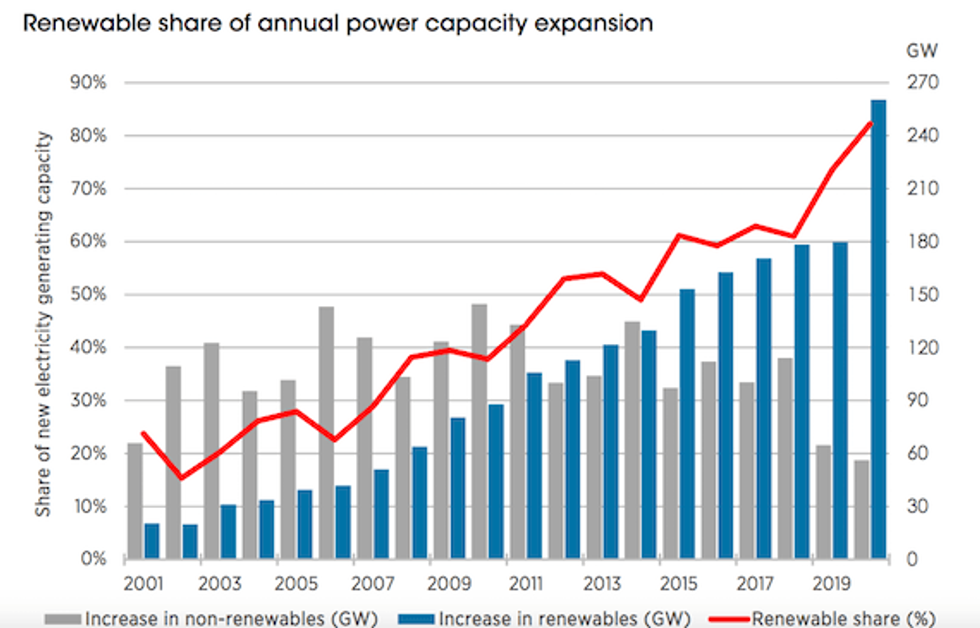
Asia has 1,286 gigawatts of renewables, and they put in 167.6 GWs just in 2020! North America, despite being industrially and technologically advanced, only has 422 gigawatts. For shame, America. Even Europe has 609 gigawatts.
Since I cover the Middle East a lot at this site, it is worth noting that this region only has a minor renewables capacity, of about 24 gigawatts, only 1% of the global production. It only put in 1.2 gigawatts last year. This result is because the region has so much natural gas. But note that renewables are nevertheless cheaper and more reliable in their pricing. In the region, only Morocco has made real strides toward renewables, though there are some big projects planned in Egypt.
The rate of new wind energy installation almost doubled in 2020 year on year, with an increase of of 111 gigawatts in 2020 against only 58 new gigawatts in 2019.
China was the world leader here, putting in 72.4 gigawatts of new wind all by itself. The U.S. only put in 14.2 gigawatts of wind.
This kind of statistic has made President Biden worried about American competitiveness in the new world that is taking shape. China is leaving us in the dust.
Offshore wind reached 5% of total wind capacity in 2020. It is still a small part of the sector but it is growing rapidly and has enormous potential.
In what is perhaps a sign of the future, solar energy, which was a poor cousin to wind a few years ago, has now caught up with it and its responsible for just about as much electricity production.
Asia was the leader here too, putting in 78 gigawatts of new solar in 2020 (up from 55 GW in 2019). China alone put in nearly 50 gigawatts of new solar. Vietnam put in 11.6 GW of new solar. Japan, despite being an advanced industrial country, only put in 5 GW of new solar.
India only put in 4 GW of solar in 2020, despite its big ambitions, about the same as South Korea.
The United States was down around the Vietnam level, with only 14.9 gigawatts of new solar.
I've been in places like Florida, Georgia, Alabama, Louisiana, Texas, and Arizona in the summer, and I cannot understand why every single house doesn't have solar panels. In some Republican-ruled such states, the legislature has even put in fees to discourage solar and promote dirty fossil fuels, which are wrecking the planet with global heating.
As a result, China is making the breakthroughs in solar panel technology and is a major exporter of panels. The U.S.? Desperately breaking up underground rocks and polluting the environment chasing the last wisps of natural gas under there so as to add to the climate emergency.
I grew up in the age of the moon shot and I am not used to America being so backward.
Bonus Video: CGTN America: "China's efforts in fighting climate change"
The new report on 2020 by the International Renewable Energy Agency reveals that the world's renewable energy generation capacity increased by an astonishing 10.3% in 2020 despite the global economic slowdown during the coronavirus pandemic. It beats the previous record for an annual increase in this sector by a healthy 50%.
The bad news for Americans is that most of this increase took place in Asia, especially China. In this strategic set of technologies, China is eating America's lunch.
Given that China beat the pandemic even before the vaccine with masks and social distancing, while the odious Trump left counties on their own and refused to mobilize the federal government, it is no surprise that the Chinese economy saw a growth spurt last fall and grew for the year. In the first quarter of 2021, China's economy grew an eye-popping 18.3%! Along with its rapid march to renewables, China is becoming more and more formidable. Unlike the Biden administration, I don't see this as a threat, but as a healthy challenge. If we want to compete, we have to swing into action.
Those who argue we absolutely must construct more nuclear plants to beat the climate emergency are clearly just wrong.
In 2020, the global net increase in renewables was 261 gigawatts (GW). That is the nameplate capacity of some 300 nuclear power plants! There are actually only 440 nuclear power plants in the whole world, with a generation capacity of 390 gigawatts.
So let's just underline this point. The world put in two-thirds as much renewable energy in one year as is produced by all the existing nuclear plants!
Those who argue we absolutely must construct more nuclear plants to beat the climate emergency are clearly just wrong. Renewables can do it all, and they can be installed much more inexpensively and way faster than nuclear plants. Nuclear is a distraction and a diversion of resources at a time when we are racing to get the Earth down to producing no net carbon dioxide.
Asia was responsible for the lion's share of the new renewables capacity, at 61%.
In other words, the United States was lying down on the job. President Joe Biden wants to turn this lackluster performance around and put the U.S. back into the vanguard of this crucial emerging technology.
Almost all (91%) of the new renewables capacity consisted in wind and solar farms.
Asia has 1,286 gigawatts of renewables, and they put in 167.6 GWs just in 2020! North America, despite being industrially and technologically advanced, only has 422 gigawatts. For shame, America. Even Europe has 609 gigawatts.
Since I cover the Middle East a lot at this site, it is worth noting that this region only has a minor renewables capacity, of about 24 gigawatts, only 1% of the global production. It only put in 1.2 gigawatts last year. This result is because the region has so much natural gas. But note that renewables are nevertheless cheaper and more reliable in their pricing. In the region, only Morocco has made real strides toward renewables, though there are some big projects planned in Egypt.
The rate of new wind energy installation almost doubled in 2020 year on year, with an increase of of 111 gigawatts in 2020 against only 58 new gigawatts in 2019.
China was the world leader here, putting in 72.4 gigawatts of new wind all by itself. The U.S. only put in 14.2 gigawatts of wind.
This kind of statistic has made President Biden worried about American competitiveness in the new world that is taking shape. China is leaving us in the dust.
Offshore wind reached 5% of total wind capacity in 2020. It is still a small part of the sector but it is growing rapidly and has enormous potential.
In what is perhaps a sign of the future, solar energy, which was a poor cousin to wind a few years ago, has now caught up with it and its responsible for just about as much electricity production.
Asia was the leader here too, putting in 78 gigawatts of new solar in 2020 (up from 55 GW in 2019). China alone put in nearly 50 gigawatts of new solar. Vietnam put in 11.6 GW of new solar. Japan, despite being an advanced industrial country, only put in 5 GW of new solar.
India only put in 4 GW of solar in 2020, despite its big ambitions, about the same as South Korea.
The United States was down around the Vietnam level, with only 14.9 gigawatts of new solar.
I've been in places like Florida, Georgia, Alabama, Louisiana, Texas, and Arizona in the summer, and I cannot understand why every single house doesn't have solar panels. In some Republican-ruled such states, the legislature has even put in fees to discourage solar and promote dirty fossil fuels, which are wrecking the planet with global heating.
As a result, China is making the breakthroughs in solar panel technology and is a major exporter of panels. The U.S.? Desperately breaking up underground rocks and polluting the environment chasing the last wisps of natural gas under there so as to add to the climate emergency.
I grew up in the age of the moon shot and I am not used to America being so backward.
Bonus Video: CGTN America: "China's efforts in fighting climate change"
The new report on 2020 by the International Renewable Energy Agency reveals that the world's renewable energy generation capacity increased by an astonishing 10.3% in 2020 despite the global economic slowdown during the coronavirus pandemic. It beats the previous record for an annual increase in this sector by a healthy 50%.
The bad news for Americans is that most of this increase took place in Asia, especially China. In this strategic set of technologies, China is eating America's lunch.
Given that China beat the pandemic even before the vaccine with masks and social distancing, while the odious Trump left counties on their own and refused to mobilize the federal government, it is no surprise that the Chinese economy saw a growth spurt last fall and grew for the year. In the first quarter of 2021, China's economy grew an eye-popping 18.3%! Along with its rapid march to renewables, China is becoming more and more formidable. Unlike the Biden administration, I don't see this as a threat, but as a healthy challenge. If we want to compete, we have to swing into action.
Those who argue we absolutely must construct more nuclear plants to beat the climate emergency are clearly just wrong.
In 2020, the global net increase in renewables was 261 gigawatts (GW). That is the nameplate capacity of some 300 nuclear power plants! There are actually only 440 nuclear power plants in the whole world, with a generation capacity of 390 gigawatts.
So let's just underline this point. The world put in two-thirds as much renewable energy in one year as is produced by all the existing nuclear plants!
Those who argue we absolutely must construct more nuclear plants to beat the climate emergency are clearly just wrong. Renewables can do it all, and they can be installed much more inexpensively and way faster than nuclear plants. Nuclear is a distraction and a diversion of resources at a time when we are racing to get the Earth down to producing no net carbon dioxide.
Asia was responsible for the lion's share of the new renewables capacity, at 61%.
In other words, the United States was lying down on the job. President Joe Biden wants to turn this lackluster performance around and put the U.S. back into the vanguard of this crucial emerging technology.
Almost all (91%) of the new renewables capacity consisted in wind and solar farms.
Asia has 1,286 gigawatts of renewables, and they put in 167.6 GWs just in 2020! North America, despite being industrially and technologically advanced, only has 422 gigawatts. For shame, America. Even Europe has 609 gigawatts.
Since I cover the Middle East a lot at this site, it is worth noting that this region only has a minor renewables capacity, of about 24 gigawatts, only 1% of the global production. It only put in 1.2 gigawatts last year. This result is because the region has so much natural gas. But note that renewables are nevertheless cheaper and more reliable in their pricing. In the region, only Morocco has made real strides toward renewables, though there are some big projects planned in Egypt.
The rate of new wind energy installation almost doubled in 2020 year on year, with an increase of of 111 gigawatts in 2020 against only 58 new gigawatts in 2019.
China was the world leader here, putting in 72.4 gigawatts of new wind all by itself. The U.S. only put in 14.2 gigawatts of wind.
This kind of statistic has made President Biden worried about American competitiveness in the new world that is taking shape. China is leaving us in the dust.
Offshore wind reached 5% of total wind capacity in 2020. It is still a small part of the sector but it is growing rapidly and has enormous potential.
In what is perhaps a sign of the future, solar energy, which was a poor cousin to wind a few years ago, has now caught up with it and its responsible for just about as much electricity production.
Asia was the leader here too, putting in 78 gigawatts of new solar in 2020 (up from 55 GW in 2019). China alone put in nearly 50 gigawatts of new solar. Vietnam put in 11.6 GW of new solar. Japan, despite being an advanced industrial country, only put in 5 GW of new solar.
India only put in 4 GW of solar in 2020, despite its big ambitions, about the same as South Korea.
The United States was down around the Vietnam level, with only 14.9 gigawatts of new solar.
I've been in places like Florida, Georgia, Alabama, Louisiana, Texas, and Arizona in the summer, and I cannot understand why every single house doesn't have solar panels. In some Republican-ruled such states, the legislature has even put in fees to discourage solar and promote dirty fossil fuels, which are wrecking the planet with global heating.
As a result, China is making the breakthroughs in solar panel technology and is a major exporter of panels. The U.S.? Desperately breaking up underground rocks and polluting the environment chasing the last wisps of natural gas under there so as to add to the climate emergency.
I grew up in the age of the moon shot and I am not used to America being so backward.
Bonus Video: CGTN America: "China's efforts in fighting climate change"