SUBSCRIBE TO OUR FREE NEWSLETTER
Daily news & progressive opinion—funded by the people, not the corporations—delivered straight to your inbox.
5
#000000
#FFFFFF
To donate by check, phone, or other method, see our More Ways to Give page.
Daily news & progressive opinion—funded by the people, not the corporations—delivered straight to your inbox.
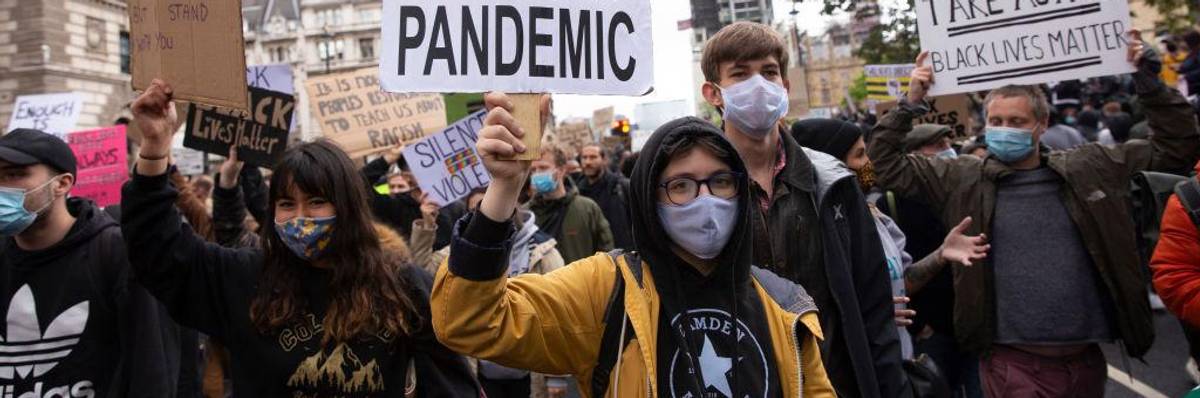
Biden inherits truly fearsome troubles--among them the spiking pandemic, the collapsing economy, corrosive inequality, catastrophic climate change and entrenched structural racism. (Photo: Phil Clarke Hill/In Pictures via Getty Images)
A new president takes office with the sense of possibility that comes with a new dawn. This is particularly true for Joe Biden, taking office after the divisive turmoil of Donald Trump's years in office.
Biden inherits truly fearsome troubles--among them the spiking pandemic, the collapsing economy, corrosive inequality, catastrophic climate change and entrenched structural racism. He stood up for Black Lives Matter and has promised a new day for civil rights, with particular emphasis on police reform.
Biden should consider steps to revive and empower the U.S. Commission on Civil Rights, preferably with new leadership, new authority and adequate staffing, to undertake the crucial mission of monitoring civil rights progress, investigating abuses and recommending remedies.
America's institutionalized racism goes far beyond the police, of course. We've witnessed the spread of brazen voter suppression schemes since the Supreme Court disemboweled the Voting Rights Act. Our public schools grow ever more separate and unequal. Blacks and Latinos have suffered disproportionately in the economic collapse surrounding the pandemic, and from the pandemic itself. The racial gap in housing, health care, wealth and more grow worse. And now as America grows more diverse, discrimination against other minorities from Latinos to Native Americans demands redress.
Biden will no doubt appoint an attorney general sensitive to these concerns. Across the government, civil rights divisions will be revived and recharged. Action on voting rights, on reducing mass incarceration, on police reform will follow. As part of this renewed commitment, Biden should consider steps to revive and empower the U.S. Commission on Civil Rights, preferably with new leadership, new authority and adequate staffing, to undertake the crucial mission of monitoring civil rights progress, investigating abuses and recommending remedies.
The U.S. Commission was created under President Dwight D Eisenhower, a Republican, in the 1957 Civil Rights Act. Its mission was "the continuous appraisal of the status of civil rights and the efficiency of the machinery with which we hope to improve that status." It was charged with collecting data, holding hearings, providing a clearing house and coordination of state and private agencies working in civil rights. It would issue regular reports and make recommendations in regard to remedying civil rights abuses.
In its early years, the commission played a vital role. Its prestigious members helped develop the case and formulate the reforms that informed the early civil rights acts, the Voting Rights Act of 1965 and the Fair Housing Act of 1968 among others.
In the 1980s, Ronald Reagan sought to weaken the commission, reducing its staff and resources. After illegally attempting to fire three of the commissioners, Reagan forced a compromise in which eight commissioners would serve staggered six-year terms, with half appointed by the president and two by the speaker of the House and two by the president pro tempore of the Senate. Since that time, the commission has declined in stature and effectiveness.
Biden should seek to revive the commission. He should appoint a new director of national stature, and commit the resources needed to rebuild the staff and the functions of the commission. He should seek new legislation to give the president power to nominate the commissioners, investing them with greater authority.
An active commission could help spearhead the investigations and reforms vital to addressing civil and human rights in this country. It could review how civil rights legislation should be updated to address the challenges of a much more diverse country. It could hold hearings on voter suppression and gerrymandering--and on reviving the Voting Rights Act--to bring public attention to what is a growing problem. It could investigate the challenge of reforming police forces into effective agencies of public safety.
What's clear is that no department or bureau of government can undertake this effort. Each has its own sphere of authority and concern. Inter-agency efforts are cumbersome and seldom effective. An independent commission could in fact serve the function Eisenhower envisioned--providing a central monitoring agency across the broad range of civil rights concerns and helping to define the next generation of reforms.
As the new president selects the officials that will work to fulfill his pledges of civil rights and criminal justice reform, and as he formulates his initial package of administrative and legislative actions, he would be wise to include revival of the U.S. Commission on Civil Rights as a central element in that agenda.
Dear Common Dreams reader, It’s been nearly 30 years since I co-founded Common Dreams with my late wife, Lina Newhouser. We had the radical notion that journalism should serve the public good, not corporate profits. It was clear to us from the outset what it would take to build such a project. No paid advertisements. No corporate sponsors. No millionaire publisher telling us what to think or do. Many people said we wouldn't last a year, but we proved those doubters wrong. Together with a tremendous team of journalists and dedicated staff, we built an independent media outlet free from the constraints of profits and corporate control. Our mission has always been simple: To inform. To inspire. To ignite change for the common good. Building Common Dreams was not easy. Our survival was never guaranteed. When you take on the most powerful forces—Wall Street greed, fossil fuel industry destruction, Big Tech lobbyists, and uber-rich oligarchs who have spent billions upon billions rigging the economy and democracy in their favor—the only bulwark you have is supporters who believe in your work. But here’s the urgent message from me today. It's never been this bad out there. And it's never been this hard to keep us going. At the very moment Common Dreams is most needed, the threats we face are intensifying. We need your support now more than ever. We don't accept corporate advertising and never will. We don't have a paywall because we don't think people should be blocked from critical news based on their ability to pay. Everything we do is funded by the donations of readers like you. When everyone does the little they can afford, we are strong. But if that support retreats or dries up, so do we. Will you donate now to make sure Common Dreams not only survives but thrives? —Craig Brown, Co-founder |
A new president takes office with the sense of possibility that comes with a new dawn. This is particularly true for Joe Biden, taking office after the divisive turmoil of Donald Trump's years in office.
Biden inherits truly fearsome troubles--among them the spiking pandemic, the collapsing economy, corrosive inequality, catastrophic climate change and entrenched structural racism. He stood up for Black Lives Matter and has promised a new day for civil rights, with particular emphasis on police reform.
Biden should consider steps to revive and empower the U.S. Commission on Civil Rights, preferably with new leadership, new authority and adequate staffing, to undertake the crucial mission of monitoring civil rights progress, investigating abuses and recommending remedies.
America's institutionalized racism goes far beyond the police, of course. We've witnessed the spread of brazen voter suppression schemes since the Supreme Court disemboweled the Voting Rights Act. Our public schools grow ever more separate and unequal. Blacks and Latinos have suffered disproportionately in the economic collapse surrounding the pandemic, and from the pandemic itself. The racial gap in housing, health care, wealth and more grow worse. And now as America grows more diverse, discrimination against other minorities from Latinos to Native Americans demands redress.
Biden will no doubt appoint an attorney general sensitive to these concerns. Across the government, civil rights divisions will be revived and recharged. Action on voting rights, on reducing mass incarceration, on police reform will follow. As part of this renewed commitment, Biden should consider steps to revive and empower the U.S. Commission on Civil Rights, preferably with new leadership, new authority and adequate staffing, to undertake the crucial mission of monitoring civil rights progress, investigating abuses and recommending remedies.
The U.S. Commission was created under President Dwight D Eisenhower, a Republican, in the 1957 Civil Rights Act. Its mission was "the continuous appraisal of the status of civil rights and the efficiency of the machinery with which we hope to improve that status." It was charged with collecting data, holding hearings, providing a clearing house and coordination of state and private agencies working in civil rights. It would issue regular reports and make recommendations in regard to remedying civil rights abuses.
In its early years, the commission played a vital role. Its prestigious members helped develop the case and formulate the reforms that informed the early civil rights acts, the Voting Rights Act of 1965 and the Fair Housing Act of 1968 among others.
In the 1980s, Ronald Reagan sought to weaken the commission, reducing its staff and resources. After illegally attempting to fire three of the commissioners, Reagan forced a compromise in which eight commissioners would serve staggered six-year terms, with half appointed by the president and two by the speaker of the House and two by the president pro tempore of the Senate. Since that time, the commission has declined in stature and effectiveness.
Biden should seek to revive the commission. He should appoint a new director of national stature, and commit the resources needed to rebuild the staff and the functions of the commission. He should seek new legislation to give the president power to nominate the commissioners, investing them with greater authority.
An active commission could help spearhead the investigations and reforms vital to addressing civil and human rights in this country. It could review how civil rights legislation should be updated to address the challenges of a much more diverse country. It could hold hearings on voter suppression and gerrymandering--and on reviving the Voting Rights Act--to bring public attention to what is a growing problem. It could investigate the challenge of reforming police forces into effective agencies of public safety.
What's clear is that no department or bureau of government can undertake this effort. Each has its own sphere of authority and concern. Inter-agency efforts are cumbersome and seldom effective. An independent commission could in fact serve the function Eisenhower envisioned--providing a central monitoring agency across the broad range of civil rights concerns and helping to define the next generation of reforms.
As the new president selects the officials that will work to fulfill his pledges of civil rights and criminal justice reform, and as he formulates his initial package of administrative and legislative actions, he would be wise to include revival of the U.S. Commission on Civil Rights as a central element in that agenda.
A new president takes office with the sense of possibility that comes with a new dawn. This is particularly true for Joe Biden, taking office after the divisive turmoil of Donald Trump's years in office.
Biden inherits truly fearsome troubles--among them the spiking pandemic, the collapsing economy, corrosive inequality, catastrophic climate change and entrenched structural racism. He stood up for Black Lives Matter and has promised a new day for civil rights, with particular emphasis on police reform.
Biden should consider steps to revive and empower the U.S. Commission on Civil Rights, preferably with new leadership, new authority and adequate staffing, to undertake the crucial mission of monitoring civil rights progress, investigating abuses and recommending remedies.
America's institutionalized racism goes far beyond the police, of course. We've witnessed the spread of brazen voter suppression schemes since the Supreme Court disemboweled the Voting Rights Act. Our public schools grow ever more separate and unequal. Blacks and Latinos have suffered disproportionately in the economic collapse surrounding the pandemic, and from the pandemic itself. The racial gap in housing, health care, wealth and more grow worse. And now as America grows more diverse, discrimination against other minorities from Latinos to Native Americans demands redress.
Biden will no doubt appoint an attorney general sensitive to these concerns. Across the government, civil rights divisions will be revived and recharged. Action on voting rights, on reducing mass incarceration, on police reform will follow. As part of this renewed commitment, Biden should consider steps to revive and empower the U.S. Commission on Civil Rights, preferably with new leadership, new authority and adequate staffing, to undertake the crucial mission of monitoring civil rights progress, investigating abuses and recommending remedies.
The U.S. Commission was created under President Dwight D Eisenhower, a Republican, in the 1957 Civil Rights Act. Its mission was "the continuous appraisal of the status of civil rights and the efficiency of the machinery with which we hope to improve that status." It was charged with collecting data, holding hearings, providing a clearing house and coordination of state and private agencies working in civil rights. It would issue regular reports and make recommendations in regard to remedying civil rights abuses.
In its early years, the commission played a vital role. Its prestigious members helped develop the case and formulate the reforms that informed the early civil rights acts, the Voting Rights Act of 1965 and the Fair Housing Act of 1968 among others.
In the 1980s, Ronald Reagan sought to weaken the commission, reducing its staff and resources. After illegally attempting to fire three of the commissioners, Reagan forced a compromise in which eight commissioners would serve staggered six-year terms, with half appointed by the president and two by the speaker of the House and two by the president pro tempore of the Senate. Since that time, the commission has declined in stature and effectiveness.
Biden should seek to revive the commission. He should appoint a new director of national stature, and commit the resources needed to rebuild the staff and the functions of the commission. He should seek new legislation to give the president power to nominate the commissioners, investing them with greater authority.
An active commission could help spearhead the investigations and reforms vital to addressing civil and human rights in this country. It could review how civil rights legislation should be updated to address the challenges of a much more diverse country. It could hold hearings on voter suppression and gerrymandering--and on reviving the Voting Rights Act--to bring public attention to what is a growing problem. It could investigate the challenge of reforming police forces into effective agencies of public safety.
What's clear is that no department or bureau of government can undertake this effort. Each has its own sphere of authority and concern. Inter-agency efforts are cumbersome and seldom effective. An independent commission could in fact serve the function Eisenhower envisioned--providing a central monitoring agency across the broad range of civil rights concerns and helping to define the next generation of reforms.
As the new president selects the officials that will work to fulfill his pledges of civil rights and criminal justice reform, and as he formulates his initial package of administrative and legislative actions, he would be wise to include revival of the U.S. Commission on Civil Rights as a central element in that agenda.