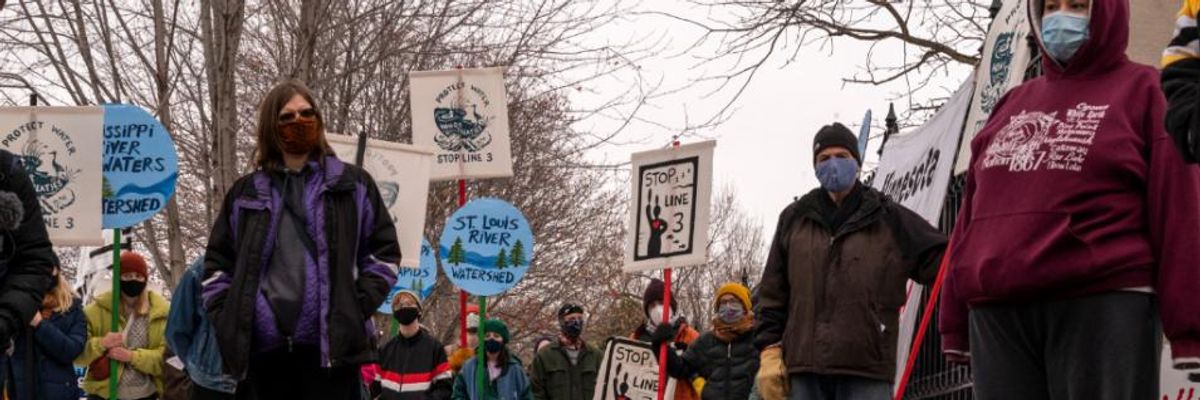
People protest against the Enbridge Energy Line 3 oil pipeline project outside the Governor's Mansion in St. Paul, Minnesota on November 14, 2020. Increasingly, corporate-funded politicians are criminalizing efforts to roll back the harms fossil fuel interests are doing to vulnerable communities. (Photo: Stephen Maturen/Getty Images)
Corporations Paying Lawmakers to Outlaw Protest Is a Crime Against Democracy
More communities are standing up to pipelines. The fossil fuel industry wants to make that a felony. We need to push for "Protesters' Bills of Rights" in state legislatures to codify the right to protest.
A few years ago, massive protests against the Dakota Access Pipeline at Standing Rock changed the popular narrative about what climate activism looked like. The protests made clear that ramming dangerous pipelines through vulnerable communities wasn't going to be easy anymore.
But since then, rather than scaling back their attacks on these communities, the fossil fuel industry decided to attack them even more fiercely.
The industry wants to criminalize anti-fossil fuel protests altogether, pushing new laws that turn routine acts of civil disobedience into serious felonies.
Indigenous water protectors at Standing Rock were subject to a violent law enforcement response. They were blasted with water cannons in the freezing cold and faced down by heavily armed police in military vehicles.
Now the industry wants to criminalize anti-fossil fuel protests altogether, pushing new laws that turn routine acts of civil disobedience into serious felonies. They've found willing partners in the American Legislative Exchange Council (ALEC). Industry and ALEC efforts have passed such laws in 13 states.
My colleague Gabrielle Colchete and I studied these anti-protest laws in our recent report, "Muzzling Dissent: How Corporate Influence Over Politics Has Fueled Anti-Protest Laws."
We focused on three states: Louisiana and West Virginia, where these laws have been passed, and Minnesota, where bills have been introduced numerous times (one even passed the legislature, but was vetoed by the governor).
In all three states, controversial fossil fuel infrastructure has faced significant resistance from affected communities. And in every case, the fossil fuel industry has been a major source of campaign money for the legislators who introduced these bills.
For example, in Louisiana, the lead sponsor of the anti-protest bill received $6,600 from oil and gas interests, the third highest of 40 industry sectors he received campaign contributions from. And in West Virginia, the lead sponsor of the anti-protest bill received substantial contributions from Dominion Energy, owner of the failed Atlantic Coast Pipeline project that passed through the state.
All three states had something else in common, too: Their controversial infrastructure projects have a disproportionate impact on marginalized communities.
In every case, the fossil fuel industry has been a major source of campaign money for the legislators who introduced these bills.
Black communities in the path of the Bayou Bridge Pipeline in Louisiana, for example, suffer a poverty rate twice the national average. For Indigenous communities in the path of the Line 3 pipeline in Minnesota, the poverty rate is three times the national average.
Many of the poorer white communities in the path of the Mountain Valley Pipeline in West Virginia have a life expectancy below the national average. The same is true of the majority-Black communities at the end of the Bayou Bridge Pipeline in Louisiana, especially in the "Cancer Alley" area.
The underlying story? Corporate interests fund the campaigns of elected officials, who return the favor-- often at the expense of their most vulnerable constituents. In this case, politicians are criminalizing efforts by their own voters to roll back the harms fossil fuel interests are doing to their communities.
There is much work to be done to reverse these unjust laws--and the systemic inequalities that drive them.
We need to push for "Protesters' Bills of Rights" in state legislatures to codify the right to protest without fear of criminalization and repression, a core democratic right that's particularly relevant today.
There is much work to be done to reverse these unjust laws--and the systemic inequalities that drive them.
We also need to restore key provisions of the National Environmental Policy Act that protect communities and ecosystems from harmful projects. We should also add another layer of review, a National Environmental Justice Assessment, to evaluate the impacts of new infrastructure projects on marginalized communities.
Finally, we need to clean up systemic corruption. We must push for a ban on hiring or appointing industry lobbyists in regulatory agencies and set up a robust system of public financing of elections as an alternative to our current system of legalized bribery.
These will all be hard political fights, but they're fights worth having. Our health, our democracy, and our planet depend on it.
We are at a crossroads
This country and this world are at a monumental crossroads. In a few short weeks, US voters will have an opportunity to beat back the forces of fascism and confront the billionaires who are rigging the economy, our media system, and our democracy, making it increasingly impossible for ordinary people to get by. We’re not just talking about the election. We’re talking about what must be done once these fascist elements are vanquished from power. We need a bolder set of solutions than what either major party has so far been willing to offer and a working-class movement ready to fight like hell for it. Trump didn't emerge from nowhere. The conditions that fueled MAGA authoritarianism were created by decades of radical neoliberal economic policies and a corrupt political system dominated by corporate interests. They slashed taxes on the super-rich, promising that the benefits would trickle down. They said giveaways to the corporate titans would make life more affordable for the rest of us. It was all bullshit. And when a bitter, betrayed populace searches for someone to blame, right-wing demagogues have little trouble finding scapegoats. People know when they're being lied to, but you won't hear any of this from the corporate media. Only independent journalism—powered and funded by people who believe in building a better world—can deliver truly trustworthy daily news. Our Fall Campaign is underway, and we need your help. To power our newsroom through the rest of the year, we need to raise $125,000 by midnight on October 31. So if you share our vision, please contribute whatever you can to sustain our work. |
A few years ago, massive protests against the Dakota Access Pipeline at Standing Rock changed the popular narrative about what climate activism looked like. The protests made clear that ramming dangerous pipelines through vulnerable communities wasn't going to be easy anymore.
But since then, rather than scaling back their attacks on these communities, the fossil fuel industry decided to attack them even more fiercely.
The industry wants to criminalize anti-fossil fuel protests altogether, pushing new laws that turn routine acts of civil disobedience into serious felonies.
Indigenous water protectors at Standing Rock were subject to a violent law enforcement response. They were blasted with water cannons in the freezing cold and faced down by heavily armed police in military vehicles.
Now the industry wants to criminalize anti-fossil fuel protests altogether, pushing new laws that turn routine acts of civil disobedience into serious felonies. They've found willing partners in the American Legislative Exchange Council (ALEC). Industry and ALEC efforts have passed such laws in 13 states.
My colleague Gabrielle Colchete and I studied these anti-protest laws in our recent report, "Muzzling Dissent: How Corporate Influence Over Politics Has Fueled Anti-Protest Laws."
We focused on three states: Louisiana and West Virginia, where these laws have been passed, and Minnesota, where bills have been introduced numerous times (one even passed the legislature, but was vetoed by the governor).
In all three states, controversial fossil fuel infrastructure has faced significant resistance from affected communities. And in every case, the fossil fuel industry has been a major source of campaign money for the legislators who introduced these bills.
For example, in Louisiana, the lead sponsor of the anti-protest bill received $6,600 from oil and gas interests, the third highest of 40 industry sectors he received campaign contributions from. And in West Virginia, the lead sponsor of the anti-protest bill received substantial contributions from Dominion Energy, owner of the failed Atlantic Coast Pipeline project that passed through the state.
All three states had something else in common, too: Their controversial infrastructure projects have a disproportionate impact on marginalized communities.
In every case, the fossil fuel industry has been a major source of campaign money for the legislators who introduced these bills.
Black communities in the path of the Bayou Bridge Pipeline in Louisiana, for example, suffer a poverty rate twice the national average. For Indigenous communities in the path of the Line 3 pipeline in Minnesota, the poverty rate is three times the national average.
Many of the poorer white communities in the path of the Mountain Valley Pipeline in West Virginia have a life expectancy below the national average. The same is true of the majority-Black communities at the end of the Bayou Bridge Pipeline in Louisiana, especially in the "Cancer Alley" area.
The underlying story? Corporate interests fund the campaigns of elected officials, who return the favor-- often at the expense of their most vulnerable constituents. In this case, politicians are criminalizing efforts by their own voters to roll back the harms fossil fuel interests are doing to their communities.
There is much work to be done to reverse these unjust laws--and the systemic inequalities that drive them.
We need to push for "Protesters' Bills of Rights" in state legislatures to codify the right to protest without fear of criminalization and repression, a core democratic right that's particularly relevant today.
There is much work to be done to reverse these unjust laws--and the systemic inequalities that drive them.
We also need to restore key provisions of the National Environmental Policy Act that protect communities and ecosystems from harmful projects. We should also add another layer of review, a National Environmental Justice Assessment, to evaluate the impacts of new infrastructure projects on marginalized communities.
Finally, we need to clean up systemic corruption. We must push for a ban on hiring or appointing industry lobbyists in regulatory agencies and set up a robust system of public financing of elections as an alternative to our current system of legalized bribery.
These will all be hard political fights, but they're fights worth having. Our health, our democracy, and our planet depend on it.
A few years ago, massive protests against the Dakota Access Pipeline at Standing Rock changed the popular narrative about what climate activism looked like. The protests made clear that ramming dangerous pipelines through vulnerable communities wasn't going to be easy anymore.
But since then, rather than scaling back their attacks on these communities, the fossil fuel industry decided to attack them even more fiercely.
The industry wants to criminalize anti-fossil fuel protests altogether, pushing new laws that turn routine acts of civil disobedience into serious felonies.
Indigenous water protectors at Standing Rock were subject to a violent law enforcement response. They were blasted with water cannons in the freezing cold and faced down by heavily armed police in military vehicles.
Now the industry wants to criminalize anti-fossil fuel protests altogether, pushing new laws that turn routine acts of civil disobedience into serious felonies. They've found willing partners in the American Legislative Exchange Council (ALEC). Industry and ALEC efforts have passed such laws in 13 states.
My colleague Gabrielle Colchete and I studied these anti-protest laws in our recent report, "Muzzling Dissent: How Corporate Influence Over Politics Has Fueled Anti-Protest Laws."
We focused on three states: Louisiana and West Virginia, where these laws have been passed, and Minnesota, where bills have been introduced numerous times (one even passed the legislature, but was vetoed by the governor).
In all three states, controversial fossil fuel infrastructure has faced significant resistance from affected communities. And in every case, the fossil fuel industry has been a major source of campaign money for the legislators who introduced these bills.
For example, in Louisiana, the lead sponsor of the anti-protest bill received $6,600 from oil and gas interests, the third highest of 40 industry sectors he received campaign contributions from. And in West Virginia, the lead sponsor of the anti-protest bill received substantial contributions from Dominion Energy, owner of the failed Atlantic Coast Pipeline project that passed through the state.
All three states had something else in common, too: Their controversial infrastructure projects have a disproportionate impact on marginalized communities.
In every case, the fossil fuel industry has been a major source of campaign money for the legislators who introduced these bills.
Black communities in the path of the Bayou Bridge Pipeline in Louisiana, for example, suffer a poverty rate twice the national average. For Indigenous communities in the path of the Line 3 pipeline in Minnesota, the poverty rate is three times the national average.
Many of the poorer white communities in the path of the Mountain Valley Pipeline in West Virginia have a life expectancy below the national average. The same is true of the majority-Black communities at the end of the Bayou Bridge Pipeline in Louisiana, especially in the "Cancer Alley" area.
The underlying story? Corporate interests fund the campaigns of elected officials, who return the favor-- often at the expense of their most vulnerable constituents. In this case, politicians are criminalizing efforts by their own voters to roll back the harms fossil fuel interests are doing to their communities.
There is much work to be done to reverse these unjust laws--and the systemic inequalities that drive them.
We need to push for "Protesters' Bills of Rights" in state legislatures to codify the right to protest without fear of criminalization and repression, a core democratic right that's particularly relevant today.
There is much work to be done to reverse these unjust laws--and the systemic inequalities that drive them.
We also need to restore key provisions of the National Environmental Policy Act that protect communities and ecosystems from harmful projects. We should also add another layer of review, a National Environmental Justice Assessment, to evaluate the impacts of new infrastructure projects on marginalized communities.
Finally, we need to clean up systemic corruption. We must push for a ban on hiring or appointing industry lobbyists in regulatory agencies and set up a robust system of public financing of elections as an alternative to our current system of legalized bribery.
These will all be hard political fights, but they're fights worth having. Our health, our democracy, and our planet depend on it.