
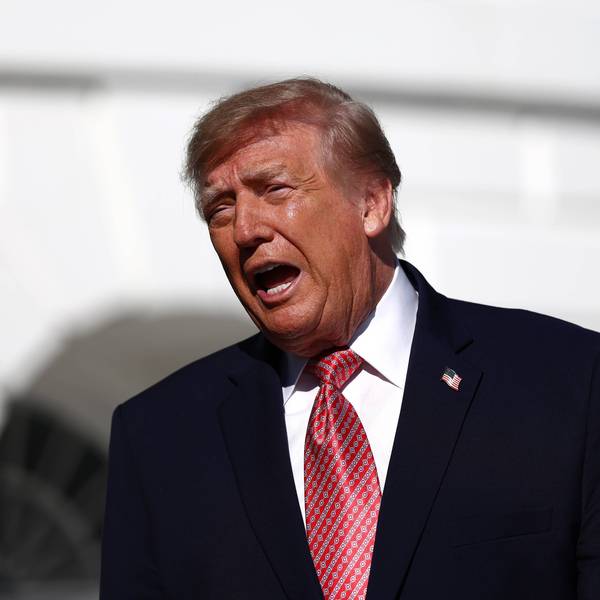

The seemingly unbreakable bonds between employment and health care mean that COVID-19 might have already cost 16.2 million newly unemployed American "warriors"--and their families--access to medical services and treatment. (Photo: (c) Greg Nash)
Can the COVID War Become a Fight for Health Care Democracy?
Americans must make it known that we can’t fight a war and then simply go on to live flourishing lives without a basic guarantee to quality medical care.
As most Americans remain hesitant to return to their normal activities amid the COVID-19 pandemic, leaders are calling on all of us to "think of [ourselves] as warriors" in a "heroic war against the invisible enemy." Our mission? To retake and occupy every square inch of the economy that the novel coronavirus invaded, planting flags and leaving trails of dollars along the way. Will there be preventable casualties and suffering? Yes. But, as soldiers, we must enter the conflict knowing that some among us may be asked to make individual sacrifices for the greater good.
Regardless of whether this wartime analogy is appropriate for the present crisis, it's pretty clear that those who are pushing the rhetoric don't really see ordinary Americans as warriors. In this country, active duty soldiers generally get to participate in America's only full integrated, direct government-run health care system, managed by the U.S. Department of Veterans Affairs (VA). As for the rest of us, the seemingly unbreakable bonds between employment and health care mean that COVID-19 might have already cost 16.2 million newly unemployed American "warriors"--and their families--access to medical services and treatment.
The bottom line is that, if our leaders are going to challenge all Americans to be warriors in the face of a pandemic, then we should be able to challenge our leaders to provide all Americans with access to a high-quality public sector health care system that can keep us strong, now and in the future.
While there has been plenty to criticize about the VA health system over the years--including, at some locations, excessive wait times and cases of patient neglect--medical researchers in 2018 found that, on average, VA inpatient care is "the same as or better than...non-VA inpatient care;" and the quality of VA outpatient care is "better than the quality of non-VA outpatient care." Even more recently, care at VA facilities was found to be "significantly better" than care at non-VA facilities on 14 of 15 specific outcome measures.
Perhaps most importantly, VA hospitals are delivering these equal-or-better-quality outcomes (on average) at lower costs than private health systems - all while "most Veterans have no out-of-pocket costs," enrollment fees, monthly premiums, or deductibles. Among the reasons for the VA's cost efficiencies compared to private health systems is that it generally has lower overhead and achieves "economies of scale in purchasing all sorts of inputs," especially prescription drugs. For these reasons, "contrary to what most Americans believe...the public sector seems better able than the private sector to provide consistently high-quality care while controlling costs."
Again, the VA health system is far from unimpeachable. It was just six years ago when a whistleblower revealed a secret waiting list in Phoenix that was created to conceal large numbers of patients who were "forced to wait months to see a doctor." That event led the then-VA Secretary to resign and tarnished the reputation of the system among some lawmakers - and it probably contributed to more recent assessments that VA medical care has been "horrible, horrible, and unfair."
Yet, despite its flaws, the VA system continues to be the best-rated health system among American adults. In fact, in two of the three most recent years for which Gallup survey data are available, the VA system boasted higher satisfaction levels than any other health care option in the U.S. In the third year, VA insurance was tied for first place with Medicare. In all three cases, 75-77% of VA participants consistently reported that they were satisfied with the way their health system worked for them, compared to just 65-67% of Americans overall.
The bottom line is that, if our leaders are going to challenge all Americans to be warriors in the face of a pandemic, then we should be able to challenge our leaders to provide all Americans with access to a high-quality public sector health care system that can keep us strong, now and in the future.
With Senator Sanders's departure from the Presidential race in April, voters are left with just two major party candidates who both currently oppose Medicare For All (M4A). Yet, perhaps in fighting the COVID War, we can still wage a battle for health care democracy. Indeed, a "Veterans' Care For All" program would arguably be even more transformative than M4A as a large-scale, forward-looking response to the present, massive-scale pandemic. After all, "Medicare is a payer, not a system." The VA, by contrast, is a "payer and a system." It pays for and directly delivers health services, meaning that it "can do things Medicare can't do." One of those things is to provide fully integrated care, whereby patients have access to everyone from primary care doctors to specialists within any given facility; and every facility in the country is open to them. In other words, in a fully integrated public health system, patients are essentially always "in network," and they're never wasting time chasing down referrals in between writing checks for co-payments.
Given the unprecedented magnitude of the COVID-19 crisis and the toll that it's taking on working families and the economy, comparisons to times of war should probably be expected. With our top officials now leaning hard into those comparisons, Americans must make it known that we can't fight a war and then simply go on to live flourishing lives without a basic guarantee to quality medical care.
We are at a crossroads
This country and this world are at a monumental crossroads. US voters have an opportunity to beat back the forces of fascism and confront the billionaires who are rigging the economy, our media system, and our democracy, making it increasingly impossible for ordinary people to get by. We’re not just talking about the election. We’re talking about what must be done once these fascist elements are vanquished from power. We need a bolder set of solutions than what either major party has so far been willing to offer and a working-class movement ready to fight like hell for it. Trump didn't emerge from nowhere. The conditions that fueled MAGA authoritarianism were created by decades of radical neoliberal economic policies and a corrupt political system dominated by corporate interests. They slashed taxes on the super-rich, promising that the benefits would trickle down. They said giveaways to the corporate titans would make life more affordable for the rest of us. It was all bullshit. And when a bitter, betrayed populace searches for someone to blame, right-wing demagogues have little trouble finding scapegoats. People know when they're being lied to, but you won't hear any of this from the corporate media. Only independent journalism—powered and funded by people who believe in building a better world—can deliver truly trustworthy daily news. Our Fall Campaign is underway, and we need your help. To power our newsroom through the rest of the year, we need to raise $125,000 by midnight on October 31. So if you share our vision, please contribute whatever you can to sustain our work. |
As most Americans remain hesitant to return to their normal activities amid the COVID-19 pandemic, leaders are calling on all of us to "think of [ourselves] as warriors" in a "heroic war against the invisible enemy." Our mission? To retake and occupy every square inch of the economy that the novel coronavirus invaded, planting flags and leaving trails of dollars along the way. Will there be preventable casualties and suffering? Yes. But, as soldiers, we must enter the conflict knowing that some among us may be asked to make individual sacrifices for the greater good.
Regardless of whether this wartime analogy is appropriate for the present crisis, it's pretty clear that those who are pushing the rhetoric don't really see ordinary Americans as warriors. In this country, active duty soldiers generally get to participate in America's only full integrated, direct government-run health care system, managed by the U.S. Department of Veterans Affairs (VA). As for the rest of us, the seemingly unbreakable bonds between employment and health care mean that COVID-19 might have already cost 16.2 million newly unemployed American "warriors"--and their families--access to medical services and treatment.
The bottom line is that, if our leaders are going to challenge all Americans to be warriors in the face of a pandemic, then we should be able to challenge our leaders to provide all Americans with access to a high-quality public sector health care system that can keep us strong, now and in the future.
While there has been plenty to criticize about the VA health system over the years--including, at some locations, excessive wait times and cases of patient neglect--medical researchers in 2018 found that, on average, VA inpatient care is "the same as or better than...non-VA inpatient care;" and the quality of VA outpatient care is "better than the quality of non-VA outpatient care." Even more recently, care at VA facilities was found to be "significantly better" than care at non-VA facilities on 14 of 15 specific outcome measures.
Perhaps most importantly, VA hospitals are delivering these equal-or-better-quality outcomes (on average) at lower costs than private health systems - all while "most Veterans have no out-of-pocket costs," enrollment fees, monthly premiums, or deductibles. Among the reasons for the VA's cost efficiencies compared to private health systems is that it generally has lower overhead and achieves "economies of scale in purchasing all sorts of inputs," especially prescription drugs. For these reasons, "contrary to what most Americans believe...the public sector seems better able than the private sector to provide consistently high-quality care while controlling costs."
Again, the VA health system is far from unimpeachable. It was just six years ago when a whistleblower revealed a secret waiting list in Phoenix that was created to conceal large numbers of patients who were "forced to wait months to see a doctor." That event led the then-VA Secretary to resign and tarnished the reputation of the system among some lawmakers - and it probably contributed to more recent assessments that VA medical care has been "horrible, horrible, and unfair."
Yet, despite its flaws, the VA system continues to be the best-rated health system among American adults. In fact, in two of the three most recent years for which Gallup survey data are available, the VA system boasted higher satisfaction levels than any other health care option in the U.S. In the third year, VA insurance was tied for first place with Medicare. In all three cases, 75-77% of VA participants consistently reported that they were satisfied with the way their health system worked for them, compared to just 65-67% of Americans overall.
The bottom line is that, if our leaders are going to challenge all Americans to be warriors in the face of a pandemic, then we should be able to challenge our leaders to provide all Americans with access to a high-quality public sector health care system that can keep us strong, now and in the future.
With Senator Sanders's departure from the Presidential race in April, voters are left with just two major party candidates who both currently oppose Medicare For All (M4A). Yet, perhaps in fighting the COVID War, we can still wage a battle for health care democracy. Indeed, a "Veterans' Care For All" program would arguably be even more transformative than M4A as a large-scale, forward-looking response to the present, massive-scale pandemic. After all, "Medicare is a payer, not a system." The VA, by contrast, is a "payer and a system." It pays for and directly delivers health services, meaning that it "can do things Medicare can't do." One of those things is to provide fully integrated care, whereby patients have access to everyone from primary care doctors to specialists within any given facility; and every facility in the country is open to them. In other words, in a fully integrated public health system, patients are essentially always "in network," and they're never wasting time chasing down referrals in between writing checks for co-payments.
Given the unprecedented magnitude of the COVID-19 crisis and the toll that it's taking on working families and the economy, comparisons to times of war should probably be expected. With our top officials now leaning hard into those comparisons, Americans must make it known that we can't fight a war and then simply go on to live flourishing lives without a basic guarantee to quality medical care.