SUBSCRIBE TO OUR FREE NEWSLETTER
Daily news & progressive opinion—funded by the people, not the corporations—delivered straight to your inbox.
5
#000000
#FFFFFF
To donate by check, phone, or other method, see our More Ways to Give page.
Daily news & progressive opinion—funded by the people, not the corporations—delivered straight to your inbox.
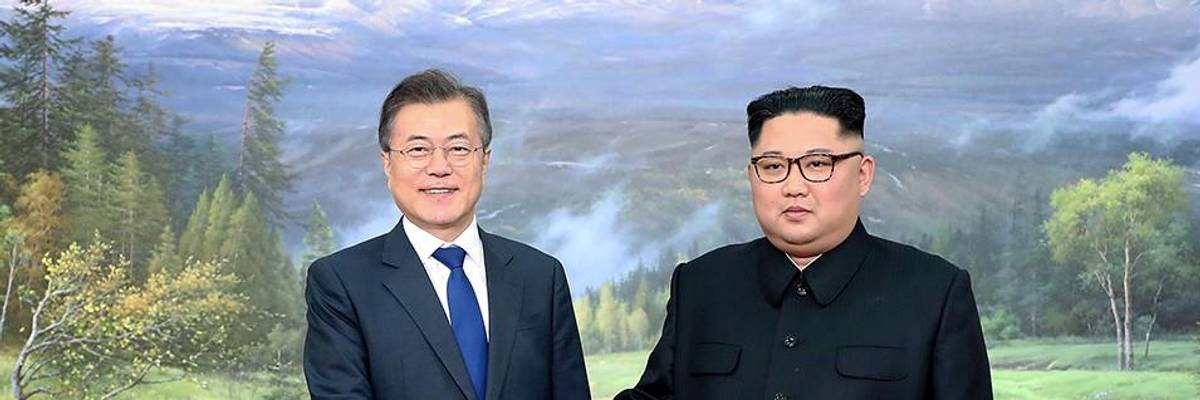
Not only does Moon now have a clear mandate domestically, the global context has changed, paving the way for him to pursue his inter-Korean peace agenda, with or without Washington's approval. (Photo by South Korean Presidential Blue House via Getty Images)
For the first time in two months, South Korea's new coronavirus cases have dropped to single digits. Seoul has not only demonstrated that it can contain the pandemic, but that it can safely hold elections, which last week led to a landslide victory for President Moon Jae-in's party in the parliamentary elections. Having earned the trust of the South Korean public and the admiration of the global community, now is the time for Moon to claim leadership over another issue that the Trump administration has woefully mismanaged: relations with North Korea.
The Trump administration's approach to North Korea has been characterized by the president developing a personal relationship with Kim Jong Un, while imposing ever-stricter sanctions and continuing to hold joint military exercises with South Korea. This has failed to move the needle on North Korea's nuclear weapons arsenal. Pyongyang continues to test weapons -- even in the midst of a global pandemic -- and shows no signs of wanting to engage with Washington.
From the beginning of his presidency, Moon--a human rights lawyer and former soldier who served in the DMZ--has made more headway than past South Korean leaders in improving inter-Korean relations.
But the universal threat of the coronavirus has created a vastly different landscape for President Moon to make progress with North Korea. Moon has all the leverage he needs to resolve a 70-year-old conflict and create a model for peace and stability in Northeast Asia.
From the beginning of his presidency, Moon -- a human rights lawyer and former soldier who served in the DMZ -- has made more headway than past South Korean leaders in improving inter-Korean relations. Five months after signing the Panmunjom Declaration in April 2018, Moon and Kim met in Pyongyang for a second summit and signed an inter-Korean military agreement that set forth a demilitarization process, including disarming soldiers in the Joint Security Area and demining portions of the DMZ. South Korea took concrete steps to revive inter-Korean cooperation, such as establishing a diplomatic compound in Kaesong and seeking to link the inter-Korean railroad at Dorasan Station at the DMZ.
Unfortunately, Moon's pro-peace diplomacy with North Korea fell victim to Washington's "maximum pressure" campaign on North Korea. In an October 2018 call to South Korean Foreign Minister Kang Kyung-Hwa, Secretary of State Mike Pompeo rebuked Seoul for moving too fast with Pyongyang and failing to move in lock step with Washington on denuclearization. When asked about South Korea's possible lifting of sanctions on North Korea, President Trump told reporters, "They won't do that without our approval. They do nothing without our approval."
Since Trump's colossal failure to reach a deal with Kim in Hanoi last year, talks have frozen, not just between Washington and Pyongyang, but also between the two Koreas. Not only does Moon now have a clear mandate domestically, the global context has changed, paving the way for him to pursue his inter-Korean peace agenda, with or without Washington's approval.
For one, South Korea doesn't have to continue conducting military exercises with the United States, which has been the ire of the North Korean regime. On March 23, U.N. Secretary-General Antonio Guterres called for a global ceasefire so that the world can address the pandemic. President Macron of France is pressing for the U.N. Security Council to back the Secretary-General's call, securing the commitments of three of five permanent members: China, the United Kingdom and the United States. The American and South Korean militaries agreed to cancel this spring's military exercises due to the pandemic; adhering to the global ceasefire gives President Moon cover to cancel them altogether.
In addition to the global ceasefire, there is growing consensus that sanctions must be lifted against particularly vulnerable countries such as North Korea. Michelle Bachelet, U.N. human rights chief and a physician, recently called for sectoral sanctions to "be eased or suspended" because they impede the delivery of vital medical and humanitarian aid. "In a context of global pandemic," Bachelet explained, "impeding medical efforts in one country heightens the risk for all of us."
With more than 2 million cases and nearly 150,000 deaths worldwide caused by COVID-19, the United States is acquiescing. On April 16, the U.S. Treasury Department announced sanctions exemptions for humanitarian assistance to North Korea, including "testing kits, respiratory devices, personal protective equipment, and medicine used in the prevention, diagnosis, treatment and recovery from COVID-19."
With two years left in his presidency -- and the U.S. and North Korea now entering the 70th year of being locked in a technical state of war -- Moon should take this opportunity to advance peace on the Korean Peninsula. The brokenness of the U.S. approach in resolving the North Korean conflict begs for leadership, which President Moon must claim for the future of regional and worldwide security.
After all, if there is one key lesson to be taken away from the handling of the COVID-19 pandemic, it's that South Korea can do some things better -- much better -- than the United States.
Dear Common Dreams reader, It’s been nearly 30 years since I co-founded Common Dreams with my late wife, Lina Newhouser. We had the radical notion that journalism should serve the public good, not corporate profits. It was clear to us from the outset what it would take to build such a project. No paid advertisements. No corporate sponsors. No millionaire publisher telling us what to think or do. Many people said we wouldn't last a year, but we proved those doubters wrong. Together with a tremendous team of journalists and dedicated staff, we built an independent media outlet free from the constraints of profits and corporate control. Our mission has always been simple: To inform. To inspire. To ignite change for the common good. Building Common Dreams was not easy. Our survival was never guaranteed. When you take on the most powerful forces—Wall Street greed, fossil fuel industry destruction, Big Tech lobbyists, and uber-rich oligarchs who have spent billions upon billions rigging the economy and democracy in their favor—the only bulwark you have is supporters who believe in your work. But here’s the urgent message from me today. It's never been this bad out there. And it's never been this hard to keep us going. At the very moment Common Dreams is most needed, the threats we face are intensifying. We need your support now more than ever. We don't accept corporate advertising and never will. We don't have a paywall because we don't think people should be blocked from critical news based on their ability to pay. Everything we do is funded by the donations of readers like you. When everyone does the little they can afford, we are strong. But if that support retreats or dries up, so do we. Will you donate now to make sure Common Dreams not only survives but thrives? —Craig Brown, Co-founder |
For the first time in two months, South Korea's new coronavirus cases have dropped to single digits. Seoul has not only demonstrated that it can contain the pandemic, but that it can safely hold elections, which last week led to a landslide victory for President Moon Jae-in's party in the parliamentary elections. Having earned the trust of the South Korean public and the admiration of the global community, now is the time for Moon to claim leadership over another issue that the Trump administration has woefully mismanaged: relations with North Korea.
The Trump administration's approach to North Korea has been characterized by the president developing a personal relationship with Kim Jong Un, while imposing ever-stricter sanctions and continuing to hold joint military exercises with South Korea. This has failed to move the needle on North Korea's nuclear weapons arsenal. Pyongyang continues to test weapons -- even in the midst of a global pandemic -- and shows no signs of wanting to engage with Washington.
From the beginning of his presidency, Moon--a human rights lawyer and former soldier who served in the DMZ--has made more headway than past South Korean leaders in improving inter-Korean relations.
But the universal threat of the coronavirus has created a vastly different landscape for President Moon to make progress with North Korea. Moon has all the leverage he needs to resolve a 70-year-old conflict and create a model for peace and stability in Northeast Asia.
From the beginning of his presidency, Moon -- a human rights lawyer and former soldier who served in the DMZ -- has made more headway than past South Korean leaders in improving inter-Korean relations. Five months after signing the Panmunjom Declaration in April 2018, Moon and Kim met in Pyongyang for a second summit and signed an inter-Korean military agreement that set forth a demilitarization process, including disarming soldiers in the Joint Security Area and demining portions of the DMZ. South Korea took concrete steps to revive inter-Korean cooperation, such as establishing a diplomatic compound in Kaesong and seeking to link the inter-Korean railroad at Dorasan Station at the DMZ.
Unfortunately, Moon's pro-peace diplomacy with North Korea fell victim to Washington's "maximum pressure" campaign on North Korea. In an October 2018 call to South Korean Foreign Minister Kang Kyung-Hwa, Secretary of State Mike Pompeo rebuked Seoul for moving too fast with Pyongyang and failing to move in lock step with Washington on denuclearization. When asked about South Korea's possible lifting of sanctions on North Korea, President Trump told reporters, "They won't do that without our approval. They do nothing without our approval."
Since Trump's colossal failure to reach a deal with Kim in Hanoi last year, talks have frozen, not just between Washington and Pyongyang, but also between the two Koreas. Not only does Moon now have a clear mandate domestically, the global context has changed, paving the way for him to pursue his inter-Korean peace agenda, with or without Washington's approval.
For one, South Korea doesn't have to continue conducting military exercises with the United States, which has been the ire of the North Korean regime. On March 23, U.N. Secretary-General Antonio Guterres called for a global ceasefire so that the world can address the pandemic. President Macron of France is pressing for the U.N. Security Council to back the Secretary-General's call, securing the commitments of three of five permanent members: China, the United Kingdom and the United States. The American and South Korean militaries agreed to cancel this spring's military exercises due to the pandemic; adhering to the global ceasefire gives President Moon cover to cancel them altogether.
In addition to the global ceasefire, there is growing consensus that sanctions must be lifted against particularly vulnerable countries such as North Korea. Michelle Bachelet, U.N. human rights chief and a physician, recently called for sectoral sanctions to "be eased or suspended" because they impede the delivery of vital medical and humanitarian aid. "In a context of global pandemic," Bachelet explained, "impeding medical efforts in one country heightens the risk for all of us."
With more than 2 million cases and nearly 150,000 deaths worldwide caused by COVID-19, the United States is acquiescing. On April 16, the U.S. Treasury Department announced sanctions exemptions for humanitarian assistance to North Korea, including "testing kits, respiratory devices, personal protective equipment, and medicine used in the prevention, diagnosis, treatment and recovery from COVID-19."
With two years left in his presidency -- and the U.S. and North Korea now entering the 70th year of being locked in a technical state of war -- Moon should take this opportunity to advance peace on the Korean Peninsula. The brokenness of the U.S. approach in resolving the North Korean conflict begs for leadership, which President Moon must claim for the future of regional and worldwide security.
After all, if there is one key lesson to be taken away from the handling of the COVID-19 pandemic, it's that South Korea can do some things better -- much better -- than the United States.
For the first time in two months, South Korea's new coronavirus cases have dropped to single digits. Seoul has not only demonstrated that it can contain the pandemic, but that it can safely hold elections, which last week led to a landslide victory for President Moon Jae-in's party in the parliamentary elections. Having earned the trust of the South Korean public and the admiration of the global community, now is the time for Moon to claim leadership over another issue that the Trump administration has woefully mismanaged: relations with North Korea.
The Trump administration's approach to North Korea has been characterized by the president developing a personal relationship with Kim Jong Un, while imposing ever-stricter sanctions and continuing to hold joint military exercises with South Korea. This has failed to move the needle on North Korea's nuclear weapons arsenal. Pyongyang continues to test weapons -- even in the midst of a global pandemic -- and shows no signs of wanting to engage with Washington.
From the beginning of his presidency, Moon--a human rights lawyer and former soldier who served in the DMZ--has made more headway than past South Korean leaders in improving inter-Korean relations.
But the universal threat of the coronavirus has created a vastly different landscape for President Moon to make progress with North Korea. Moon has all the leverage he needs to resolve a 70-year-old conflict and create a model for peace and stability in Northeast Asia.
From the beginning of his presidency, Moon -- a human rights lawyer and former soldier who served in the DMZ -- has made more headway than past South Korean leaders in improving inter-Korean relations. Five months after signing the Panmunjom Declaration in April 2018, Moon and Kim met in Pyongyang for a second summit and signed an inter-Korean military agreement that set forth a demilitarization process, including disarming soldiers in the Joint Security Area and demining portions of the DMZ. South Korea took concrete steps to revive inter-Korean cooperation, such as establishing a diplomatic compound in Kaesong and seeking to link the inter-Korean railroad at Dorasan Station at the DMZ.
Unfortunately, Moon's pro-peace diplomacy with North Korea fell victim to Washington's "maximum pressure" campaign on North Korea. In an October 2018 call to South Korean Foreign Minister Kang Kyung-Hwa, Secretary of State Mike Pompeo rebuked Seoul for moving too fast with Pyongyang and failing to move in lock step with Washington on denuclearization. When asked about South Korea's possible lifting of sanctions on North Korea, President Trump told reporters, "They won't do that without our approval. They do nothing without our approval."
Since Trump's colossal failure to reach a deal with Kim in Hanoi last year, talks have frozen, not just between Washington and Pyongyang, but also between the two Koreas. Not only does Moon now have a clear mandate domestically, the global context has changed, paving the way for him to pursue his inter-Korean peace agenda, with or without Washington's approval.
For one, South Korea doesn't have to continue conducting military exercises with the United States, which has been the ire of the North Korean regime. On March 23, U.N. Secretary-General Antonio Guterres called for a global ceasefire so that the world can address the pandemic. President Macron of France is pressing for the U.N. Security Council to back the Secretary-General's call, securing the commitments of three of five permanent members: China, the United Kingdom and the United States. The American and South Korean militaries agreed to cancel this spring's military exercises due to the pandemic; adhering to the global ceasefire gives President Moon cover to cancel them altogether.
In addition to the global ceasefire, there is growing consensus that sanctions must be lifted against particularly vulnerable countries such as North Korea. Michelle Bachelet, U.N. human rights chief and a physician, recently called for sectoral sanctions to "be eased or suspended" because they impede the delivery of vital medical and humanitarian aid. "In a context of global pandemic," Bachelet explained, "impeding medical efforts in one country heightens the risk for all of us."
With more than 2 million cases and nearly 150,000 deaths worldwide caused by COVID-19, the United States is acquiescing. On April 16, the U.S. Treasury Department announced sanctions exemptions for humanitarian assistance to North Korea, including "testing kits, respiratory devices, personal protective equipment, and medicine used in the prevention, diagnosis, treatment and recovery from COVID-19."
With two years left in his presidency -- and the U.S. and North Korea now entering the 70th year of being locked in a technical state of war -- Moon should take this opportunity to advance peace on the Korean Peninsula. The brokenness of the U.S. approach in resolving the North Korean conflict begs for leadership, which President Moon must claim for the future of regional and worldwide security.
After all, if there is one key lesson to be taken away from the handling of the COVID-19 pandemic, it's that South Korea can do some things better -- much better -- than the United States.