SUBSCRIBE TO OUR FREE NEWSLETTER
Daily news & progressive opinion—funded by the people, not the corporations—delivered straight to your inbox.
5
#000000
#FFFFFF
To donate by check, phone, or other method, see our More Ways to Give page.
Daily news & progressive opinion—funded by the people, not the corporations—delivered straight to your inbox.
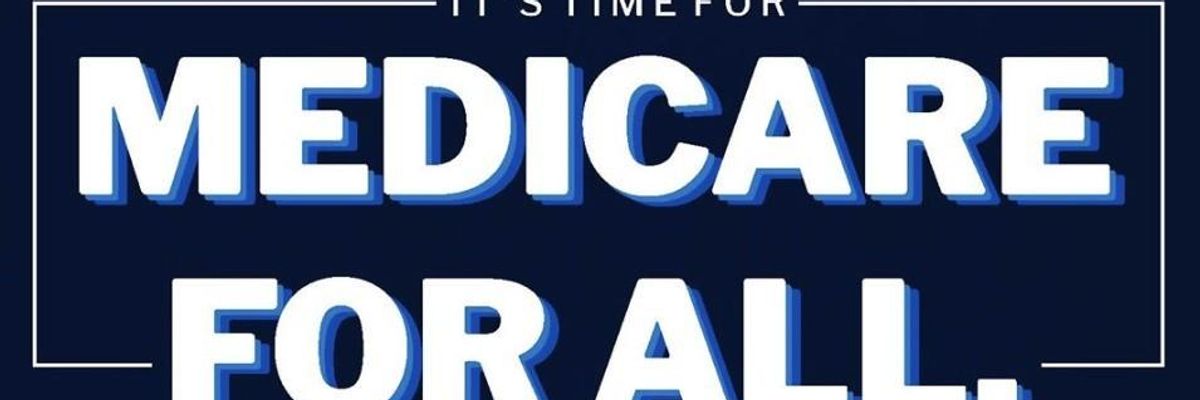
"Big pharma is out of excuses," writes Lawson. "The solutions Rep. Jayapal's bill lays out for lowering the costs of prescription drugs are thoroughly practical. They will do a much better job at ensuring patients can access their medicines than the current system, which is rigged to benefit pharma CEOs and shareholders." (Image: Office of Rep. Pramila Jayapal)
Rep. Pramila Jayapal's (D-WA) recently introduced Medicare for All Act of 2019 is a powerful and comprehensive plan to make health care a right for every American. Drastically lowering the prices of prescription drugs, while ensuring that patients are always able to get the medications they need, is an essential part of that plan.
The Medicare for All Act includes a key provision, modeled after the Medicare Negotiation and Competitive Licensing Act, which would lower drug prices for all Americans by allowing the government to negotiate lower drug prices with corporations.
"Lowering the cost of prescription drugs is essential to creating a strong Medicare for All system."
And if a corporation refused to lower the price and threatened patients' access to the medication, generic competition would be allowed using a competitive license.
Yale law professor Amy Kapczynski and Harvard professor Aaron Kesslheim demonstrated that this authority exists and is used across the government. It is simply a matter of applying the same authority to generic pharmaceutical competition. The Department of Defense has used the same authority to purchase "generic" versions of night vision lenses and lead-free bullets, and the Department of the Treasury has used the authority to purchase "generic" software.
In the United Kingdom, even though their National Health Service is a single payer, drug companies still massively overcharge for prescription drugs. For instance, the cystic fibrosis medicine Orkambi has been priced in the United Kingdom at PS$104,000 per patient, per year. (In U.S. dollars, that's currently somewhere around $130,000 to $140,000 per year.) The drug is currently not available through the NHS, and patients are forced to pay thousands of dollars each month out-of-pocket.
The UK experience provides a valuable lesson for the United States, one that Rep. Jayapal's new bill has taken to heart: For a Medicare for All system to meaningfully lower prescription drug prices, it must give the government the power to put the patent at risk, not the patient. Otherwise, the government and patients will be forced to continue absorbing higher prescription drug costs or risk not having access to needed drugs.
In other countries, when competitive licenses are issued, they are deployed rarely and then usually rescinded once drug prices have been lowered. Furthermore, the amount drug companies spend on marketing exceeds the amount they spend on research and development. From 2006 to 2015, big pharmaceutical companies spent more on share buybacks and dividends than they did on research and development.
A recent study found that federally funded research contributed to the science that underlies every one of the 210 new drugs approved between 2010 and 2016. Given that the U.S. government, funded by taxpayers, already subsidizes so much research for pharmaceutical companies through the National Institutes of Health, it is a transparent lie for pharmaceutical companies to claim that they need to charge outrageous prices for the purposes of "innovation."
Indeed, it is entirely possible to completely cut out the pharmaceutical companies by creating a new system where all research and development is publicly funded--and the prescription drugs developed are available at a fair price with no patents or exclusivity. Economist Dean Baker has estimated that the United States is likely to spend more than "$450 billion (2.2 percent of GDP) on prescription drugs this year. We would likely be spending less than $80 billion, a savings of $370 billion annually, if all drugs were sold in a free market without patents or related protections."
Big pharma is out of excuses. The solutions Rep. Jayapal's bill lays out for lowering the costs of prescription drugs are thoroughly practical. They will do a much better job at ensuring patients can access their medicines than the current system, which is rigged to benefit pharma CEOs and shareholders.
Lowering the cost of prescription drugs is essential to creating a strong Medicare for All system. With the government taking aggressive action to slash the cost of prescription drugs while making sure no one is unable to get their needed medicines, it will be that much easier to provide improved health care to every American as a fundamental human right.
This article was produced by Economy for All, a project of the Independent Media Institute.
This country and this world are at a monumental crossroads. US voters have an opportunity to beat back the forces of fascism and confront the billionaires who are rigging the economy, our media system, and our democracy, making it increasingly impossible for ordinary people to get by. We’re not just talking about the election. We’re talking about what must be done once these fascist elements are vanquished from power. We need a bolder set of solutions than what either major party has so far been willing to offer and a working-class movement ready to fight like hell for it. Trump didn't emerge from nowhere. The conditions that fueled MAGA authoritarianism were created by decades of radical neoliberal economic policies and a corrupt political system dominated by corporate interests. They slashed taxes on the super-rich, promising that the benefits would trickle down. They said giveaways to the corporate titans would make life more affordable for the rest of us. It was all bullshit. And when a bitter, betrayed populace searches for someone to blame, right-wing demagogues have little trouble finding scapegoats. People know when they're being lied to, but you won't hear any of this from the corporate media. Only independent journalism—powered and funded by people who believe in building a better world—can deliver truly trustworthy daily news. If you share our vision, please contribute whatever you can to sustain our work. |
Rep. Pramila Jayapal's (D-WA) recently introduced Medicare for All Act of 2019 is a powerful and comprehensive plan to make health care a right for every American. Drastically lowering the prices of prescription drugs, while ensuring that patients are always able to get the medications they need, is an essential part of that plan.
The Medicare for All Act includes a key provision, modeled after the Medicare Negotiation and Competitive Licensing Act, which would lower drug prices for all Americans by allowing the government to negotiate lower drug prices with corporations.
"Lowering the cost of prescription drugs is essential to creating a strong Medicare for All system."
And if a corporation refused to lower the price and threatened patients' access to the medication, generic competition would be allowed using a competitive license.
Yale law professor Amy Kapczynski and Harvard professor Aaron Kesslheim demonstrated that this authority exists and is used across the government. It is simply a matter of applying the same authority to generic pharmaceutical competition. The Department of Defense has used the same authority to purchase "generic" versions of night vision lenses and lead-free bullets, and the Department of the Treasury has used the authority to purchase "generic" software.
In the United Kingdom, even though their National Health Service is a single payer, drug companies still massively overcharge for prescription drugs. For instance, the cystic fibrosis medicine Orkambi has been priced in the United Kingdom at PS$104,000 per patient, per year. (In U.S. dollars, that's currently somewhere around $130,000 to $140,000 per year.) The drug is currently not available through the NHS, and patients are forced to pay thousands of dollars each month out-of-pocket.
The UK experience provides a valuable lesson for the United States, one that Rep. Jayapal's new bill has taken to heart: For a Medicare for All system to meaningfully lower prescription drug prices, it must give the government the power to put the patent at risk, not the patient. Otherwise, the government and patients will be forced to continue absorbing higher prescription drug costs or risk not having access to needed drugs.
In other countries, when competitive licenses are issued, they are deployed rarely and then usually rescinded once drug prices have been lowered. Furthermore, the amount drug companies spend on marketing exceeds the amount they spend on research and development. From 2006 to 2015, big pharmaceutical companies spent more on share buybacks and dividends than they did on research and development.
A recent study found that federally funded research contributed to the science that underlies every one of the 210 new drugs approved between 2010 and 2016. Given that the U.S. government, funded by taxpayers, already subsidizes so much research for pharmaceutical companies through the National Institutes of Health, it is a transparent lie for pharmaceutical companies to claim that they need to charge outrageous prices for the purposes of "innovation."
Indeed, it is entirely possible to completely cut out the pharmaceutical companies by creating a new system where all research and development is publicly funded--and the prescription drugs developed are available at a fair price with no patents or exclusivity. Economist Dean Baker has estimated that the United States is likely to spend more than "$450 billion (2.2 percent of GDP) on prescription drugs this year. We would likely be spending less than $80 billion, a savings of $370 billion annually, if all drugs were sold in a free market without patents or related protections."
Big pharma is out of excuses. The solutions Rep. Jayapal's bill lays out for lowering the costs of prescription drugs are thoroughly practical. They will do a much better job at ensuring patients can access their medicines than the current system, which is rigged to benefit pharma CEOs and shareholders.
Lowering the cost of prescription drugs is essential to creating a strong Medicare for All system. With the government taking aggressive action to slash the cost of prescription drugs while making sure no one is unable to get their needed medicines, it will be that much easier to provide improved health care to every American as a fundamental human right.
This article was produced by Economy for All, a project of the Independent Media Institute.