SUBSCRIBE TO OUR FREE NEWSLETTER
Daily news & progressive opinion—funded by the people, not the corporations—delivered straight to your inbox.
5
#000000
#FFFFFF
To donate by check, phone, or other method, see our More Ways to Give page.
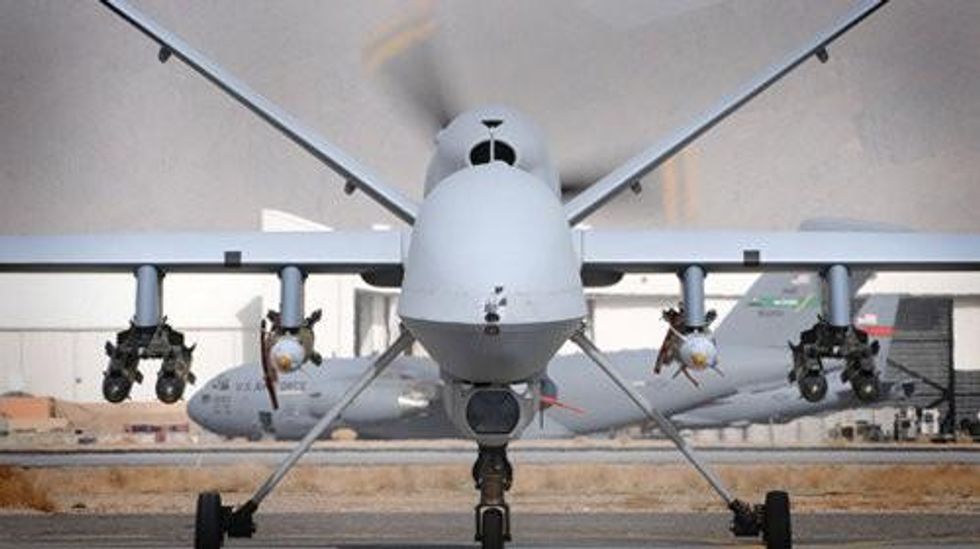
According to the story, based on a recent FOIA filed by the Electronic Frontier Foundation , the Department of Homeland Security (DHS), one of the few agencies permitted to fly drones in U.S. airspace, is lending its Predator drones to other agencies eager to "borrow" them. In 2010, for example, DHS's Customs and Border Protection (CBP) conducted 76 drone missions for other agencies. The next year, that number quadrupled, and it remained at nearly the same level in 2012. In total, CBP conducted 687 drone missions for other agencies from 2010 to 2012. According to the story, the trend has been driven by a "huge, unfed appetite among police agencies for drones and their powerful surveillance tools."
In an example of just how far this technology has come, Chris discussed one aerial surveillance system known as ARGUS-IS, which includes a super-high, 1.8 gigapixel resolution camera mounted on a drone, capable of high-resolution monitoring and recording of entire cities.
These concerns have caught senators' attention. Nineteen of the Committee's 25 members attended, and the hearing room was packed. Senator Dianne Feinstein (D-Calif.) opened the hearing with a story about waking up one morning to find a drone hovering outside her window. Senator Feinstein described how exposed she felt, having no idea what information it was collecting. Was it filming her? Was it listening? Where was it sending this information? She called on Congress to put in place strong privacy protections for Americans, including requiring a warrant for law enforcement's use of drones. Edward Markey (D-Mass.) raised similar concerns regarding the potential for spying and the lack of transparency on what drones are collecting.
Deployed without proper regulation, drones equipped with facial recognition software, infrared technology, and speakers capable of monitoring personal conversations would cause real harms to our privacy rights. Interconnected drones could enable mass tracking of vehicles and people in wide areas. Imagine the personal information it could gather if deployed over a political rally or gun show. A tiny drone called the Hummingbird, developed for stealth surveillance, has a wingspan of only 6.5 inches and weighs less than a single AA battery. This could go completely unnoticed while peering into the window of a home or place of worship.
Widespread drone use could completely change our concept of privacy, and it's not only the ACLU that's worried. An Associated Press poll found that one-third of Americans fear police use of drones will lead to an erosion of our privacy rights, and 43 states have already considered legislation restricting their use.
To be sure, drones are a fascinating new technology with many beneficial uses - including in search and rescue missions, to monitor crops, for scientific research, mapping, and more. Senator Cory Booker (D-N.J.) pointed out during the hearing the important role drones could play in protecting First Amendment activities, much like the ability to film police activity with a smartphone has played a crucial role in creating accountability and reining in police misconduct.
However, unregulated drone use could pose serious threats to our privacy. Fortunately, if Congress moves quickly, we have time to get strong privacy protections in place before drones hit the skies en masse. These important decisions must be made in an open and democratic fashion -- not on the fly by individual police departments.
Many Commerce Committee senators at the hearing expressed their wish to see drones get off the ground quickly for their economic benefits. But it was also good to see so much concern expressed about privacy. For drones to benefit us all, Congress must act to ensure they develop within the law and in line with our founding principles.
According to the story, based on a recent FOIA filed by the Electronic Frontier Foundation , the Department of Homeland Security (DHS), one of the few agencies permitted to fly drones in U.S. airspace, is lending its Predator drones to other agencies eager to "borrow" them. In 2010, for example, DHS's Customs and Border Protection (CBP) conducted 76 drone missions for other agencies. The next year, that number quadrupled, and it remained at nearly the same level in 2012. In total, CBP conducted 687 drone missions for other agencies from 2010 to 2012. According to the story, the trend has been driven by a "huge, unfed appetite among police agencies for drones and their powerful surveillance tools."
In an example of just how far this technology has come, Chris discussed one aerial surveillance system known as ARGUS-IS, which includes a super-high, 1.8 gigapixel resolution camera mounted on a drone, capable of high-resolution monitoring and recording of entire cities.
These concerns have caught senators' attention. Nineteen of the Committee's 25 members attended, and the hearing room was packed. Senator Dianne Feinstein (D-Calif.) opened the hearing with a story about waking up one morning to find a drone hovering outside her window. Senator Feinstein described how exposed she felt, having no idea what information it was collecting. Was it filming her? Was it listening? Where was it sending this information? She called on Congress to put in place strong privacy protections for Americans, including requiring a warrant for law enforcement's use of drones. Edward Markey (D-Mass.) raised similar concerns regarding the potential for spying and the lack of transparency on what drones are collecting.
Deployed without proper regulation, drones equipped with facial recognition software, infrared technology, and speakers capable of monitoring personal conversations would cause real harms to our privacy rights. Interconnected drones could enable mass tracking of vehicles and people in wide areas. Imagine the personal information it could gather if deployed over a political rally or gun show. A tiny drone called the Hummingbird, developed for stealth surveillance, has a wingspan of only 6.5 inches and weighs less than a single AA battery. This could go completely unnoticed while peering into the window of a home or place of worship.
Widespread drone use could completely change our concept of privacy, and it's not only the ACLU that's worried. An Associated Press poll found that one-third of Americans fear police use of drones will lead to an erosion of our privacy rights, and 43 states have already considered legislation restricting their use.
To be sure, drones are a fascinating new technology with many beneficial uses - including in search and rescue missions, to monitor crops, for scientific research, mapping, and more. Senator Cory Booker (D-N.J.) pointed out during the hearing the important role drones could play in protecting First Amendment activities, much like the ability to film police activity with a smartphone has played a crucial role in creating accountability and reining in police misconduct.
However, unregulated drone use could pose serious threats to our privacy. Fortunately, if Congress moves quickly, we have time to get strong privacy protections in place before drones hit the skies en masse. These important decisions must be made in an open and democratic fashion -- not on the fly by individual police departments.
Many Commerce Committee senators at the hearing expressed their wish to see drones get off the ground quickly for their economic benefits. But it was also good to see so much concern expressed about privacy. For drones to benefit us all, Congress must act to ensure they develop within the law and in line with our founding principles.
According to the story, based on a recent FOIA filed by the Electronic Frontier Foundation , the Department of Homeland Security (DHS), one of the few agencies permitted to fly drones in U.S. airspace, is lending its Predator drones to other agencies eager to "borrow" them. In 2010, for example, DHS's Customs and Border Protection (CBP) conducted 76 drone missions for other agencies. The next year, that number quadrupled, and it remained at nearly the same level in 2012. In total, CBP conducted 687 drone missions for other agencies from 2010 to 2012. According to the story, the trend has been driven by a "huge, unfed appetite among police agencies for drones and their powerful surveillance tools."
In an example of just how far this technology has come, Chris discussed one aerial surveillance system known as ARGUS-IS, which includes a super-high, 1.8 gigapixel resolution camera mounted on a drone, capable of high-resolution monitoring and recording of entire cities.
These concerns have caught senators' attention. Nineteen of the Committee's 25 members attended, and the hearing room was packed. Senator Dianne Feinstein (D-Calif.) opened the hearing with a story about waking up one morning to find a drone hovering outside her window. Senator Feinstein described how exposed she felt, having no idea what information it was collecting. Was it filming her? Was it listening? Where was it sending this information? She called on Congress to put in place strong privacy protections for Americans, including requiring a warrant for law enforcement's use of drones. Edward Markey (D-Mass.) raised similar concerns regarding the potential for spying and the lack of transparency on what drones are collecting.
Deployed without proper regulation, drones equipped with facial recognition software, infrared technology, and speakers capable of monitoring personal conversations would cause real harms to our privacy rights. Interconnected drones could enable mass tracking of vehicles and people in wide areas. Imagine the personal information it could gather if deployed over a political rally or gun show. A tiny drone called the Hummingbird, developed for stealth surveillance, has a wingspan of only 6.5 inches and weighs less than a single AA battery. This could go completely unnoticed while peering into the window of a home or place of worship.
Widespread drone use could completely change our concept of privacy, and it's not only the ACLU that's worried. An Associated Press poll found that one-third of Americans fear police use of drones will lead to an erosion of our privacy rights, and 43 states have already considered legislation restricting their use.
To be sure, drones are a fascinating new technology with many beneficial uses - including in search and rescue missions, to monitor crops, for scientific research, mapping, and more. Senator Cory Booker (D-N.J.) pointed out during the hearing the important role drones could play in protecting First Amendment activities, much like the ability to film police activity with a smartphone has played a crucial role in creating accountability and reining in police misconduct.
However, unregulated drone use could pose serious threats to our privacy. Fortunately, if Congress moves quickly, we have time to get strong privacy protections in place before drones hit the skies en masse. These important decisions must be made in an open and democratic fashion -- not on the fly by individual police departments.
Many Commerce Committee senators at the hearing expressed their wish to see drones get off the ground quickly for their economic benefits. But it was also good to see so much concern expressed about privacy. For drones to benefit us all, Congress must act to ensure they develop within the law and in line with our founding principles.