SUBSCRIBE TO OUR FREE NEWSLETTER
Daily news & progressive opinion—funded by the people, not the corporations—delivered straight to your inbox.
5
#000000
#FFFFFF
To donate by check, phone, or other method, see our More Ways to Give page.
This could be the end of the Internet as we know it. But it doesn't have to be.
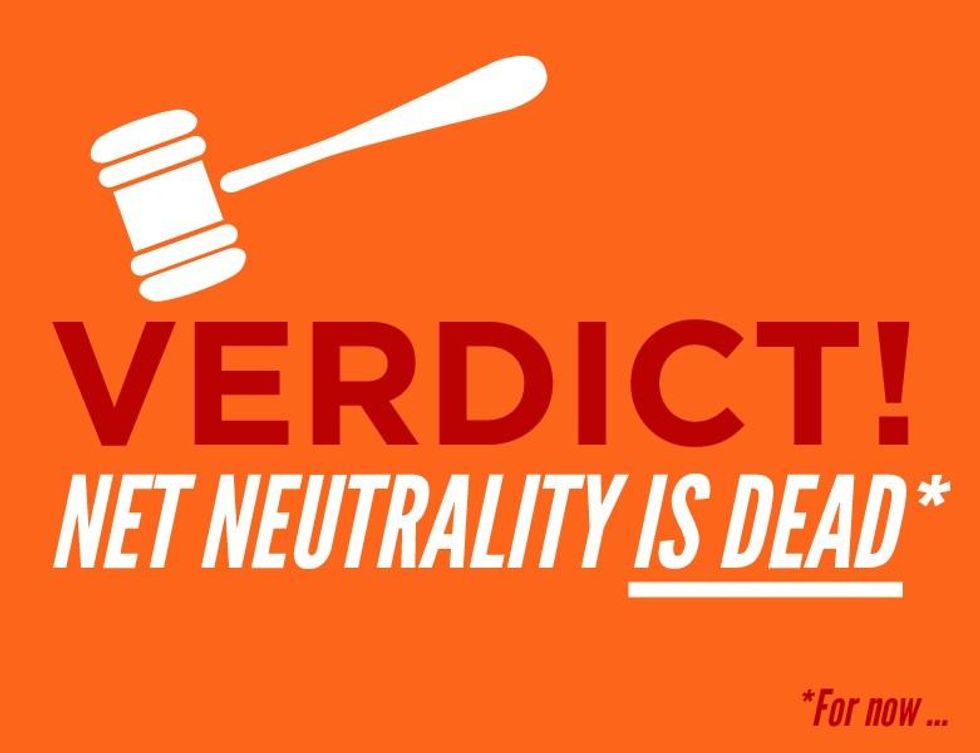
The big news: A federal appeals court on Tuesday struck down the Federal Communications Commission's Open Internet Order. This decision means that companies like AT&T, Comcast and Verizon--which brought the lawsuit--are now free to block or slow down any website, application or service they like.
We could pay dearly for the previous FCC's weak political will and wishy-washy approach. But today's ruling leaves the door wide open to a better approach. It's not too late for the FCC to reverse its terrible decisions and repair its doomed strategy.
These companies will rush to change the Web and line their own pockets at our expense -- creating new tolls for app makers, expensive price tiers for popular sites, and fast lanes open only to the few content providers that can afford them.
It didn't have to be this way.
The FCC's rules were designed to prevent Internet service providers from blocking or interfering with Web traffic. Instead of reversing a Bush-era decision that weakened the FCC's authority over broadband, and establishing solid legal footing, former FCC Chairman Julius Genachowski issued the rules in 2010 under the complicated and shaky legal framework the court rejected today.
The rules the court struck down left much to be desired, but they were a step toward preserving Internet users' freedom to go wherever they wanted, whenever they wanted.
Now, just as Verizon promised it would in court, the biggest broadband providers will race to turn the open and vibrant Web into something that looks like cable TV--where they pick and choose the channels for you. They'll establish fast lanes for the few giant companies that can afford to pay exorbitant tolls and reserve the slow lanes for everyone else.
We could pay dearly for the previous FCC's weak political will and wishy-washy approach. But today's ruling leaves the door wide open to a better approach. It's not too late for the FCC to reverse its terrible decisions and repair its doomed strategy.
That's right. The FCC could make all this go away by simply reading the law correctly and reclaiming the authority it already has to protect Internet users for good. The agency had clear authority before the Bush administration abdicated it and the Obama administration failed to fix the mistake.
New FCC Chairman Tom Wheeler recently stated that the FCC must be able to protect broadband users and preserve the Internet's fundamental open architecture. Now he has no other choice but to restore and reassert the FCC's clear authority over our nation's communications infrastructure.
There will be serious pushback from the most powerful phone and cable companies (and an array of hired guns and front groups). They will make threats, recycle all of their debunked myths about the Internet--and promise we can trust them not to do any of the bad things they've fought so hard to do.
For too long, the FCC has worked to fulfill the wish lists of the big phone and cable monopolies--instead of looking out for Internet users like us.
Now the free and open Internet is flat-lining. But Wheeler has the paddles in his hands and the power to resuscitate Net Neutrality. We'll know soon if he has the political guts to use them.
We need strong protections and sensible policies to ensure the Internet continues to thrive and prosper. But to make that happen the millions of people who have fought for Net Neutrality--and the millions more who have rallied against Web-censorship bills like SOPA/PIPA and outrages like the NSA's unchecked spying and surveillance--rise up like never before.
Together we can fight back against these greedy Internet service providers. We can save the Internet we love. But we have to act now.
This could be the end of the Internet as we know it. But it doesn't have to be.
The big news: A federal appeals court on Tuesday struck down the Federal Communications Commission's Open Internet Order. This decision means that companies like AT&T, Comcast and Verizon--which brought the lawsuit--are now free to block or slow down any website, application or service they like.
We could pay dearly for the previous FCC's weak political will and wishy-washy approach. But today's ruling leaves the door wide open to a better approach. It's not too late for the FCC to reverse its terrible decisions and repair its doomed strategy.
These companies will rush to change the Web and line their own pockets at our expense -- creating new tolls for app makers, expensive price tiers for popular sites, and fast lanes open only to the few content providers that can afford them.
It didn't have to be this way.
The FCC's rules were designed to prevent Internet service providers from blocking or interfering with Web traffic. Instead of reversing a Bush-era decision that weakened the FCC's authority over broadband, and establishing solid legal footing, former FCC Chairman Julius Genachowski issued the rules in 2010 under the complicated and shaky legal framework the court rejected today.
The rules the court struck down left much to be desired, but they were a step toward preserving Internet users' freedom to go wherever they wanted, whenever they wanted.
Now, just as Verizon promised it would in court, the biggest broadband providers will race to turn the open and vibrant Web into something that looks like cable TV--where they pick and choose the channels for you. They'll establish fast lanes for the few giant companies that can afford to pay exorbitant tolls and reserve the slow lanes for everyone else.
We could pay dearly for the previous FCC's weak political will and wishy-washy approach. But today's ruling leaves the door wide open to a better approach. It's not too late for the FCC to reverse its terrible decisions and repair its doomed strategy.
That's right. The FCC could make all this go away by simply reading the law correctly and reclaiming the authority it already has to protect Internet users for good. The agency had clear authority before the Bush administration abdicated it and the Obama administration failed to fix the mistake.
New FCC Chairman Tom Wheeler recently stated that the FCC must be able to protect broadband users and preserve the Internet's fundamental open architecture. Now he has no other choice but to restore and reassert the FCC's clear authority over our nation's communications infrastructure.
There will be serious pushback from the most powerful phone and cable companies (and an array of hired guns and front groups). They will make threats, recycle all of their debunked myths about the Internet--and promise we can trust them not to do any of the bad things they've fought so hard to do.
For too long, the FCC has worked to fulfill the wish lists of the big phone and cable monopolies--instead of looking out for Internet users like us.
Now the free and open Internet is flat-lining. But Wheeler has the paddles in his hands and the power to resuscitate Net Neutrality. We'll know soon if he has the political guts to use them.
We need strong protections and sensible policies to ensure the Internet continues to thrive and prosper. But to make that happen the millions of people who have fought for Net Neutrality--and the millions more who have rallied against Web-censorship bills like SOPA/PIPA and outrages like the NSA's unchecked spying and surveillance--rise up like never before.
Together we can fight back against these greedy Internet service providers. We can save the Internet we love. But we have to act now.
This could be the end of the Internet as we know it. But it doesn't have to be.
The big news: A federal appeals court on Tuesday struck down the Federal Communications Commission's Open Internet Order. This decision means that companies like AT&T, Comcast and Verizon--which brought the lawsuit--are now free to block or slow down any website, application or service they like.
We could pay dearly for the previous FCC's weak political will and wishy-washy approach. But today's ruling leaves the door wide open to a better approach. It's not too late for the FCC to reverse its terrible decisions and repair its doomed strategy.
These companies will rush to change the Web and line their own pockets at our expense -- creating new tolls for app makers, expensive price tiers for popular sites, and fast lanes open only to the few content providers that can afford them.
It didn't have to be this way.
The FCC's rules were designed to prevent Internet service providers from blocking or interfering with Web traffic. Instead of reversing a Bush-era decision that weakened the FCC's authority over broadband, and establishing solid legal footing, former FCC Chairman Julius Genachowski issued the rules in 2010 under the complicated and shaky legal framework the court rejected today.
The rules the court struck down left much to be desired, but they were a step toward preserving Internet users' freedom to go wherever they wanted, whenever they wanted.
Now, just as Verizon promised it would in court, the biggest broadband providers will race to turn the open and vibrant Web into something that looks like cable TV--where they pick and choose the channels for you. They'll establish fast lanes for the few giant companies that can afford to pay exorbitant tolls and reserve the slow lanes for everyone else.
We could pay dearly for the previous FCC's weak political will and wishy-washy approach. But today's ruling leaves the door wide open to a better approach. It's not too late for the FCC to reverse its terrible decisions and repair its doomed strategy.
That's right. The FCC could make all this go away by simply reading the law correctly and reclaiming the authority it already has to protect Internet users for good. The agency had clear authority before the Bush administration abdicated it and the Obama administration failed to fix the mistake.
New FCC Chairman Tom Wheeler recently stated that the FCC must be able to protect broadband users and preserve the Internet's fundamental open architecture. Now he has no other choice but to restore and reassert the FCC's clear authority over our nation's communications infrastructure.
There will be serious pushback from the most powerful phone and cable companies (and an array of hired guns and front groups). They will make threats, recycle all of their debunked myths about the Internet--and promise we can trust them not to do any of the bad things they've fought so hard to do.
For too long, the FCC has worked to fulfill the wish lists of the big phone and cable monopolies--instead of looking out for Internet users like us.
Now the free and open Internet is flat-lining. But Wheeler has the paddles in his hands and the power to resuscitate Net Neutrality. We'll know soon if he has the political guts to use them.
We need strong protections and sensible policies to ensure the Internet continues to thrive and prosper. But to make that happen the millions of people who have fought for Net Neutrality--and the millions more who have rallied against Web-censorship bills like SOPA/PIPA and outrages like the NSA's unchecked spying and surveillance--rise up like never before.
Together we can fight back against these greedy Internet service providers. We can save the Internet we love. But we have to act now.