

The trouble with making "functional" government the great aspiration of the American experiment -- as so many pundits and politicians now do -- is that a smoothly operating Congress is not necessarily moral, humane or even economically smart.
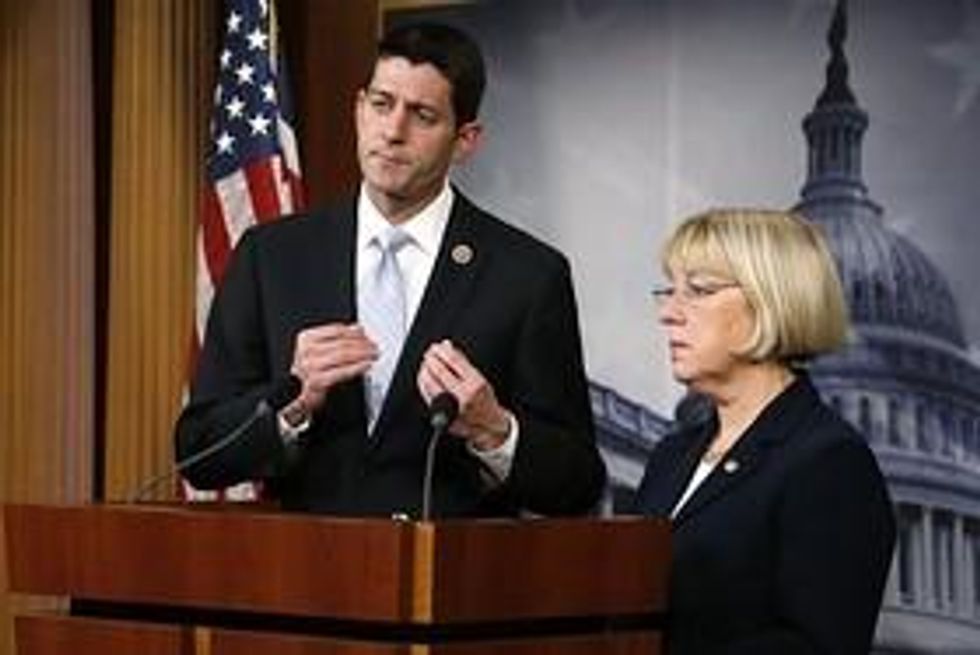
It is important to remember this disconnect as we consider the budget deal announced late Tuesday by House Budget Committee chairman Paul Ryan, R-Wisconsin, and Senate Budget Committee chairman Patty Murray, D-Washington.
"This agreement breaks through the recent dysfunction to prevent another government shutdown and roll back sequestration's cuts to defense and domestic investments in a balanced way," said Murray. "It's a good step in the right direction that can hopefully rebuild some trust and serve as a foundation for continued bipartisan work."
Ryan was equally self-congratulatory, declaring that -- after a fall the saw a government shutdown, nasty wrangling over the historically uncontroversial task of raising the debt ceiling and general congressional dysfunction - he and Murray had achieved "a clear improvement on the status quo."
"This agreement makes sure that we don't have a government shutdown scenario in January," he added. "It makes sure we don't have another government shutdown scenario in October. It makes sure that we don't lurch from crisis to crisis."
Murray and Ryan are excited that they had stopped fighting for long enough to agree to $63 billion in "sequester relief" -- as opposed to an actual end to sequestration -- and $23 billion in net deficit reduction. They also glad that they have set the discretionary spending level for fiscal year 2014 at $1.012 trillion, while setting the level at $1.014 trillion for fiscal year 2015. That apparently qualifies - in the eyes of the budget negotiators -- as a sufficient alternative to lurching from crisis to crisis.
But the agreement does not address the crises that matters. "This plan won't create jobs, get the economy back on track, or meaningfully cut the deficit," explains Congressman Peter DeFazio, D-Oregon.
And that's not the worst of it.
What of the 1.3 million jobless Americans who -- with a fully Dickensian twist -- now stand to lose Federal unemployment benefits three days after Christmas?
The budget agreement does not look like a "step in the right direction" for them. And unless Democrats succeed in renewing benefits in a distinct piece of legislation that apparently must pass this week -- as Congress is moving rapidly toward recess -- many of the most economically-vulnerable Americans will be "lurching from crisis to crisis" very soon.
Their crisis is our crisis. According to the non-partisan Congressional Budget Office, extending benefits for the long-term unemployed would boost a still slow economy by two-tenths of a percent in the coming year -- creating 200,000 needed jobs. As the CBO explains: "Recipients of the additional benefits would increase their spending on consumer goods and services. That increase in aggregate demand would encourage businesses to boost production and hire more workers than they otherwise would, particularly given the expected slack in the capital and labor markets."
Without providing for the extension, something that easily and appropriately could have been done in the budget agreement, Ryan and Murray failed in their most basic humanitarian and economic duties.
And what of the federal workers and members of the military who will be required to take what is effectively a pay cut in order to pay more for their retirement benefits?
" Federal workers have sacrificed over $113 billion for deficit reduction since 2011, including a three-year pay freeze and increased pension contributions for newly hired employees. This figure does not include the up to eight furlough days caused by sequestration this summer and a 16-day shutdown in October which resulted in financial hardship and profound anxiety for half the government's workforce and their families," noted unions that represent federal employees. "Given these contributions, we are dismayed to learn that increasing the pension contributions and/or changing the retirement formula for current federal employees is on the table. This is simply unacceptable."
This is, also, absurd.
Despite Murray's prodding, the House and Senate budget chairs did not close a single tax loophole. But they did come up with a scheme to take money away from public employees and people serving in the military -- effectively reducing what millions of Americans will have to spend on Main Street.
Members of House and Senate who are paid $174,000 annually, collect generous benefits and -- thanks to redistricting and an incumbent-rewarding campaign finance system -- enjoy no small measure of job security, can pat themselves on the back for breaking through "the recent dysfunction." But forcing others to lurch from crisis to crisis so that you can tell yourself you have taken "a step in the right direction" is definitively socially and economically dysfunctional. Not to mention cruel, and irresponsible.
The trouble with making "functional" government the great aspiration of the American experiment -- as so many pundits and politicians now do -- is that a smoothly operating Congress is not necessarily moral, humane or even economically smart.
It is important to remember this disconnect as we consider the budget deal announced late Tuesday by House Budget Committee chairman Paul Ryan, R-Wisconsin, and Senate Budget Committee chairman Patty Murray, D-Washington.
"This agreement breaks through the recent dysfunction to prevent another government shutdown and roll back sequestration's cuts to defense and domestic investments in a balanced way," said Murray. "It's a good step in the right direction that can hopefully rebuild some trust and serve as a foundation for continued bipartisan work."
Ryan was equally self-congratulatory, declaring that -- after a fall the saw a government shutdown, nasty wrangling over the historically uncontroversial task of raising the debt ceiling and general congressional dysfunction - he and Murray had achieved "a clear improvement on the status quo."
"This agreement makes sure that we don't have a government shutdown scenario in January," he added. "It makes sure we don't have another government shutdown scenario in October. It makes sure that we don't lurch from crisis to crisis."
Murray and Ryan are excited that they had stopped fighting for long enough to agree to $63 billion in "sequester relief" -- as opposed to an actual end to sequestration -- and $23 billion in net deficit reduction. They also glad that they have set the discretionary spending level for fiscal year 2014 at $1.012 trillion, while setting the level at $1.014 trillion for fiscal year 2015. That apparently qualifies - in the eyes of the budget negotiators -- as a sufficient alternative to lurching from crisis to crisis.
But the agreement does not address the crises that matters. "This plan won't create jobs, get the economy back on track, or meaningfully cut the deficit," explains Congressman Peter DeFazio, D-Oregon.
And that's not the worst of it.
What of the 1.3 million jobless Americans who -- with a fully Dickensian twist -- now stand to lose Federal unemployment benefits three days after Christmas?
The budget agreement does not look like a "step in the right direction" for them. And unless Democrats succeed in renewing benefits in a distinct piece of legislation that apparently must pass this week -- as Congress is moving rapidly toward recess -- many of the most economically-vulnerable Americans will be "lurching from crisis to crisis" very soon.
Their crisis is our crisis. According to the non-partisan Congressional Budget Office, extending benefits for the long-term unemployed would boost a still slow economy by two-tenths of a percent in the coming year -- creating 200,000 needed jobs. As the CBO explains: "Recipients of the additional benefits would increase their spending on consumer goods and services. That increase in aggregate demand would encourage businesses to boost production and hire more workers than they otherwise would, particularly given the expected slack in the capital and labor markets."
Without providing for the extension, something that easily and appropriately could have been done in the budget agreement, Ryan and Murray failed in their most basic humanitarian and economic duties.
And what of the federal workers and members of the military who will be required to take what is effectively a pay cut in order to pay more for their retirement benefits?
" Federal workers have sacrificed over $113 billion for deficit reduction since 2011, including a three-year pay freeze and increased pension contributions for newly hired employees. This figure does not include the up to eight furlough days caused by sequestration this summer and a 16-day shutdown in October which resulted in financial hardship and profound anxiety for half the government's workforce and their families," noted unions that represent federal employees. "Given these contributions, we are dismayed to learn that increasing the pension contributions and/or changing the retirement formula for current federal employees is on the table. This is simply unacceptable."
This is, also, absurd.
Despite Murray's prodding, the House and Senate budget chairs did not close a single tax loophole. But they did come up with a scheme to take money away from public employees and people serving in the military -- effectively reducing what millions of Americans will have to spend on Main Street.
Members of House and Senate who are paid $174,000 annually, collect generous benefits and -- thanks to redistricting and an incumbent-rewarding campaign finance system -- enjoy no small measure of job security, can pat themselves on the back for breaking through "the recent dysfunction." But forcing others to lurch from crisis to crisis so that you can tell yourself you have taken "a step in the right direction" is definitively socially and economically dysfunctional. Not to mention cruel, and irresponsible.
The trouble with making "functional" government the great aspiration of the American experiment -- as so many pundits and politicians now do -- is that a smoothly operating Congress is not necessarily moral, humane or even economically smart.
It is important to remember this disconnect as we consider the budget deal announced late Tuesday by House Budget Committee chairman Paul Ryan, R-Wisconsin, and Senate Budget Committee chairman Patty Murray, D-Washington.
"This agreement breaks through the recent dysfunction to prevent another government shutdown and roll back sequestration's cuts to defense and domestic investments in a balanced way," said Murray. "It's a good step in the right direction that can hopefully rebuild some trust and serve as a foundation for continued bipartisan work."
Ryan was equally self-congratulatory, declaring that -- after a fall the saw a government shutdown, nasty wrangling over the historically uncontroversial task of raising the debt ceiling and general congressional dysfunction - he and Murray had achieved "a clear improvement on the status quo."
"This agreement makes sure that we don't have a government shutdown scenario in January," he added. "It makes sure we don't have another government shutdown scenario in October. It makes sure that we don't lurch from crisis to crisis."
Murray and Ryan are excited that they had stopped fighting for long enough to agree to $63 billion in "sequester relief" -- as opposed to an actual end to sequestration -- and $23 billion in net deficit reduction. They also glad that they have set the discretionary spending level for fiscal year 2014 at $1.012 trillion, while setting the level at $1.014 trillion for fiscal year 2015. That apparently qualifies - in the eyes of the budget negotiators -- as a sufficient alternative to lurching from crisis to crisis.
But the agreement does not address the crises that matters. "This plan won't create jobs, get the economy back on track, or meaningfully cut the deficit," explains Congressman Peter DeFazio, D-Oregon.
And that's not the worst of it.
What of the 1.3 million jobless Americans who -- with a fully Dickensian twist -- now stand to lose Federal unemployment benefits three days after Christmas?
The budget agreement does not look like a "step in the right direction" for them. And unless Democrats succeed in renewing benefits in a distinct piece of legislation that apparently must pass this week -- as Congress is moving rapidly toward recess -- many of the most economically-vulnerable Americans will be "lurching from crisis to crisis" very soon.
Their crisis is our crisis. According to the non-partisan Congressional Budget Office, extending benefits for the long-term unemployed would boost a still slow economy by two-tenths of a percent in the coming year -- creating 200,000 needed jobs. As the CBO explains: "Recipients of the additional benefits would increase their spending on consumer goods and services. That increase in aggregate demand would encourage businesses to boost production and hire more workers than they otherwise would, particularly given the expected slack in the capital and labor markets."
Without providing for the extension, something that easily and appropriately could have been done in the budget agreement, Ryan and Murray failed in their most basic humanitarian and economic duties.
And what of the federal workers and members of the military who will be required to take what is effectively a pay cut in order to pay more for their retirement benefits?
" Federal workers have sacrificed over $113 billion for deficit reduction since 2011, including a three-year pay freeze and increased pension contributions for newly hired employees. This figure does not include the up to eight furlough days caused by sequestration this summer and a 16-day shutdown in October which resulted in financial hardship and profound anxiety for half the government's workforce and their families," noted unions that represent federal employees. "Given these contributions, we are dismayed to learn that increasing the pension contributions and/or changing the retirement formula for current federal employees is on the table. This is simply unacceptable."
This is, also, absurd.
Despite Murray's prodding, the House and Senate budget chairs did not close a single tax loophole. But they did come up with a scheme to take money away from public employees and people serving in the military -- effectively reducing what millions of Americans will have to spend on Main Street.
Members of House and Senate who are paid $174,000 annually, collect generous benefits and -- thanks to redistricting and an incumbent-rewarding campaign finance system -- enjoy no small measure of job security, can pat themselves on the back for breaking through "the recent dysfunction." But forcing others to lurch from crisis to crisis so that you can tell yourself you have taken "a step in the right direction" is definitively socially and economically dysfunctional. Not to mention cruel, and irresponsible.