SUBSCRIBE TO OUR FREE NEWSLETTER
Daily news & progressive opinion—funded by the people, not the corporations—delivered straight to your inbox.
5
#000000
#FFFFFF
To donate by check, phone, or other method, see our More Ways to Give page.
Ever since the first big revelations about the National Security Agency five months ago, Dianne Feinstein has been in overdrive to defend the surveillance state. As chair of the Senate Intelligence Committee, she generates an abundance of fog, weasel words, anti-whistleblower slander and bogus notions of reform -- while methodically stabbing civil liberties in the back.
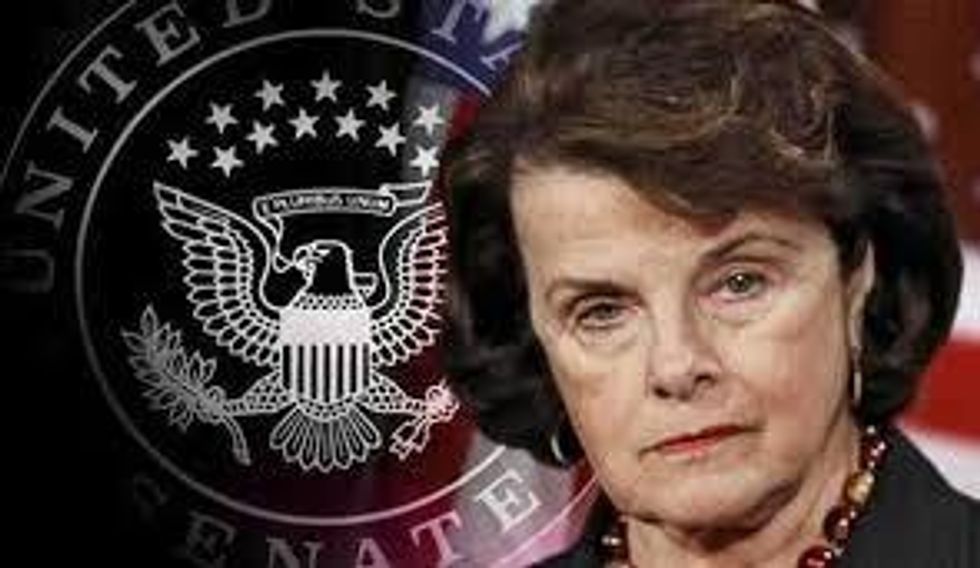
Feinstein's powerful service to Big Brother, reaching new heights in recent months, is just getting started. She's hard at work to muddy all the waters of public discourse she can -- striving to protect the NSA from real legislative remedies while serving as a key political enabler for President Obama's shameless abuse of the First, Fourth and Fifth Amendments.
Last Sunday, on CBS, when Feinstein told "Face the Nation" viewers that Edward Snowden has done "enormous disservice to our country," it was one of her more restrained smears. In June, when Snowden first went public as a whistleblower, Feinstein quickly declared that he had committed "an act of treason." Since then, she has refused to tone down the claim. "I stand by it," she told The Hill on Oct. 29.
Days ago, taking it from the top of the NSA's main talking points, Feinstein led off a San Francisco Chronicle op-ed piece with 9/11 fear-mongering. "The Sept. 11, 2001, attack on the United States was highly organized and sophisticated and designed to strike at the heart of the American economy and government," she wrote, and quickly added: "We know that terrorists remain determined to kill Americans and our allies."
From there, Senator Feinstein praised the NSA's "call-records program" and then insisted: "This is not a surveillance program." (Paging Mr. Orwell.)
Feinstein's essay -- touting her new bill, the "FISA Improvements Act," which she just pushed through the Senate Intelligence Committee -- claimed that the legislation will "bridge the gap between preventing terrorism and protecting civil liberties." But as Electronic Frontier Foundation activist Trevor Timm writes, the bill actually "codifies some of the NSA's worst practices, would be a huge setback for everyone's privacy, and it would permanently entrench the NSA's collection of every phone record held by U.S. telecoms."
California's senior senator is good at tactical maneuvers that blow media smoke. In late October -- while continuing to defend the NSA's planetary dragnet on emails and phone calls -- Feinstein voiced concern "that certain surveillance activities have been in effect for more than a decade and that the Senate Intelligence Committee wasn't satisfactorily informed." Spinning the myth that congressional oversight of the NSA really exists, she added: "Therefore, our oversight needs to be strengthened and increased."
As usual, Feinstein's verbal gymnastics were in sync with choreography from the Obama White House. The "certain surveillance activities" that she has begun to criticize are the NSA's efforts targeting the phones of German Chancellor Angela Merkel and other allied foreign leaders. Feinstein mildly chided Obama for ostensibly not being aware of the eavesdropping on Merkel's cell phone ("That is a big problem"), but she was merely snipping at a few threads of the NSA's vast global spying -- while, like the administration as a whole, reaffirming support for the vast fabric of the agency's surveillance programs.
The White House is now signaling policy changes in response to the uproar about monitoring Merkel's phone, the New York Times reported on Nov. 5, but "President Obama and his top advisers have concluded that there is no workable alternative to the bulk collection of huge quantities of 'metadata,' including records of all telephone calls made inside the United States." Feinstein is on the same page: eager to fine tune and continue mass surveillance.
With fanfare that foreshadows a drawn-out onslaught of hype, Feinstein has announced that the Senate Intelligence Committee will hold hearings on NSA surveillance. "Her committee is now making preparations for a major investigative undertaking, which is expected to take at least several months," the Wall Street Journal reports. When the show is over, "The report that results from the probe will be classified."
With Dianne Feinstein's hand on the gavel, you can expect plenty of fake inquiries to pantomime actual oversight. She has shown a clear commitment to deep-sixing vital information about the surveillance state, in a never-ending quest for the uninformed consent of the governed. "From out of the gate, we know that her entire approach is to make those hearings into a tragic farce," I said during an interview on C-SPAN Radio last week. "Her entire approach to this issue has been to do damage control for the NSA.... She is an apologist and a flack for the surveillance state, she is aligned with the Obama White House with that agenda, and we at the grassroots must push back against that kind of a politics."
Ever since the first big revelations about the National Security Agency five months ago, Dianne Feinstein has been in overdrive to defend the surveillance state. As chair of the Senate Intelligence Committee, she generates an abundance of fog, weasel words, anti-whistleblower slander and bogus notions of reform -- while methodically stabbing civil liberties in the back.
Feinstein's powerful service to Big Brother, reaching new heights in recent months, is just getting started. She's hard at work to muddy all the waters of public discourse she can -- striving to protect the NSA from real legislative remedies while serving as a key political enabler for President Obama's shameless abuse of the First, Fourth and Fifth Amendments.
Last Sunday, on CBS, when Feinstein told "Face the Nation" viewers that Edward Snowden has done "enormous disservice to our country," it was one of her more restrained smears. In June, when Snowden first went public as a whistleblower, Feinstein quickly declared that he had committed "an act of treason." Since then, she has refused to tone down the claim. "I stand by it," she told The Hill on Oct. 29.
Days ago, taking it from the top of the NSA's main talking points, Feinstein led off a San Francisco Chronicle op-ed piece with 9/11 fear-mongering. "The Sept. 11, 2001, attack on the United States was highly organized and sophisticated and designed to strike at the heart of the American economy and government," she wrote, and quickly added: "We know that terrorists remain determined to kill Americans and our allies."
From there, Senator Feinstein praised the NSA's "call-records program" and then insisted: "This is not a surveillance program." (Paging Mr. Orwell.)
Feinstein's essay -- touting her new bill, the "FISA Improvements Act," which she just pushed through the Senate Intelligence Committee -- claimed that the legislation will "bridge the gap between preventing terrorism and protecting civil liberties." But as Electronic Frontier Foundation activist Trevor Timm writes, the bill actually "codifies some of the NSA's worst practices, would be a huge setback for everyone's privacy, and it would permanently entrench the NSA's collection of every phone record held by U.S. telecoms."
California's senior senator is good at tactical maneuvers that blow media smoke. In late October -- while continuing to defend the NSA's planetary dragnet on emails and phone calls -- Feinstein voiced concern "that certain surveillance activities have been in effect for more than a decade and that the Senate Intelligence Committee wasn't satisfactorily informed." Spinning the myth that congressional oversight of the NSA really exists, she added: "Therefore, our oversight needs to be strengthened and increased."
As usual, Feinstein's verbal gymnastics were in sync with choreography from the Obama White House. The "certain surveillance activities" that she has begun to criticize are the NSA's efforts targeting the phones of German Chancellor Angela Merkel and other allied foreign leaders. Feinstein mildly chided Obama for ostensibly not being aware of the eavesdropping on Merkel's cell phone ("That is a big problem"), but she was merely snipping at a few threads of the NSA's vast global spying -- while, like the administration as a whole, reaffirming support for the vast fabric of the agency's surveillance programs.
The White House is now signaling policy changes in response to the uproar about monitoring Merkel's phone, the New York Times reported on Nov. 5, but "President Obama and his top advisers have concluded that there is no workable alternative to the bulk collection of huge quantities of 'metadata,' including records of all telephone calls made inside the United States." Feinstein is on the same page: eager to fine tune and continue mass surveillance.
With fanfare that foreshadows a drawn-out onslaught of hype, Feinstein has announced that the Senate Intelligence Committee will hold hearings on NSA surveillance. "Her committee is now making preparations for a major investigative undertaking, which is expected to take at least several months," the Wall Street Journal reports. When the show is over, "The report that results from the probe will be classified."
With Dianne Feinstein's hand on the gavel, you can expect plenty of fake inquiries to pantomime actual oversight. She has shown a clear commitment to deep-sixing vital information about the surveillance state, in a never-ending quest for the uninformed consent of the governed. "From out of the gate, we know that her entire approach is to make those hearings into a tragic farce," I said during an interview on C-SPAN Radio last week. "Her entire approach to this issue has been to do damage control for the NSA.... She is an apologist and a flack for the surveillance state, she is aligned with the Obama White House with that agenda, and we at the grassroots must push back against that kind of a politics."
Ever since the first big revelations about the National Security Agency five months ago, Dianne Feinstein has been in overdrive to defend the surveillance state. As chair of the Senate Intelligence Committee, she generates an abundance of fog, weasel words, anti-whistleblower slander and bogus notions of reform -- while methodically stabbing civil liberties in the back.
Feinstein's powerful service to Big Brother, reaching new heights in recent months, is just getting started. She's hard at work to muddy all the waters of public discourse she can -- striving to protect the NSA from real legislative remedies while serving as a key political enabler for President Obama's shameless abuse of the First, Fourth and Fifth Amendments.
Last Sunday, on CBS, when Feinstein told "Face the Nation" viewers that Edward Snowden has done "enormous disservice to our country," it was one of her more restrained smears. In June, when Snowden first went public as a whistleblower, Feinstein quickly declared that he had committed "an act of treason." Since then, she has refused to tone down the claim. "I stand by it," she told The Hill on Oct. 29.
Days ago, taking it from the top of the NSA's main talking points, Feinstein led off a San Francisco Chronicle op-ed piece with 9/11 fear-mongering. "The Sept. 11, 2001, attack on the United States was highly organized and sophisticated and designed to strike at the heart of the American economy and government," she wrote, and quickly added: "We know that terrorists remain determined to kill Americans and our allies."
From there, Senator Feinstein praised the NSA's "call-records program" and then insisted: "This is not a surveillance program." (Paging Mr. Orwell.)
Feinstein's essay -- touting her new bill, the "FISA Improvements Act," which she just pushed through the Senate Intelligence Committee -- claimed that the legislation will "bridge the gap between preventing terrorism and protecting civil liberties." But as Electronic Frontier Foundation activist Trevor Timm writes, the bill actually "codifies some of the NSA's worst practices, would be a huge setback for everyone's privacy, and it would permanently entrench the NSA's collection of every phone record held by U.S. telecoms."
California's senior senator is good at tactical maneuvers that blow media smoke. In late October -- while continuing to defend the NSA's planetary dragnet on emails and phone calls -- Feinstein voiced concern "that certain surveillance activities have been in effect for more than a decade and that the Senate Intelligence Committee wasn't satisfactorily informed." Spinning the myth that congressional oversight of the NSA really exists, she added: "Therefore, our oversight needs to be strengthened and increased."
As usual, Feinstein's verbal gymnastics were in sync with choreography from the Obama White House. The "certain surveillance activities" that she has begun to criticize are the NSA's efforts targeting the phones of German Chancellor Angela Merkel and other allied foreign leaders. Feinstein mildly chided Obama for ostensibly not being aware of the eavesdropping on Merkel's cell phone ("That is a big problem"), but she was merely snipping at a few threads of the NSA's vast global spying -- while, like the administration as a whole, reaffirming support for the vast fabric of the agency's surveillance programs.
The White House is now signaling policy changes in response to the uproar about monitoring Merkel's phone, the New York Times reported on Nov. 5, but "President Obama and his top advisers have concluded that there is no workable alternative to the bulk collection of huge quantities of 'metadata,' including records of all telephone calls made inside the United States." Feinstein is on the same page: eager to fine tune and continue mass surveillance.
With fanfare that foreshadows a drawn-out onslaught of hype, Feinstein has announced that the Senate Intelligence Committee will hold hearings on NSA surveillance. "Her committee is now making preparations for a major investigative undertaking, which is expected to take at least several months," the Wall Street Journal reports. When the show is over, "The report that results from the probe will be classified."
With Dianne Feinstein's hand on the gavel, you can expect plenty of fake inquiries to pantomime actual oversight. She has shown a clear commitment to deep-sixing vital information about the surveillance state, in a never-ending quest for the uninformed consent of the governed. "From out of the gate, we know that her entire approach is to make those hearings into a tragic farce," I said during an interview on C-SPAN Radio last week. "Her entire approach to this issue has been to do damage control for the NSA.... She is an apologist and a flack for the surveillance state, she is aligned with the Obama White House with that agenda, and we at the grassroots must push back against that kind of a politics."