

One of the things that makes Sandy different from Katrina is that it's a relatively clean story. The lessons of Katrina were numerous and painful--they had to do with race, with class, with the willful incompetence of a government that had put a professional Arabian horse fancier in charge of its rescue efforts.
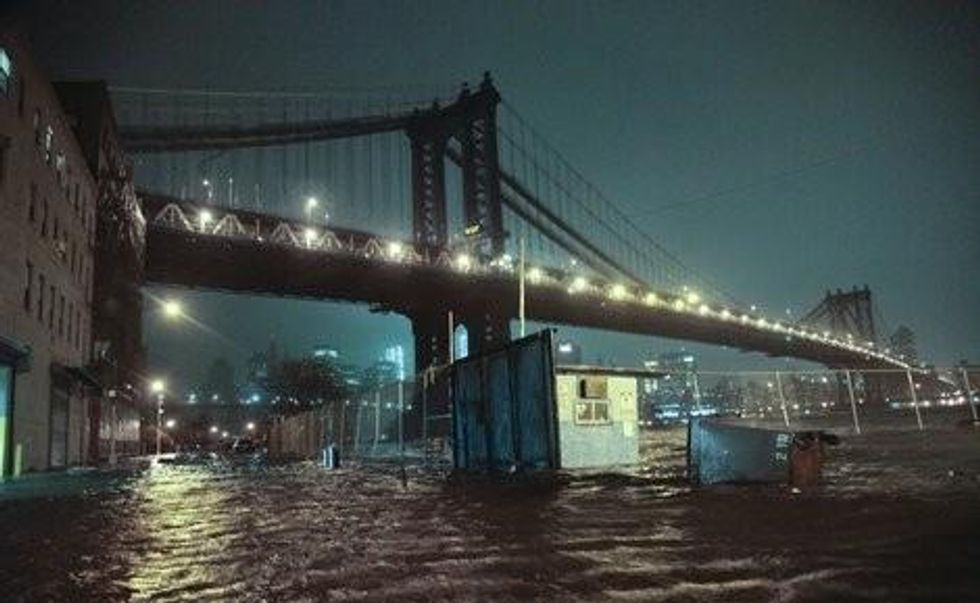
Sandy, by contrast, has been pretty straightforward. It's hit rich, poor, and middle class Americans with nearly equal power, though of course the affluent always have it easier in the aftermath of tragedy. Government officials prepared forthrightly for its arrival, and have refrained from paralysis and bickering in its wake. Which allows us to concentrate on the only really useful message it might deliver: that we live in a changed world, where we need both to adapt to the changes, and to prevent further changes so great that adaptation will be impossible.
Science and its practical consort Engineering mostly come out of this week with enhanced reputations. For some years now, various researchers have been predicting that such a trauma was not just possible but almost certain, as we raised the temperature and with it the level of the sea--just this past summer, for instance, scientists demonstrated that seas were rising faster near the northeast United States (for reasons having to do with alterations to the Gulf Stream) than almost anyplace on the planet. They had described, in the long run, the loaded gun, right down to a set of documents describing the precise risk to the New York subway system.
As nature pulled the trigger in mid-October, when a tropical wave left Africa and moved into the Atlantic and began to spin, scientists were able to do the short-term work of hurricane forecasting with almost eerie precision. Days before Sandy came ashore we not only knew approximately where it would go, but that its barometric pressure would drop below previous records and hence that its gushing surge would set new marks. The computer models dealt with the weird hybrid nature of the storm--a tropical cyclone hitting a blocking front--with real aplomb; it was a bravura performance.
In so doing, it should shame at least a little those people who argue against the computer modeling of climate change on the grounds that "they can't even tell the weather three days ahead of time--how can they predict the climate?" But in fact "they" can tell the weather, and in the process they saved thousands upon thousands of lives. They can tell the future too. No serious climate scientist believes that the sea will rise less than a meter this century, unless we get off fossil fuel with great speed; many anticipate it will rise far more. Think about what that means--as one researcher put it this week, it means that any average storm will become an insidious threat.
It's possible that we can spend enough money to somehow protect Manhattan--and it's possible that we can't. It's impossible to imagine that we will be able to protect, say, the Asian subcontinent, or the Pearl River delta of China, or any of the other crowded places imperiled by rising seas. In fact, the last year has seen even more serious flooding in Bangkok and Manila, and a recent study found that New York was only seventeenth on the list of cities at risk of such flooding, with Mumbai and Calcutta leading the league.
Having great scientists, and taking those scientists seriously, are two different things, of course. Our climate scientists--led by James Hansen, who lives in New Jersey and does his work from a NASA lab on the Upper West Side--have trotted patiently up to Capitol Hill every year for the last two decades to present their latest findings, and been entirely ignored, the fossil fuel industry having purchased one of our political parties and cowed the other. But it may be that firsthand experience will accomplish what academic studies have not--Governor Andrew Cuomo, for instance, was forthright in his declarations this week that climate change was a "reality," that we were "vulnerable" as a result, and that we would need to adjust to deal with it.
But that adjustment can't just be building new seawalls, because we'll never catch up. The same researchers who predicted events like this week's horror have warned that unless we cease burning coal and gas and oil the planet's temperature--already elevated by a degree--will climb another four or five. At which point "civilization" will be another word for "ongoing emergency response."
Building new defenses will be expensive but relatively popular; cracking down on the fossil fuel industry will be a great trial, and indeed Cuomo has an important test approaching. He must decide at some point in the coming years whether to allow fracking within the borders of the Empire State. A lead author of a very weak report from his Department of Environmental Conservation is a climate denier; after Sandy it will be interesting to see if the governor asks for a new study from people in touch with actual science. I think he might; as powerful as the fracking lobby is, the sight of a hundred apartment and office lobbies filled with seawater is more visceral. We've been given a warning by science, and a wake-up call by nature; it is up to us now to heed them.
One of the things that makes Sandy different from Katrina is that it's a relatively clean story. The lessons of Katrina were numerous and painful--they had to do with race, with class, with the willful incompetence of a government that had put a professional Arabian horse fancier in charge of its rescue efforts.
Sandy, by contrast, has been pretty straightforward. It's hit rich, poor, and middle class Americans with nearly equal power, though of course the affluent always have it easier in the aftermath of tragedy. Government officials prepared forthrightly for its arrival, and have refrained from paralysis and bickering in its wake. Which allows us to concentrate on the only really useful message it might deliver: that we live in a changed world, where we need both to adapt to the changes, and to prevent further changes so great that adaptation will be impossible.
Science and its practical consort Engineering mostly come out of this week with enhanced reputations. For some years now, various researchers have been predicting that such a trauma was not just possible but almost certain, as we raised the temperature and with it the level of the sea--just this past summer, for instance, scientists demonstrated that seas were rising faster near the northeast United States (for reasons having to do with alterations to the Gulf Stream) than almost anyplace on the planet. They had described, in the long run, the loaded gun, right down to a set of documents describing the precise risk to the New York subway system.
As nature pulled the trigger in mid-October, when a tropical wave left Africa and moved into the Atlantic and began to spin, scientists were able to do the short-term work of hurricane forecasting with almost eerie precision. Days before Sandy came ashore we not only knew approximately where it would go, but that its barometric pressure would drop below previous records and hence that its gushing surge would set new marks. The computer models dealt with the weird hybrid nature of the storm--a tropical cyclone hitting a blocking front--with real aplomb; it was a bravura performance.
In so doing, it should shame at least a little those people who argue against the computer modeling of climate change on the grounds that "they can't even tell the weather three days ahead of time--how can they predict the climate?" But in fact "they" can tell the weather, and in the process they saved thousands upon thousands of lives. They can tell the future too. No serious climate scientist believes that the sea will rise less than a meter this century, unless we get off fossil fuel with great speed; many anticipate it will rise far more. Think about what that means--as one researcher put it this week, it means that any average storm will become an insidious threat.
It's possible that we can spend enough money to somehow protect Manhattan--and it's possible that we can't. It's impossible to imagine that we will be able to protect, say, the Asian subcontinent, or the Pearl River delta of China, or any of the other crowded places imperiled by rising seas. In fact, the last year has seen even more serious flooding in Bangkok and Manila, and a recent study found that New York was only seventeenth on the list of cities at risk of such flooding, with Mumbai and Calcutta leading the league.
Having great scientists, and taking those scientists seriously, are two different things, of course. Our climate scientists--led by James Hansen, who lives in New Jersey and does his work from a NASA lab on the Upper West Side--have trotted patiently up to Capitol Hill every year for the last two decades to present their latest findings, and been entirely ignored, the fossil fuel industry having purchased one of our political parties and cowed the other. But it may be that firsthand experience will accomplish what academic studies have not--Governor Andrew Cuomo, for instance, was forthright in his declarations this week that climate change was a "reality," that we were "vulnerable" as a result, and that we would need to adjust to deal with it.
But that adjustment can't just be building new seawalls, because we'll never catch up. The same researchers who predicted events like this week's horror have warned that unless we cease burning coal and gas and oil the planet's temperature--already elevated by a degree--will climb another four or five. At which point "civilization" will be another word for "ongoing emergency response."
Building new defenses will be expensive but relatively popular; cracking down on the fossil fuel industry will be a great trial, and indeed Cuomo has an important test approaching. He must decide at some point in the coming years whether to allow fracking within the borders of the Empire State. A lead author of a very weak report from his Department of Environmental Conservation is a climate denier; after Sandy it will be interesting to see if the governor asks for a new study from people in touch with actual science. I think he might; as powerful as the fracking lobby is, the sight of a hundred apartment and office lobbies filled with seawater is more visceral. We've been given a warning by science, and a wake-up call by nature; it is up to us now to heed them.
One of the things that makes Sandy different from Katrina is that it's a relatively clean story. The lessons of Katrina were numerous and painful--they had to do with race, with class, with the willful incompetence of a government that had put a professional Arabian horse fancier in charge of its rescue efforts.
Sandy, by contrast, has been pretty straightforward. It's hit rich, poor, and middle class Americans with nearly equal power, though of course the affluent always have it easier in the aftermath of tragedy. Government officials prepared forthrightly for its arrival, and have refrained from paralysis and bickering in its wake. Which allows us to concentrate on the only really useful message it might deliver: that we live in a changed world, where we need both to adapt to the changes, and to prevent further changes so great that adaptation will be impossible.
Science and its practical consort Engineering mostly come out of this week with enhanced reputations. For some years now, various researchers have been predicting that such a trauma was not just possible but almost certain, as we raised the temperature and with it the level of the sea--just this past summer, for instance, scientists demonstrated that seas were rising faster near the northeast United States (for reasons having to do with alterations to the Gulf Stream) than almost anyplace on the planet. They had described, in the long run, the loaded gun, right down to a set of documents describing the precise risk to the New York subway system.
As nature pulled the trigger in mid-October, when a tropical wave left Africa and moved into the Atlantic and began to spin, scientists were able to do the short-term work of hurricane forecasting with almost eerie precision. Days before Sandy came ashore we not only knew approximately where it would go, but that its barometric pressure would drop below previous records and hence that its gushing surge would set new marks. The computer models dealt with the weird hybrid nature of the storm--a tropical cyclone hitting a blocking front--with real aplomb; it was a bravura performance.
In so doing, it should shame at least a little those people who argue against the computer modeling of climate change on the grounds that "they can't even tell the weather three days ahead of time--how can they predict the climate?" But in fact "they" can tell the weather, and in the process they saved thousands upon thousands of lives. They can tell the future too. No serious climate scientist believes that the sea will rise less than a meter this century, unless we get off fossil fuel with great speed; many anticipate it will rise far more. Think about what that means--as one researcher put it this week, it means that any average storm will become an insidious threat.
It's possible that we can spend enough money to somehow protect Manhattan--and it's possible that we can't. It's impossible to imagine that we will be able to protect, say, the Asian subcontinent, or the Pearl River delta of China, or any of the other crowded places imperiled by rising seas. In fact, the last year has seen even more serious flooding in Bangkok and Manila, and a recent study found that New York was only seventeenth on the list of cities at risk of such flooding, with Mumbai and Calcutta leading the league.
Having great scientists, and taking those scientists seriously, are two different things, of course. Our climate scientists--led by James Hansen, who lives in New Jersey and does his work from a NASA lab on the Upper West Side--have trotted patiently up to Capitol Hill every year for the last two decades to present their latest findings, and been entirely ignored, the fossil fuel industry having purchased one of our political parties and cowed the other. But it may be that firsthand experience will accomplish what academic studies have not--Governor Andrew Cuomo, for instance, was forthright in his declarations this week that climate change was a "reality," that we were "vulnerable" as a result, and that we would need to adjust to deal with it.
But that adjustment can't just be building new seawalls, because we'll never catch up. The same researchers who predicted events like this week's horror have warned that unless we cease burning coal and gas and oil the planet's temperature--already elevated by a degree--will climb another four or five. At which point "civilization" will be another word for "ongoing emergency response."
Building new defenses will be expensive but relatively popular; cracking down on the fossil fuel industry will be a great trial, and indeed Cuomo has an important test approaching. He must decide at some point in the coming years whether to allow fracking within the borders of the Empire State. A lead author of a very weak report from his Department of Environmental Conservation is a climate denier; after Sandy it will be interesting to see if the governor asks for a new study from people in touch with actual science. I think he might; as powerful as the fracking lobby is, the sight of a hundred apartment and office lobbies filled with seawater is more visceral. We've been given a warning by science, and a wake-up call by nature; it is up to us now to heed them.