SUBSCRIBE TO OUR FREE NEWSLETTER
Daily news & progressive opinion—funded by the people, not the corporations—delivered straight to your inbox.
5
#000000
#FFFFFF
To donate by check, phone, or other method, see our More Ways to Give page.
Last week, upon arrival, I looked at the sagging ceilings over the kitchen, living room and entryway and felt certain that shifting to new living quarters should be the top priority. The following evening, tremors caused by a small local earthquake sent me running out of the house to interrupt a game of volleyball all the others were playing, but cooler heads prevailed and the game continued - what else was there to do? I stayed outside to watch. Later, we talked about the inevitable need to make a move away from our dangerous dwelling and do it soon, so now the daily schedule includes scouring the neighborhood for a new home with comparable space and rent.
Some daily problems are predictable. For example, Ali knows he is behind many other students in the Kabul secondary school he attends, because back in Bamiyan, where he grew up, he'd had limited opportunities to learn the basics of reading, writing and arithmetic. On mornings in the APV house, he struggles to make sense of notes he has carefully recorded in class. Early this morning, he was sitting in the yard carefully writing and rewriting a sentence describing the function of the present continuous tense in English, preparing for an English exam later that day. He and I spent some time writing English sentences in the present and present continuous tenses, and then he taught me how to do the same in Dari. Some problems at least have simple solutions.
Abdulhai wants the best for his widowed mother. Like almost every other Afghan family, Abdulhai has experienced deep personal loss, the loss of his father to war. I remember one late evening in Kabul some months ago when he confided in me and Hakim about the difficult memories of fleeing away from the fighting through the snowy mountains of Bamiyan province where his simple and honest family resides.
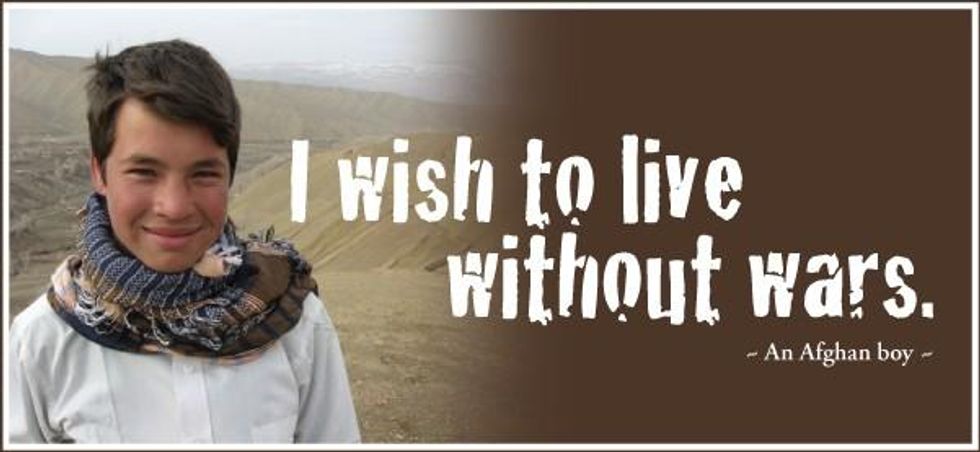
Shedding some tears, he said, "I wish I could buy my mother a good pair of shoes. "Abdulhai has a growing commitment to working among fellow Afghan peers and youth to understand and practice non-violence. In 2011, his picture was selected by Fellowship of Reconciliation USA to be featured on the big board at Times Square in New York. It was a poster of Abdulhai on his favorite hills behind his village, with these words reflecting his heart, "I wish to live without wars."
The small community here listens to its members' problems - very much including the needs of their loved ones - and tries hard to sort out cooperative ways to help them respond. Each member of the community comes from a home grappling with problems attendant on economic destitution. Aided by small contributions from peace activists abroad, they creatively "troubleshoot" ways to keep their project going.
Meanwhile, they are doing their best to address social problems in the struggling neighborhood around them. This week, after several delays, a workshop for seamstresses has been set up right here in our living quarters. Each morning, eight women, both Pashto and Hazara, come to learn tailoring skills. The Afghan Women's Fund assisted the group by buying eight sewing machines along with fabric, thread, scissors and patterns. With the help of a neighbor who is an accomplished seamstress herself and is willing to teach others to sew for a nominal salary, the women will learn tailoring skills and earn desperately needed income.
Today, we sat with a mother whose child comes to the after school tutoring program Afghan Peace Volunteers launched three months ago. Her husband struggles with an addiction to opium. By collecting laundry from homes near hers and washing the clothing from morning till night, she earns the equivalent of $3 per day. Hakim asked whether her husband might be able to help earn income, but she said she is afraid to let him out of the house for fear that he'll be drawn back to drug usage. Two of the APVs vouched for an impressive program we have visited which has helped people overcome their addictions. Some of the people who were helped by the program now run a small restaurant in our neighborhood. Before she left, a meeting was arranged between the young mother and the woman who founded and coordinates this program.
I'm privileged to watch young and vulnerable practitioners of peacemaking risk their own safety to advocate for those even less safe. And poverty, which descends from war, which engenders war, equals danger as surely as war does. It's the ceiling of a collapsing room. Here in Kabul, it's so much harder to escape the connectedness of what Dr. King called the "evil triplets" of poverty, discrimination, and war.
Last summer, in Mexico, a movement arose which aims to bring together people suffering the ravages of multiple wars, encouraging them to pour out their grief together and demand needed social change. The "Caravan of Solace," led by renowned Mexican poet Javier Sicilia, traveled across Mexico several times, reaching many thousands of people in a country where 50,000 people have been killed by drug violence since 2007. The Movement for Peace with Justice and Dignity insists that militarized solutions will not work.
Now the same organizers will be traveling across the United States as the Caravan for Peace, calling for an end to drug wars and military wars. They will proceed along a multistate route culminating in Washington, D.C. on the 11th of September 2012.
The Afghan Peace Volunteers, who have paid close attention to the Caravan of Solace, were very pleased to speak with one of the main organizers by phone last summer. Now, their hopes are raised quite high because Caravan for Peace organizers, in coordination with Global Exchange, recently invited them to participate in the caravan during the final ten days of travel across the U.S.
Abdulhai and Ali await an August 5th interview at the U.S. Embassy in Kabul; their opportunity to join the Caravan for Peace and to contribute their perspective to discussions along the route rests on whether consular officials will approve their request for a visa. You can register your support for them in this process here.
They would be accompanied by their mentor, Singaporean born Dr. Wee Teck Young, whom we call Hakim.The U.S. Embassy will want assurance that they will return to Afghanistan, that they won't seek to escape a collapsing roof in a country where it often seems as though the weight of poverty, warfare and discrimination could threaten future collapse. But Ali, Abdulhai and the APVs have realized that they have good work they can do here and now, building on several years of activity developing the Afghan Peace Volunteers. As with many of us, sometimes the work involves setting our own houses in order (and there's always more order we can set them in) and often it involves small actions we can take to help one another. Joining the Caravan for Peace would be a big step for the APVs, giving them a chance to feel solidarity with people from Mexico and across the U.S. who support Afghan Peace Volunteers in their clear and simple message: "We want to live without wars."
Last week, upon arrival, I looked at the sagging ceilings over the kitchen, living room and entryway and felt certain that shifting to new living quarters should be the top priority. The following evening, tremors caused by a small local earthquake sent me running out of the house to interrupt a game of volleyball all the others were playing, but cooler heads prevailed and the game continued - what else was there to do? I stayed outside to watch. Later, we talked about the inevitable need to make a move away from our dangerous dwelling and do it soon, so now the daily schedule includes scouring the neighborhood for a new home with comparable space and rent.
Some daily problems are predictable. For example, Ali knows he is behind many other students in the Kabul secondary school he attends, because back in Bamiyan, where he grew up, he'd had limited opportunities to learn the basics of reading, writing and arithmetic. On mornings in the APV house, he struggles to make sense of notes he has carefully recorded in class. Early this morning, he was sitting in the yard carefully writing and rewriting a sentence describing the function of the present continuous tense in English, preparing for an English exam later that day. He and I spent some time writing English sentences in the present and present continuous tenses, and then he taught me how to do the same in Dari. Some problems at least have simple solutions.
Abdulhai wants the best for his widowed mother. Like almost every other Afghan family, Abdulhai has experienced deep personal loss, the loss of his father to war. I remember one late evening in Kabul some months ago when he confided in me and Hakim about the difficult memories of fleeing away from the fighting through the snowy mountains of Bamiyan province where his simple and honest family resides.
Shedding some tears, he said, "I wish I could buy my mother a good pair of shoes. "Abdulhai has a growing commitment to working among fellow Afghan peers and youth to understand and practice non-violence. In 2011, his picture was selected by Fellowship of Reconciliation USA to be featured on the big board at Times Square in New York. It was a poster of Abdulhai on his favorite hills behind his village, with these words reflecting his heart, "I wish to live without wars."
The small community here listens to its members' problems - very much including the needs of their loved ones - and tries hard to sort out cooperative ways to help them respond. Each member of the community comes from a home grappling with problems attendant on economic destitution. Aided by small contributions from peace activists abroad, they creatively "troubleshoot" ways to keep their project going.
Meanwhile, they are doing their best to address social problems in the struggling neighborhood around them. This week, after several delays, a workshop for seamstresses has been set up right here in our living quarters. Each morning, eight women, both Pashto and Hazara, come to learn tailoring skills. The Afghan Women's Fund assisted the group by buying eight sewing machines along with fabric, thread, scissors and patterns. With the help of a neighbor who is an accomplished seamstress herself and is willing to teach others to sew for a nominal salary, the women will learn tailoring skills and earn desperately needed income.
Today, we sat with a mother whose child comes to the after school tutoring program Afghan Peace Volunteers launched three months ago. Her husband struggles with an addiction to opium. By collecting laundry from homes near hers and washing the clothing from morning till night, she earns the equivalent of $3 per day. Hakim asked whether her husband might be able to help earn income, but she said she is afraid to let him out of the house for fear that he'll be drawn back to drug usage. Two of the APVs vouched for an impressive program we have visited which has helped people overcome their addictions. Some of the people who were helped by the program now run a small restaurant in our neighborhood. Before she left, a meeting was arranged between the young mother and the woman who founded and coordinates this program.
I'm privileged to watch young and vulnerable practitioners of peacemaking risk their own safety to advocate for those even less safe. And poverty, which descends from war, which engenders war, equals danger as surely as war does. It's the ceiling of a collapsing room. Here in Kabul, it's so much harder to escape the connectedness of what Dr. King called the "evil triplets" of poverty, discrimination, and war.
Last summer, in Mexico, a movement arose which aims to bring together people suffering the ravages of multiple wars, encouraging them to pour out their grief together and demand needed social change. The "Caravan of Solace," led by renowned Mexican poet Javier Sicilia, traveled across Mexico several times, reaching many thousands of people in a country where 50,000 people have been killed by drug violence since 2007. The Movement for Peace with Justice and Dignity insists that militarized solutions will not work.
Now the same organizers will be traveling across the United States as the Caravan for Peace, calling for an end to drug wars and military wars. They will proceed along a multistate route culminating in Washington, D.C. on the 11th of September 2012.
The Afghan Peace Volunteers, who have paid close attention to the Caravan of Solace, were very pleased to speak with one of the main organizers by phone last summer. Now, their hopes are raised quite high because Caravan for Peace organizers, in coordination with Global Exchange, recently invited them to participate in the caravan during the final ten days of travel across the U.S.
Abdulhai and Ali await an August 5th interview at the U.S. Embassy in Kabul; their opportunity to join the Caravan for Peace and to contribute their perspective to discussions along the route rests on whether consular officials will approve their request for a visa. You can register your support for them in this process here.
They would be accompanied by their mentor, Singaporean born Dr. Wee Teck Young, whom we call Hakim.The U.S. Embassy will want assurance that they will return to Afghanistan, that they won't seek to escape a collapsing roof in a country where it often seems as though the weight of poverty, warfare and discrimination could threaten future collapse. But Ali, Abdulhai and the APVs have realized that they have good work they can do here and now, building on several years of activity developing the Afghan Peace Volunteers. As with many of us, sometimes the work involves setting our own houses in order (and there's always more order we can set them in) and often it involves small actions we can take to help one another. Joining the Caravan for Peace would be a big step for the APVs, giving them a chance to feel solidarity with people from Mexico and across the U.S. who support Afghan Peace Volunteers in their clear and simple message: "We want to live without wars."
Last week, upon arrival, I looked at the sagging ceilings over the kitchen, living room and entryway and felt certain that shifting to new living quarters should be the top priority. The following evening, tremors caused by a small local earthquake sent me running out of the house to interrupt a game of volleyball all the others were playing, but cooler heads prevailed and the game continued - what else was there to do? I stayed outside to watch. Later, we talked about the inevitable need to make a move away from our dangerous dwelling and do it soon, so now the daily schedule includes scouring the neighborhood for a new home with comparable space and rent.
Some daily problems are predictable. For example, Ali knows he is behind many other students in the Kabul secondary school he attends, because back in Bamiyan, where he grew up, he'd had limited opportunities to learn the basics of reading, writing and arithmetic. On mornings in the APV house, he struggles to make sense of notes he has carefully recorded in class. Early this morning, he was sitting in the yard carefully writing and rewriting a sentence describing the function of the present continuous tense in English, preparing for an English exam later that day. He and I spent some time writing English sentences in the present and present continuous tenses, and then he taught me how to do the same in Dari. Some problems at least have simple solutions.
Abdulhai wants the best for his widowed mother. Like almost every other Afghan family, Abdulhai has experienced deep personal loss, the loss of his father to war. I remember one late evening in Kabul some months ago when he confided in me and Hakim about the difficult memories of fleeing away from the fighting through the snowy mountains of Bamiyan province where his simple and honest family resides.
Shedding some tears, he said, "I wish I could buy my mother a good pair of shoes. "Abdulhai has a growing commitment to working among fellow Afghan peers and youth to understand and practice non-violence. In 2011, his picture was selected by Fellowship of Reconciliation USA to be featured on the big board at Times Square in New York. It was a poster of Abdulhai on his favorite hills behind his village, with these words reflecting his heart, "I wish to live without wars."
The small community here listens to its members' problems - very much including the needs of their loved ones - and tries hard to sort out cooperative ways to help them respond. Each member of the community comes from a home grappling with problems attendant on economic destitution. Aided by small contributions from peace activists abroad, they creatively "troubleshoot" ways to keep their project going.
Meanwhile, they are doing their best to address social problems in the struggling neighborhood around them. This week, after several delays, a workshop for seamstresses has been set up right here in our living quarters. Each morning, eight women, both Pashto and Hazara, come to learn tailoring skills. The Afghan Women's Fund assisted the group by buying eight sewing machines along with fabric, thread, scissors and patterns. With the help of a neighbor who is an accomplished seamstress herself and is willing to teach others to sew for a nominal salary, the women will learn tailoring skills and earn desperately needed income.
Today, we sat with a mother whose child comes to the after school tutoring program Afghan Peace Volunteers launched three months ago. Her husband struggles with an addiction to opium. By collecting laundry from homes near hers and washing the clothing from morning till night, she earns the equivalent of $3 per day. Hakim asked whether her husband might be able to help earn income, but she said she is afraid to let him out of the house for fear that he'll be drawn back to drug usage. Two of the APVs vouched for an impressive program we have visited which has helped people overcome their addictions. Some of the people who were helped by the program now run a small restaurant in our neighborhood. Before she left, a meeting was arranged between the young mother and the woman who founded and coordinates this program.
I'm privileged to watch young and vulnerable practitioners of peacemaking risk their own safety to advocate for those even less safe. And poverty, which descends from war, which engenders war, equals danger as surely as war does. It's the ceiling of a collapsing room. Here in Kabul, it's so much harder to escape the connectedness of what Dr. King called the "evil triplets" of poverty, discrimination, and war.
Last summer, in Mexico, a movement arose which aims to bring together people suffering the ravages of multiple wars, encouraging them to pour out their grief together and demand needed social change. The "Caravan of Solace," led by renowned Mexican poet Javier Sicilia, traveled across Mexico several times, reaching many thousands of people in a country where 50,000 people have been killed by drug violence since 2007. The Movement for Peace with Justice and Dignity insists that militarized solutions will not work.
Now the same organizers will be traveling across the United States as the Caravan for Peace, calling for an end to drug wars and military wars. They will proceed along a multistate route culminating in Washington, D.C. on the 11th of September 2012.
The Afghan Peace Volunteers, who have paid close attention to the Caravan of Solace, were very pleased to speak with one of the main organizers by phone last summer. Now, their hopes are raised quite high because Caravan for Peace organizers, in coordination with Global Exchange, recently invited them to participate in the caravan during the final ten days of travel across the U.S.
Abdulhai and Ali await an August 5th interview at the U.S. Embassy in Kabul; their opportunity to join the Caravan for Peace and to contribute their perspective to discussions along the route rests on whether consular officials will approve their request for a visa. You can register your support for them in this process here.
They would be accompanied by their mentor, Singaporean born Dr. Wee Teck Young, whom we call Hakim.The U.S. Embassy will want assurance that they will return to Afghanistan, that they won't seek to escape a collapsing roof in a country where it often seems as though the weight of poverty, warfare and discrimination could threaten future collapse. But Ali, Abdulhai and the APVs have realized that they have good work they can do here and now, building on several years of activity developing the Afghan Peace Volunteers. As with many of us, sometimes the work involves setting our own houses in order (and there's always more order we can set them in) and often it involves small actions we can take to help one another. Joining the Caravan for Peace would be a big step for the APVs, giving them a chance to feel solidarity with people from Mexico and across the U.S. who support Afghan Peace Volunteers in their clear and simple message: "We want to live without wars."