

SUBSCRIBE TO OUR FREE NEWSLETTER
Daily news & progressive opinion—funded by the people, not the corporations—delivered straight to your inbox.
5
#000000
#FFFFFF
To donate by check, phone, or other method, see our More Ways to Give page.
Daily news & progressive opinion—funded by the people, not the corporations—delivered straight to your inbox.

"The government," said the judge, "has failed to identify any real countervailing harm in continuing [temporary protected status] for Venezuelan beneficiaries."
An effort by the Trump administration to unilaterally strip the temporary protected status (TPS) of approximately 350,000 Venezuelan refugees living in the United States was blocked Monday night by a federal court judge who described the order by Secretary of Homeland Security Secretary Kristi Noem as being "motivated by unconstitutional animus."
In a 78-page ruling, U.S. District Judge Edward Chen in San Francisco said Noem's rescinding of an order made under the Biden administration "threatens to: inflict irreparable harm on hundreds of thousands of persons whose lives, families, and livelihoods will be severely disrupted, cost the United States billions in economic activity, and injure public health and safety in communities throughout the United States. At the same time, the government has failed to identify any real countervailing harm in continuing TPS for Venezuelan beneficiaries."
The ruling puts a pause on the Trump administration's action, which would have stripped the humanitarian protections next week and opened the door for immediate deportations of those previously granted the right to live in the U.S. due to the economic and political instability in their home country.
Plaintiffs in the lawsuit argued that Trump's Department of Homeland Security (DHS) violated the Administrative Procedure Act by failing to follow necessary rules set by Congress in reaching its decision to end the protections. "Until now, no administration had ever moved to rescind a grant of TPS protection," said the Haitian Bridge Alliance (HBA), among the groups that helped bring the challenge in court.
Chen said the TPS holders who acted as plaintiffs in the case—represented by the National Day Laborer Organizing Network (NDLON), the ACLU Foundations of Northern California and Southern California, the Center for Immigration Law and Policy (CILP) at UCLA School of Law, and HBA—were likely to prevail on the merits, showing that Noem's order was "unauthorized by law, arbitrary and capricious, and motivated by unconstitutional animus."
Jose Palma, coordinator of the National TPS Alliance, welcomed the decision.
"In the face of adversity, we stand united," Palma said in a statement after the ruling.
"This is not just a legal win," Palma continued, "but a testament to the strength of the TPS community and all who fight alongside us. We will continue this fight with unwavering resolve, not only to protect the future of 350,000 Venezuelans but to defend all TPS holders in this country. Together, we will ensure that the voices of those who seek safety and opportunity are heard and that no one is unjustly torn from their families."
Jessica Bansal, an attorney with NDLON, said, "the Venezuelan TPS holders, like all TPS holders, are living and working lawfully in this country pursuant to a humanitarian program created by Congress 30 years ago. Today's decision to pause the Trump administration's unlawful attempt to strip them of protection provides them and their families with much-needed relief."
One of the plaintiffs, identified by the initials M.H. and due to lose her status within days, also expressed relief.
"My daughter and I rely on TPS to live here," she said. "Without TPS, I would risk being separated from my husband and young son, both of whom are U.S. citizens. I am beyond elated to know that the judge has granted protection while we continue this fight to protect my family and hundreds of thousands of others."
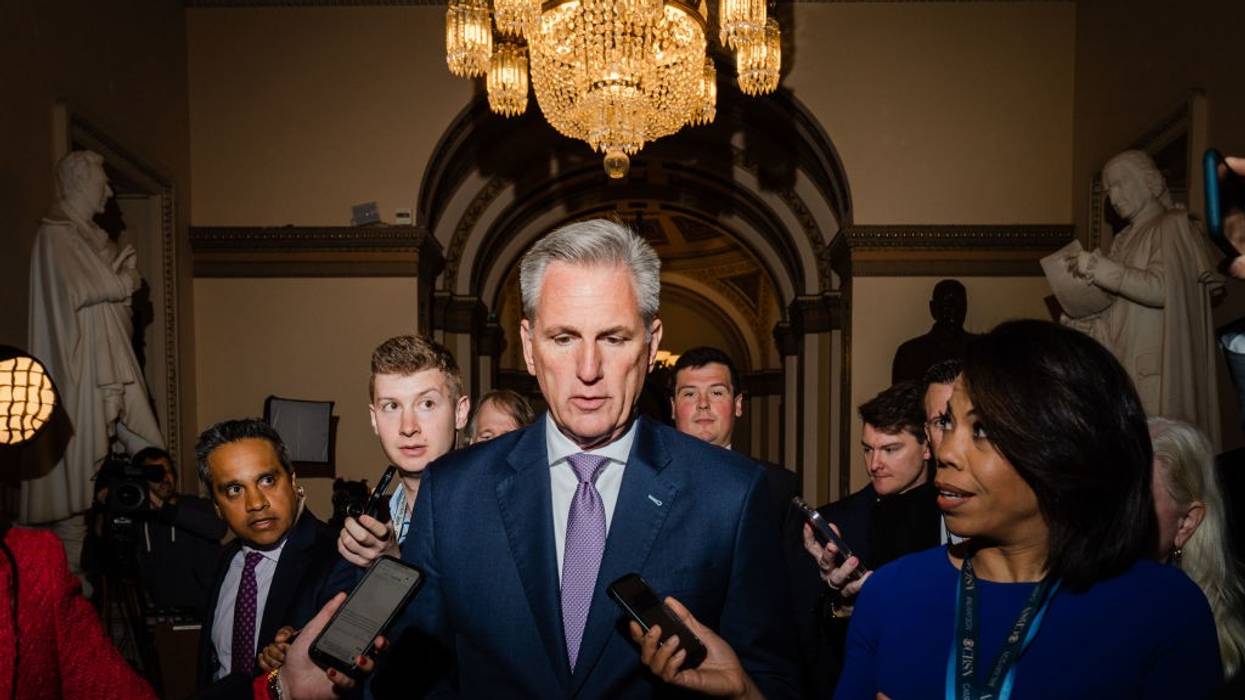
"In tax cuts in 2017 passed by the other side of the aisle, we see wonderful tax cuts for yacht owners and private jets," said Rep. Alexandria Ocasio-Cortez. "But in order to balance our budget now, we're talking about cuts to SNAP, to food out of babies' mouths."
Before House Speaker Kevin McCarthy opened debate Wednesday on a bill that would raise the nation's debt ceiling while gutting social programs and imposing more barriers to access them, nearly 200 House Democrats from across the ideological spectrum signed a letter imploring Republican deficit hawks to drop their demands and pass a clean hike.
Since Washington's arbitrary and arguably unconstitutional borrowing limit was breached in January, Treasury Secretary Janet Yellen has implemented "extraordinary measures" enabling the U.S. government to meet its financial obligations for a few additional months. Unless President Joe Biden's administration takes unilateral action to disarm the debt ceiling, Congress has until sometime between July and September to increase or suspend the federal borrowing cap. If Republicans refuse to do so, the U.S. is poised to suffer an unprecedented default that would have catastrophic impacts both domestically and globally.
Fully aware of the stakes, GOP lawmakers are holding the economy hostage in a bid to further weaken the nation's comparatively meager welfare state and its insufficient climate policies. Last week, McCarthy (R-Calif.) unveiled the so-called Limit, Save, Grow Act, which would raise the debt ceiling, but only in conjunction with measures to peg discretionary spending at fiscal year 2022 levels through 2033; establish new work requirements for Medicaid beneficiaries and expand work requirements for recipients of food aid and income support; force through a Big Oil-friendly energy package; repeal recently approved clean energy investments and Internal Revenue Service (IRS) funding; eliminate Biden's contested student debt cancellation plan; claw back unspent Covid-19 relief money; and require congressional approval before any major federal regulations can take effect.
Wednesday's letter—led by House Budget Committee Ranking Member Brendan Boyle (D-Pa.), Congressional Progressive Caucus (CPC) Chair Pramila Jayapal (D-Wash.), and New Democrat Coalition Chair Annie Kuster (D-N.H.)—calls on McCarthy to fulfill his duty to "uphold the full faith and credit" of the U.S. by "allowing prompt floor consideration of legislation to raise the debt ceiling without any extraneous policies attached."
House Democrats pointed out that "congressional Republicans voted to raise the debt ceiling without preconditions or crisis on three separate occasions" under former President Donald Trump and urged them "to do the same on this occasion."
Democratic lawmakers also reminded McCarthy—who recently described the national debt as "the greatest threat to our future"—that "congressional Republicans voted to pass the Tax Cuts and Jobs Act (TCJA) in 2017, which the Congressional Budget Office (CBO) estimated would increase the federal deficit by $1.9 trillion over 10 years, with 83% of the law's benefits estimated to accrue to the richest 1% by 2027."
Progressive Rep. Alexandria Ocasio-Cortez (D-N.Y.) recently contrasted GOP lawmakers' willingness to attack the poor and slash popular initiatives like Supplementary Nutrition Assistance Program (SNAP) with their previous support for the highly regressive and deeply unpopular TCJA, which corporations and the wealthy enthusiastically welcomed when Trump signed it into law.
"In tax cuts in 2017 passed by the other side of the aisle, we see wonderful tax cuts for yacht owners and private jets," said Ocasio-Cortez. "But in order to balance our budget now, we're talking about cuts to SNAP, to food out of babies' mouths, instead of actually reexamining the inequities within our tax system."
As the letter notes, "The first act of House Republicans in the 118th Congress... was passing legislation—which Democrats unanimously opposed—to rescind funding for IRS enforcement against tax evasion by wealthy individuals and large corporations. The CBO estimated that by reducing revenue, that legislation would increase the deficit by $114 billion over 10 years."
In addition to refusing to consider how creating a fairer tax code and cracking down on tax dodging would increase revenue, GOP lawmakers have shown little interest in shrinking the ever-expanding U.S. military budget.
Overall, the Limit, Save, Grow Act—heavily influenced by the far-right House Freedom Caucus' austerity blueprint—would reduce the federal deficit by roughly $4.8 trillion over 10 years, according to a CBO estimate published Tuesday.
But as journalist Bryce Covert observed, it's essential to remember that this meaningless achievement would be realized in part by taking away Medicaid and SNAP benefits from millions of people.
In a Wednesday blog post, Josh Bivens and Samantha Sanders of the Economic Policy Institute warned that if McCarthy's "deeply unrealistic spending cuts actually came to pass, the human toll would be enormous, and economic growth would be deeply damaged."
"The McCarthy proposal," they wrote, "also resurfaces a completely inaccurate but alarmingly persistent conservative claim: the idea that government anti-poverty programs are unnecessarily generous, bloated, and are keeping people out of the workforce who should otherwise be supporting themselves entirely through income earned in the labor market."
"The U.S. safety net is in serious need of reforms, but not because of inaccurate claims that its excess generosity keeps people out of work," they continued. "The biggest problem with the U.S. safety net is that our programs don't help as many people, or as effectively, as they should."
Echoing House Democrats, Bivens and Sanders derided McCarthy's claim that his proposal would put the U.S. on a path to "fiscal responsibility" and lower inflation as "laughable."
"The biggest driver of deficits for the last 20 years has been a steady trend toward ever-larger tax cuts for corporations and the richest U.S. households," the pair wrote. "No one who actually wants to reduce the federal deficit should be looking to do that on the backs of the poorest and most vulnerable Americans."
In their letter, House Democrats said that "instead of supporting an agenda of deficit-exploding tax cuts for the wealthiest individuals and corporations, we welcome an honest discussion regarding the federal budget that makes clear that the deficit is made up of revenues and investments and that sustainable fiscal solutions will ensure our revenues match the level of investments needed to maintain our economic growth and prosperity."
However, the CPC tweeted, "negotiations on what the government is spending its money on have a time and place—the yearly budget process."
"Republicans are welcome to try to get their extremist wish list met that way," the group added. "But that must happen separately from the threat of U.S. default."
The GOP cleared a key procedural hurdle on Wednesday afternoon when the House approved the rule governing debate on the Limit, Save, Grow Act in a 219-210 party-line vote. McCarthy is seeking to pass the legislation later on Wednesday.
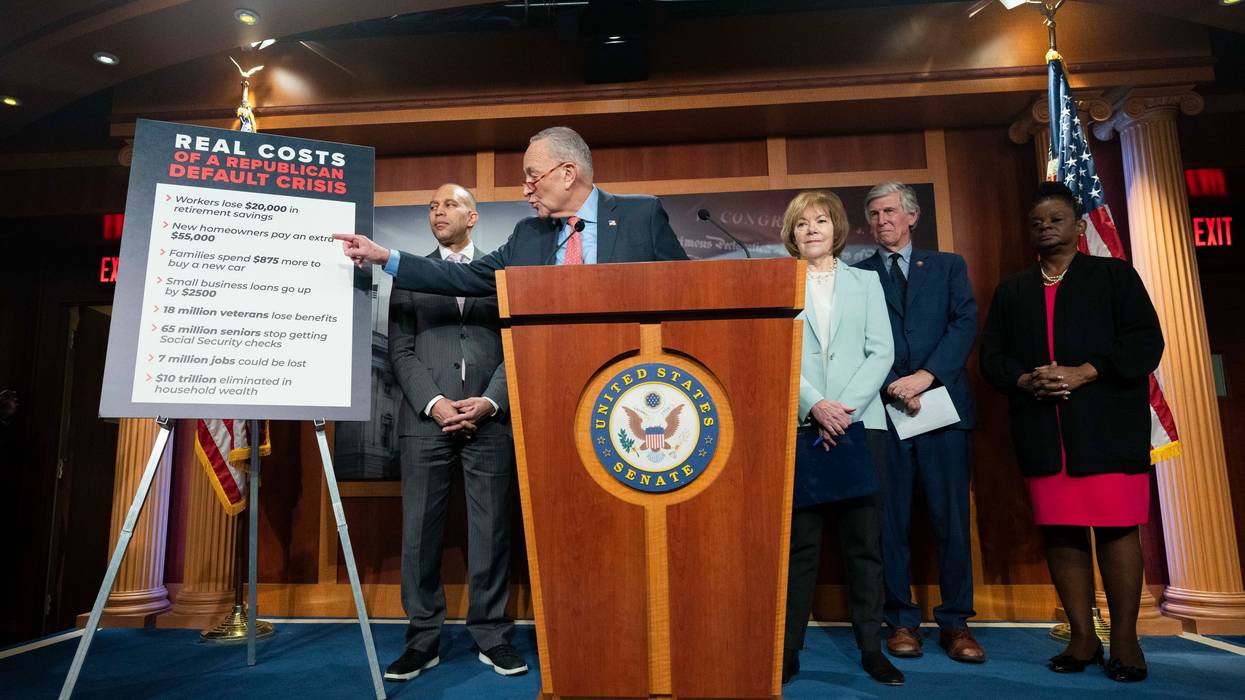
"House Republicans' approach is dangerous and destabilizing," warned Senate Majority Leader Chuck Schumer. "Republicans are gambling with Americans' savings, benefits, and lives, all to play a political game."
Congressional Democrats on Thursday forcefully called out their Republican colleagues for holding the economy hostage by refusing to raise the country's $31.4 trillion debt ceiling without major spending cuts, risking the first-ever U.S. default.
Democrats declined to even try to raise the nation's arbitrary and arguably unconstitutional borrowing limit while they still controlled both chambers of Congress during last year's lame-duck session, setting up the current fight. Because the ceiling has already been hit, Treasury Secretary Janet Yellen is now taking "extraordinary measures" to give lawmakers more time to act, but the deadline to do so looms, with a default possible as early as June, based on the latest federal estimates.
"This report shows that a Republican default crisis means real dollars coming out of American families' wallets and savings decimated."
Senate Majority Leader Chuck Schumer (D-N.Y.) and House Minority Leader Hakeem Jeffries (D-N.Y.) along with other key party members came together Thursday to unveil an alarming six-page Joint Economic Committee (JEC) Democratic staff report.
"This report shows that a Republican default crisis means real dollars coming out of American families' wallets and savings decimated. This is not a hypothetical exercise to the millions of Americans—including veterans and seniors—who rely on the United States government for benefits, pensions, and disability," Schumer said in a statement.
"House Republicans' approach is dangerous and destabilizing," he added. "Even the threat of a breach will raise costs on everything from car loans to mortgages. Republicans are gambling with Americans' savings, benefits, and lives, all to play a political game."
Specifically, according to the report, if the GOP forced a historic and "catastrophic" default:
"A decade ago credit rating agencies downgraded the U.S. credit rating after Republican debt limit brinkmanship, and it drove borrowing costs for the American people higher in a variety of ways," noted Rep. Don Beyer (D-Va.). "This Joint Economic Committee report quantifies what kind of damage regular people could see if that happens again, and it is very bad."
"This would affect everyone who borrows money, including the United States government, which would have to pay more in its borrowing costs," he explained. "In other words, Republican hostage-taking on the debt limit would actually increase the deficit."
Beyer, Schumer, and Jeffries were joined at the news conference Thursday by Rep. Gwen Moore (D-Wis.) as well as Sens. Tina Smith (D-Minn.) and Martin Heinrich (D-N.M.), the JEC chairman-designate, who stressed that "the debt ceiling is not a bargaining chip."
While several of them slammed "MAGA Republican in the House," 71-year-old Moore chose to describe the GOP lawmakers whose actions are jeopardizing not only the U.S. but also the global economy another way.
"I have a great-granddaughter that falls out and rolls on the floor when she can't have her way. I tell her she needs to get up because she's not gonna get it," Moore said. "Republicans need to get up and stop holding our economy hostage."
"We are not going to devastate our seniors and our children, and we will not sabotage the world's standard credit rating," the congresswoman declared. "Republicans need to get up off the ground and raise the debt limit!"
Adding to concerns about the U.S. and global economies are recent bank turmoil and repeated interest rate hikes by the Federal Reserve—which, along with Congress, is facing criticism for regulatory rollbacks that experts tie to the bank failures.
As Punchbowl News reported Wednesday:
Instead of expressing caution, senior GOP lawmakers are leaning into their plans to demand spending cuts in return for raising the nation's borrowing limit. The Republicans we spoke to doubled down, arguing the same factors that led to the failure of Silicon Valley Bank and Signature Bank necessitate urgency in reducing government spending.
"This is the best time to do it," House Budget Committee Chair Jodey Arrington (R-Texas) said of the debt limit fight. "That interest rate pressure that is creating some risk in the banking industry is a result of the inflation that has been induced by the massive amounts of spending."
[...]
Arrington's panel will play a central role in the Republican posture heading into negotiations with President Joe Biden. While House Republicans have yet to release their budget, GOP leaders have vowed to roll back spending to FY2022 levels. That would mean a cut of roughly $130 billion from last year's funding level. Democrats and the White House have assailed the plan as an attack on working families, seniors, and veterans, while Republicans insist the cuts are necessary to rein in inflation.
The Texas Republican said it "makes sense that when you have a debt ceiling negotiation," lawmakers would "reflect on the indebtedness of our country" and look to cut spending at the same time.
Punchbowl noted similar remarks this week from Reps. Carlos Gimenez (R-Fla.) and John Rose (R-Tenn.) along with GOP Conference Secretary Lisa McClain.
Biden introduced his budget blueprint for FY2024 earlier this month. Though progressives condemned the president's historically high request for military spending as "madness" they also praised his push for massive social investments as well as tax hikes targeting wealthy individuals and corporations.
Meanwhile, "House Republican leaders did not respond to multiple questions from USA TODAY about when the GOP budget would be ready," the newspaper reported Wednesday.
As USA TODAY detailed:
An initial proposal from the House Budget Committee includes cuts to the Environmental Protection Agency, Biden's student debt cancellation, and funding for electric vehicles for the U.S. post office.
It also includes reinstating work requirements to the Temporary Assistance for Needy Families and the Supplemental Nutrition Assistance Program, or SNAP.
A proposal from the House Freedom Caucus includes $131 billion in cuts for fiscal year 2024.
"Extreme MAGA House Republicans are showing us what they value: tax breaks for the rich," Biden said of the caucus' proposal. "They demand the biggest Medicare benefits cut in decades, ship jobs overseas, defund law enforcement, devastate our national and border security. It's a gut punch to the middle class."
As Liz Zelnick from the watchdog Accountable.US warned, "The MAGA extremists running the House fully intend to manufacture a disastrous default crisis by making demands they know to be nonstarters—like letting wealthy tax cheats and big polluters off the hook."

This is a proposed pathway to counteract the Republican Party's economic terrorism.
This is a proposal to the Biden administration on how it might get the debt ceiling law declared unconstitutional by a federal court before the likely default date in June.
It's not hyperbolic to say that congressional Republicans are engaging in economic terrorism. They've taken the U.S. and global economy hostage and threatened to shoot it if President Joe Biden doesn't pay a ransom of cutting spending that Congress has already appropriated. Even if Biden wanted to negotiate with these terrorists, he wouldn't know how, since they won't even specify what the ransom is or what cuts would satisfy them. And that's because if they do specify the ransom, to be meaningful it would be politically unpopular because it would have to cut popular domestic programs—including Social Security and Medicare--and defund part of the military to make a material difference to the national debt.
Biden has rightly said that he won't negotiate with the hostage-takers. But the Republicans have become even more reckless and extremist than in past debt ceiling crises and seem prepared to send the global economy over the financial cliff. In contrast, Biden and congressional Democrats care about a functioning government and the national economy, so when it comes close to "D[efault]-Day," there's a real danger they'll cave and pay a ransom that would hurt ordinary Americans and encourage future hostage-taking.
The best strategy is to get a federal court to declare the debt ceiling unconstitutional and for the administration to issue new debt as necessary to pay the government's bills. Over the past week, I've been in dialogue with some of the country's most respected constitutional scholars including Laurence Tribe, Erwin Chermerinsky, Neil H. Buchanan, and Michael Dorf. They all agree that the debt ceiling law is unconstitutional.
As a matter of Constitutional law, the president has the right to prevent the Republican Congress from questioning the national debt and to issue new bonds to prevent default.
Even Professor Tribe, who during the 2011 debt ceiling stand-off between President Obama and Speaker Biden was skeptical that the Constitution provided an off-ramp, has now written to me directly that he's "long since rethought and revised" this view. He tweeted: "Some of history's greatest lessons echo the words of Amazing Grace: 'We once were blind but now we see.'" In another tweet, he eviscerated the constitutionality of the debt ceiling law: "The debt ceiling is a misnomer: it does nothing to cap spending but just creates and illusory threat to stiff our creditors. That's because Section 4 of the 14th Amendment forbids defaulting on the nation's debts."
Section 4 of the 14th Amendment states in plain language: "The validity of the public debt of the United States, authorized by law, including debts incurred for payment of pensions and bounties for services in suppressing insurrection or rebellion, shall not be questioned."
As Professor Eric Foner, America's leading historian of Reconstruction, has argued in the New York Times, the original intent of this Amendment was to prevent former insurrectionist Confederate leaders who might be elected to Congress from repudiating all or part of the Federal government's debt from the Civil War while honoring the Confederate debt (which was specifically prohibited.)
As Foner writes, "the amendment's language is mandatory, not permissive — the validity of the public debt 'shall not be questioned.' Today, over a century and a half after the amendment's ratification, this promise is no longer considered an 'extraordinary guarantee'; it is an essential attribute of a modern economy."
In its only decision regarding this constitutional clause, Perry v. United States (1935) the Supreme Court stated: "While this provision was undoubtedly inspired by the desire to put beyond question the obligations of the Government issued during the Civil War, its language indicates a broader connotation. We regard it as confirmatory of a fundamental principle, which applies as well to the government bonds in question, and to others duly authorized by the Congress, as to those issued before the Amendment was adopted. Nor can we perceive any reason for not considering the expression 'the validity of the public debt' as embracing what- ever concerns the integrity of the public obligations." (emphasis added)
The question is: How can President Biden implement this Constitutional mandate and issue new debt to meet the government's financial obligations if the default date is reached and Congressional Republicans refuse to raise the debt ceiling, thrusting the national and global economy into a profound crisis?
Foner proposes that "if the current House of Representatives abdicates this responsibility, throwing the nation into default by refusing to raise the debt limit, President Biden should act on his own, taking steps to ensure that the federal government meets its financial obligations, as the Constitution requires."
As a matter of Constitutional law, the president has the right to prevent the Republican Congress from questioning the national debt and to issue new bonds to prevent default. In 2011, former President Bill Clinton advised then President Barack Obama to use his constitutional powers to raise the nation's legal borrowing limit on his own if he had to and "force the courts to stop [him']" in order to prevent the United States from defaulting on its debt obligations for the first time in history. Obama instead sent then-Vice-President Biden to negotiate a deal with then-House Speaker Boehner that hamstrung the federal budget and slowed recovery from the 2008 financial crisis.
In any case, while legally correct, the problem with this strategy is that financial markets would likely reject these bonds, or require much higher interest rates because they would be deterred by the risk that the Supreme Court could conceivably overturn the President's action in the future. In the end, a financial crisis would occur anyway.
The only way to avoid this is to get a ruling from a federal court that the debt ceiling law is unconstitutional before the drop-dead date.
Ideally, the Biden administration would file an emergency petition with the Supreme Court asking SCOTUS for a declaratory judgement that debt ceiling law is unconstitutional. Unfortunately, there is no constitutional procedure to ask SCOTUS directly for a ruling since the administration wouldn't be suing anyone in particular and there would be no case in controversy with an actual opposing party so the case wouldn't fall under SCOTUS's Article III original jurisdiction.
So here's an alternative strategy to get the issue into federal court before the drop-dead date: President Biden and Treasury Secretary Yellen should publicly announce now that they plan to continue issuing new Treasury bonds in the normal course in the amounts and on the schedule that debt becomes due despite extraordinary measures. Republicans would almost certainly find a party to sue the administration in federal court to block these plans.
There would then be an actual case in controversy that courts could adjudicate. There is a chance that a court could find that the Republican plaintiff lacks standing to bring the case. But standing can be a malleable standard and courts often bend over backward to grant standing when they really want to hear a case. As legal commentator Mark Joseph Stern has previously argued in Slate, "certain key circuit courts and the Supreme Court seem to follow one standing rule: When a majority wants to decide a case on the merits, they find some justification to grant standing; when it doesn't, they don't." The Republicans would probably forum shop for a district court—say in Texas—that would accept the case. If that court issued a ruling against the administration, the administration could then file a petition with SCOTUS for an emergency appeal.
There is, of course, no guarantee that a lower federal court or SCOTUS would rule in the administration's favor. While they call themselves "textualists" and "originalists" the right-wing Supreme Court majority is increasingly results-oriented and finds whatever text or historical meaning they can conjure up to rule the way they want to. But it's at least possible that even this right-wing court wouldn't be aligned with House Republicans in allowing a default on the national debt. As argued above, the text of the 14th Amendment is quite clear-: "The validity of the public debt of the United States, authorized by law… shall not be questioned." And as leading historian Eric Foner explained, the original intent of the Amendment was "mandatory" and prohibited the questioning of all legally authorized federal debt.
And perhaps the Justices' own self-interest would incline at least two of the conservatives to join with the liberals in finding the debt ceiling unconstitutional. After all, the Justices all have investment portfolios and their salaries and pensions are paid by Treasury, all of which would be jeopardized by a default.
If, as it should, a federal court ruled before the drop debt date that the debt ceiling is unconstitutional, it would end once and for all the charade of a potential government default which would jeopardize the national and global economy. And even if the court ruled to the contrary, we would be no worse off than present, when markets assume the debt ceiling is legal and Biden will avoid default by making a deal with McCarthy.
What's to lose by the Biden administration giving this strategy a try?

"The debt limit must be cleanly raised to avoid default and ensure the continuation of funding for the government and critical programs," the AFGE president told lawmakers.
The largest union of federal workers in the U.S. urged Congress this week to raise the debt ceiling without mandating reductions in social spending, arguing that President Joe Biden is right to reject the GOP's attempt to use the nation's borrowing limit as leverage to force through devastating cuts.
"The debt limit must be cleanly raised to avoid default and ensure the continuation of funding for the government and critical programs like Social Security, Medicare, veterans' benefits, and the U.S. military," Everett Kelley, president of the American Federation of Government Employees (AFGE), wrote in a letter sent to every member of Congress on Monday. "No negotiation that puts these programs or any aspect of federal employee compensation at risk should be considered."
Several House Republicans are threatening to block the lifting of the country's borrowing cap—an arbitrary and arguably unconstitutional figure set by Congress—unless Democrats agree to slash government spending, including on vital social programs
Notably, Capitol Hill's deficit hawks oppose reducing the Pentagon's ever-growing budget and rescinding former President Donald Trump's tax cuts for the wealthy.
The U.S. government's outstanding debt officially hit the statutory limit of $31.4 trillion last Thursday, at which point the Treasury Department started repurposing federal funds.
Treasury Secretary Janet Yellen recently told congressional leaders that "the use of extraordinary measures enables the government to meet its obligations for only a limited amount of time," possibly through early June. She implored Congress to "act in a timely manner to increase or suspend the debt limit," warning that "failure to meet the government's obligations would cause irreparable harm to the U.S. economy, the livelihoods of all Americans, and global financial stability."
A 2011 debt ceiling standoff enabled the GOP to impose austerity and led to a historic downgrading of the U.S. government's credit rating, but the country has never defaulted on its debt. Economists warn that doing so would likely trigger chaos in financial markets, resulting in millions of job losses and the elimination of $15 trillion in wealth.
Aware that an economic calamity is at stake, many Republican lawmakers "have announced that they will not support an increase in the debt ceiling without concomitant reductions in spending, possibly in the form of reductions to Social Security, Medicare, and Medicaid," Kelley wrote in the letter sent earlier this week.
"The White House says it will not negotiate such an arrangement," he added. "AFGE strongly supports the administration's refusal to negotiate on this matter."
"No negotiation that puts these programs or any aspect of federal employee compensation at risk should be considered."
In a Wednesday speech from the floor of the upper chamber, Senate Majority Leader Chuck Schumer (D-N.Y.) criticized "the House GOP's reckless approach to the debt ceiling" and challenged Speaker Kevin McCarthy (R-Calif.) "to level with the American people" on which popular programs his party wants to cut.
"The debt ceiling is a subject of the highest consequence, and using it as a bargaining chip, using it as brinkmanship, as hostage-taking, as Republicans are trying to do is exceedingly dangerous," said Schumer.
"If the House of Representatives continues on [its] current course and allows the United States to default on its debt obligations, every single American is going to pay a terrible and expensive price," Schumer continued. "The consequences of default are not some theoretical abstraction; if default happens, Americans will see the consequences in their daily lives."
"Interest rates will go soaring on everything from credit cards, and student loans, to cars, mortgages, and more," he added. "That's thousands of dollars for each American going right out the door, and it will happen through no fault of their own."
As many observers pointed out repeatedly in the wake of the midterm elections, Democrats had the power to prevent this high-risk game of brinkmanship altogether by raising the debt ceiling—or abolishing it completely—when they still controlled both chambers of Congress.
Despite ample warnings from Sen. Elizabeth Warren (D-Mass.) and other progressive lawmakers and advocacy groups, conservative Democrats refused to take unilateral action during the lame-duck session.
On Wednesday, Schumer pleaded with GOP lawmakers to simply raise the debt ceiling without demanding policy concessions in exchange.
"I'd remind my Republican colleagues that they did it before when Trump was president three times; no Democratic obstruction or hostage-taking," said Schumer. "We did it once together when Biden was president. And much of this debt comes from spending when Trump was president, voted on by a Republican House and a Republican Senate."
"It's a bit of hypocrisy now to say that they can't do it again, and they are holding it hostage and are playing a dangerous form of brinksmanship," Schumer argued. "It shouldn't matter who is president. It's still bills we already incurred that must be paid for the good of all Americans."
As new controversial metadata laws took effect in Australia on Tuesday, whistleblower Edward Snowden took to Twitter to warn the country's residents about the privacy violations accompanying the legislation.
The new laws require Australian telecommunications companies and internet service providers (ISPs) to store user metadata--like phone records and IP addresses--for two years. During this time, it may be accessed by law enforcement without a warrant. Civil liberties and internet freedom groups have criticized the laws as invasive and unconstitutional.
"Beginning today, if you are Australian, everything you do online has been tracked, stored, and retained for 2 years," Snowden wrote, linking to a campaign by the advocacy group GetUp! that gave instructions on how to circumvent the data retention scheme.
The laws are "costly, ineffective, and against the public interest," GetUp! wrote in its campaign.
According to (pdf) the Australian Privacy Foundation, an internet advocacy group and a subsidiary of Privacy International, the laws require telecoms to maintain, at a minimum:
After a similar metadata dragnet was attempted in Germany, it was deemed unconstitutional in 2010. Further, the German Parliament's Working Group on Data Retention published a study in 2011 that concluded that Germany's similar metadata dragnet, which had been found unconstitutional in 2010, had resulted in a .006 percent increase in crime clearance rates--a "marginal" boost that showed "the relationship between ends and means is disproportionate."
And yet, the Australian government, led by newly installed Prime Minister Malcolm Turnbull, "says it has taken into account suggestions made by courts overseas that have overturned the legislation," writes Sydney Morning Herald technology editor Ben Grubb.
To counter the invasive new laws, GetUp! and other civil liberties groups recommend that users install privacy software on their phones and computers, such as encrypted messaging apps, secure browsers like Tor, or a virtual private network (VPN).
"Go dark against data retention," the group states. "Absurdly, the flawed legislation leaves open numerous loopholes, which can be used to evade the data retention. This means the data retention dragnet will capture the data of innocent Australians and cost millions of dollars while allowing those who don't want to be caught to remain hidden."