SUBSCRIBE TO OUR FREE NEWSLETTER
Daily news & progressive opinion—funded by the people, not the corporations—delivered straight to your inbox.
5
#000000
#FFFFFF
To donate by check, phone, or other method, see our More Ways to Give page.
Daily news & progressive opinion—funded by the people, not the corporations—delivered straight to your inbox.
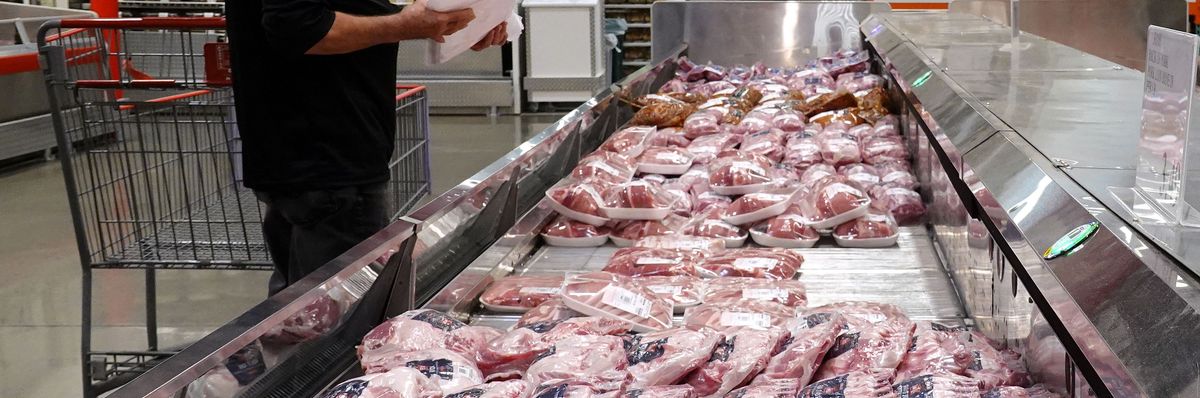
A customer shops for meat at a Costco store on November 11, 2025, in Novato, California.
“The next time you go to a restaurant and then uncontrollably vomit and diarrhea in your pants, you should send a note of thanks to the Republican and Democratic senators,” said David Sirota, founder of The Lever.
While the Republican and Democratic senators who passed this week’s emergency funding bill to reopen the government took heat for their failure to provide a solution to rising health insurance premiums, they also slipped other provisions under the radar that will likely harm Americans’ health.
As The Lever reported Tuesday, senators inserted language into the bill that would gut food safety regulations that prevent illness and death, as well as regulations on ultraprocessed foods.
The changes come “amid a lobbying blitz and a flood of campaign cash” from the food and restaurant industries which have spent more than $13 million lobbying the White House, Congress, and the Food and Drug Administration (FDA) this year.
Amid a surge of product recalls for bacteria like Listeria, Salmonella, and E. coli, the number of dangerous cases of foodborne illness doubled last year, according to the Public Interest Network. These illnesses annually result in around 53,000 hospitalizations and 900 deaths, according to a report from the Government Accountability Office.
Nevertheless, The Lever reports that the “new funding bill blocks federal rules designed to trace sources of outbreaks, and to prevent contamination of produce.” One provision bans the use of funds to administer or enforce the FDA’s "Requirements for Additional Traceability Records for Certain Foods," published in November 2022.
That traceability rule, The Lever notes, is “aimed to establish new record-keeping standards for companies to track their food products across the supply chain. Those records could help regulators identify the point of origin in the event of a major disease outbreak or food contamination event. The rule applied to produce, seafood, and certain dairy products, such as cheese, and exempted small businesses from the rule.”
The rule was initially proposed by the Trump administration during the Covid-19 pandemic, and enacted in 2023 by the Biden administration over aggressive opposition from industry groups. But after Trump’s return to office this year, they began a multimillion-dollar effort to lobby Congress to repeal the measure.
The National Restaurant Association spent nearly $2.5 million to lobby lawmakers to eliminate the rule, while the International Foodservice Distributors Association spent more than $600,000. In August, the Trump FDA proposed a rule to delay the traceability standards until 2028.
As The Lever explains: “The line inserted on page 154 of the new funding package contains identical language as the federal rule and would enshrine it into law.”
Two groups that have lobbied aggressively for deregulation of food tracking, the National Restaurant Association and the National Grocers Association, donated more than $750,000 to both parties’ congressional candidates and more than $145,000 to the two parties’ congressional election committees in the last election.
And they gave a combined $17,000 to three of the seven Democrats who joined Republicans in backing the bill—Sens. Jacky Rosen (D-Nev.), Tim Kaine (D-Va.), and Dick Durbin (D-Ill.).
“The next time you go to a restaurant and then uncontrollably vomit and diarrhea in your pants, you should send a note of thanks to the Republican and Democratic senators who helped their campaign donors slip this language into their legislation to reopen the government,” wrote The Lever’s founder, David Sirota, on social media.
The traceability rule is one of several regulations the bill, which is expected to come up for a vote in the House on Wednesday, would gut. It also requires that none of the bill’s funds go toward enforcing a 2015 FDA rule requiring stricter inspections of wine grapes, hops, almonds, and certain other crops.
It also axes funds for the FDA to establish new regulations to limit the public’s high intake of sodium, which is commonly found in highly processed foods. The effort to gut these regulations notably flies in the face of Health and Human Services Secretary Robert F. Kennedy, Jr.’s so-called “Make America Healthy” initiative.
Kennedy’s “MAHA” report, released in May, explicitly called for guidelines “that emphasize unprocessed foods while strictly limiting high-fat, high-sugar, and high-sodium processed items.”
“The most MAGA thing ever is embracing the so-called MAHA movement and then quietly gutting food safety regulations and research into ultra-processed foods,” said Neal Kwatra, the founder of the New York-based progressive group Metropolitan Public Strategies. “Just previously unseen levels of gaslighting on politics vs. actual policy.”
But Democrats allowed the measure to pass, too. For this, Melanie D’Arrigo, the executive director of the Campaign for New York Health, blamed the overwhelming power of corporate money.
“As long as corporations and billionaires are legally allowed to pay off politicians, we will never have a government that works for us,” she said.
Dear Common Dreams reader, It’s been nearly 30 years since I co-founded Common Dreams with my late wife, Lina Newhouser. We had the radical notion that journalism should serve the public good, not corporate profits. It was clear to us from the outset what it would take to build such a project. No paid advertisements. No corporate sponsors. No millionaire publisher telling us what to think or do. Many people said we wouldn't last a year, but we proved those doubters wrong. Together with a tremendous team of journalists and dedicated staff, we built an independent media outlet free from the constraints of profits and corporate control. Our mission has always been simple: To inform. To inspire. To ignite change for the common good. Building Common Dreams was not easy. Our survival was never guaranteed. When you take on the most powerful forces—Wall Street greed, fossil fuel industry destruction, Big Tech lobbyists, and uber-rich oligarchs who have spent billions upon billions rigging the economy and democracy in their favor—the only bulwark you have is supporters who believe in your work. But here’s the urgent message from me today. It's never been this bad out there. And it's never been this hard to keep us going. At the very moment Common Dreams is most needed, the threats we face are intensifying. We need your support now more than ever. We don't accept corporate advertising and never will. We don't have a paywall because we don't think people should be blocked from critical news based on their ability to pay. Everything we do is funded by the donations of readers like you. When everyone does the little they can afford, we are strong. But if that support retreats or dries up, so do we. Will you donate now to make sure Common Dreams not only survives but thrives? —Craig Brown, Co-founder |
While the Republican and Democratic senators who passed this week’s emergency funding bill to reopen the government took heat for their failure to provide a solution to rising health insurance premiums, they also slipped other provisions under the radar that will likely harm Americans’ health.
As The Lever reported Tuesday, senators inserted language into the bill that would gut food safety regulations that prevent illness and death, as well as regulations on ultraprocessed foods.
The changes come “amid a lobbying blitz and a flood of campaign cash” from the food and restaurant industries which have spent more than $13 million lobbying the White House, Congress, and the Food and Drug Administration (FDA) this year.
Amid a surge of product recalls for bacteria like Listeria, Salmonella, and E. coli, the number of dangerous cases of foodborne illness doubled last year, according to the Public Interest Network. These illnesses annually result in around 53,000 hospitalizations and 900 deaths, according to a report from the Government Accountability Office.
Nevertheless, The Lever reports that the “new funding bill blocks federal rules designed to trace sources of outbreaks, and to prevent contamination of produce.” One provision bans the use of funds to administer or enforce the FDA’s "Requirements for Additional Traceability Records for Certain Foods," published in November 2022.
That traceability rule, The Lever notes, is “aimed to establish new record-keeping standards for companies to track their food products across the supply chain. Those records could help regulators identify the point of origin in the event of a major disease outbreak or food contamination event. The rule applied to produce, seafood, and certain dairy products, such as cheese, and exempted small businesses from the rule.”
The rule was initially proposed by the Trump administration during the Covid-19 pandemic, and enacted in 2023 by the Biden administration over aggressive opposition from industry groups. But after Trump’s return to office this year, they began a multimillion-dollar effort to lobby Congress to repeal the measure.
The National Restaurant Association spent nearly $2.5 million to lobby lawmakers to eliminate the rule, while the International Foodservice Distributors Association spent more than $600,000. In August, the Trump FDA proposed a rule to delay the traceability standards until 2028.
As The Lever explains: “The line inserted on page 154 of the new funding package contains identical language as the federal rule and would enshrine it into law.”
Two groups that have lobbied aggressively for deregulation of food tracking, the National Restaurant Association and the National Grocers Association, donated more than $750,000 to both parties’ congressional candidates and more than $145,000 to the two parties’ congressional election committees in the last election.
And they gave a combined $17,000 to three of the seven Democrats who joined Republicans in backing the bill—Sens. Jacky Rosen (D-Nev.), Tim Kaine (D-Va.), and Dick Durbin (D-Ill.).
“The next time you go to a restaurant and then uncontrollably vomit and diarrhea in your pants, you should send a note of thanks to the Republican and Democratic senators who helped their campaign donors slip this language into their legislation to reopen the government,” wrote The Lever’s founder, David Sirota, on social media.
The traceability rule is one of several regulations the bill, which is expected to come up for a vote in the House on Wednesday, would gut. It also requires that none of the bill’s funds go toward enforcing a 2015 FDA rule requiring stricter inspections of wine grapes, hops, almonds, and certain other crops.
It also axes funds for the FDA to establish new regulations to limit the public’s high intake of sodium, which is commonly found in highly processed foods. The effort to gut these regulations notably flies in the face of Health and Human Services Secretary Robert F. Kennedy, Jr.’s so-called “Make America Healthy” initiative.
Kennedy’s “MAHA” report, released in May, explicitly called for guidelines “that emphasize unprocessed foods while strictly limiting high-fat, high-sugar, and high-sodium processed items.”
“The most MAGA thing ever is embracing the so-called MAHA movement and then quietly gutting food safety regulations and research into ultra-processed foods,” said Neal Kwatra, the founder of the New York-based progressive group Metropolitan Public Strategies. “Just previously unseen levels of gaslighting on politics vs. actual policy.”
But Democrats allowed the measure to pass, too. For this, Melanie D’Arrigo, the executive director of the Campaign for New York Health, blamed the overwhelming power of corporate money.
“As long as corporations and billionaires are legally allowed to pay off politicians, we will never have a government that works for us,” she said.
While the Republican and Democratic senators who passed this week’s emergency funding bill to reopen the government took heat for their failure to provide a solution to rising health insurance premiums, they also slipped other provisions under the radar that will likely harm Americans’ health.
As The Lever reported Tuesday, senators inserted language into the bill that would gut food safety regulations that prevent illness and death, as well as regulations on ultraprocessed foods.
The changes come “amid a lobbying blitz and a flood of campaign cash” from the food and restaurant industries which have spent more than $13 million lobbying the White House, Congress, and the Food and Drug Administration (FDA) this year.
Amid a surge of product recalls for bacteria like Listeria, Salmonella, and E. coli, the number of dangerous cases of foodborne illness doubled last year, according to the Public Interest Network. These illnesses annually result in around 53,000 hospitalizations and 900 deaths, according to a report from the Government Accountability Office.
Nevertheless, The Lever reports that the “new funding bill blocks federal rules designed to trace sources of outbreaks, and to prevent contamination of produce.” One provision bans the use of funds to administer or enforce the FDA’s "Requirements for Additional Traceability Records for Certain Foods," published in November 2022.
That traceability rule, The Lever notes, is “aimed to establish new record-keeping standards for companies to track their food products across the supply chain. Those records could help regulators identify the point of origin in the event of a major disease outbreak or food contamination event. The rule applied to produce, seafood, and certain dairy products, such as cheese, and exempted small businesses from the rule.”
The rule was initially proposed by the Trump administration during the Covid-19 pandemic, and enacted in 2023 by the Biden administration over aggressive opposition from industry groups. But after Trump’s return to office this year, they began a multimillion-dollar effort to lobby Congress to repeal the measure.
The National Restaurant Association spent nearly $2.5 million to lobby lawmakers to eliminate the rule, while the International Foodservice Distributors Association spent more than $600,000. In August, the Trump FDA proposed a rule to delay the traceability standards until 2028.
As The Lever explains: “The line inserted on page 154 of the new funding package contains identical language as the federal rule and would enshrine it into law.”
Two groups that have lobbied aggressively for deregulation of food tracking, the National Restaurant Association and the National Grocers Association, donated more than $750,000 to both parties’ congressional candidates and more than $145,000 to the two parties’ congressional election committees in the last election.
And they gave a combined $17,000 to three of the seven Democrats who joined Republicans in backing the bill—Sens. Jacky Rosen (D-Nev.), Tim Kaine (D-Va.), and Dick Durbin (D-Ill.).
“The next time you go to a restaurant and then uncontrollably vomit and diarrhea in your pants, you should send a note of thanks to the Republican and Democratic senators who helped their campaign donors slip this language into their legislation to reopen the government,” wrote The Lever’s founder, David Sirota, on social media.
The traceability rule is one of several regulations the bill, which is expected to come up for a vote in the House on Wednesday, would gut. It also requires that none of the bill’s funds go toward enforcing a 2015 FDA rule requiring stricter inspections of wine grapes, hops, almonds, and certain other crops.
It also axes funds for the FDA to establish new regulations to limit the public’s high intake of sodium, which is commonly found in highly processed foods. The effort to gut these regulations notably flies in the face of Health and Human Services Secretary Robert F. Kennedy, Jr.’s so-called “Make America Healthy” initiative.
Kennedy’s “MAHA” report, released in May, explicitly called for guidelines “that emphasize unprocessed foods while strictly limiting high-fat, high-sugar, and high-sodium processed items.”
“The most MAGA thing ever is embracing the so-called MAHA movement and then quietly gutting food safety regulations and research into ultra-processed foods,” said Neal Kwatra, the founder of the New York-based progressive group Metropolitan Public Strategies. “Just previously unseen levels of gaslighting on politics vs. actual policy.”
But Democrats allowed the measure to pass, too. For this, Melanie D’Arrigo, the executive director of the Campaign for New York Health, blamed the overwhelming power of corporate money.
“As long as corporations and billionaires are legally allowed to pay off politicians, we will never have a government that works for us,” she said.