

SUBSCRIBE TO OUR FREE NEWSLETTER
Daily news & progressive opinion—funded by the people, not the corporations—delivered straight to your inbox.
5
#000000
#FFFFFF
To donate by check, phone, or other method, see our More Ways to Give page.
Daily news & progressive opinion—funded by the people, not the corporations—delivered straight to your inbox.
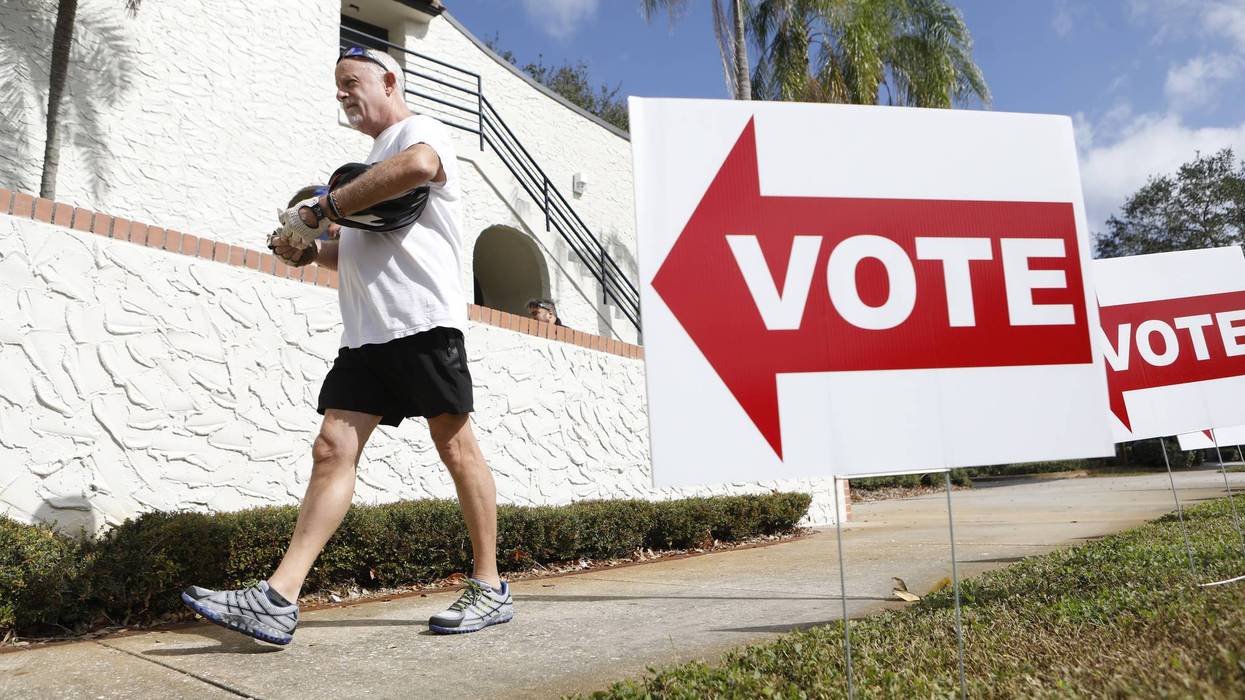
If and when other states replicate Florida’s hardball tactics against ballot measures, it would represent the greatest threat to direct democracy in years.
In February, the Florida Department of State determined that no citizen-initiated measures qualified for the Florida 2026 general election ballot. This was not an accident. This outcome is the culmination of a multi-year, multi-pronged attack on the ballot measure process in Florida, with the most draconian blow coming last May.
On May 2, 2025, the Florida legislature passed House Bill 1205, a law that restricts, criminalizes, and penalizes ballot initiative efforts in Florida. HB 1205 is a direct assault on Florida’s citizen-led constitutional amendment process—imposing vague, burdensome, and punitive restrictions that threaten to chill core political speech and discourage civic participation. Although there are several insidious provisions in this law—severe petition-related fines and penalties, restrictive circulation periods, and burdensome petition circulation training obligations, including for volunteers—one of the most damaging provisions only revealed its true nature weeks after the law went into effect.
Unique to the Florida ballot measure process, statewide initiative proponents are obligated to pay a verification fee for each petition they submit. Prior to HB 1205, the cost averaged about 87 cents per petition. On its face, this obligation was already unconstitutional. However, HB 1205 went even further, redefining the “actual cost” of signature verification and authorizing county supervisors to calculate the new per-petition cost, and begin collecting it from statewide ballot initiatives.
Starting on June 30, 2025, the county supervisors began posting their increased signature verification rates. Many newly posted fees are dramatically higher. For example, Lee County raised fees from $0.95 to $4.40 per petition, a 363% increase, while Gilchrist County raised fees from $0.10 to $2.77 per petition, a 2,670% increase. On average, Florida’s three largest counties increased fees to more than $3.77 per signature. As a result, it will now cost sponsors millions of dollars to verify enough petitions to qualify for the ballot. By comparison, no other state even comes close—the largest filing fee we are aware of is Montana’s fee of $3,700, which a court promptly struck down as unconstitutional under state law.
If the regressive policies of HB 1205 are left unchecked, other states will immediately adopt the same types of policies.
There is no question that Florida has been a breeding ground for bad legislation in recent years. Just to name a few—in 2005, Florida passed the first “stand your ground” law. Florida was one of the first states to ban “critical race theory” from its classrooms and was the first state to ban the AP African American studies course. Attacks on the ballot measure process have escalated in recent years, and there is no question that state legislatures look to one another for novel ideas to make the ballot measure process more restrictive. Once a restrictive policy is seen as permissible in one state, other states move quickly to adopt it for themselves. For instance, several states have tried to increase their ballot measure passage thresholds after Florida increased its threshold to 60%. Likewise, geographic circulation requirements, circulator registration and reporting obligations, and circulator payment restrictions have spread like wildfire across Republican-controlled states. Without a doubt, if the regressive policies of HB 1205 are left unchecked, other states will immediately adopt the same types of policies.
And yet, there is still hope. After HB 1205 passed last year, Florida Decides Healthcare, the Medicaid expansion initiative campaign, immediately filed a lawsuit in federal court arguing that HB 1205 is a direct assault on Florida’s citizen-led ballot measure process. That case went to trial on February 9, where the State attempted to defend its restrictions. If HB 1205 is allowed to stand, it will be prohibitively expensive for any initiative to get on the ballot in Florida. If and when other states replicate Florida’s hardball tactics against ballot measures, it would represent the greatest threat to direct democracy in years. Democracy advocates around the country should watch this trial closely, and we should all applaud Florida Decides Healthcare for standing up for their direct democracy rights.
"The gridlock and partisanship we see in Washington, DC can be dispiriting. But history shows that states can build momentum that eventually leads to change at the federal level."
Even as President Donald Trump and his administration have been ripping up environmental and consumer protection regulations, a number of state laws are set to take effect next year that could at least mitigate some of the damage.
A Monday statement from Environment America and the Public Interest Network highlighted a number of new laws aimed at curbing corporate polluters and enhancing consumer welfare.
First, the groups highlighted "Right to Repair" laws set to take effect in Washington, Nevada, Oregon, and Colorado, which give people the right to repair their own appliances and electronics without burdensome costs or barriers.
The groups lavished particular praise on Colorado's "Right to Repair" laws that they said provide "the broadest repair protections in the country," with new regulations that will give businesses in the state "access to what they and independent repair providers need to fix their electronics themselves."
Illinois, meanwhile, will fully phase out the sale of fluorescent lightbulbs, which will be replaced by energy-efficient LED bulbs. The groups estimate that eliminating the fluorescent bulbs will collectively save Illinois households more than $1.5 billion on their utility bills by 2050, while also reducing energy waste and mercury pollution.
Illinois also drew praise for enacting a ban on polystyrene foam foodware that will take effect on January 1.
The groups also highlighted the work being done in Oregon to protect consumers with legislation mandating price transparency to eliminate surprise junk fees on purchases; prohibiting ambulance companies from socking out-of-network patients with massive fees for rides to nearby hospitals; and placing new restrictions on the ability of medical debt to negatively impact a person's credit score.
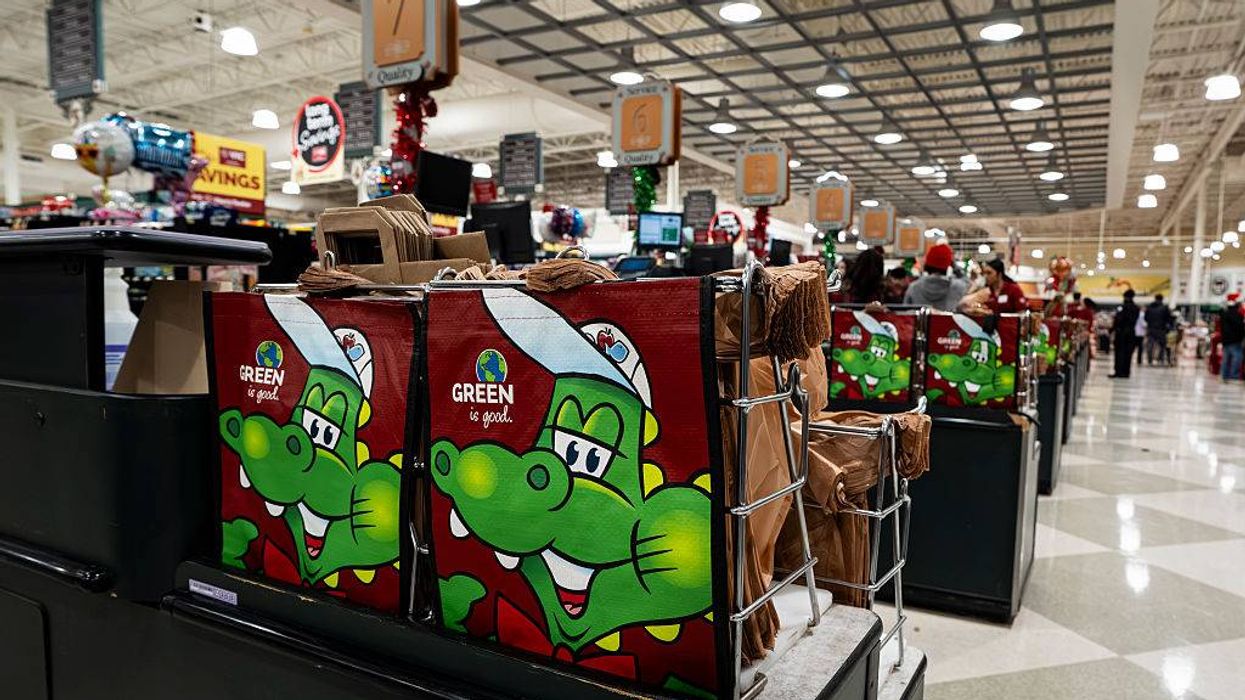
California also got a mention in the groups' release for closing a loophole that allowed supermarkets to continue using plastic bags and for creating a new privacy tool for consumers allowing them to request that online data brokers delete all of the personal information they have gathered on them over the years.
Emily Rusch, vice president and senior director of state offices for the Public Interest Network, contrasted the action being taken in the states to protect consumers and the environment with a lack of action being done at the federal level.
"The gridlock and partisanship we see in Washington, DC can be dispiriting," said Rusch. "But history shows that states can build momentum that eventually leads to change at the federal level. As we build on this progress in 2026, we look forward to working with anyone—Republican, Democrat, or independent—with whom we can find common ground."

"If you want better roads, better schools, better healthcare, better public transit... or just a generally better life, then the best way of funding that is by taxing the ultrawealthy, not allowing them to exploit more tax loopholes."
While ultrawealthy Americans are unlikely to face any extra federal taxes any time soon due to the makeup of Congress, legislators in at least 10 U.S. states this year are aiming to pass tax policies targeting their richest residents to raise revenue for the common good.
Lawmakers in California, Connecticut, Hawaii, Illinois, Maryland, New York, and Washington introduced coordinated wealth tax bills a year ago. Some were inspired by U.S. Sen. Elizabeth Warren's (D-Mass.) 2020 presidential campaign proposal, which featured a 2% annual tax for assets above $50 million and a 3% tax for assets over $1 billion.
Now, less than a month into 2024, legislators in 10 states are developing or have introduced wealth tax bills. Amber Wallin of the State Revenue Alliance confirmed to The New York Times on Tuesday that all of the states that were working on such legislation last year, except Illinois, have been joined by Minnesota, Nevada, Pennsylvania, and Vermont.
"A new wealth tax in Massachusetts last year that was expected to raise $1 billion actually raised $1.5 billion, helping to fund green infrastructure, education, and childcare."
"The way our tax structure is set up, our middle class is carrying an undue burden, compared to folks at the top," Democratic Vermont Rep. Emilie Kornheiser (Windham-7), told the Times. "We want to make sure that all Vermonters are paying their fair share."
Kornheiser, who chairs the state House Committee on Ways and Means, is sponsoring H. 827, which would tax the unrealized gains of Vermonters with over $10 million in assets after exemptions, and H.828, which would impose a 3% surcharge on individuals' incomes of $500,000 or more.
The panel that Kornheiser leads discussed the legislation on Tuesday, though it remains to be seen whether the bills' backers can get them out of committee—where all of last year's proposals died. Democrats have supermajorities in both chambers of the Vermont General Assembly, but as Bloomberg noted, the hearing for the new bills was held "just hours after Republican Gov. Phil Scott presented a fiscal year 2025 budget that steers the state away from new taxes and fees."
It's not just Republican officials who pose potential roadblocks to increased taxes on the rich.
"Texas voters overwhelmingly passed a constitutional amendment in November that would preemptively bar any future efforts by the state to tax wealth or net worth," The Times pointed out. Earlier this month in California, Democratic Gov. Gavin Newsom, who is widely considered a possible 2028 presidential candidate, "rejected the idea of plugging the state's $37.9 billion budget deficit with a wealth tax."
Despite such opposition, polling suggests most Americans want the ultrarich to face tax hikes. Pew Research Center found last April that 6 in 10 U.S. adults say the feeling that some corporations and wealthy people don't pay their fair share bothers them a lot.
Even three-quarters of millionaires across G20 countries "support higher taxes on wealth to help address the cost-of-living crisis and improve public services," according to polling from last week. That survey was released as 260 millionaires and billionaires implored political leaders at the World Economic Forum in Davos, Switzerland to raise taxes on the wealthy.
The Institute for Policy Studies (IPS) highlighted on social media Wednesday that state lawmakers already have a model proving how such legislation can improve the lives of residents: Massachusetts' Fair Share Amendment, which was passed through a 2022 ballot initiative and requires those with incomes over $1 million to pay a 4% annual surtax.
"A new wealth tax in Massachusetts last year that was expected to raise $1 billion actually raised $1.5 billion, helping to fund green infrastructure, education, and childcare," IPS said in response to the Times reporting.
Justice Democrats also welcomed news of the state-level efforts,
saying that "if you want better roads, better schools, better healthcare, better public transit... or just a generally better life, then the best way of funding that is by taxing the ultrawealthy, not allowing them to exploit more tax loopholes."
The fresh push for wealth taxes comes as states face anticipated drops in revenue. In a November analysis for the Center on Budget and Policy Priorities (CBPP), senior adviser for state tax policy Wesley Tharpe found that as the Covid-19 pandemic raged from 2021-23, 26 states cut personal or corporate income tax rates, with half of them doing so multiple times.
Of those 26 states, only Connecticut, New York, and Pennsylvania have legislators working on wealth tax legislation. However, as Tharpe explained in a Wednesday blog post, federal pandemic relief has expired, and all the states that slashed taxes now "stand to collect an estimated $111 billion less over the next five years than they otherwise would have, with the price tag in lost revenues hitting nearly $30 billion a year by 2028."
"Shrinking revenues will jeopardize current levels of state support for vital public services like schools, health services, and income support programs," he warned. "They will also constrain states' future potential by limiting policymakers' ability to make new investments to tackle unmet or emerging needs and issues, such as child poverty, the health of pregnant or postpartum people, or housing affordability."
Tharpe argued that state policymakers "should seize the opportunity to break the tax-cut fever and pivot in a more equitable, prosperous, responsible, and forward-looking direction." He even provided some examples of states that "have recently shined a light on a different, brighter path of protecting and raising revenues to support current services and new investments."
In addition to Massachusetts' amendment, he pointed to Minnesota's crackdown on corporate tax avoidance and Washington's new excise tax on income from the sale of stocks and other investments, which targets the wealthiest 0.2% of Washingtonians.
"States including Colorado, Maine, New Jersey, New York, and Vermont, and the District of Columbia have also raised new revenues to fund initiatives like universal free school meals, expanded childcare and paid leave, and more affordable housing options," the CBPP expert noted. "More states should follow suit in 2024 and beyond."

State-level progress on election protection, ballot access, and voting rights is a reflection of a basic reality documented in poll after poll: Voters want meaningful reforms to democracy.
Over the past few years, states across the country have passed laws that make voting more difficult and elections more vulnerable to partisan interference, and 2023 is no exception. But it is critical to remember that there is also flourishing pro-democracy movement that has pushed many states to make important strides in the opposite direction.
This past year, at least 24 states enacted over 50 laws that protect the freedom to vote, prevent attacks on the electoral process, crack down on gerrymandering, or strengthen campaign finance safeguards as of December 1, 2023. Yet state lawmakers cannot safeguard democracy on their own. Robust federal legislation is needed to ensure that democracy is protected across the country and that every voter has equal access to the ballot.
Among the most notable advances in 2023 was Minnesota’s passage of a transformative package of pro-voter reforms. Among them is automatic voter registration, bringing the total number of states with automatic voter registration to 23 plus the District of Columbia. This means that when eligible Minnesota residents interact with certain state agencies—including when applying for a driver’s license or state health insurance—they will automatically be registered to vote unless they choose to opt out. The legislation also allows 16- and 17-year-olds to pre-register to vote, enacts new protections for election workers, and creates a permanent absentee voter list.
While state reforms are critical, they are not a substitute for federal legislation that would set baseline national standards to protect the freedom to vote and make other critical changes.
Minnesota lawmakers also passed legislation this year that restores voting rights for people convicted of a felony, instantly re-enfranchising over 50,000 Minnesotans on parole, probation, or community release—and countless more in the future.
Another closely divided Midwestern state, Michigan, made important advances. This year, lawmakers passed a package of legislation to implement Proposal 2, a pro-voter constitutional amendment that was approved by Michigan voters in 2022 with nearly 60% of the vote. (Proposal 2 is one of several pro-democracy amendments that Michigan voters approved with overwhelming margins in the past few years.)
Michigan voters now have nine days of early voting, improved absentee ballot options, a higher number of ballot drop boxes, and an expanded list of acceptable voter IDs. This reform will benefit the many voters who prefer to vote by mail, a trend that exploded in popularity during the pandemic and remains highly popular in the state.
Additionally, Michigan lawmakers passed legislation this year protecting election officials from harassment and another that automatically registers individuals to vote upon release from incarceration—the first state to offer such an immediate and automatic restoration of voting rights.
In New Mexico, the legislature passed a wide-ranging bill that restores voting rights to individuals with a felony conviction, establishes automatic voter registration, and added voting rights protections for Native Americans. It also made it so voters who want to vote by mail only have to opt-in once.
The Nevada legislature passed a series of pro-voter laws this year that were signed by the state’s Republican governor: one that improves ballot access for eligible incarcerated voters by requiring jails to better provide voting materials, another that standardizes the design of mail-in ballot return envelopes and clarifies electioneering rules, and one that make it easier to vote on Native American reservations.
In another notable development, Connecticut became the sixth state to establish a state-level Voting Rights Act. In recent years, states have passed their own versions of the Voting Rights Act to protect voting access for historically disenfranchised groups. This trend is in response to two Supreme Court rulings that gutted the federal Voting Rights Act of 1965.
2023 also saw several states enact significant new campaign finance reforms. Minnesota improved campaign finance safeguards to boost transparency and deter foreign influence in elections. Almost 90% of Maine voters adopted new safeguards to prevent foreign governments and corporations from interfering in the state’s elections. And New York State’s groundbreaking small donor matching system went into effect, and over 150 candidates have already signed up to participate.
Important voting reforms are not exclusive to blue states, with many pro-democracy bills also passing in red and purple states this year. For example, Oklahoma codified protections for election officials, and Louisiana and Utah improved voting access for voters with disabilities. The divided Virginia legislature voted to ease absentee ballot requirements, a measure that was signed into law by a Republican governor. Lastly, an important win for direct democracy took place in Ohio, where 57% of voters rejected a proposal that would have increased the threshold required to pass citizen-initiated constitutional amendments from 50% to 60%.
This state-level progress is a reflection of a basic reality documented in poll after poll: Voters want meaningful reforms to democracy. And in 24 states this year, elected officials have responded, passing critical reforms that will improve the state of democracy for many Americans.
Ultimately though, while state reforms are critical, they are not a substitute for federal legislation that would set baseline national standards to protect the freedom to vote and make other critical changes. Access to the ballot box, secure election systems, fair district maps, and strong campaign finance laws are the basic safeguards needed to ensure we have a democracy that works for all Americans, regardless of where they live.
"The work we've done over the last five months will make a generational impact on our state—it will lower costs, improve lives, and cut child poverty," said Gov. Tim Walz.
Progressives are applauding what Minnesota House Speaker Melissa Hortman called the state's "transformational" legislative session, which ended on Tuesday after the Democratic-Farmer-Labor Party passed nearly every item on its agenda, securing economic justice, reproductive rights, and labor protections for Minnesotans.
With the DFL holding only a narrow majority in the state House and Senate—a six-vote and one-vote margin, respectively—policy researcher Will Stancil said on social media that "the scale of their achievement cannot be overstated."
"The Minnesota Legislature just completed what is probably the most productive session anywhere in the country since probably the New Deal," he said. "Sweeping bills and reforms across every area of life."
Stancil was among a number of progressives who highlighted nearly two dozen bills passed by the DFL and signed into law by Democratic Gov. Tim Walz, who posted an image of a whiteboard with party's legislative agenda on it along with the word, "Done."
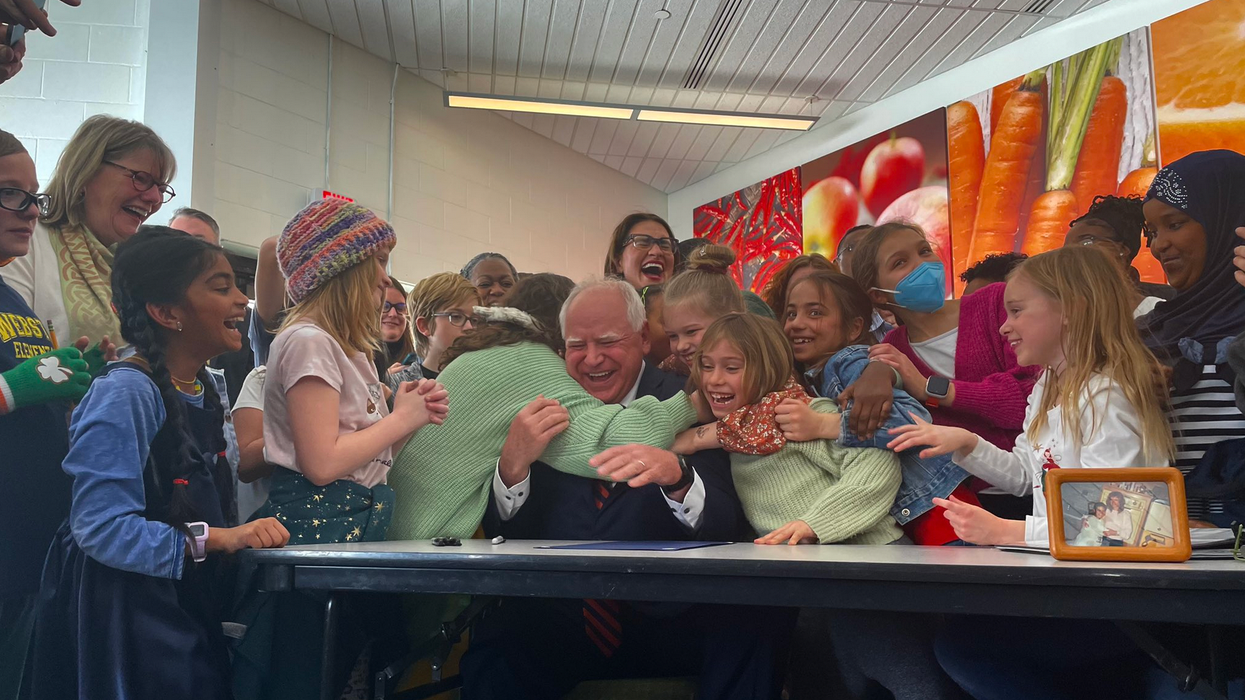
The party's achievements over the past five months include a statewide paid family and medical leave program, which provides 20 weeks of leave; the legalization of recreational marijuana use; and a law providing free school meals to all public and charter school students—part of Walz's plan to "make Minnesota the best state in the country to raise a child."
"The work we've done over the last five months will make a generational impact on our state—it will lower costs, improve lives, and cut child poverty," said Walz on Tuesday.
The party also passed a bill codifying Roe v. Wade amid a nationwide assault on abortion rights, legal protections for transgender youths who receive gender-affirming healthcare in the state, and a bill setting a minimum wage for Uber and Lyft drivers, leading a crowd of drivers to give the legislation's sponsor, state Sen. Omar Fateh (D-62), a "hero's welcome" after it passed on Sunday.
"Rather than looking at the November numbers result and imposing some kind of self-limiting narrative about the scope of their mandate, Minnesota Democrats looked at their priorities and said, 'How much of the list can we get done?'" said Stancil. "Turns out the answer was 'Almost everything.'"
The party's achievements in Minnesota, said pro-workers' rights media organization More Perfect Union, should "set the precedent for state governments across the country."
"On the balance," said the organization, "Minnesota progressives took narrow House and Senate majorities following years of gridlock—and in their first session in power, managed to set the bar for Democratic legislatures."
While elected officials in Washington have gotten little done over the past four years, Republicans in statehouses across the country have advanced a conservative agenda that includes privatizing social services, cutting taxes, undermining renewable energy, restricting access to abortion, dismantling public sector unions, and blocking Medicaid expansion.
"If there's one truth of divided government," Betsy Woodruff wrote for Slate last week, "it's that the most significant legislative action often happens on the state level instead of in gridlocked Washington. While the U.S. Congress has been bogged down in a morass, state legislatures with single-party rule have been hopping. In the last few years, for instance, the Republicans who control Texas' legislature and governorship have passed bills banning abortion after 20 weeks, tightening regulations on abortion clinics, reducing the number of required standardized tests for students, running the table on tort reform, and requiring photo ID to vote."
In 2015, Republicans--and the American Legislative Exchange Council (ALEC), which prepackages conservative bills for state legislators to champion in their home states--are poised to assume even more influence. Because on Election Day, the GOP is likely to make unprecedented state-level gains.
"Republicans have the opportunity to take control of a record number of state legislative chambers across the country this year, as Democrats play defense in unfavorable terrain," the Washington Post declared last week.
"Republicans, who hold a majority of U.S. governor's offices and legislatures, see a path to expand their dominance to unprecedented levels in elections next week," Bloomberg echoed.
In fact, analysts predict that this year, the GOP stands to gain a "state legislature supermajority" that could further embolden lawmakers to advance conservative, ALEC-crafted legislation with little pushback. Today, Republicans control 59 of the 98 partisan chambers in 49 states (Nebraska's unicameral legislature is officially nonpartisan). The Republican Legislative Campaign Committee has set a goal of attaining 66 legislative chambers.
As of Tuesday morning, the Republican party apparatus itself appeared confident that they'd pick up at least six, or possibly as many as 10, chambers on November 4: "At the state legislative level, Republicans are positioned for a historic night, with modern highs in majorities controlled and total number of legislative seats held within reach, exceeding totals achieved in 2010," read a memo sent out by Republican State Leadership Committee (RSLC) political director Justin Richards. "This is largely through new female and diverse candidate recruitment, as well as through winning strategies in states and districts previously won by President Obama."
The RSLC estimated that on Tuesday the GOP will flip chambers in Colorado, Kentucky, Minnesota, New Hampshire, New Mexico, and West Virginia, while cementing or expanding their majorities in 16 other chambers currently held by Republicans. "Victories in these states help us expand the potential paths for a Republican nominee to build a new coalition to win 270 electoral votes in 2016 and beyond," Richards' memo declares.
In gubernatorial races--the outcomes of which clearly influence the ability of state legislatures to pass their agendas--the margins are slimmer than in legislative contests.
"The range of possible Election Day outcomes for gubernatorial races is broad--a net gain of nine or 10 seats for either party is possible," Governing reported last week. "However, if a strong national wave doesn't materialize and the contests are decided more or less on their own merits, than a net gain of one or two seats for the Democrats seems likeliest."
Writing at The Nation, John Nichols explained why "[t]he results from gubernatorial races will tell us a great deal about where the country is really at after the most expensive midterm election campaign in American history."
"Republican governors moved after the 2010 election to implement austerity policies that, while different from state to state, have included assaults on labor unions and funding for public education and public services," he wrote. "Those have not proved to be economically sound, or it turns out politically popular. How voters express their distaste for austerity in the states could send the clearest signal of the 2014 election cycle."
For political satirist John Oliver's irreverent take on the role of state legislatures, how they've been hijacked, and why paying attention to them is important, watch the clip below:
State Legislatures and ALEC: Last Week Tonight with John Oliver (HBO)While midterm coverage is largely focused on the parts of Congress that do very little, vital (and bizarre) midterm elections are ...