SUBSCRIBE TO OUR FREE NEWSLETTER
Daily news & progressive opinion—funded by the people, not the corporations—delivered straight to your inbox.
5
#000000
#FFFFFF
To donate by check, phone, or other method, see our More Ways to Give page.
Daily news & progressive opinion—funded by the people, not the corporations—delivered straight to your inbox.
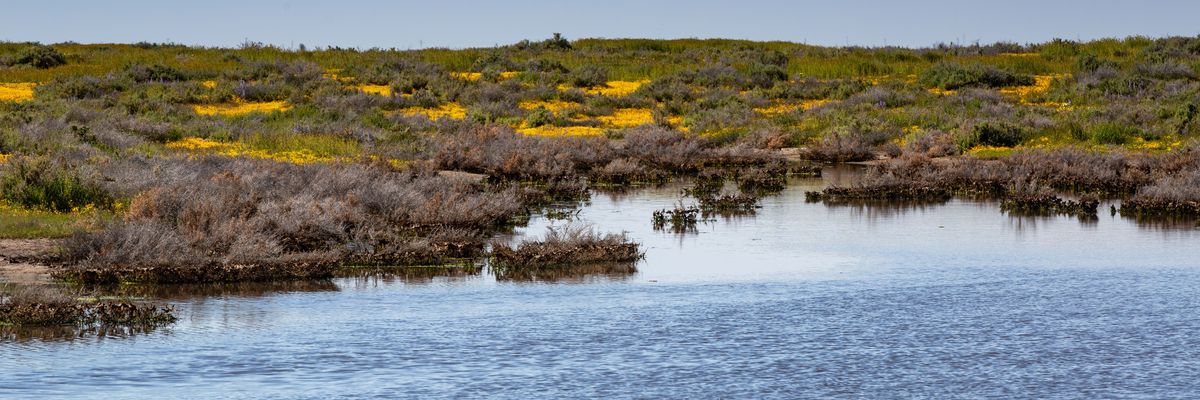
Alkali wetlandsare seen on April 22, 2023, in Carrizo Plain National Monument, California.
"Eliminating protections from small streams and wetlands will mean more pollution downstream—in our drinking water, at our beaches, and in our rivers," said one advocate.
Environmental justice campaigners on Monday said the Trump administration's latest rollback of wetland protections was "a gift to developers and polluters at the expense of communities" and demanded permanent protections for waterways.
“Clean water protections shouldn’t change with each administration,” said Betsy Southerland, former director of the Office of Science and Technology in the US Environmental Protection Agency’s (EPA) Office of Water. “Every family deserves the same right to safe water, no matter where they live or who’s in office.”
EPA Administrator Lee Zeldin proposed changes to the rule known as "Waters of the United States" (WOTUS), which has been the subject of debate and legal challenges in recent decades. Under the Trump administration, as in President Donald Trump's first term, the EPA will focus on regulating permanent bodies of water like oceans, lakes, rivers, and streams.
The administration would more closely follow a 2023 Supreme Court decision, Sackett v. EPA, which the Natural Resources Defense Council (NRDC) found this year would remove federal protections from 60-95% of wetlands across the nation.
The Zeldin rule would eliminate protections for most wetlands without visible surface water, going even further than Sackett v. EPA in codifying a narrower definition of wetlands that should be protected, said the Environmental Protection Network (EPN). The rule comes after pressure from industry groups that have bristled over past requirements to protect all waterways.
Wetlands provide critical wildlife habitats, replenish groundwater, control flooding, and protect clean water by filtering pollution.
The Biden administration required the Clean Water Act to protect “traditional navigable waters, the territorial seas, interstate waters, as well as upstream water resources that significantly affect those waters," but was constrained by the Sackett ruling in 2023.
“This proposed rule is unnecessary and damaging, and ignores the scientific reality of what is happening to our nation’s water supply."
Tarah Heinzen, legal director for Food and Water Watch, said the new rule "weakens the bedrock Clean Water Act, making it easier to fill, drain, and pollute sensitive waterways from coast to coast."
“Clean water is under attack in America, as polluting profiteers plunder our waters—Trump’s EPA is openly aiding and abetting this destruction," said Heinzen. “This rule flies in the face of science and commonsense. Eliminating protections from small streams and wetlands will mean more pollution downstream—in our drinking water, at our beaches, and in our rivers."
The "critical functions" of wetlands, she added, "will only become more important as worsening climate change makes extreme weather more frequent. EPA must reverse course."
Leda Huta, vice president of government relations for American Rivers, added that the change to WOTUS will "likely make things worse for flood-prone communities and industries dependent on clean, reliable water."
“This proposed rule is unnecessary and damaging, and ignores the scientific reality of what is happening to our nation’s water supply,” said Huta. "The EPA is taking a big swipe at the Clean Water Act, our greatest tool for ensuring clean water nationwide.”
The proposal was applauded by the National Association of Manufacturers, whose president, Jay Timmins, said companies' "ability to invest and build across the country" has been "undermined" by the Obama and Biden administration's broader interpretation of WOTUS.
But Southerland said Zeldin's proposal "ignores decades of science showing that wetlands and intermittent streams are essential to maintaining the health of our rivers, lakes, and drinking water supplies."
“This is one of the most significant setbacks to clean water protections in half a century,” she said. "It’s a direct assault on the clean water Americans rely on.”
Drew Caputo, vice president of litigation for lands, wildlife, and oceans at Earthjustice, said the group was evaluating the legality of the proposal and would "not hesitate to go to court to protect the cherished rivers, lakes, streams, and wetlands that all Americans need and depend on.”
"The proposal avoids specifying the exact scale of the deregulation it proposes, but it clearly would result in a serious reduction in legal protections for waters across the United States," said Caputo. "Many waters that have been protected by the Clean Water Act for over 50 years would lose those protections under this proposal."
Dear Common Dreams reader, It’s been nearly 30 years since I co-founded Common Dreams with my late wife, Lina Newhouser. We had the radical notion that journalism should serve the public good, not corporate profits. It was clear to us from the outset what it would take to build such a project. No paid advertisements. No corporate sponsors. No millionaire publisher telling us what to think or do. Many people said we wouldn't last a year, but we proved those doubters wrong. Together with a tremendous team of journalists and dedicated staff, we built an independent media outlet free from the constraints of profits and corporate control. Our mission has always been simple: To inform. To inspire. To ignite change for the common good. Building Common Dreams was not easy. Our survival was never guaranteed. When you take on the most powerful forces—Wall Street greed, fossil fuel industry destruction, Big Tech lobbyists, and uber-rich oligarchs who have spent billions upon billions rigging the economy and democracy in their favor—the only bulwark you have is supporters who believe in your work. But here’s the urgent message from me today. It's never been this bad out there. And it's never been this hard to keep us going. At the very moment Common Dreams is most needed, the threats we face are intensifying. We need your support now more than ever. We don't accept corporate advertising and never will. We don't have a paywall because we don't think people should be blocked from critical news based on their ability to pay. Everything we do is funded by the donations of readers like you. When everyone does the little they can afford, we are strong. But if that support retreats or dries up, so do we. Will you donate now to make sure Common Dreams not only survives but thrives? —Craig Brown, Co-founder |
Environmental justice campaigners on Monday said the Trump administration's latest rollback of wetland protections was "a gift to developers and polluters at the expense of communities" and demanded permanent protections for waterways.
“Clean water protections shouldn’t change with each administration,” said Betsy Southerland, former director of the Office of Science and Technology in the US Environmental Protection Agency’s (EPA) Office of Water. “Every family deserves the same right to safe water, no matter where they live or who’s in office.”
EPA Administrator Lee Zeldin proposed changes to the rule known as "Waters of the United States" (WOTUS), which has been the subject of debate and legal challenges in recent decades. Under the Trump administration, as in President Donald Trump's first term, the EPA will focus on regulating permanent bodies of water like oceans, lakes, rivers, and streams.
The administration would more closely follow a 2023 Supreme Court decision, Sackett v. EPA, which the Natural Resources Defense Council (NRDC) found this year would remove federal protections from 60-95% of wetlands across the nation.
The Zeldin rule would eliminate protections for most wetlands without visible surface water, going even further than Sackett v. EPA in codifying a narrower definition of wetlands that should be protected, said the Environmental Protection Network (EPN). The rule comes after pressure from industry groups that have bristled over past requirements to protect all waterways.
Wetlands provide critical wildlife habitats, replenish groundwater, control flooding, and protect clean water by filtering pollution.
The Biden administration required the Clean Water Act to protect “traditional navigable waters, the territorial seas, interstate waters, as well as upstream water resources that significantly affect those waters," but was constrained by the Sackett ruling in 2023.
“This proposed rule is unnecessary and damaging, and ignores the scientific reality of what is happening to our nation’s water supply."
Tarah Heinzen, legal director for Food and Water Watch, said the new rule "weakens the bedrock Clean Water Act, making it easier to fill, drain, and pollute sensitive waterways from coast to coast."
“Clean water is under attack in America, as polluting profiteers plunder our waters—Trump’s EPA is openly aiding and abetting this destruction," said Heinzen. “This rule flies in the face of science and commonsense. Eliminating protections from small streams and wetlands will mean more pollution downstream—in our drinking water, at our beaches, and in our rivers."
The "critical functions" of wetlands, she added, "will only become more important as worsening climate change makes extreme weather more frequent. EPA must reverse course."
Leda Huta, vice president of government relations for American Rivers, added that the change to WOTUS will "likely make things worse for flood-prone communities and industries dependent on clean, reliable water."
“This proposed rule is unnecessary and damaging, and ignores the scientific reality of what is happening to our nation’s water supply,” said Huta. "The EPA is taking a big swipe at the Clean Water Act, our greatest tool for ensuring clean water nationwide.”
The proposal was applauded by the National Association of Manufacturers, whose president, Jay Timmins, said companies' "ability to invest and build across the country" has been "undermined" by the Obama and Biden administration's broader interpretation of WOTUS.
But Southerland said Zeldin's proposal "ignores decades of science showing that wetlands and intermittent streams are essential to maintaining the health of our rivers, lakes, and drinking water supplies."
“This is one of the most significant setbacks to clean water protections in half a century,” she said. "It’s a direct assault on the clean water Americans rely on.”
Drew Caputo, vice president of litigation for lands, wildlife, and oceans at Earthjustice, said the group was evaluating the legality of the proposal and would "not hesitate to go to court to protect the cherished rivers, lakes, streams, and wetlands that all Americans need and depend on.”
"The proposal avoids specifying the exact scale of the deregulation it proposes, but it clearly would result in a serious reduction in legal protections for waters across the United States," said Caputo. "Many waters that have been protected by the Clean Water Act for over 50 years would lose those protections under this proposal."
Environmental justice campaigners on Monday said the Trump administration's latest rollback of wetland protections was "a gift to developers and polluters at the expense of communities" and demanded permanent protections for waterways.
“Clean water protections shouldn’t change with each administration,” said Betsy Southerland, former director of the Office of Science and Technology in the US Environmental Protection Agency’s (EPA) Office of Water. “Every family deserves the same right to safe water, no matter where they live or who’s in office.”
EPA Administrator Lee Zeldin proposed changes to the rule known as "Waters of the United States" (WOTUS), which has been the subject of debate and legal challenges in recent decades. Under the Trump administration, as in President Donald Trump's first term, the EPA will focus on regulating permanent bodies of water like oceans, lakes, rivers, and streams.
The administration would more closely follow a 2023 Supreme Court decision, Sackett v. EPA, which the Natural Resources Defense Council (NRDC) found this year would remove federal protections from 60-95% of wetlands across the nation.
The Zeldin rule would eliminate protections for most wetlands without visible surface water, going even further than Sackett v. EPA in codifying a narrower definition of wetlands that should be protected, said the Environmental Protection Network (EPN). The rule comes after pressure from industry groups that have bristled over past requirements to protect all waterways.
Wetlands provide critical wildlife habitats, replenish groundwater, control flooding, and protect clean water by filtering pollution.
The Biden administration required the Clean Water Act to protect “traditional navigable waters, the territorial seas, interstate waters, as well as upstream water resources that significantly affect those waters," but was constrained by the Sackett ruling in 2023.
“This proposed rule is unnecessary and damaging, and ignores the scientific reality of what is happening to our nation’s water supply."
Tarah Heinzen, legal director for Food and Water Watch, said the new rule "weakens the bedrock Clean Water Act, making it easier to fill, drain, and pollute sensitive waterways from coast to coast."
“Clean water is under attack in America, as polluting profiteers plunder our waters—Trump’s EPA is openly aiding and abetting this destruction," said Heinzen. “This rule flies in the face of science and commonsense. Eliminating protections from small streams and wetlands will mean more pollution downstream—in our drinking water, at our beaches, and in our rivers."
The "critical functions" of wetlands, she added, "will only become more important as worsening climate change makes extreme weather more frequent. EPA must reverse course."
Leda Huta, vice president of government relations for American Rivers, added that the change to WOTUS will "likely make things worse for flood-prone communities and industries dependent on clean, reliable water."
“This proposed rule is unnecessary and damaging, and ignores the scientific reality of what is happening to our nation’s water supply,” said Huta. "The EPA is taking a big swipe at the Clean Water Act, our greatest tool for ensuring clean water nationwide.”
The proposal was applauded by the National Association of Manufacturers, whose president, Jay Timmins, said companies' "ability to invest and build across the country" has been "undermined" by the Obama and Biden administration's broader interpretation of WOTUS.
But Southerland said Zeldin's proposal "ignores decades of science showing that wetlands and intermittent streams are essential to maintaining the health of our rivers, lakes, and drinking water supplies."
“This is one of the most significant setbacks to clean water protections in half a century,” she said. "It’s a direct assault on the clean water Americans rely on.”
Drew Caputo, vice president of litigation for lands, wildlife, and oceans at Earthjustice, said the group was evaluating the legality of the proposal and would "not hesitate to go to court to protect the cherished rivers, lakes, streams, and wetlands that all Americans need and depend on.”
"The proposal avoids specifying the exact scale of the deregulation it proposes, but it clearly would result in a serious reduction in legal protections for waters across the United States," said Caputo. "Many waters that have been protected by the Clean Water Act for over 50 years would lose those protections under this proposal."