

SUBSCRIBE TO OUR FREE NEWSLETTER
Daily news & progressive opinion—funded by the people, not the corporations—delivered straight to your inbox.
5
#000000
#FFFFFF
To donate by check, phone, or other method, see our More Ways to Give page.
Daily news & progressive opinion—funded by the people, not the corporations—delivered straight to your inbox.
As Indigenous activists maintained resistance to a proposed oil pipeline in North Dakota this week, allied groups on Thursday sent an open letter to President Barack Obama asking him to urge the U.S. Army Corps of Engineers to pull its permits for the project.
"After years of pipeline disasters--from the massive tar sands oil spill in Kalamazoo, Michigan in 2010, to the recent oil pipeline spills in the San Joaquin Valley and Ventura, CA--our organizations and our millions of members and supporters are concerned about the threat these projects pose to our safety, our health, and the environment," reads the letter (pdf), signed by groups such as the Indigenous Environmental Network, the Sierra Club, and 350.org.
The letter was published as a federal judge delayed a decision on allowing the construction to continue.
U.S. Judge James Boasberg said after a hearing in Washington, D.C., on Wednesday that he would decide by September 9 on whether to halt work on the pipeline amid a lawsuit filed against the corps by Standing Rock Sioux tribal leaders. Last week, pipeline developers agreed to pause construction until the decision is made.
"Whatever the final outcome in court, I believe we have already established an important principle--that is, tribes will be heard on important matters that affect our vital interests," Standing Rock Sioux Chairman Dave Archambault II said Wednesday, according to the Bismarck Tribune.
If the $3.7 billion pipeline is built, it will transport 500,000 barrels of oil a day past the Standing Rock Sioux reservation in North Dakota and through several rivers, including the Mississippi and Missouri rivers, which supply water to millions of people. The pipeline would then traverse North Dakota, South Dakota, and Iowa before eventually stopping in Illinois.
"Everyone knows what is at stake, and we won't be sacrificed."
--Angela Bevans
Camps have sprung up around the contested area as the action against the pipeline stretches into its third week, and Amnesty International announced Wednesday that it had sent a delegation of human rights observers to the protest site. Opponents say the project would destroy sacred and culturally important lands and threaten their access to clean water.
Angela Bevans, an assistant attorney with a Sioux background, told the Guardian on Thursday that "[a]ny delay is a win for us. It will give Dakota Access pause and let people know that Standing Rock still needs assistance on this."
"We've suffered incarceration, massacre, and internment. This is just another chapter in the government allowing a private company to take something that doesn't belong to them just because they can," Bevans said. "It's not a matter of whether there will be a spill; it's when it will happen. Everyone knows what is at stake, and we won't be sacrificed. We are protecting the lifeblood of our people; these rivers are the arteries of Mother Earth."
This week, the chances of passing the corporate trade deal TTIP have been dealt several more serious blows. Even the chances of passing TTIP's sister agreement, CETA (the Canada-EU deal), are starting to look decidedly shaky.
Here are the key highlights of the week.
The big new fact is the sheer scale of opposition to 'free trade' deals in the US. All leading presidential candidates have expressed some opposition to the current free trade agenda, with even free trader Clinton saying she's deeply uneasy. A new opinion poll shows only 18% of Americans support TTIP, down from 53% in 2014.
This matters because Obama only has eight months left in office and it seems unlikely that substantial progress will be made in that time. After that, the future is anyone's guess. That's a key reason Obama came to Germany this week - to speed things up.
But the US President was met by tens of thousands of protestors in Hannover, making clear that TTIP is toxic in Europe, too. The same opinion poll already quoted found 17% of Germans support TTIP—down from 55% two years ago. TTIP campaigning is reported to have accelerated substantially in France this week, and it's growing as an issue throughout Europe.
We released papers this week that show that the UK government isn't taking the corporate courts too seriously. The only risk assessment they've carried out on TTIP strongly advises the government that there are lots of risks and no benefits. On EU-Canada deal CETA, they hadn't even conducted a corporate court system risk assessment. So much for the evidence!
Events have moved rapidly on CETA this week too. CETA risks becoming a Trojan horse for TTIP, with many of the same provisions, including the infamous corporate court system. Although the EU Commission has created a reformed version of this system in CETA, all the most notorious cases we cite would still be a problem under this 'new' system.
CETA will go to the EU Council (of all EU governments) for ratification in June, and be formally signed in September. It will then go to the EU parliament, where we expect a vote next January or February.
Although we didn't expect to win any victories at the Council, that's all changed this week. First up, Romania, in dispute with Canada over visa issues, has threatened to veto CETA at the June meeting. Next, the Walloon parliament voted a critical motion on CETA that could tie the hands of the Belgian government and force it's abstention.
One problem with EU trade deals is that they can come into effect even without a vote in member parliaments. Under something known as 'provisional implementation', CETA could take effect in Britain early next year without a parliamentary vote here. In fact, even if the British parliament voted CETA down, the corporate court system would still stay in effect for 3 years! The June meeting is the last chance governments have to block these processes .
However, last night the Dutch parliament voted for a non-binding motion to reject this provisional implementation. The Netherlands might yet hold a referendum on CETA too.
In The UK we got news of the 41st TTIP Free Zone: Rhondda Cynon Taf County Borough Council. This came hot on the heels of the Barcelona TTIP Free Zones conference, attracting 40 councillors and mayors from across the EU, where a declaration was agreed on which called for the end of negotiations on TTIP and TiSA and for the non-ratification of CETA.
It was also the 13th round of negotiations happening in New York, prompting German Economic Minister Sigmar Gabriel to comment: "Whether we can reach a deal this year really depends on whether we can create trust in the process. And unfortunately, we are very far from creating trust in the process."
So we're very much on the front foot. With the EU referendum approaching, is David Cameron really going to attend an EU meeting and support the idea that CETA come into effect without a parliamentary vote? We have 2 months to convince him that that's a terrible idea.
America! Something is amiss. We are in the final throes of a desperate situation, and the numbers just aren't adding up. What can be done?
The facts are almost too dreadful to discuss: No matter how you slice it, spin it, or openly lie about it like Ted Cruz on a ketamine bender, it's become officially impossible to find any true and tangible evidence that President Obama - AKA Kenyan Comrade Nazi Socialist Obama - has utterly destroyed America, as promised.
Worse still, there is very little time left. The months are ticking away until Obama leaves office and becomes something altogether more terrifying: One of the most effective, lauded, sought-after ex-presidents in American history, next to Bill Clinton. Calamitous!
Ergo, the question is getting more urgent by the day: Can he still do it? Is there enough time for President Obama to undo all the undeniable improvements and socioeconomic progress that President Obama hath wrought? Let us pray.
The signs, regrettably, are not good. Unemployment just hit an eight-year low, down to 4.9 percent. Wages are (finally) ticking up, keeping better pace with all the new jobs, another 150,000 in January alone, officially joining Obama's nauseating string of 71 straight months of consecutive job growth.
That's downright shameful. Reports suggest the economy is so robust, many people are actually quitting their jobs, confident they will easily find another, thanks to the Obama-led economic recovery. Dude must be mortified.
It gets worse. It turns out the Affordable Care Act, which every Right-wing politician and pundit, bar none, swore on his mother's dead Medicare would devastate the economy and cause what was already the worst, most expensive, least effective health care system in the modern world to implode completely, has instead added another 13 million to the roster of the newly insured, most of them younger people.
Uglier still? Minimal adverse effects. It's doing pretty great, actually. Insurance companies have not collapsed. Rates, for most, have been dinged only mildly. Doctors are not jumping out of windows. And of course, millions now have insurance who would otherwise have been prevented from getting it before, and you can't be turned down for pre-existing conditions, and... oh, hell, you know the rest. Blah blah blah, good news many improvements everybody's mostly pretty happy.
Fools!
Perhaps a bit of gratitude is in order? Because truly, it could have been a lot worse. What if those early liberal visions for true health care overhaul - single-payer, for example - hadn't been so brutally beaten down by the Right? What if real reform had taken place? Or, for that matter, real environmental legislation? What if the GOP and the late Justice Scalia weren't so helpfully, openly partisan and grossly obstructionist?
Disaster, that's what. Pharmaceutical lobbyists would almost certainly be less obscenely powerful. Exxon's donations to GOP SuperPACs would slump. Hospital executives would struggle to buy a third Range Rover. Ghastly!
So I ask again, with extra ominousness: Why aren't we suffering more? Why aren't the vast majority of Americans far worse off? I mean, is this it? When will this nightmare of imperfect growth, recovery and undeniably improved overall health finally end?
Look, it's been nearly eight years. The mellow intellectual socialist black dude has had forever to make good on the GOP's fanatical demand that he ruin the nation and impregnate their terrified white daughters. Shouldn't the rich be much less rich? Shouldn't the stock market have collapsed by now?
Why is America's standing in the world so much better than a decade ago? Why are gay people so goddamn happy? Why are women becoming increasingly powerful and omnipresent? Why is the Republican party mocked and derided the world over? What happened to the ruinous supremacy of the Angry White Christian Male?
The answer, of course, is obvious: You've been duped.
Don't you get it? Everything is actually far worse than it seems. There are no jobs. You are not healthy. Your stock portfolio has not exploded in the past decade. CNN Money is lying when it says "Obama is shaping up to be one of the best presidents for the stock market in modern history, even with the recent pullback in 2016." It is not likely you reading this column right now on a beautiful, technologically marvelous digital device paid for, in sum, by the overall economic recovery. North is actually south. Progress is actually failure. Women and black people and Muslims and immigrants are actually destroying the country.
All part of a monstrous liberal hoax, you see, this "recovery," this "robust economy," this "historic resurgence," exactly like climate science and organic bananas, electric cars and feminism. Don't you see?
Here's the real truth: We are, each of us, floating inside a strange, mystical eight-year Obamabubble made of thoughtful rejoinders, Zen-like calm and effortless three-pointers from the perimeter. It's a bubble that's about to pop any second to reveal that the Dow is really at 3,000, ISIS has taken over the Freedom Tower and we've all been speaking German and just didn't realize it.
It's the only way to explain it. How else to vindicate the curdled Republican Establishment, every member of which has been so egregiously, so laughably wrong, and so consistently, for eight years straight? How to excuse the fact that every one of them has been promising us the exact same thing: a face-melting Obamacalypse, any second now?
And yet... nothing. Just the opposite, in fact. The poor dears.
Surely, some underwhelming charts exist. If you tweak the metric a little, unemployment isn't all that great - it's only, uh, moderately great. And many of those new jobs cited by the DOL are low-wage and service sector. And employment participation rates aren't quite as strong as they could be. So, you know, take that.
Also, military spending is actually up. And the truth is, Obama's health care reform is pretty weak on the actual reform: Insurance companies are still making billions. Big Pharma has never been so powerful. Most hospitals are still for-profit. Wall Street could not be more happily coldblooded.
Wait, isn't that good news? Obama's policies have only made the rich richer, the military machine more bloated, the stock market explode, oil companies mostly quite happy? I'm getting confused.
But never mind that now. Because it appears Obama hasn't given up just yet.
Behold, his administration's final, $4.1 trillion budget. It's packed to the brim with all sorts of nation-killing initiatives, soul-destroying taxes and hope-obliterating spending plans, a gruesome pile of mostly good ideas, a few fairly lousy ones and a handful of truly great ones that, should some of them actually make it through, would almost certainly leave the country much better off... all by destroying us completely.
Typical.
Good luck, Mr. President! We're all pulling for you. You monster.
The Senate narrowly invoked cloture on fast-track trade legislation Tuesday morning, setting up a final vote Wednesday that will surely send the bill to President Obama's desk for his signature.
In so doing, Congress will surrender remarkable authority to Obama and his successors. For the next six years, Congress will be unable to amend any trade deal signed by the president, and only 50 votes will be required for Senate passage--a reduced burden that hasn't been granted to minimum-wage hikes, equal-pay legislation, gun control, campaign-finance reform, nor any other non-budgetary legislation of the Obama era.
In exchange, these future administrations will promise to be guided by negotiating objectives in the fast-track legislation on human rights, labor standards, and the environment, though many experts and congressional Democrats have decried the objectives as meaningless--in some cases they are satisfied if the president self-certifies that unspecified "progress" was made towards the negotiating goal.
The Senate wasn't supposed to have to vote again; it passed fast-track legislation weeks ago and sent it to the House. But House liberals rebelled and temporarily killed the House package by voting down a program that provides job training to workers screwed over by trade deals. This program was a Democratic priority, but one they strategically killed in order to hopefully stop the entire fast-track passage.
But House Speaker John Boehner held another vote last week and sent fast track back to the Senate without the trade-assistance program, and so the Senate had to vote again on this bill.
There was substantial doubt that Senate Democrats would back fast track without trade assistance for workers, but they did--resting on assurances from congressional Republicans that they will pass the assistance program soon.
The final vote was 60-37, achieving cloture by the thinnest possible margin. (Three senators were absent; Tennessee Republican Bob Corker was delayed getting to Washington, but said he would have voted for fast track; Senators Robert Menendez and Mike Lee both voted "no" last time.)
After the vote, Senator Sherrod Brown took the Senate floor and declared, "This is a day of celebration in the corporate suites of this country, to be sure."
Senator and presidential candidate Bernie Sanders added that "this trade agreement was supported by virtually every major corporation in this country, the vast majority of whom have outsourced millions of jobs to low-wage countries all over the world."
Thirteen Senate Democrats helped get fast track over the line: Michael Bennet of Colorado, Maria Cantwell and Patty Murray of Washington, Tom Carper and Chris Coons of Delaware, Dianne Feinstein of California, Heidi Heitkamp of North Dakota, Tim Kaine and Mark Warner of Virginia, Claire McCaskill of Missouri, Bill Nelson of Florida, Ron Wyden of Oregon, and Jeanne Shaheen of New Hampshire.
Right off the bat, some progressive activists pledged to exact a price for supporting fast track. "The Senate Democrats who allowed Fast Track should know that this vote will be remembered, it will not be erased, and we will hold you accountable," said Jim Dean of Democracy for America in a statement. "Accountability could mean primaries now or in the future, taking no action in your next difficult election, or support for progressive alternatives in future Senate leadership elections. Make no mistake, the memory of this clear betrayal of working families will follow you for years to come."
The threat about Senate leadership elections is particularly notable; Senator Patty Murray is reportedly seeking the whip post in the new Senate, and provided a crucial vote for fast track. The current whip and her presumed competitor for the post, Senator Dick Durbin, voted against fast track.
Once Fast Track passes tomorrow (there is only a 50-vote requirement post-cloture, which this bill will easily achieve) and Obama signs Fast Track, the fight turns to the highly controversial Trans-Pacific Partnership.
Sometime in the late summer or early fall, the Obama administration will finally release the full TPP text, after the president signs it. After 90 days, Congress can vote on it.
Without question, fast track makes the TPP much more likely to pass. No amendments can gum up the process or chase off support, and we already can easily see there are 50 votes in the Senate based on the fast-track votes. But the House remains no sure thing for the TPP. Fast track twice passed by only two votes.
When the TPP actually comes out, there will be some really ugly details that are likely to enrage liberals and solidify opposition among Democrats. For months the White House has been dodging some criticisms of the TPP by stressing that the text isn't final, but that will no longer be an option.
The unknown details of the TPP, incidentally, are what Hillary Clinton cites for not yet having an official position on the trade deal. If the Democrat base gets truly riled up when the details do come out, she may end up opposing the deal. This would give cover for every congressional Democrat to do the same.
Members of the House will also be in the thick of their reelection campaign this fall, and increased progressive activism and actual primary challengers will no doubt make a TPP vote even harder.
On the Republican side, Boehner will almost surely have a more difficult time gathering Republican votes for the TPP than he did for fast track. One argument frequently made by Republicans during the congressional fast-track debate was that it benefited the GOP, too--that it was also a vote to give a theoretical Republican president in 2017 immense power to shape trade deals without congressional meddling. That has no application to the TPP debate.
And 2016 will no doubt have the same effect on the Republican side, as incumbents face challenges from opponents to their right who may decide to blast them for supporting Obama's trade agenda. The presidential race provides more pressure, and we're already seeing it: Only weeks ago, Ted Cruz voted to move fast track. Tuesday, he released an op-ed on Breitbart.com bashing "Obamatrade" and voted against cloture.
So while progressives lost the fast-track battle, the trade debate isn't quite over yet. "What [the vote] doesn't mean is that Congress must pass [the TPP]," said Robert Weissman, president of Public Citizen. "When the inexcusable and anti-democratic veil of secrecy surrounding the TPP is finally lifted, and the American people see what is actually in the agreement, they are going to force their representatives in Washington to vote that deal down."
In what advocates of locally-owned and operated broadband networks are calling "a great moment for the principle of local self-reliance," President Obama has announced his intention to fight back against efforts by the telecommunications industry to block the building or improvement of municipal internet networks.
"These prohibitions on municipal broadband were passed lightning-fast through state legislatures with tons of AT&T and cable company money behind them and they are blatantly anti-public." --Holmes Wilson, Fight for the FutureCiting places like Cedar Falls in Iowa, Tennessee's Chattanooga, and Lafayette, Louisiana--cities "which have Internet speeds nearly 100 times faster than the national average and deliver it at an affordable price"--Obama said it is time to end corporate opposition to the initiatives that have made such powerful and more democratically-controlled networks possible.
"In too many places across America, some big companies are doing everything they can to keep out competitors," Obama said in a video statement. "Today I am saying we are going to change that. Enough is enough."
Watch:
President Obama is Going to Help Make Your Internet Faster! Upworthy ExclusiveUpworthy Exclusive: President Obama previews the new plan to bring faster broadband access to communities across the country ...
Alongside his announcement, the White House presented a fact sheet outlining the municipal broadband initiative and a new report (pdf) authored by the National Economic Council and Council of Economic Advisers which examines the success stories of "community-based broadband" projects. As part of the administration's effort, a specific focus will be placed on making it easier for municipalities that want to build their own networks to do so. According to the fact sheet:
Laws in 19 states -- some specifically written by special interests trying to stifle new competitors -- have held back broadband access and, with it, economic opportunity. Today, President Obama is announcing a new effort to support local choice in broadband, formally opposing measures that limit the range of options available to communities to spur expanded local broadband infrastructure, including ownership of networks. As a first step, the Administration is filing a letter with the Federal Communications Commission (FCC) urging it to join this effort by addressing barriers inhibiting local communities from responding to the broadband needs of their citizens.
Rebecca Toewes, a communication specialist with the Institute for Local-Self Reliance (ILSR), which has been among the nation's strongest advocates of municipal broadband, reacted with welcome surprise to the president's announcement and called it "a great moment for the principle of local self-reliance." In a post on the Community Broadband Networks website, an ISLR project which focuses on the issue, Toewes wrote:
When we started to hear rumors that the White House was investigating community owned networks, we were excited but not sure what to expect. I have to admit that seeing President Obama - the President of the United States - saying that Cedar Falls was smart to invest in themselves was much more powerful than I ever expected.
The efforts of so many people to legitimize community networks are now paying off. Belittled by the big cable companies and their paid experts, we certainly were not destined to reach this point. But we are here - and everyone now recognizes that local governments can play an important role in ensuring we all have great Internet access.
In an interview with Guardian, Holmes Wilson, co-director of the nonprofit digital rights advocacy group Fight for the Future, said Obama's broadband rollout is a "a wonderful and obvious step" towards a better internet for U.S. residents.
"These prohibitions on municipal broadband were passed lightning-fast through state legislatures with tons of AT&T and cable company money behind them and they are blatantly anti-public," Wilson said. "If the town wants to get together and try to do better than the local internet provider, why on earth would you want to stop that?"
Curious about what a "municipal broadband network" is or why they are seen as so important by some? This video, produced by the 'Decide Locally' campaign, explains:
Community Broadband NetworksWondering why some communities have decided to build their own networks, sometimes in competition with massive cable and ...
The Guardian adds:
Along with this proposal, Obama is calling for a removal of all "unnecessary regulatory and policy barriers to broadband build-out," according to a White House outline. A coalition of government agencies would attempt to speed up the implementation of these programs, though how much power such an entity would actually have is unclear.
Obama is also calling for a national broadband summit in June, where community leaders would discuss the best practices for enabling fast broadband in cities. But a looming vote on net neutrality rules expected in late February could change that discussion. In early November, Obama announced that he strongly opposed efforts by telecoms companies to get online "fast lanes" for customers that pay more for internet. FCC watchers expect a vote to fall somewhere between, in an effort to keep telecom lobbyists at bay while offering an olive branch to open-internet advocates
"We desperately need a net neutrality rule that says: if you are an internet provider, you have to treat all content equally," said Fight for the Future's Wilson. "Otherwise we are going to get local internet providers, local monopolies, using their market power to distort what people can do and say online and extract more money from customers."
The Keystone XL tar sands pipeline into the highest profile environmental fight in recent memory
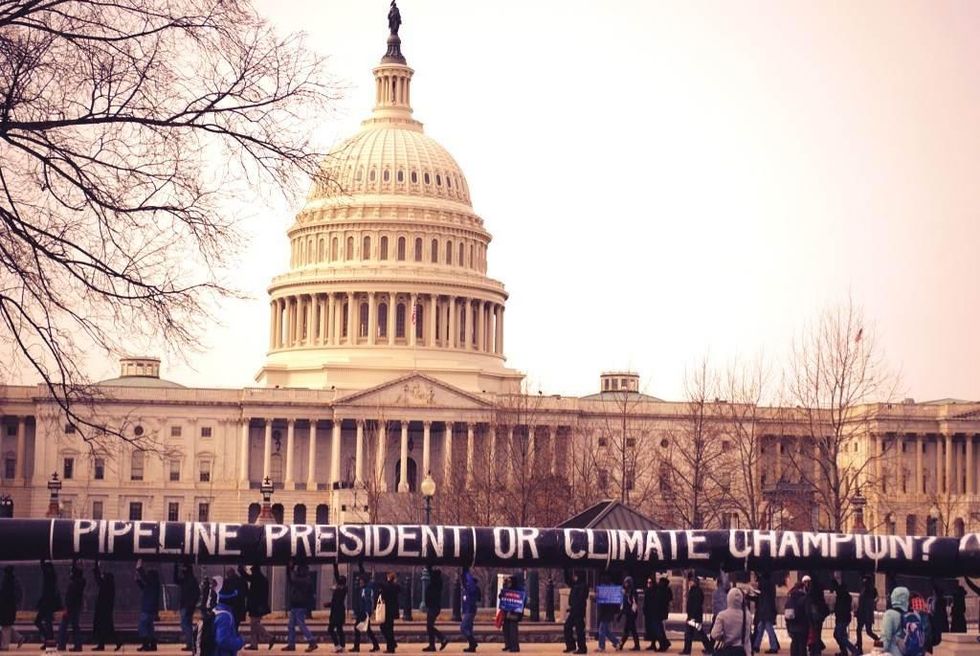
Earlier this morning, I took a break from press calls and preparations for this weekend's big XL Dissent protest in Washington, D.C. to go back and watch some of the original videos we made during Tar Sands Action, the two-weeks of sit-ins in August 2011 that helped turn the Keystone XL tar sands pipeline into the highest profile environmental fight in recent memory.
In a video from the first day of the protests, Gus Speth, a former White House official and co-founder of the Natural Resources Defense Council, says, "We have to draw a line in the sand somewhere and this is a perfect place to draw it. It's a new, controversial, unconventional fossil resource with tremendous potential to harm the global climate, and for Obama to do something in his own power which doesn't require Congress, that would be electrifying and send a powerful signal around this country and around the world that we are going to act."
Tar Sands Action: Come Join Us!A short film capturing first day of 2-weeks of sit-ins at the White House to stop the proposed Keystone XL Pipeline. More info: ...
He continues, "Power responds to a demand and we have to let that demand be heard. It's time to step outside the system and do some things we haven't done before."
Speth was arrested that day and spent two nights in DC central cell block. He got a message out from jail that read, "The only thing we need is more company."
"From the fossil fuel divestment movement to the increasing levels of direct action and civil disobedience, young people are finding powerful ways to make an impact and stand in solidarity with the frontline communities who are feeling the impacts of our dirty energy economy and the climate crisis."
And boy, did he get it. Over the two weeks of Tar Sands Action, 1,253 people were arrested during daily sit-ins protesting the pipeline. Since then, arrests have continued across the country, from the Tar Sands Blockade in Texas, to young people in Michigan (who are still fighting charges), to more civil rights and environmental leaders back at the White House. Those that have gone to jail have been joined by tens of thousands more protesters in the streets during events like Forward on Climate, which brought over 40,000 people to the Capitol last February.
This weekend, will be the largest single act of civil disobedience yet. Over 1,000 students and young people are expected to take part in the XL Dissent protest at the White House. More than 300 of them are planning on risking arrest. If the action goes according to plan, it could turn out to be the largest youth-led act of civil disobedience at the White House in a generation.
I've had the chance to talk with some of the students involved in XL Dissent and the thing that continues to strike me is how level-headed and pragmatic they are. They're risking arrest this weekend not because they're wild-eyed radicals, but because they agree with Speth that power responds to a demand, and that getting that demand heard often requires working outside traditional channels.
Howard Zinn wrote, "Protest beyond the law is not a departure from democracy; it is absolutely essential to it." After years of greening campuses, pushing for recycling and carbon neutrality, and educating their classmates about the threat of climate change, students are increasingly adopting protest as a tool for social change. From the fossil fuel divestment movement to the increasing levels of direct action and civil disobedience, young people are finding powerful ways to make an impact and stand in solidarity with the frontline communities who are feeling the impacts of our dirty energy economy and the climate crisis.
President Obama should know something about the power of principled protest. As he recounts in his autobiography "Dreams From My Father," his first public speech was at a college rally pushing for divestment from apartheid South Africa. As the President looks out from the windows of the White House this Sunday at the hundreds of student activists getting taken away from his fence in handcuffs, many of them divestment organizers back on campus, perhaps it will remind him of the reasons that got him into politics in the first place.
Keystone XL is more than an environmental issue, it's a test of character. The young people taking part in XL Dissent are demonstrating theirs. Now, it's time for the President to show his.