SUBSCRIBE TO OUR FREE NEWSLETTER
Daily news & progressive opinion—funded by the people, not the corporations—delivered straight to your inbox.
5
#000000
#FFFFFF
To donate by check, phone, or other method, see our More Ways to Give page.


Daily news & progressive opinion—funded by the people, not the corporations—delivered straight to your inbox.
A lawyer for former Olympian Davey Hearn said the indictment "reflects the administration's effort to scapegoat Davey and to shift blame for their own failures."
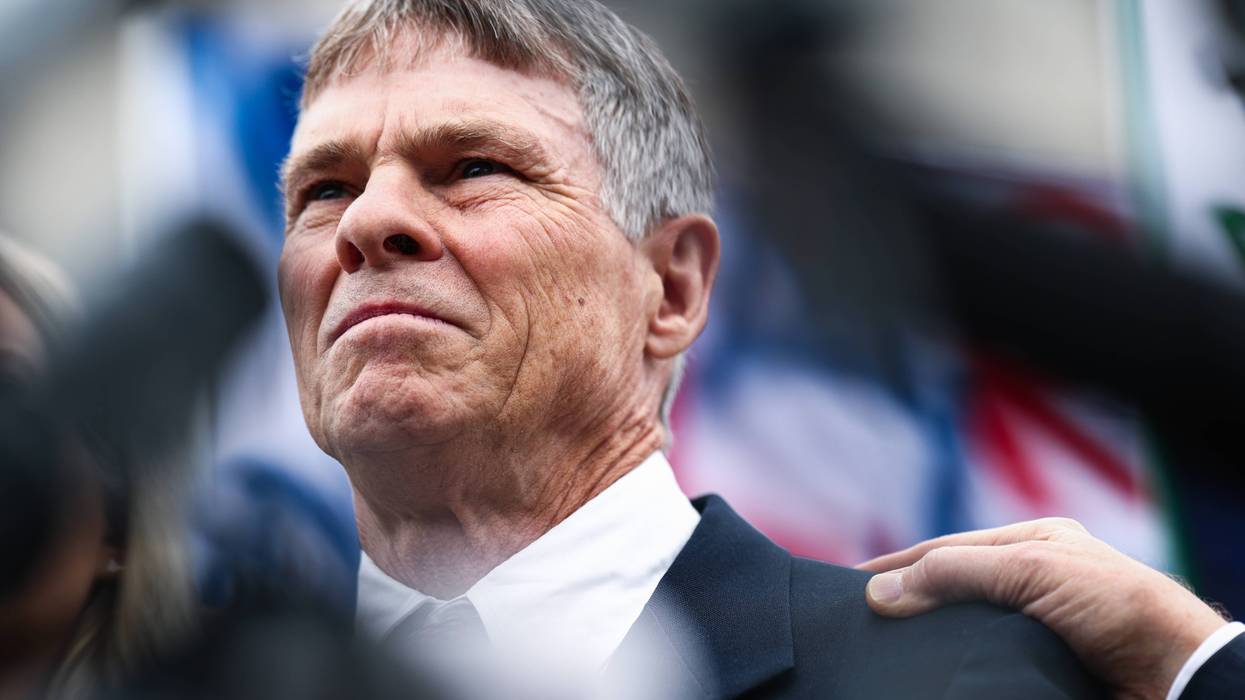
As supporters gathered outside the courthouse in support, former Olympic canoe racer David "Davey" Hearn pleaded not guilty on Thursday after being charged by the Trump administration with vandalizing the Lincoln Memorial Reflecting Pool.
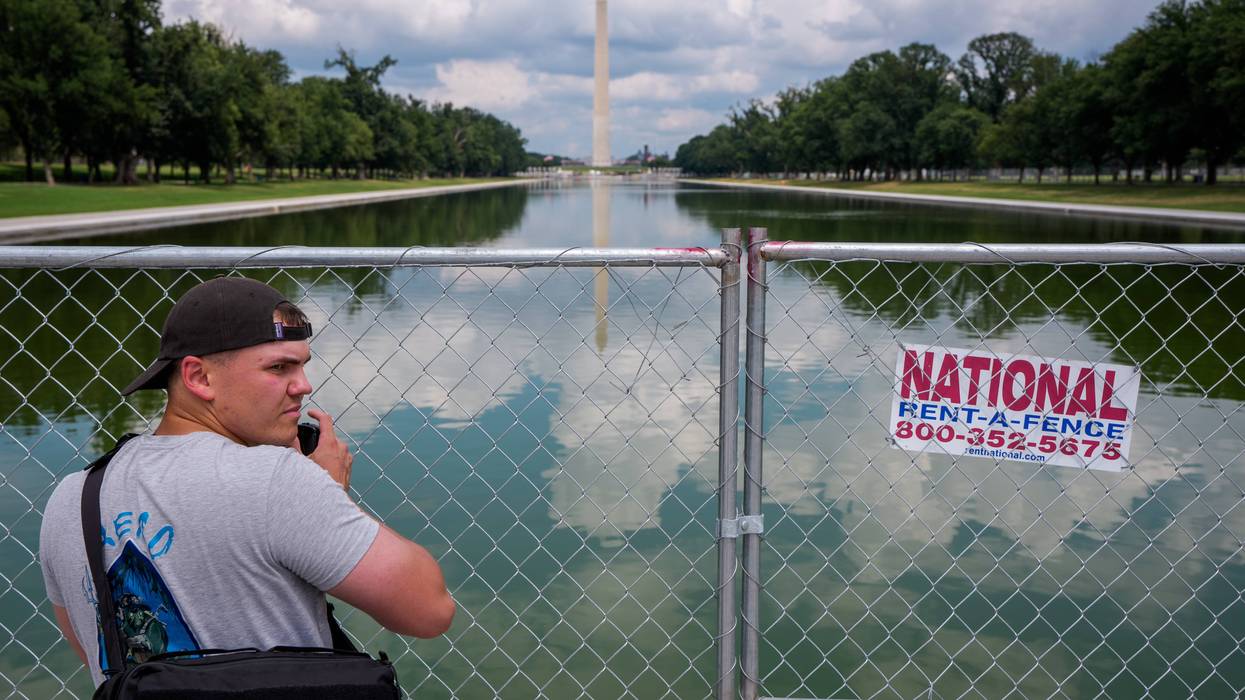
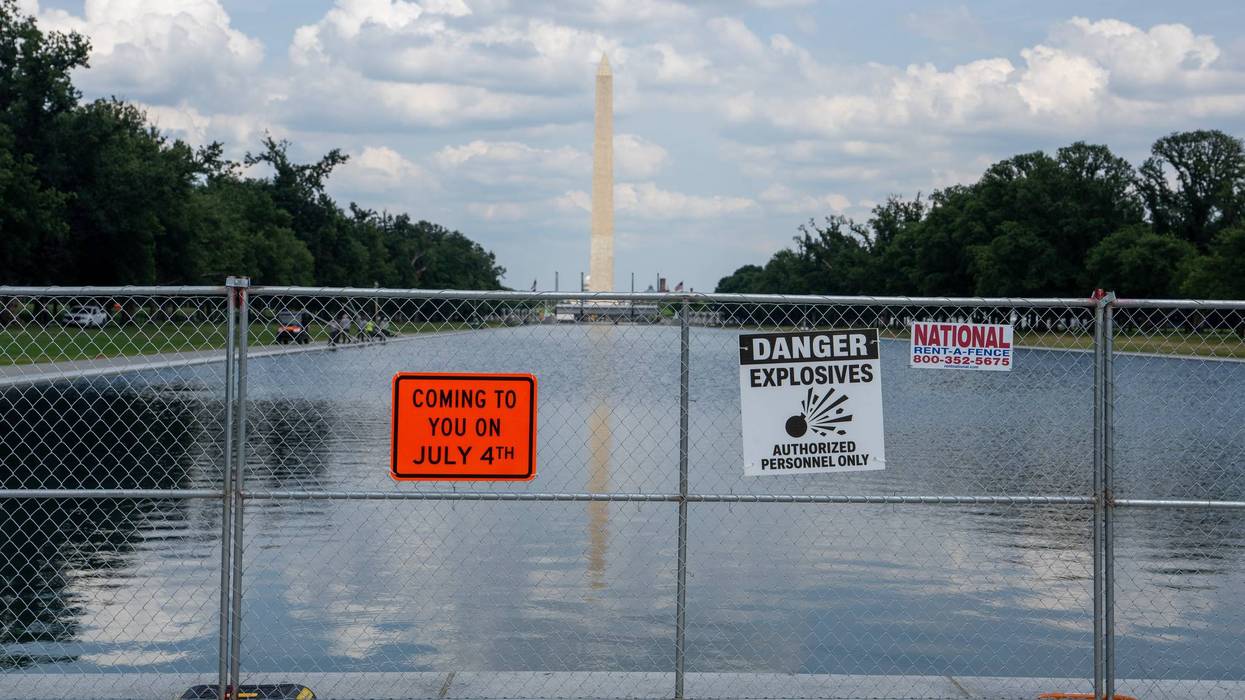
Last week, Jeanine Pirro, the US Attorney for the District of Columbia, secured a criminal indictment for property destruction against the 67-year-old Hearn for allegedly “forcefully and violently pulling up and removing the bottom liner” of the pool in June.
Hearn, who could face up to 10 years in prison if convicted, has said he was not vandalizing the pool and was simply pulling up a piece of the lining that had already begun to peel off.
"Today, Davey Hearn pled not guilty—because he is not guilty," said his attorney, Norm Eisen. "If Mr. Hearn can be charged with a felony for touching the Reflecting Pool, every American is at risk, and every American should be alarmed about this prosecution."
As he attempted to renovate the Reflecting Pool in the lead-up to the nation's 250th anniversary on July 4, President Donald Trump alleged that the scourge of algae blooms and peeling lining that have plagued the pool were caused by vandals, though he has provided little evidence.
The White House has claimed that at least seven people have been arrested for vandalism, though it provided no public information about other cases.
The company that installed the blue coating had previously worked at a Trump golf club, and the company that installed the water-cleaning system was owned by an investment firm led by a reported top Trump donor. Both received no-bid contracts awarded by the Department of the Interior.
Eisen said that the attempt to prosecute Hearn "reflects the administration's effort to scapegoat Davey and to shift blame for their own failures."
Hearn previously told The Associated Press that he was detained by National Guard troops and US Park Police for five hours after he reached into the pool to examine the newly peeled lining and briefly touched a piece of it. The canoeist said he let go of the lining as soon as he was told to do so by a park employee.
"It is not a crime to touch the Reflecting Pool," Eisen said.
Ryan Goodman, the co-editor-in-chief of Just Security, has said Hearn's indictment fits a "pattern of abuse of power" by Pirro, who was plucked from her previous job as a pro-Trump Fox News host to become DC's top prosecutor last year.
Goodman noted that, in a similar fashion to Pirro's use of the law against Trump's enemies, like the investigation into former Federal Reserve Chair Jerome Powell and the attempt to prosecute members of Congress who encouraged the military not to obey unlawful orders, the indictment against Hearn came immediately after Trump posted on Truth Social that he should spend "years in jail."
"Here we have it again," he said. "It's in lock-step with the president on this particular instance in which it seemed like authorities thought this was just a misdemeanor in the first instance. It smells really bad."
As Hearn was arraigned Thursday morning, dozens of supporters, including former Olympians, gathered outside the DC Superior Court at a "Free Davey!" rally to show solidarity.
Adam Van Grack, who chaired the Olympic national governing body for canoe and kayak sports and was coached by Hearn, described his former mentor as "someone who has spent decades giving back to athletes, to our community, and to our nation."
Van Grack noted Hearn's decades of volunteer work to maintain property owned by the US National Park Service that canoeists used for training.
“This is a person who has devoted his life to representing the United States on an international stage, caring for the community and protecting and caring for National Park Service property,” Van Grack said. “So the idea that he is a malicious destroyer of federal property shocks the conscience and makes no sense to anybody who’s ever known Davey Hearn.”
"What happened to Adrián Rengel is government-sanctioned torture and a failure to recognize his humanity because he happened to be an immigrant."
One of the more than 200 Venezuelan men whom US President Donald Trump sent to a notorious prison in El Salvador last year, Neiyerver Adrián León Rengel, sued the United States of America in a federal court on Tuesday, seeking $1.3 million in damages.
León Rengel entered the United States at a port of entry in June 2023, during the Biden administration, for a pre-scheduled appointment, at which "he underwent screenings and provided his biometrics," according to the complaint, filed in Washington, DC. He was released and scheduled to appear before an immigration judge in April 2028.
However, the filing details, after Trump returned to office, León Rengel "was wrongly identified as a member of the gang Tren de Aragua (TDA), repeatedly denied due process, falsely imprisoned, intentionally deceived, and—ultimately—illegally sent to El Salvador in blatant violation of a court order."
León Rengel was sent to El Salvador's Terrorism Confinement Center (CECOT), where Human Rights Watch found deportees were subjected to "systematic torture."
He told CBS News in Spanish that "there came a point when I thought about hanging myself with the sheet they gave us... It was hell. Total hell."
As CBS—which eventually aired an investigation into the prison despite interference from editor-in-chief Bari Weiss—reported Tuesday:
León Rengel was arrested once in the US after a traffic stop and pleaded guilty to a misdemeanor for possession of drug paraphernalia in Texas, documents show. León Rengel said the car where the material was found was not his. He said he paid a small fine.
Beyond that misdemeanor, León Rengel's lawyers said he has no criminal history, and that he was deported despite having an active immigration case and lacking a deportation order. Justice Department records reviewed by CBS News do not list a deportation order for León Rengel and show he had an immigration court hearing scheduled for April 2028.
León Rengel said he was identified as a Tren de Aragua gang member because of a tattoo on his left hand of a lion with a hair clipper on its mouth. He said he has cut hair in the US and Venezuela, and denies having any gang ties. Other former CECOT prisoners have similarly said they were accused of gang membership because of their tattoos.
DHS told the network that "this illegal alien was deemed a public safety threat as a confirmed associate of the Tren de Aragua gang and processed for removal from the US." The department declined to provide any evidence to support its claim that he is a TDA member, saying that doing so would "undermine" national security.
León Rengel was ultimately freed from CECOT and returned to Venezuela as part of a prisoner swap last summer. He is the first of the deportees to file such a lawsuit under the Federal Tort Claims Act.
"This case reveals an illegal and morally bereft plan of action at the highest levels of our government to defy a federal court, strip a man of his rights, and hand him over to a foreign government for torture to prove a political point," said retired Amb. Norm Eisen, co-founder and executive chair of Democracy Defenders Fund, in a statement.
"Adrián Rengel spent four months in abhorrent, inhumane conditions because senior officials chose to flout the rule of law," he continued. "We are filing suit today to get justice for him. The rule of law applies no matter what the political aims of the administration."
In addition to Eisen's group, León Rengel is represented by the law firm Mariziani, Stevens & Gonzalez, with support from the League of United Latin American Citizens (LULAC).
"What happened to Adrián Rengel is government-sanctioned torture and a failure to recognize his humanity because he happened to be an immigrant. He deserves his day in court," said LULAC CEO Juan Proaño. "His four months of illegal confinement is the devastating outcome of a system designed to treat Latino immigrants as criminals simply because of where they were born or the color of their skin."
"Rengel and others were stripped of due process, lied to about where they were being sent, and handed over to a foreign dictatorship to be tortured in America's name," Proaño added. "The United States government had the power to stop this, and they chose not to. The court should deliver the justice the executive branch intentionally denied him."
Trump may try to push "oddball, ludicrous, unconstitutional theories" to keep the GOP in power, one Democratic attorney general said.
Democratic state attorneys general across the US are preparing for President Donald Trump to take unprecedented actions to interfere with the 2026 midterm elections.
As reported by Politico on Monday, the Democratic AGs have been conducting war games aimed at countering "a series of increasingly extreme scenarios" where Trump tries to block Democrats from retaking the US House of Representatives later this year.
Among the many possibilities that the AGs are preparing for are that the Trump administration orders the seizure of ballots and voting machines, defunds the post office to block the delivery of mail-in ballots, and sends federal immigration enforcement officials or even the US military to patrol polling places.
The AGs have also been carefully monitoring Trump officials' rhetoric for hints of future election subversion plots, such as when US Homeland Security Secretary Kristi Noem said recently that the US Department of Homeland Security (DHS) would "make sure we have the right people voting, electing the right leaders."
Washington Attorney General Nick Brown told Politico that such statements are a "red-alarm fire that people need to take very seriously," and emphasized that Democrats need to be ready for the president to commit outright crimes to keep the GOP in power.
"He will try anything,” warned Brown. "We have to just sort of think creatively about: If you were the president and you were trying to invalidate an election or undermine an election, what are the oddball, ludicrous, unconstitutional theories that you might advance?"
In addition to Noem's comments about DHS getting involved in elections, Trump ally Steve Bannon has floated sending US Immigration and Customs Enforcement (ICE) officials to monitor polling places, while Trump in January said that "we shouldn’t even have an election" this year.
California Attorney General Rob Bonta told Politico that it was "sad and tragic" that his office had to take such preparations, but said it was necessary because the president "wants to continue to have his party prevail, seemingly by whatever means necessary."
Michigan Attorney General Dana Nessel pointed to the recent FBI seizure of materials related to the 2020 election from Fulton County, Georgia as a sign of what's to come during the midterm elections.
"We recognize that what happened in Fulton County could happen in Detroit," she said. "Not because there’s any merit to claims that anything wrong happened in Detroit, but because we know that those claims will be made again."
Politico also reported on Monday that Democracy Defenders Action has recruited Rep. LaMonica McIver (D-NJ) to deliver a "State of Our Democracy" speech on Tuesday ahead of Trump's State of the Union address where she will outline the threats the president and his administration pose to Americans' voting rights.
Norm Eisen, executive chairman of Democracy Defenders Action, told Politico that the speech was necessary because "the threats facing our democracy have never been greater."
"The Constitution gives this authority to the states and Congress, not you!" said the head of Democracy Defenders Fund, threatening a lawsuit.
US President Donald Trump continued his "authoritarian takeover of our election system" over the weekend, threatening an executive order requiring every voter to present identification, which experts swiftly denounced as clearly "unconstitutional."
"Voter I.D. Must Be Part of Every Single Vote. NO EXCEPTIONS!" Trump wrote on his Truth Social platform late Saturday. "I Will Be Doing An Executive Order To That End!!! Also, No Mail-In Voting, Except For Those That Are Very Ill, And The Far Away Military. USE PAPER BALLOTS ONLY!!!"
Less than two weeks ago, Trump declared on the platform that "I am going to lead a movement to get rid of MAIL-IN BALLOTS, and also, while we're at it, Highly 'Inaccurate,' Very Expensive, and Seriously Controversial VOTING MACHINES." He claimed, without evidence, that voting by mail leads to "MASSIVE VOTER FRAUD," and promised to take executive action ahead of the 2026 midterms.
Those posts came as battles over his March executive order (EO), "Preserving and Protecting the Integrity of American Elections," are playing out in federal court. The measure was largely blocked by multiple district judges, but the president is appealing.
Trump's voter ID post provoked a new threat of legal action to stop his unconstitutional attacks on the nation's election system.
"Go ahead, make my day Mr. Trump," said Norm Eisen, who co-founded Democracy Defenders Fund and served as White House special counsel for ethics and government reform during the Obama administration.
"We at Democracy Defenders Fund immediately sued you and got an injunction on your first voting EO," he noted. "We will do the same here if you try it again. The Constitution gives this authority to the states and Congress, not you!"
In addition to pointing out that Trump is "an absentee voter himself," Democracy Docket explained Sunday that "the US Constitution gives the states the primary authority to regulate elections, while empowering Congress to 'at any time by Law make or alter such Regulations.' The Framers never considered authorizing the president to oversee elections."
According to the National Conference of State Legislatures: "Thirty-six states have laws requesting or requiring voters to show some form of identification at the polls. The remaining 14 states and Washington, DC use other methods to verify the identity of voters."
Those laws already prevent Americans from participating in elections, according to the Brennan Center for Justice at New York University School of Law.
"Overly burdensome photo ID requirements block millions of eligible American citizens from voting," the center's voter ID webpage says. "As many as 11% of eligible voters do not have the kind of ID that is required by states with strict ID requirements, and that percentage is even higher among seniors, minorities, people with disabilities, low-income voters, and students."
"This case is a milestone in pushing back on Musk and DOGE's illegality," said Norm Eisen of the State Democracy Defenders Fund.
A U.S. judge on Tuesday barred the Trump administration-created Department of Government Efficiency from taking "any actions relating" to the federal international aid agency it began pushing to dismantle in February, and said "special government employee" Elon Musk likely acted unconstitutionally "in multiple ways" by moving to shut down the agency.
In Maryland, U.S. District Judge Theodore Chuang ruled in favor of 26 current and former employees of the U.S. Agency for International Development (USAID), one of the earliest targets of Musk's push to slash government spending and fire tens of thousands of civil servants. Chuang ordered DOGE to restore email, payment, and system access to all current USAID employees.
The workers are being represented by the State Democracy Defenders Fund, and have accused Musk of acting unconstitutionally.
"Today's decision is an important victory against Elon Musk and his DOGE attack on USAID, the United States government, and the Constitution," said Norm Eisen, executive chair of the group. "They are performing surgery with a chainsaw instead of a scalpel, harming not just the people USAID serves but also the majority of Americans who count on the stability of our government. This case is a milestone in pushing back on Musk and DOGE's illegality."
Chuang is one of several federal judges who have blocked President Donald Trump and Musk's actions ostensibly aimed at improving "efficiency" and eliminating waste in the federal government; other judges have blocked the president's freezing of federal grants and loans, his invocation of the Alien Enemies Act, and his order attacking diversity, equity, and inclusiveness programs.
But Chuang's ruling reportedly marks the first time a judge has ruled that Musk should likely be required to be confirmed by the U.S. Senate under the Constitution's appointments clause.
"The record of his activities to date establishes that his role has been and will continue to be as the leader of DOGE, with the same duties and degree of continuity as if he was formally in that position,'" wrote Chuang.
The State Democracy Defenders Fund noted Tuesday that "the Constitution's appointments clause only gives those powers to people nominated by the president and confirmed by the U.S. Senate, neither of which applies to Musk. Since Musk's role as the de facto DOGE administrator constitutes the performance of significant governmental duties that should only be handled by duly appointed officers of the United States, the plaintiffs ultimately seek a permanent injunction preventing Musk and his team from continuing their roles."
The Trump administration has claimed Musk is only an adviser to the president and is not the administrator of DOGE, which has spearheaded efforts to shut down agencies including the Department of Education and the Consumer Financial Protection Bureau (CFPB), and to fire federal employees across agencies.
"If a president could escape appointments clause scrutiny by having advisers go beyond the traditional role of White House advisers who communicate the president's priorities to agency heads and instead exercise significant authority throughout the federal government so as to bypass duly appointed officers, the appointments clause would be reduced to nothing more than a technical formality," the judge said.
Chuang rejected the claim that DOGE's actions are not being directed by Musk, saying the Tesla CEO and Trump megadonor appeared to have been involved in closing the CFPB and to "have taken other unilateral actions without any apparent authorization from agency officials."
"The evidence presently favors the conclusion that contrary to defendants' sweeping claim that Musk acted only as an adviser, Musk made the decisions to shut down USAID's headquarters and website even though he 'lacked the authority to make that decision,'" Chuang said, quoting an argument from the Trump administration.
Mimi Marziani of Marziani, Stevens & Gonzalez PLLC, which helped defend the USAID workers in court, said the plaintiffs "are regular Americans who have faithfully served our country and the public good but have had their lives turned upside down because Musk wants to play master of the universe."
"We are proud to stand up for the plaintiffs and the Constitution," said Marziani, "which is designed to guard against these very sorts of abuses because our nation depends upon a government for all, not for a few."
"It's increasingly clear that we're entering a modern McCarthy moment," said the head of the ACLU.
U.S. President Donald Trump's campaign-like speech at the Department of Justice on Friday sparked a fresh wave of alarm over the Republican's attacks on his critics, disrespect for the rule of law, and plans for his second term.
Trump—who was convicted of 34 felonies in New York before returning to the White House—slammed his perceived opponents as "scum" and "thugs," called efforts to hold him accountable for alleged criminal activity "bullshit," and declared: "We will expel the rogue actors and corrupt forces from our government. We will expose... their egregious crimes and severe misconduct."
Trump's appearance with U.S. Attorney General Pam Bondi and props promoting drug enforcement displayed his intent to remake the federal judiciary and fueled speculation that he will appoint Florida-based District Judge Aileen Cannon, who dismissed the classified documents case against him, to the nation's Supreme Court.
"Some of the most hallowed halls of justice in America were disgraced by the president of the United States, who has inappropriately installed his personal lawyers and other loyalists into leadership roles at the Department of Justice," said Lena Zwarensteyn, senior director of the fair courts program and an adviser at the Leadership Conference on Civil and Human Rights.
"This reinforces what we knew: The independence of the department has been compromised. During his remarks, the president sought to undermine faith in our judicial system, attacked lawyers who support due process and the rule of law, and made it clear that he expects the attorney general and other leaders to use the full force and resources of the Justice Department to roll back our civil and human rights, target his enemies, and operationalize a worldview that perpetuates white supremacy," she said. "The anti-immigrant rhetoric that both he and the attorney general used was reprehensible and unacceptable."
Zwarensteyn stressed that "in our democracy, Justice Department lawyers—including the attorney general—are the people's lawyers, not the president's lawyers, and they have a sacred duty to enforce our nation's laws without prejudice and with an eye toward justice. The DOJ must be seen by the public—every member, from every community—as fair and independent arbiters of our legal system. Today's appearance at the DOJ by the president, during which he thanked and called out his appointees and personal lawyers, will further tarnish the public's trust of the department and undermine our democracy."
"This cannot be the way that the DOJ—the nation's signature agency for the enforcement of our federal civil rights laws—functions moving forward. We need a DOJ that is working for the people, not the president, and we demand better of our federal government and its leaders," she concluded, calling on the Senate to reject his nomination of Harmeet Dhillon to a key department post.
One of Trump's targets during the speech was Norm Eisen, who was involved with the president's first impeachment and previously served as White House special counsel for ethics and government reform, U.S. ambassador to the Czech Republic, and board chair of the watchdog Citizens for Responsibility and Ethics in Washington (CREW).
Eisen responded with a video on social media, highlighting his work with State Democracy Defenders Action, which he co-founded.
ACLU executive director Anthony Romero said in a statement that "Ambassador Norman Eisen is a great American patriot, with an extraordinary career in public service. He has served the American people for decades inside and outside of government. He has worked to defend democracy at home and abroad."
"It is a sad day when the president of the United States personally attacks an individual of such character," Romero continued. "When charitable organizations like CREW, the ACLU, and others sue the federal government to uphold the law, we are playing a vital role in upholding American values."
The ACLU leader also warned that "it's increasingly clear that we're entering a modern McCarthy moment. When the government is targeting a former ambassador, a legal permanent resident, law firms, and even universities and treating them like enemies of the state, it is a dark day for American democracy."
Since Trump returned to power in January, his administration has not only empowered billionaire Elon Musk to dismantle the federal government but also targeted news outlets, student protesters, and education institutions while signaling a willingness to ignore court orders—fueling calls for Congress to hit him with a historic third impeachment.
"Hasn't Trump delayed accountability long enough?" asked Norm Eisen of the Brookings Institution.
Arguments from lawyers for President-elect Donald Trump in a legal filing made public Monday amounted to "nonsense," said longtime legal analyst Norm Eisen, as the Republican leader attempts to avoid a sentencing that would cement his status later this month as the first convicted felon to serve as president of the United States.
Trump's attorneys filed a "notice of automatic stay" three days after New York Supreme Court Justice Juan Merchan upheld the president-elect's criminal conviction of 34 counts of falsifying business documents. The case—one of four pending criminal cases against Trump while he ran for president last year—pertains to a $130,000 hush-money payment made to adult film actress Stormy Daniels just before Trump's 2016 electoral victory.
In upholding the conviction, Merchan rejected Trump's motion to vacate a New York jury's guilty verdict last May and scheduled his sentencing for January 10.
On Monday, lawyers Todd Blanche and Emil Bove—who are also Trump's nominees for deputy attorney general and assistant to the deputy attorney general—claimed the case should be paused because of a U.S. Supreme Court ruling last summer which gave presidents broad immunity for "official acts" they take.
"I call BS," said Eisen, a senior fellow at the Brookings Institution, explaining on the social media platform X that presidential immunity "does not apply here" because the case pertains to events that took place before Trump was first elected president.
Trump's claim that he should enjoy "sitting-president immunity" is also "nonsense," said Eisen, as he has not been the sitting president since January 2021 and won't be again until January 20, 10 days after the scheduled sentencing.
"His claim that sitting-president immunity extends into the transitional period while he is 'president-elect' is nonsense," said Eisen. "There's no such doctrine in American law. He's making this up."
Blanche and Bove demanded that Merchan indicate by 2:00 pm on Monday whether he would block the sentencing.
"Lawyers don't impose deadlines on judges; it's the other way around," said MSNBC legal analyst Kristy Greenberg. "But that didn't stop Trump's lawyers from giving Judge Merchan a deadline of TODAY at 2:00 pm to say whether he'll proceed with 1/10 sentencing, or else they will file an emergency appeal."
A spokesperson for the district attorney's office told The Washington Post that the judge was expected to file a response Monday.
In the filing, Eisen said, "Trump argues that 'further criminal proceedings are automatically stayed by operation of federal constitutional law.'"
"Wrong again!" he wrote. "There is no automatic stay. He's making this shit up as he goes along."
"Hasn't Trump delayed accountability long enough?" said Eisen. "You know if he gets this stay, his sentencing will never occur. I strongly oppose a stay—and so does the interest of justice."
The 9-0 ruling which reverses a decision by the Colorado Supreme Court, warned one pro-democracy watchdog, "undermines the integrity of our Constitution and emboldens those seeking to disrupt and dismantle our democratic systems."
The U.S. Supreme Court delivered Republican presidential candidate Donald Trump a resounding legal victory on Monday by rejecting a push by Colorado voters to have him disqualified from the state's ballot under a clause of the 14th Amendment on the grounds that the former president was guilty of insurrection due to his actions leading up to and on January 6, 2021.
Though the Colorado Supreme Court last year ruled in favor of the argument to exclude Trump in this year's election, Monday's 9-0 ruling said, "Because the Constitution makes Congress, rather than the States, responsible for enforcing Section 3 [of the 14th Amendment] against federal officeholders and candidates, we reverse."
The decision by the nation's highest court was unanimous, though Justices Sonia Sotomayor, Elana Kagan, and Ketanji Brown Jackson—the three remaining liberals on the Court—signed a concurring opinion in the judgment, indicating a varied reason for supporting the underlying decision. In addition to Colorado, officials in Maine and Illinois have moved to remove Trump from the ballot.
"The Supreme Court couldn't exonerate Trump because the evidence of his guilt was overwhelming, so instead the Justices neutered our Constitution's built-in defense against insurrectionists and said the facts don't matter."
Supporters of the effort to disqualify Trump from seeking public office due to his insurrectionary words and deeds following his loss in the 2020 election, which he refused to accept, condemned Monday's ruling.
"This decision is disgraceful," said Ron Fein, legal director of Free Speech For People (FSFP), which pioneered the first litigation under Section 3 of the 14th Amendment and co-led the successful Illinois challenge. "The Supreme Court couldn't exonerate Trump because the evidence of his guilt was overwhelming, so instead the Justices neutered our Constitution's built-in defense against insurrectionists and said the facts don't matter."
Legal experts said the ruling did not hinge on the question of whether or not Trump was, in fact, guilty of insurrection but only that Colorado was not qualified to invoke the 14th Amendment.
"Yes, the Supreme Court ruled for Trump based on only Congress having the power to enforce the 14th amendment," said Norm Eisen, senior fellow at the Brookings Institute and an outspoken Trump critic. "But just as important as what they did is what they didn't do. They did not expressly challenge that he was an insurrectionist—and the concurrence emphasizes that finding."
Nonetheless, Common Cause called the ruling a "major setback for democracy" that sets a worrying precedent.
"This decision undermines the integrity of our Constitution and emboldens those seeking to disrupt and dismantle our democratic systems. For over 200 years, all but one of our leaders have abided by the Constitution and practiced the peaceful transfer of power," said Kathay Feng, the group's vice president of programs.
"This ruling reverses the Colorado Supreme Court’s decision, and with it, green lights future presidents to intimidate, threaten, and attack Congress into obedience," Feng added. "Our Constitution depends on checks and balances. Removing states as a check on tyrannical presidents threatens the future of our democracy."
In its statement, FSFP similarly said the ruling was "dangerous" as it "encourages Trump–and those who follow his example–to engage in more insurrections and disregard more broadly the Constitution."
"As one Senator explained in 1866 when advocating for Section 3, 'the man who has once violated his oath will be more liable to violate his fealty to the Government in the future,'" the group noted. "The framers of the Fourteenth Amendment learned this lesson in blood, and gave us Section 3 to prevent a repeat. With today's ruling, the Supreme Court has utterly failed in its duty to uphold this constitutional mandate at this critical moment in history."
The agreement "is a step in the right direction for security," said one observer, "but that's not the only area where AI can cause harm."
Like an executive order introduced by U.S. President Joe Biden last month, a global agreement on artificial intelligence released Sunday was seen by experts as a positive step forward—but one that would require more action from policymakers to ensure AI isn't harmful to workers, democratic systems, and the privacy of people around the world.
The 20-page agreement, first reported Monday, was reached by 18 countries including the U.S., U.K., Germany, Israel, and Nigeria, and was billed as a deal that would push companies to keep AI systems "secure by design."
The agreement is nonbinding and deals with four main areas: secure design, development, deployment, and operation and maintenance.
Policymakers including the director of the U.S. Cybersecurity and Infrastructure Security Agency, Jen Easterly, forged the agreement with a heavy focus on keeping AI technology safe from hackers and security breaches.
The document includes recommendations such as implementing standard cybersecurity best practices, monitoring the security of an AI supply chain across the system's life cycle, and releasing models "only after subjecting them to appropriate and effective security evaluation."
"This is the first time that we have seen an affirmation that these capabilities should not just be about cool features and how quickly we can get them to market or how we can compete to drive down costs," Easterly told Reuters. The document, she said, represents an "agreement that the most important thing that needs to be done at the design phase is security."
Norm Eisen, senior fellow at the think tank Brookings Institution, said the deal "is a step in the right direction for security" in a field that U.K. experts recently warned is vulnerable to hackers who could launch "prompt injection" attacks, causing an AI model to behave in a way that the designer didn't intend or reveal private information.
"But that's not the only area where AI can cause harm," Eisen said on social media.
Eisen pointed to a recent Brrokings analysis about how AI could "weaken" democracy in the U.S. and other countries, worsening the "flood of misinformation" with deepfakes and other AI-generated images.
"Advocacy groups or individuals looking to misrepresent public opinion may find an ally in AI," wrote Eisen, along with Nicol Turner Lee, Colby Galliher, and Jonathan Katz last week. "AI-fueled programs, like ChatGPT, can fabricate letters to elected officials, public comments, and other written endorsements of specific bills or positions that are often difficult to distinguish from those written by actual constituents... Much worse, voice and image replicas harnessed from generative AI tools can also mimic candidates and elected officials. These tactics could give rise to voter confusion and degrade confidence in the electoral process if voters become aware of such scams."
At AppleInsider, tech writer Malcolm Owen denounced Sunday's agreement as "toothless and weak," considering it does not require policymakers or companies to adhere to the guidelines.
Owen noted that tech firms including Google, Amazon, and Palantir consulted with global government agencies in developing the guidelines.
"These are all guidelines, not rules that must be obeyed," wrote Owen. "There are no penalties for not following what is outlined, and no introduction of laws. The document is just a wish list of things that governments want AI makers to really think about... And, it's not clear when or if legislation will arrive mandating what's in the document."
European Union member countries passed a draft of what the European Parliament called "the world's first comprehensive AI law" earlier this year with the AI Act. The law would require AI systems makers to publish summaries of the training material they use and prove that they will not generate illegal content. It would also bar companies from scraping biometric data from social media, which a U.S. AI company was found to be doing last year.
"AI tools are evolving rapidly," said Eisen on Monday, "and policymakers need to keep up."