

SUBSCRIBE TO OUR FREE NEWSLETTER
Daily news & progressive opinion—funded by the people, not the corporations—delivered straight to your inbox.
5
#000000
#FFFFFF
To donate by check, phone, or other method, see our More Ways to Give page.
Daily news & progressive opinion—funded by the people, not the corporations—delivered straight to your inbox.
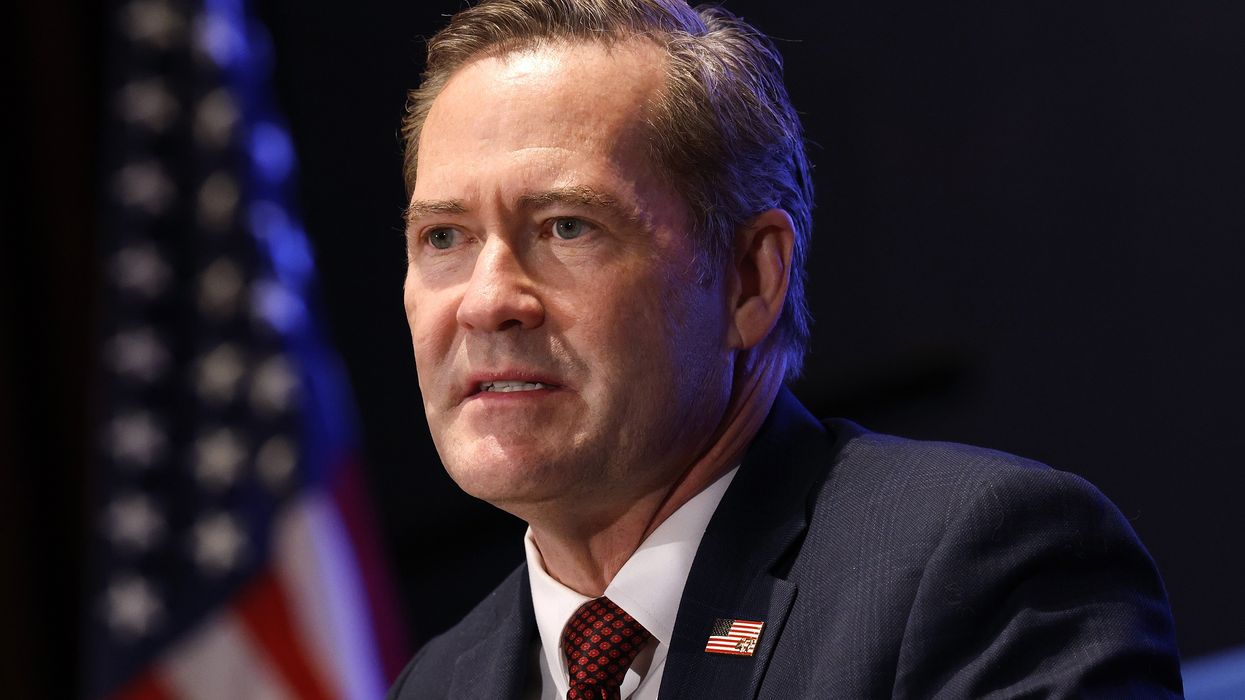
"Now Waltz can share sensitive U.S. military secrets on Signal chats with not just journalists—but all 193 countries of the world."
Political observers had assumed Thursday that White House officials deemed National Security Adviser Michael Waltz unqualified for a top Trump administration position after he was fired following the "Signalgate" scandal.
But in what one analyst called a "surprise twist," Waltz's dismissal actually freed him up for another high-level role: that of United Nations ambassador.
Soon after sources leaked the news that Waltz had been dismissed, President Donald Trump announced on his Truth Social platform that he was nominating the national security adviser to be his ambassador.
Waltz was removed from the national security position in the wake of the scandal that's also embroiled Defense Secretary Pete Hegseth and other administration officials.
He organized a group chat on the commercial messaging app Signal in which officials discussed plans to bomb Yemen in March and inadvertently added the journalist Jeffrey Goldberg to the discussion.
It was later reported that Waltz and his staff had created at least 20 group chats using the app to discuss sensitive foreign policy issues, prompting calls for his resignation.
"Now Waltz can share sensitive U.S. military secrets on Signal chats with not just journalists—but all 193 countries of the world," said lawyer and commentator Tristan Snell after the new nomination was announced.
Journalist Jamie Dupree noted that when Waltz meets with senators for his confirmation hearings, he is likely to face "all sorts of questions about the Signalgate episode" from Democrats.
In his announcement, Trump said Waltz "has worked hard to put our nation's interests first" and expressed confidence that he will do the same as U.N. ambassador. He named Secretary of State Marco Rubio as Waltz's temporary replacement as national security adviser.
Trump previously named Rep. Elise Stefanik (R-N.Y.) to be his U.N. ambassador but withdrew her nomination in March, citing the Republicans' narrow majority in the House.

"Firing Waltz is an admission of guilt by the administration about the leaking of classified war plans," said one Democratic strategist. "They have to fire Hegseth now."
U.S. National Security Adviser Michael Waltz and a top deputy have been fired from the Trump administration, with more dismissals expected imminently in the wake of the "Signalgate" scandal, insiders familiar with the decision told multiple major media outlets on Thursday.
Fox News confirmed that Waltz and his deputy Alex Wong were fired Thursday, and that more staffers are likely to be terminated. Calls for Waltz's resignation mounted amid revelations that the former Republican congressman and members of his staff created at least 20 group chats on the encrypted messaging application Signal to coordinate official work on sensitive foreign policy issues.
"Waltz's firing is just the beginning of the overdue accountability that the American people."
In one of the most egregious incidents of the scandal, Waltz, Defense Secretary Pete Hegseth, and other top Trump administration officials added a journalist to a Signal group chat about plans to bomb Yemen.
"I take full responsibility. I built the group," Waltz acknowledged in a March 25 Fox News interview. "It's embarrassing. We're going to get to the bottom of it."
It was later revealed that Hegseth shared Yemen war plans in a second private group chat whose members included relatives and his personal lawyer.
It is unclear who will replace Waltz. Steve Witkoff—President Donald Trump's special envoy to the Middle East—is considered a top contender for the job.
Trump publicly defended Waltz and his national security team throughout the scandal, telling reporters last month that they've "had big success with the Houthis," the Yemeni rebel group targeted by U.S.-led airstrikes that have killed and wounded hundreds of people, reportedly including more than 150 civilians and scores of African migrants at a detention center.
Waltz appeared on
Fox News' "Fox and Friends" just hours before he was sacked, lavishing praise upon Trump and Hegseth:
Mike Waltz was on Fox & Friends just hours before his firing slathering praise on Trump and Pete Hegseth
[image or embed]
— Aaron Rupar ( @atrupar.com) May 1, 2025 at 8:17 AM
Responding to Waltz's ouster, U.S. Sen. Elizabeth Warren (D-Mass.) took a sardonic swipe at Hegseth on social media.
"Pete Hegseth shows real leadership by passing the blame to Mike Waltz," she wrote. "Was it Waltz who set up Signal on Hegseth's office computer and added his wife, brother, and lawyer in a war plan group chat?"
Democratic strategist Mike Nellis also zeroed in on the defense secretary,
writing on the social media site X that "firing Waltz is an admission of guilt by the administration about the leaking of classified war plans."
"They have to fire Hegseth now—especially after he leaked to his wife, brother, and personal attorney," Nellis added. "Complete shitshow."
Sean Vitka, executive director of the online activist group Demand Progress, said that Waltz' firing underscores the need for a Signalgate probe—which Republicans in the House of Representatives blocked on Tuesday.
"Waltz, and Defense Secretary Hegseth, put our service members and national security at risk by recklessly chatting about imminent military plans on channels that could have been spied on by foreign adversaries—channels that Waltz compromised with his incompetence," Vitka continued.
"Waltz's firing is just the beginning of the overdue accountability that the American people, including our men and women in uniform, deserve," he added. "Congress must demand answers about how our military was exposed like this, and why."
Democratic Minnesota Gov. Tim Walz, who was former Vice President Kamala Harris' 2024 running mate, responded to Waltz's dismissal in six words on social media.
"Mike Waltz has left the chat," he said.

"There must be accountability for this administration's dangerous disregard for our national security," said one Democratic congressman and former military prosecutor.
U.S. National Security Adviser Mike Waltz and members of his staff have created at least 20 group chats on the encrypted messaging app Signal to coordinate official work on sensitive policy issues around the world, four people who were added to such groups told Politico.
Waltz was already under fire for a group chat about the U.S. bombing Yemen when the report broke. Politico's Dasha Burns wrote on Wednesday that "none of the four individuals said they were aware of whether any classified information was shared, but all said that posts in group chats did include sensitive details of national security work."
The anonymous sources told Politico that the group chats involved policy issues involving China, Ukraine, Gaza, the Middle East, Europe, and Africa. One of them said, "It was commonplace to stand up chats on any given national security topic," one of the four sources told the outlet.
The Politico article comes a day after The Washington Post reported that Waltz and other members of President Donald Trump's National Security Council conducted official government business via their personal Gmail accounts, which are far less secure than Signal chats.
The fresh revelations also come as "Signalgate"—in which Waltz, Defense Secretary Pete Hegseth, and other top Trump administration officials added a journalist to a Signal group chat about plans to bomb Yemen—still smolders.
Calls for Waltz's resignation or firing, which were already numerous in the wake of Signalgate, mounted Wednesday.
Resign.
[image or embed]
— Senator Ed Markey ( @markey.senate.gov) April 2, 2025 at 2:26 PM
"Waltz must resign. Hegseth must resign," Rep. Ted Lieu (D-Calif.), a member of the House Foreign Affairs Committee, said on the social media site Bluesky. "There must be accountability for this administration's dangerous disregard for our national security."
Referring to the Signal group chats, Rep. Jimmy Gomez (D-Calif.) asked on the social media site X, "How many more are there?"
"Even Trump allies say this doesn't pass the smell test," he added. "National Security Adviser Waltz and Pete Hegseth need to be fired."
Beginning in March of 2017 and for the following eight years, at 11:00 a.m. on every Saturday morning, a group of New Yorkers has assembled in Manhattan’s Union Square for “the Yemen vigil.” Their largest banner proclaims: “Yemen is Starving.” Other signs say: “Put a human face on war in Yemen,” and “Let Yemen Live.”
Participants in the vigil decry the suffering in Yemen where one of every two children under the age of five is malnourished, “a statistic that is almost unparalleled across the world.” UNICEF reports that 540,000 Yemeni girls and boys are severely and acutely malnourished, an agonizing, life-threatening condition which weakens immune systems, stunts growth, and can be fatal.
The World Food Program says that a child in Yemen dies once every ten minutes, from preventable causes, including extreme hunger. According to Oxfam, more than 17 million people, almost half of Yemen’s population, face food insecurity, while aerial attacks have decimated much of the critical infrastructure on which its economy depends.
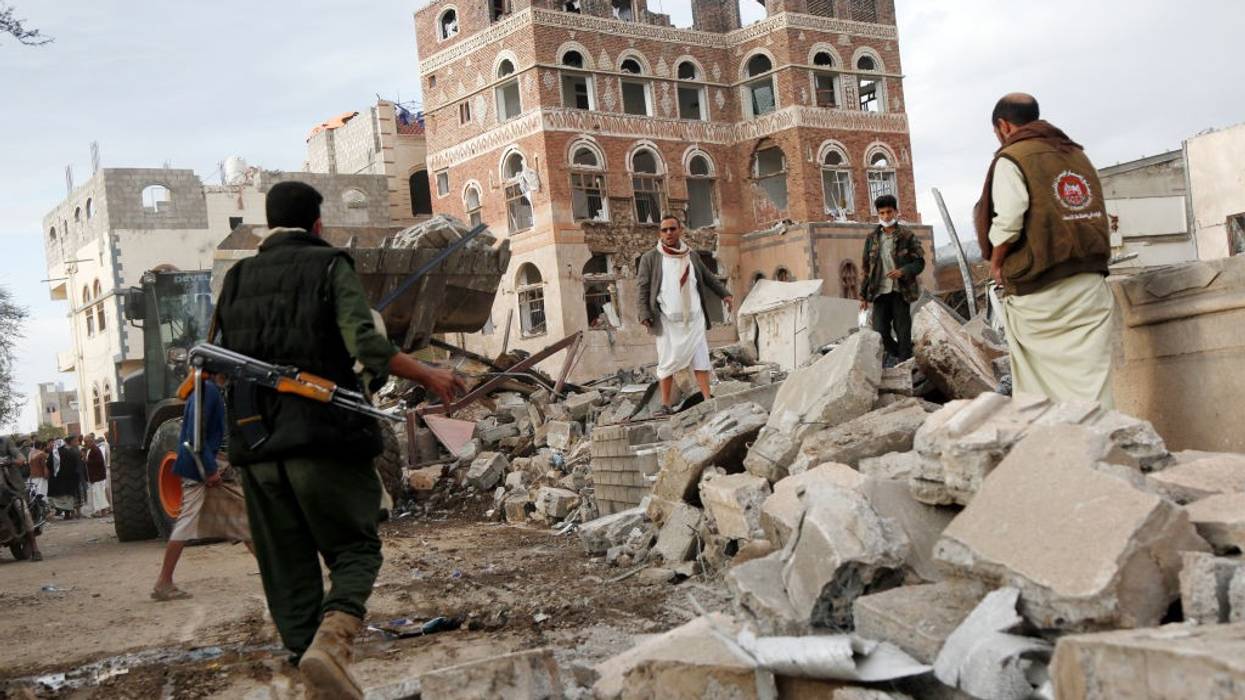
Since March 15, the United States has launched strikes on more than forty locations across Yemen in an ongoing attack against members of the Houthi movement, which has carried out more than 100 attacks on shipping vessels linked to Israel and its allies since October 2023. The Houthis say they are acting in solidarity with Palestinians in Gaza and have recently resumed the campaign following the failed ceasefire between Israel and Hamas.
Despite the efforts of peace activists across the country, a child in Yemen dies every ten minutes from preventable cause...
The new round of U.S. airstrikes has damaged critical ports and roads which UNICEF describes as “lifelines for food and medicine,” and killed at least twenty-five civilians, including four children, in the first week alone. Of the thirty-eight recorded strikes, twenty-one hit non-military, civilian targets, including a medical storage facility, a medical center, a school, a wedding hall, residential areas, a cotton gin facility, a health office, Bedouin tents, and Al Eiman University. The Houthis claim that at least fifty-seven people have died in total.
Earlier this week, it was revealed that Defense Secretary Pete Hegseth, Vice President J.D. Vance, and other high-level Trump Administration officials had discussed real-time planning around these strikes in a group chat on Signal, a commercial messaging app. During the past week, Congressional Democrats including U.S. Senator Schumer and U.S. Representative Hakeem Jeffries expressed outrage over the Trump Administration’s recklessness, with Jeffries saying that what has happened “shocks the conscience.”
President Trump commented that there was “no harm done” in the administration’s use of Signal chats, “because the attack was unbelievably successful.” But the Democrats appear more shocked and outraged by the disclosure of highly secret war plans over Signal than by the actual nature of the attacks, which have killed innocent people, including children.
In fact, U.S. elected officials have seldom commented on the agony Yemen’s children endure as they face starvation and disease. Nor has there been discussion of the inherent illegality of the United States’s bombing campaign against an impoverished country in defense of Israel amid its genocide of Palestinians.
As commentator Mohamad Bazzi writes in The Guardian, “Anyone interested in real accountability for U.S. policy-making should see this as a far bigger scandal than the one currently unfolding in Washington over the leaked Signal chat.”
On Saturday, March 29, participants in the Yemen vigil will distribute flyers with the headline “Yemen in the Crosshairs” that warn of an alarming buildup of U.S. Air Force B2 Spirit stealth bombers landing at the U.S. base on Diego Garcia, a tiny island in the Indian Ocean.
According to the publication Army Recognition, two aircraft have already landed at Diego Garcia, and two others are currently en route, in a move that may indicate further strikes against Yemen. The B2 Spirit bombers are “uniquely capable of carrying the Massive Ordnance Penetrator (MOP), a 30,000-pound bomb designed to destroy hardened and deeply buried targets ... This unusual movement of stealth bombers may indicate preparations for potential strikes against Houthi targets in Yemen or serve as a deterrent message to Iran.”
The Yemen vigil flyer points out that multiple Massive Ordnance Penetrator bombs can use their GPS precision guidance system to “layer in” multiple warheads on a precise location, with each “digging” more deeply than the one before it to achieve deeper penetration. “This is considered particularly critical to achieving U.S. and broader Western Bloc objectives of neutralizing the Ansarullah Coalition’s military strength,” reports Military Watch Magazine, “as key Yemeni military and industrial targets are fortified deeply underground.”
Despite the efforts of peace activists across the country, a child in Yemen dies every ten minutes from preventable causes—and the Democratic Representatives in the Senate and the House from New York don’t seem to care.
A version of this article first appeared at The Progressive.
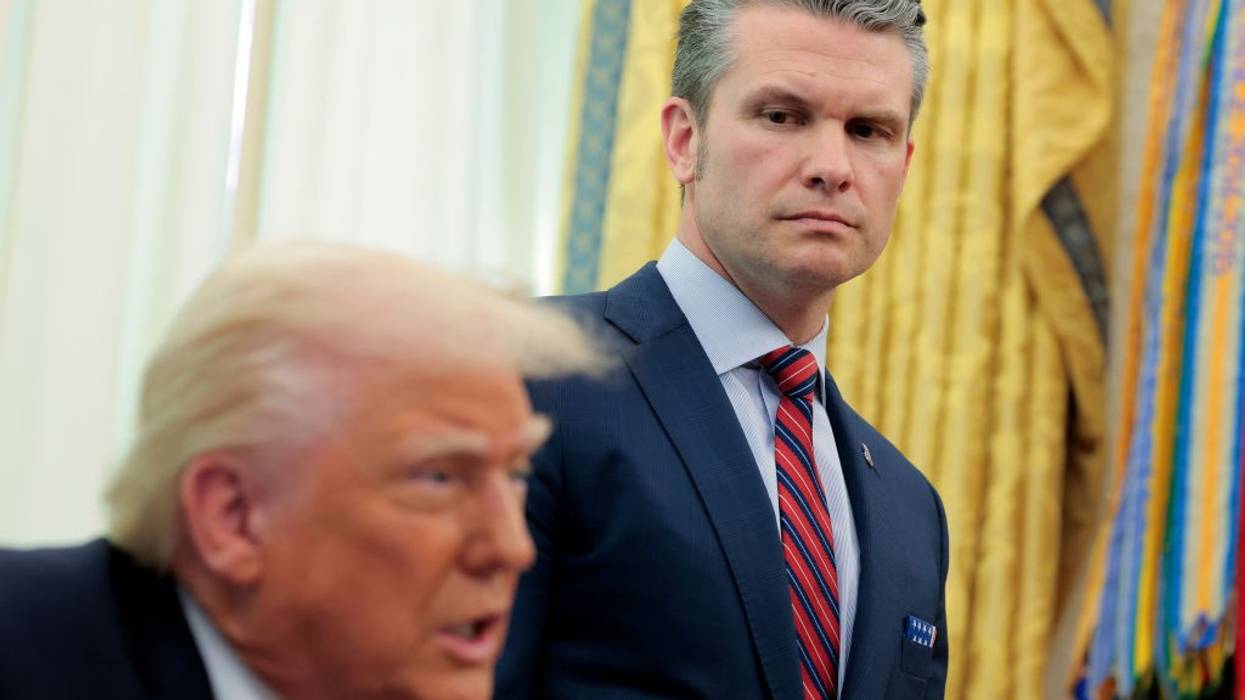
"A reminder that various administration officials lied under oath in the Senate yesterday," said one former Democratic congressman, "which is a crime punishable by imprisonment."
In response to U.S. Secretary of Defense Pete Hegseth claiming on live television earlier this week that "nobody was texting war plans," The Atlantic magazine on Wednesday morning published the "war plans" that were, in fact, shared on the private sector messaging app Signal by top members of President Donald Trump's national security team, including Hegseth and national security advisor Mike Waltz.
It was The Atlantic's Jeffrey Goldberg who on Monday published a bombshell report about how he was, seemingly "inadvertently," added to the Signal group chat by Waltz, a conversation that, in addition to Hegseth, also included director of national security Tulsi Gabbard, CIA director John Ratcliffe, White House deputy chief of staff Stephen Miller, Vice President JD Vance, and others.
In the new piece published, Goldberg said that public denials by these top officials since the original reporting presented the magazine "with a dilemma" about what to do with information the editorial team had initially withheld, citing national security concerns.
"These are strike plans. There must be a broad investigation of how compromised our national security is because of their shocking incompetence." — Rep. Veronica Escobar (D-Texas)
Though its editorial decision to withhold information was criticized by some journalists who believe the public has a right to know such details—including reporter Ken Klippenstein who accused the magazine of falling prey to "media paternalism" by not initally releasing the full contents of the chat—Goldberg explained The Atlantic's decision this way:
we withheld specific information related to weapons and to the timing of attacks that we found in certain texts. As a general rule, we do not publish information about military operations if that information could possibly jeopardize the lives of U.S. personnel. That is why we chose to characterize the nature of the information being shared, not specific details about the attacks.
However—citing Hegseth's on-air denial Monday, a statement by Trump that nothing in the chat was "classified," as well as testimony before a committee in the U.S. Senate on Tuesday by Gabbard and Ratcliffe, both of whom said under oath that classified information was not shared—Goldberg said the magazine's assessment changed.
"We believe," writes Goldberg in the latest piece, "that people should see the texts in order to reach their own conclusions. There is a clear public interest in disclosing the sort of information that Trump advisers included in nonsecure communications channels, especially because senior administration figures are attempting to downplay the significance of the messages that were shared."
Given that the nation's highest-level national security officials, up to and including the President of the United States, have said the material is not classified, the magazine acknowledged—and since the attack plans were for an operation already carried out against Houthis targets in Yemen—it would be strange if The Atlantic still felt not at liberty to publish them.
After reaching out to various agencies in advance of its decision to publish, Goldberg reports that the White House still objected to the release of the exchange, with press secretary Karoline Leavitt claiming that even though "there was no classified information transmitted in the group chat," the administration holds that what was said on the unsecured, third-party communication app was "intended to be a an [sic] internal and private deliberation amongst high-level senior staff and sensitive information was discussed."
What follows are screenshots of the detailed war plans discussed on the Signal group chat by Trump's top officials, as reported by The Atlantic:
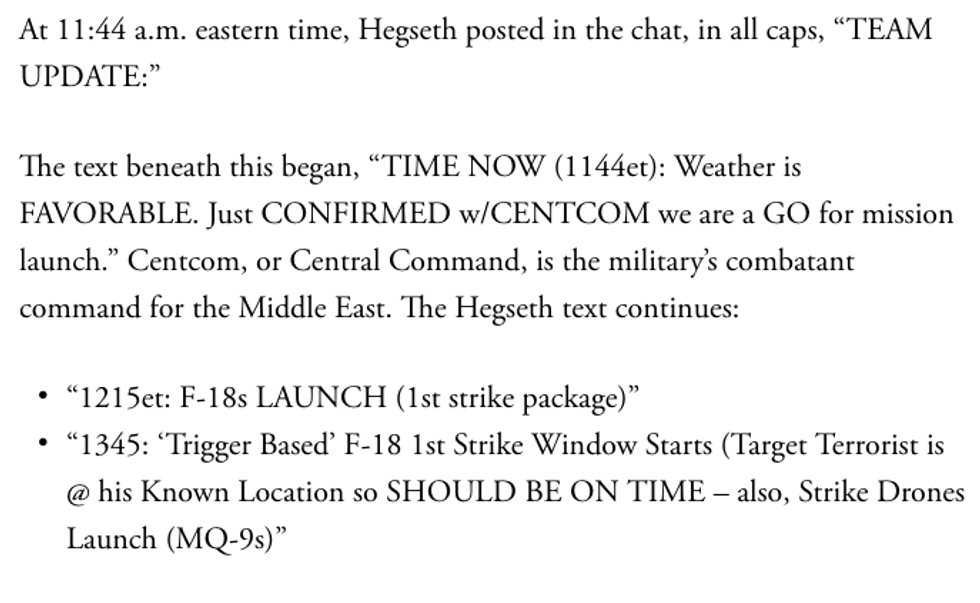
After this portion, Goldberg notes: "If this text had been received by someone hostile to American interests—or someone merely indiscreet, and with access to social media—the Houthis would have had time to prepare for what was meant to be a surprise attack on their strongholds. The consequences for American pilots could have been catastrophic."
More details:
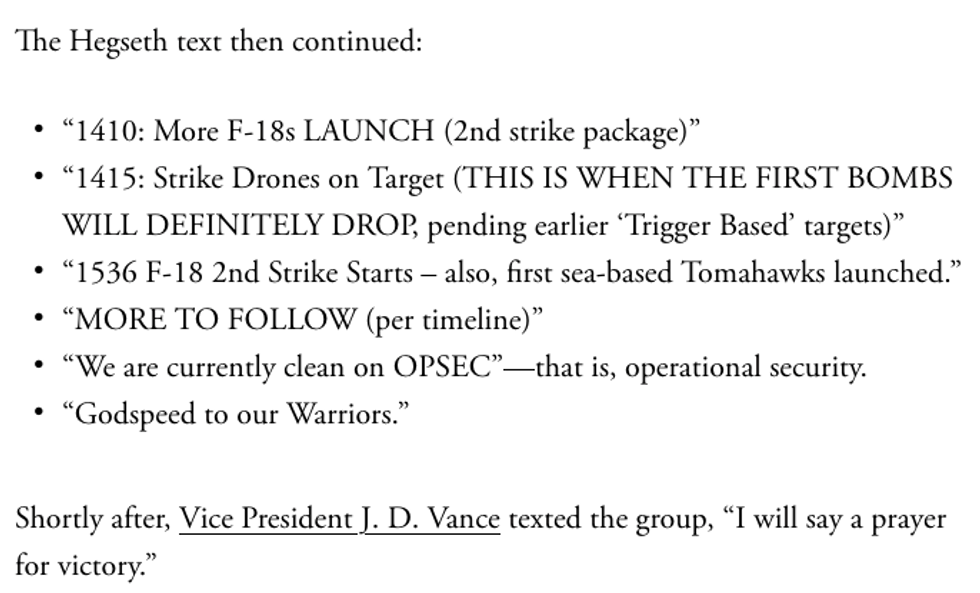
And then these paragraphs:
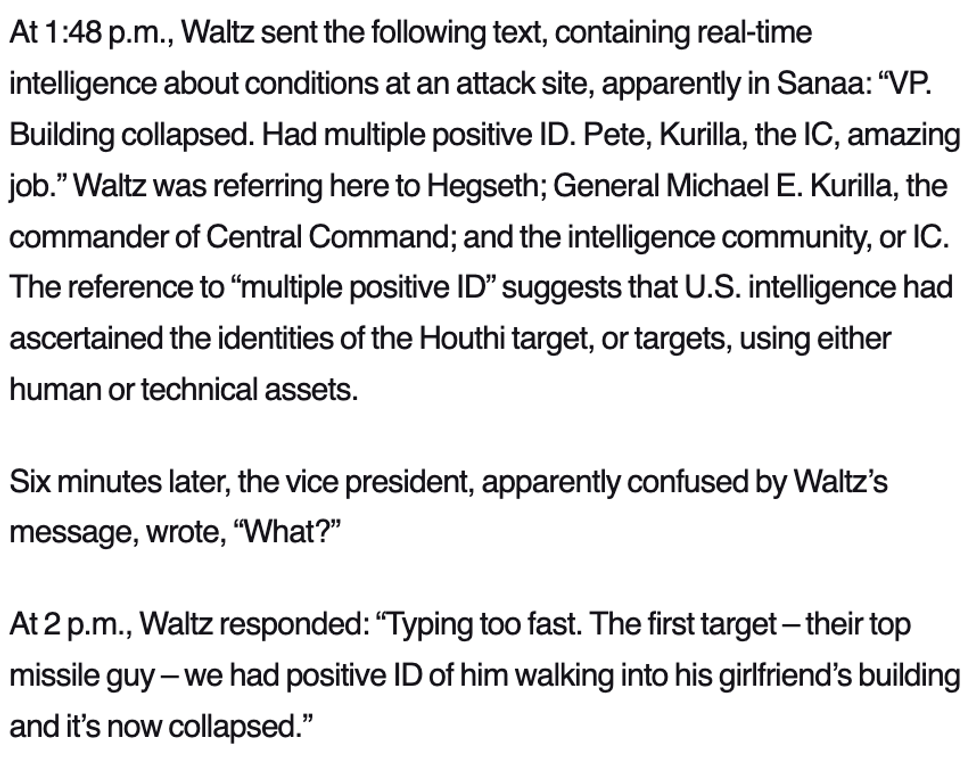
While The Atlantic's new reporting on Wednesday sits behind a paywall, reaction to it was immediate and widespread.
"Hegseth repeatedly lied to the American people and should be fired—along with all the others in the chat," said Rep. Veronica Escobar (D-Texas) in response to Goldberg's latest revelations. "These are strike plans. There must be a broad investigation of how compromised our national security is because of their shocking incompetence."
On Wednesday, two Democratic House members—Rep. Gerald E. Connolly, Ranking Member of the Committee on Oversight and Government Reform, and Rep. Maxwell Alejandro Frost, Ranking Member of the Subcommittee on Economic Growth, Energy Policy, and Regulatory Affairs—launched a congressional probe into whether or not war plans were discussed in the group chat and called on every official involved to preserve all related documents and communications.
"This incident raises grave concerns about the misuse of unsecured communication platforms for classified discussions and the potential that American military and intelligence professionals may have been compromised by the reckless dissemination of such classified material,” Connolly and Frost wrote in a letter addressed to all the officials involved.
Given their testimony before the Senate on Tuesday, Ratcliffe and Gabbard may come under specific scrutiny by members of that committee and other lawmakers.
"A reminder that various administration officials lied under oath in the Senate yesterday," said former Democratic congressman Mondaire Jones, "which is a crime punishable by imprisonment."

"We are now at a level where it can in no way be characterized as a harmless visit from a politician's wife," said Prime Minister Mute B. Egede in reaction to planned trip by Second Lady Usha Vance.
Greenland's Prime Minister Mute B. Egede is letting his displeasure with the Trump administration be known, with new remarks Sunday rebuking expected U.S. delegations this week that include visits by Second Lady Usha Vance, national security advisor Michael Waltz, and Energy Secretary Chris Wright.
"What is the national security adviser doing in Greenland? The only purpose is to demonstrate power over us," Egede said in an interview with the Greenland newspaper Sermitsiaq. "His mere presence in Greenland will no doubt fuel American belief in Trump's mission—and the pressure will increase."
Egede denounced the trips by the U.S. officials as "highly aggressive" and said that Trump appears totally uninterested in the fact that the people of Greenland have rebuffed every overture from the president who says he wants the United States to take over—"one way or another"— the autonomous Danish territory.
While Vance's trip is geared more to cultural events and destinations, Waltz and Wright made clear their intentions are based on the strategic interests of the Trump administration. Egede suggested given all that's transpired in recent months, nobody should be naive about what is going on.
"We are now at a level where it can in no way be characterized as a harmless visit from a politician's wife," said of Vance, the wife of Vice President JD Vance.
Despite public polls showing how deeply unpopular the thought of U.S. takeover is to the people of Greenland, Egede said their efforts effort to be diplomatic about the situation just "bounces off Donald Trump and his administration in their mission to own and control Greenland."
Sending the national security advisor at such a time of tensions, he added, "will no doubt fuel American belief in Trump's mission — and the pressure will increase."

A parliamentary document says the legislation "must be seen in light of the geopolitical interests in Greenland and the current situation where representatives of an allied great power have expressed interest in taking over" the territory.
Faced with repeated threats from U.S. President Donald Trump, who wants to take over resource-rich Greenland, the Danish territory's parliament on Tuesday enacted a ban on foreign political donations, ahead of its March 11 elections.
The new measure—which also bars political parties in the self-governing territory from accepting domestic donations above 200,000 Danish kroner (about $27,700) or 20,000 kroner (about $2,770) from a single contributor—is intended to protect "Greenland's political integrity," The Associated Press reported, citing a parliamentary document translated from Danish.
The document states that the legislation "must be seen in light of the geopolitical interests in Greenland and the current situation where representatives of an allied great power have expressed interest in taking over and controlling Greenland."
According to the AP:
A senior legal officer at Greenland's parliament, Kent Fridberg, told The Associated Press he did not know whether any foreign donors had contributed to Greenland's political parties and the idea for the bill was "basically a preventative measure."
Fridberg noted that some Russian politicians had voiced a similar interest—and that political parties in Greenland are generally funded by public means.
Even before returning to the White House last month, Trump revived his first-term interest in making Greenland part of the United States. In early January, he even refused to rule out using military force to seize both the autonomous island nation and the Panama Canal.
Danish and Greenlandic leaders have forcefully pushed back against Trump's remarks, and polling published last week by a pair of newspapers—Denmark's Berlingske and Greenland's Sermitsiaq—shows that 85% of Greenlanders oppose joining the U.S.
Public opinion polling conducted in Greenland in 2018 has also received fresh attention recently, including from Trump himself. Gustav Agneman, an associate professor of economics at the Norwegian University of Science and Technology, was part of the team that conducted those older surveys, which he discussed in a Tuesday piece for The Conversation.
"Two-thirds of the participants thought that 'Greenland should become an independent country at some point in the future,'" he noted. "Opinions were more divergent regarding the timing of independence. When asked how they would vote in an independence referendum if it were held today, respondents who stated a preference were evenly split between 'yes' and 'no' to independence."
As Agneman detailed:
Each year, Denmark sends a block grant that covers approximately half of Greenland's budget. This supports a welfare system that is more extensive than what is available to most Americans. In addition, Denmark administers many costly public services, including national defense.
This backdrop presents a dilemma for many Greenlanders who aspire to independence, as they weigh welfare concerns against political sovereignty. This was also evident from my study, which revealed that economic considerations influence independence preferences.
For many Greenlanders, the island nation’s rich natural resources present a potential bridge between economic self-sufficiency and full sovereignty. Foreign investments and the associated tax revenues from resource extraction are seen as key to reducing economic dependence on Denmark. Presumably, these natural resources, which include rare earths and other strategic minerals, also help explain Trump's interest in Greenland.
During a January appearance on Fox News, Trump's national security adviser, Mike Waltz, made clear why the Republican has renewed interest in the takeover of the nearby territory, saying: "It's oil and gas. It's our national security. It's critical minerals."
One of the most outspoken critics of Trump's plan is leftist Greenlandic Prime Minister Múte Egede, who supports independence and has said: "Greenland is ours. We are not for sale and will never be for sale. We must not lose our long struggle for freedom."
Announcing the elections for Greenland's parliament, the Inatsisartut, Egede said on Facebook Tuesday that "we are facing an unprecedented and challenging time," and stressed the need "for cooperation and unity" among the island's roughly 60,000 residents.

Journalist Jeremy Scahill noted that Mike Waltz's comments echo "a plan Netanyahu has hinted at: Israel views this deal as only one phase to get the Israeli and U.S. hostages out."
U.S. President-elect Donald Trump's pick to serve as national security adviser said late Wednesday that the incoming administration will support future Israeli attacks on Gaza even as Trump hailed the tenuous new cease-fire and hostage-release agreement as a signal "to the entire world that my administration would seek peace."
In an appearance on Fox News late Wednesday after the agreement was announced, Rep. Mike Waltz (R-Fla.) said that "we've made it very clear to the Israelis, and I want the people of Israel to hear me on this: If they need to go back in [to Gaza], we're with them."
"Hamas is not going to continue as a military entity and it's certainly not going to govern Gaza," Waltz added.
The national security adviser nominee expressed a similar position in a podcast appearance prior to the announcement of the cease-fire deal, which is currently in jeopardy as Israeli Prime Minister Benjamin Netanyahu accuses Hamas of reneging on the terms of the agreement—a claim Hamas has rejected.
Asked whether a cease-fire agreement would mean "the war is over," Waltz said, "Hamas would like to believe that."
"But we've been clear that Gaza has to be fully demilitarized, Hamas has to be destroyed to the point that it cannot reconstitute, and that Israel has every right to fully protect itself," he added. "All of those objectives are still very much in place."
"We need to get our people out," Waltz continued, "and then we need to achieve those objectives in this war."
Trump’s national security advisor Mike Waltz lays out a plan Netanyahu has hinted at: Israel views this deal as only one phase to get the Israeli and U.S. hostages out. He says Hamas will be destroyed and Gaza totally demilitarized. pic.twitter.com/4aBsPgXY3q
— jeremy scahill (@jeremyscahill) January 16, 2025
Drop Site's Jeremy Scahill noted that the approach Waltz laid out mirrors "a plan Netanyahu has hinted at: Israel views this deal as only one phase to get the Israeli and U.S. hostages out."
Last month, Netanyahu said that Israeli forces would "return to fighting" once hostages are freed.
"There is no point in pretending otherwise," said Netanyahu, "because returning to fighting is needed in order to complete the goals of the war."
Under the first phase of the deal announced Wednesday, a six-week cease-fire would begin as soon as Sunday and 33 hostages would be freed in exchange for the release of more than 1,000 Palestinian detainees. The second and third stages of the deal are contingent upon negotiations that will take place during the first.
The text also stipulates the "withdrawal of Israeli forces eastwards from densely populated areas along the borders of the Gaza Strip" and a reduction of Israeli troop presence in the Philadelphi corridor—an issue that has repeatedly emerged as a sticking point in cease-fire negotiations.
The agreement states that "the Israeli side will gradually reduce the forces in the corridor area during stage 1 based on the accompanying maps and the agreement between both sides."
"After the last hostage release of stage one, on day 42, the Israeli forces will begin their withdrawal and complete it no later than day 50," the text continues.
But Netanyahu's office insisted Thursday that the same number of forces would remain in the corridor during the deal's first phase—a position that critics said runs counter to the agreement.
While Trump and his allies celebrated the announced agreement as a master stroke of dealmaking and aid groups voiced hope for some reprieve for devastated Palestinians in Gaza, Netanyahu's spokesman told The New York Times in a text message that "there isn't any deal at the moment."
Israel's cabinet was expected to vote on the deal Thursday, but Netanyahu delayed the meeting and accused Hamas of trying to "extort last-minute concessions."
Hamas officials denied the charge, saying they are committed to the agreed-upon text.
Ruby Chen, the father of a 19-year-old Israeli-American soldier who was taken captive by Hamas on October 7, 2023, suggested Thursday that Netanyahu "might be looking to get out of" the deal as he faces backlash from far-right members of his coalition.
Citing unnamed sources, The Washington Post reported Thursday that "behind closed doors, Netanyahu has been promising his far-right allies that the war could resume after the first, 42-day phase of the cease-fire, when Hamas is to release 33 hostages in exchange for the release of more than 1,000 Palestinian prisoners."
Paul Pillar, a non-resident fellow at the Quincy Institute for Responsible Statecraft, wrote Thursday that "there remains the possibility that a renewed war in Gaza will, beginning a few weeks from now, become a problem for Trump just as it was for Biden."
"But two main factors will incline President Trump not to exert any pressure on the Israeli government to turn away from renewing its devastation and ethnic cleansing in the Gaza Strip," Pillar predicted. "One is Trump's relationship with his domestic evangelical political base, with its unconditional support for most anything Israel does. The other is that his ally Netanyahu has done him a big favor with his handling of the ceasefire negotiations, and now Trump owes Netanyahu favors in return."
According to one Israeli report, Trump offered Netanyahu a "gift bag" of concessions in exchange for accepting a pre-inauguration cease-fire deal, including sanctions relief for violent Israeli settlers in the illegally occupied West Bank.
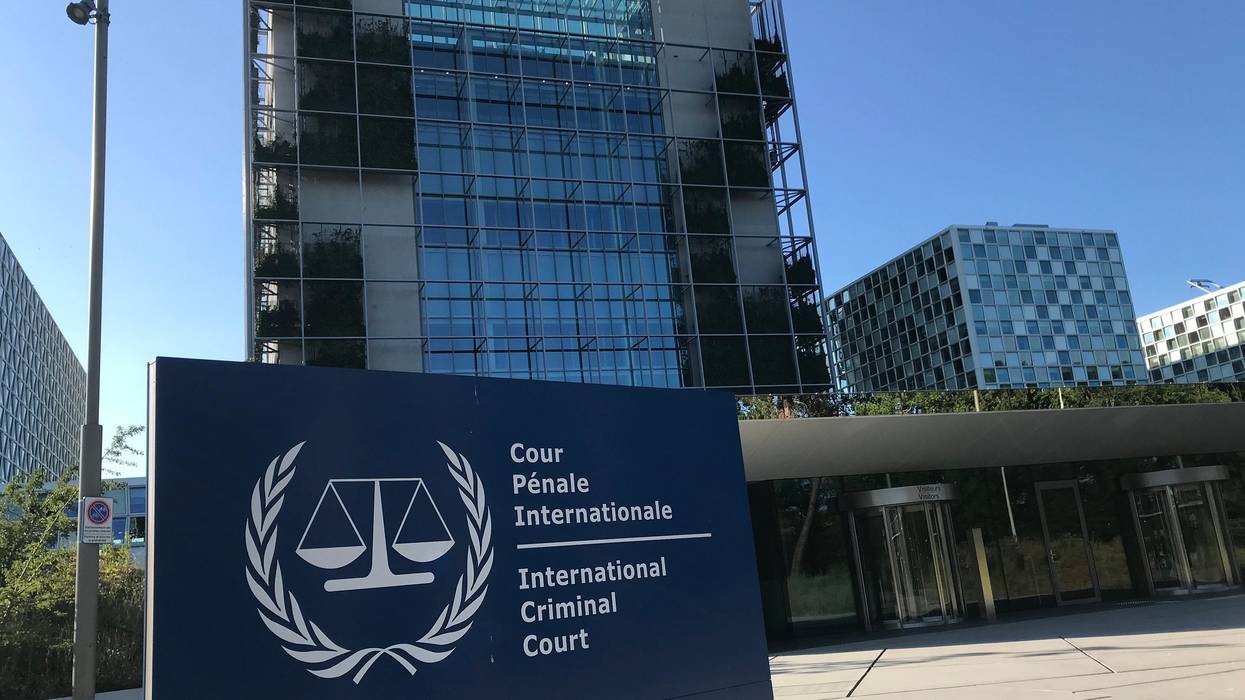
"As fires rage across Los Angeles, the priority of American officials is to sanction the ICC," said one critic.
Forty-five congressional Democrats on Thursday voted with the U.S. House of Representatives' Republican majority in favor of legislation to sanction International Criminal Court officials following the tribunal's issuance of arrest warrants for Israel's prime minister and his former defense chief for alleged crimes against humanity in Gaza.
House lawmakers voted 243-140 in favor of H.R. 23, the Illegitimate Court Counteraction Act. Introduced by Reps. Chip Roy (R-Texas) and Brian Mast (R-Fla.), the bill would "impose sanctions with respect to the International Criminal Court (ICC) engaged in any effort to investigate, arrest, detain, or prosecute any protected person of the United States and its allies."
In November, the ICC issued warrants for the arrest of Israeli Prime Minister Benjamin Netanyahu and Yoav Gallant, his former defense minister, "for crimes against humanity and war crimes" in Gaza. According to Gaza officials, Israel's 15-month assault and "complete siege" of the embattled coastal enclave have left more than 165,000 Palestinians dead, wounded, or missing, and over 2 million others forcibly displaced, starved, or sickened.
The ICC also ordered the arrest of Hamas leader Mohammed Diab Ibrahim Al-Masri for crimes against humanity and war crimes allegedly committed during the October 7, 2023 attack on Israel and subsequent kidnapping and imprisonment of more than 250 people.
Rep. Ritchie Torres (D-N.Y.)—who according to AIPAC Tracker is the top congressional recipient of campaign contributions from pro-Israel lobbyists including the American Israel Public Affairs Committee—said on social media ahead of Thursday's vote that "the ICC's decision to issue arrest warrants against the leadership of Israel represents the weaponization of international law at its most egregious."
Mast, the new chair of the House Foreign Affairs Committee, accused the ICC of "legitimizing the false accusations of Israeli war crimes... in order to stop the overwhelming success of Israeli military operations."
However, Congresswoman Ilhan Omar (D-Minn.), one of 140 Democrats who voted against the bill, said on social media that "human rights lawyers and others documenting the worst atrocities committed on this planet are heroes who should be celebrated—not punished when the war criminals they pursue are allies of the United States."
"The way this bill is written, Israeli survivors of the Hamas massacres on October 7th who gave testimony about the crimes they endured could be sanctioned for cooperating with the ICC," she continued. "This bill would also be a significant blow to efforts to secure justice for [Russian President Vladimir] Putin's victims in Ukraine, and for the victims of both genocides in Darfur,
including the one that is ongoing."
"However my colleagues feel about the ICC or how they feel about Netanyahu's atrocities in Gaza, the passage of this bill is a profound mistake," Omar added. "For those reasons, I opposed this bill."
Amnesty International USA called the vote "deeply disappointing."
"The ICC is part of a global system of international justice of which the U.S. was a chief architect at Nuremberg and beyond," added Amnesty—whose main international organization recently accused Israel of genocide and suspended its Israeli branch for alleged anti-Palestinian bigotry. "If the Senate follows suit, it will do grave harm to the interests of all victims globally and to the U.S. government's ability to champion human rights and the cause of justice."
The United States—which supports Israel with tens of billions of dollars in armed aid and diplomatic cover—reportedly worked with Israel to thwart the ICC's effort to arrest Israeli leaders. The U.S. also opposes the South African-led genocide case against Israel currently before the International Court of Justice.
Outgoing U.S. President Joe Biden has condemned the ICC's effort to arrest Netanyahu and Gallant—who despite being a fugitive from justice was warmly welcomed at the White House last month.
During his first term, Republican U.S. President-elect Donald Trump sanctioned top ICC officials and banned them from entering the United States.
Rep. Mike Waltz (R-Fla.), Trump's pick for national security adviser, has threatened a "strong response" to the ICC in retaliation for seeking to arrest the Israeli leaders.

"It's oil and gas. It's our national security. It's critical minerals," the next national security adviser told a Fox News host.
Amid mounting fears over U.S. President Donald Trump's interest in purchasing or potentially even invading the Danish territory Greenland, his incoming national security adviser made the reasons why quite clear in a Wednesday interview on Fox News.
Speaking with Fox host Jesse Watters about Trump's recent comments on Greenland, Congressman Mike Waltz (R-Fla.), his incoming national security adviser, expanded on the president-elect's Tuesday declaration that Denmark should give the autonomous island northeast of Canada to the United States "because we need it for national security."
Walz said that "this is not just about Greenland. This is about the Arctic. You have Russia that is trying to become king of the Arctic with 60-plus icebreakers, some of them nuclear-powered. Do you know how many we have, Jesse? We have two, and one just caught on fire. This is about critical minerals. This is about natural resources. This is about, as the polar ice caps pull back, the Chinese are now cranking out icebreakers and pushing up there as well. So, it's oil and gas. It's our national security. It's critical minerals."
"And Denmark can be a great ally, but you can't treat Greenland—which they have operational control over—as some kind of backwater. It's in the Western Hemisphere, multiple presidents have tried to bring it into our sphere," Waltz continued, noting Donald Trump Jr.'s personal trip to the island on Tuesday. "As you just saw from Don Jr. landing up there, that people of Greenland, all 56,000 of them, are excited about the prospect of making the Western Hemisphere great again."
Rather than acknowledging Greenland residents' concerns about and opposition to Trump's recent interest—positions echoed by Danish and other European leaders—Watters expressed that, if he lived there, he would prefer to be "on the American side of things" rather than affiliated with Denmark, then refocused on the discussion of natural resources.
Waltz told him that "you're starting to see shipping lanes and shipping coming across the North side, the famous Northwest Passage. That all has to be secured, Jesse. And right now we don't have a single base in the North side of Alaska and we need the Canadians to step up. They're next to last in NATO defense spending."
The Trump adviser also tied the president-elect's desire to take over Greenland to some of his other proposals, such as designating Mexican cartels as terrorist organizations, reclaiming the Panama Canal—possibly by force—and renaming the Gulf of Mexico. Waltz did not mention Trump's pitch to make Canada, whose prime minister just announced his resignation, the 51st state.
"So this is about reintroducing America in the Western Hemisphere, whether that is taking on the cartels, the Panama Canal, Greenland, the 'Gulf of America'—which I love, I'm waiting to see the maps redrawn," Waltz said. "You can call it Monroe Doctrine 2.0, but this is all part of the America First agenda and it's been ignored for far too long."
"Call It Monroe Doctrine 2.0" - Trump National Security Advisor Mike Waltz on Greenland and Panama Canal
Read his full comments - https://t.co/OURdqs2A3r
"The famous Northwest Passage has to be secured... taking on the Mexican cartels, the Panama Canal, Greenland... You can… pic.twitter.com/y3uyuP23Og
— RCP Video (@rcpvideo) January 9, 2025
While Trump and his allies promote a fresh wave of imperialism ahead of the January 20 inauguration, others are highlighting its connections to U.S. history—including political economist C.J. Polychroniou, who addressed how "Trump's second administration seems set on advancing a new version of Manifest Destiny" in a Thursday opinion piece for Common Dreams.
"Imperialism seems to be Trump's new theme, but his overall vision of power is reminiscent of U.S. imperialist attitudes of the 19th century. He seems to believe that territorial expansion of the boundaries of the United States would make the country safer, stronger, and more prosperous," Polychroniou wrote. "Of course, this could all just be a symptom of Trump's arrogance and ignorance, but there can be no denying that imperialism is embedded in U.S. political culture. The U.S. has been preparing for a future global conflict for quite some time now, first with Russia and then with China."
"The truth is that U.S. imperialism never died," Polychroniou stressed, pointing to the nation's massive military budget and hundreds of bases around the world. "Of course, imperialism has taken new forms in the 21st century and the dynamics of exploitation have changed. But imperialism is still about world hegemony and a struggle for the control of strategic resources."
"The U.S. continues to exercise imperial power by using all its available tools and weapons to make the world conform to its own whims and wants as it tries to shore up its declining economic dominance," he added. "But with Trump's return to the White House, and armed as he appears to be with a new version of Manifest Destiny, U.S. imperialism may become more aggressive and even more dangerous to world peace. If that turns out to be the case, the world is headed for an even more violent future."
In a Thursday piece for The Nation also exploring Greenland's "strategically significant" location and the global superpowers vying for more regional control, national affairs correspondent John Nichols highlighted that Greenland Prime Minister Múte Egede of the democratic socialist Inuit Ataqatigiit party and Erik Jensen, leader of the social democratic Siumut movement, have both responded to Trump's comments by emphasizing that their territory "is not for sale."
As Nichols detailed:
Both Inuit Ataqatigiit and Siumut favor independence for the island, which is now a self-governing territory of the Kingdom of Denmark. Eighty percent of the votes in Greenland's 2021 election were cast for pro-independence parties. And Egede now says: "The history and current conditions have shown that our cooperation with the Kingdom of Denmark has not succeeded in creating full equality. It is now time for our country to take the next step."
The goal, explains the prime minister, is to "remove the shackles of colonialism."
"Work has already begun on creating the framework for Greenland as an independent state," according to Egede, who signaled in his New Year's address that a referendum could be held as soon as this year.