

SUBSCRIBE TO OUR FREE NEWSLETTER
Daily news & progressive opinion—funded by the people, not the corporations—delivered straight to your inbox.
5
#000000
#FFFFFF
To donate by check, phone, or other method, see our More Ways to Give page.


Daily news & progressive opinion—funded by the people, not the corporations—delivered straight to your inbox.
On 20 September, at the request of the young people who have been staging school strikes around the world, we're walking out of our workplaces and homes to spend the day demanding action on the climate crisis, the greatest existential threat that all of us face. It's a one-day climate strike, if you will - and it will not be the last. This is going to be the beginning of a week of action all over the world. And we hope to make it a turning point in history.
We hope to make it a turning point in history.
We hope others will join us: that people will leave their offices, their farms, their factories; that candidates will step off the campaign trail and football stars will leave the pitch; that movie actors will scrub off their makeup and teachers lay down their chalk; that cooks will close their restaurants and bring meals to protests; that pensioners too will break their daily routines and join together in sending the one message our leaders must hear: day by day, a business as usual approach is destroying the chance for a healthy, safe future on our planet.
We are well aware that, by itself, this strike and a week of international climate action won't change the course of events. The good news is that we have the technologies we need - the price of a solar panel has plunged 90% in the past decade. And we know the policies to make them work: all across the planet some version of a Green New Deal has been proposed, laws that would speedily replace fossil fuels with the power of sun and wind, along the way providing good jobs and stabilising strong local economies. We salute the people - many of them young - working hard to pass those measures against the entrenched opposition of the fossil fuel industry.
The September day of global action is designed to support those people. We hope all kinds of environmental, public health, social justice and development groups will join in, but our greatest hope is simply to show that those working on this crisis have the backing of millions of human beings who harbour a growing dread about our environmental plight but who have so far stayed mostly on the sidelines. It may take a few attempts to get those kind of numbers in the streets, but we don't have too long: our window for effective climate action is closing fast.
We know not everyone can join us. On a grossly unequal planet, some people literally can't do without a single day's pay, or they work for bosses who would fire them if they dared try. And some jobs simply can't stop: emergency room doctors should keep at their tasks. But many of us can put off for 24 hours our usual day to day routine, confident it will be there when we return. We hope some people will spend the day in protest: against new pipelines, or the banks that fund them; against the oil companies and the politicians that spread their lies. We hope others will spend the day putting insulation in the walls of their neighbours' homes, or building cycle paths. We hope everyone will take at least a few minutes in a city park or a farm field or on the roof of their apartment to simply soak in the beauty of the world it's our privilege to protect.
Obviously this is a lot to ask. A day in the life of the world is a big deal, and all of us are used to our routines. But we're not comfortable letting schoolchildren carry all the weight here - they need our backing. And disrupting our normal lives seems key - it's normal life that is doing us in, the fact that we rise each morning and do pretty much the same things we did the day before, even amid an unfolding crisis.
We are the people who happen to be alive at the moment when our choices will determine the future for tens of thousands of years: how high the seas will rise, how far the deserts will spread, how fast the forests will burn. Part of our work must be to protect theat future.
Margaret Atwood, Genevieve Azam, Tom Ballard, Fadel Barro, Nnimmo Bassey, May Boeve, Patrick Bond, Mike Brune, Nicola Bullard, Sharan Burrow, Valerie Cabanes, Rachel Carmona, Dr Craig Challen, Noam Chomsky, Maxime Combes, Thomas Coutrot, Cyril Dion, Tasneem Essop, Christiana Figueres, Prof Tim Flannery, Nancy Fraser, KC Golden, Tom BK Goldtooth, Maggie Gyllenhaal, Dr John Hewson, John Holloway, Prof Lesley Hughes, Tomas Insua, Satvir Kaur, Barbara Kingsolver, Winona LaDuke, Jenni Laiti, Bruno Latour, Annie Leonard, Michael Mann, Gina McCarthy, Heather McGhee, Luca Mercalli, Moema Miranda, Jennifer Morgan, Tadzio Muller, Kumi Naidoo, Mohamed Nasheed, Carlo Petrini, Dr Anne Poelina, Mark Ruffalo, Peter Sarsgaard, Dr Vandana Shiva, Rebecca Solnit, Gus Speth, Prof Will Steffen, Tom Steyer, Chris Taylor, Terry Tempest-Williams, Aurelie Trouve, Farhana Yamin, Lennox Yearwood are signatories to this article
With Democratic candidates for president coming forward and progressives nationwide defining the agenda ahead, this is a good time to look hard at where we are as a country. Abraham Lincoln put it best: "If we could first know where we are... we could better judge what to do and how to do it."
So where are we? There are many ways to judge, but one important way is to compare ourselves to other advanced democracies and see where we stand in the rankings. Let's focus on twenty well-to-do countries, all members of the Organization for Economic Cooperation and Development (OECD). In addition to the U.S., the group includes the fifteen major countries of Western Europe, Japan, Australia, New Zealand, and Canada.
Surely it is time to think clearly about how we arrived at this place, and what it means when huge problems arise and persist across almost the whole spectrum of national life. Now it is time to decide "what to do and how to do it."
Next, we need to know which rankings are important. People have different aspirations for the U.S., as we know all too well. The information presented below seeks to bypass abstractions like the overall economy and look instead at the situation facing actual people. To this end, it looks at U.S. performance in the areas of social welfare and economic security, environment and climate, health and well-being, education, gender rights and women, and democratic governance.
Theses realities deserve our most serious attention and links to all the referenced data are included for further exploration. These measures of our current situation--this "People's State of the Nation" as it were--point to where American efforts must be. Even a few minutes with your head bowed over this material--which shows the U.S. woefully behind our peer countries--should convince you that we have let our national situation deteriorate for far too long. The following statistics show the United States is at the very bottom in treatment of women, treatment of children, environmental performance, and many key measures of social and economic well-being, including poverty, inequality, and longevity. No wonder Americans are frustrated and angry.
We now face a daunting, festering array of challenges that were decades in the making. These are issues that deeply afflict our lives and living, and will require the most determined and sustained policy response if we are to save ourselves and help others abroad facing even more dire prospects.
Many aspects of our national condition cannot be adequately captured in international comparisons, for example the special burdens across almost all issues faced by blacks and other minorities in America. The same is true for many international issues, like troops of some variety on the ground today in an estimated 149 of the world's 195 countries.
If we fail to come together to address these challenges, we will remain mired in desperate needs, split by deep divisions, and endlessly burdened and diverted by the cumulative consequences of global warming.
Surely it is time to think clearly about how we arrived at this place, and what it means when huge problems arise and persist across almost the whole spectrum of national life. Now it is time to decide "what to do and how to do it."
We know what is at stake on individual issues explored below, like the treatment of children. But, on a larger canvas, what is also at stake is the success of our experiment in nationhood. If we fail to come together to address these challenges, we will remain mired in desperate needs, split by deep divisions, and endlessly burdened and diverted by the cumulative consequences of global warming.
A look at the numbers
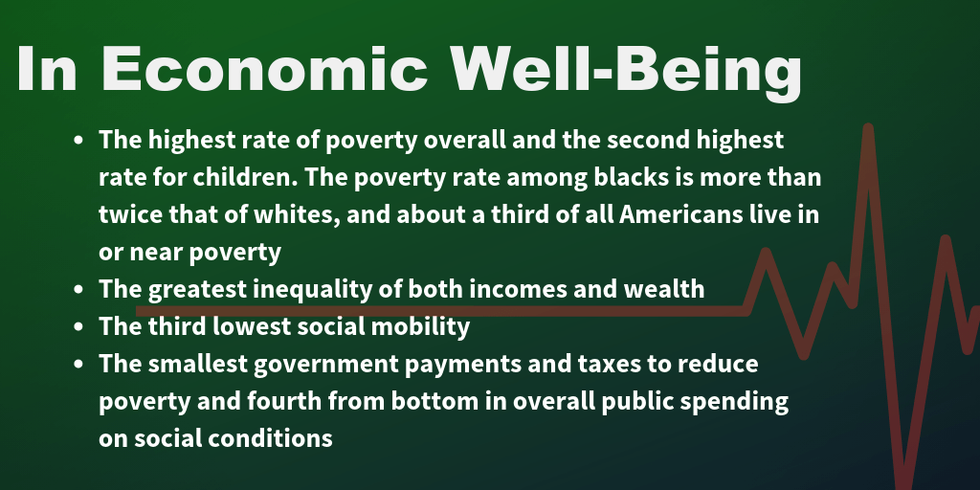
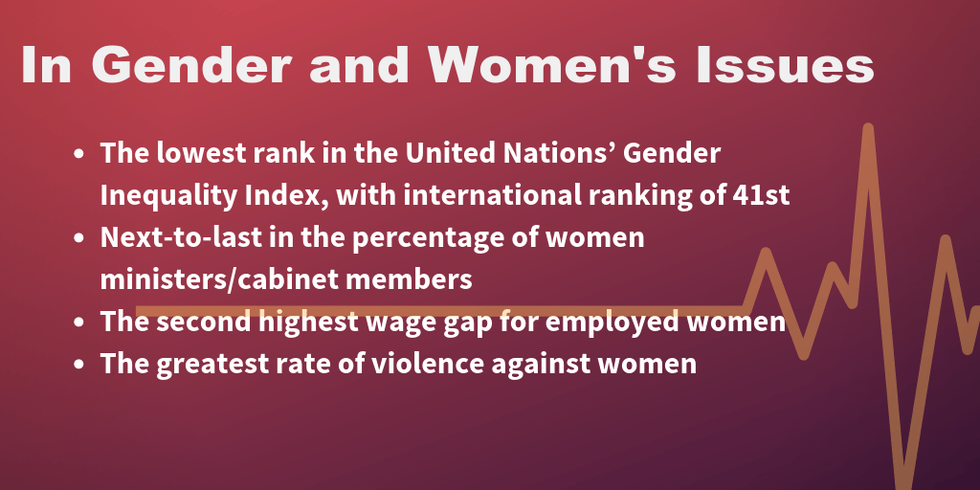
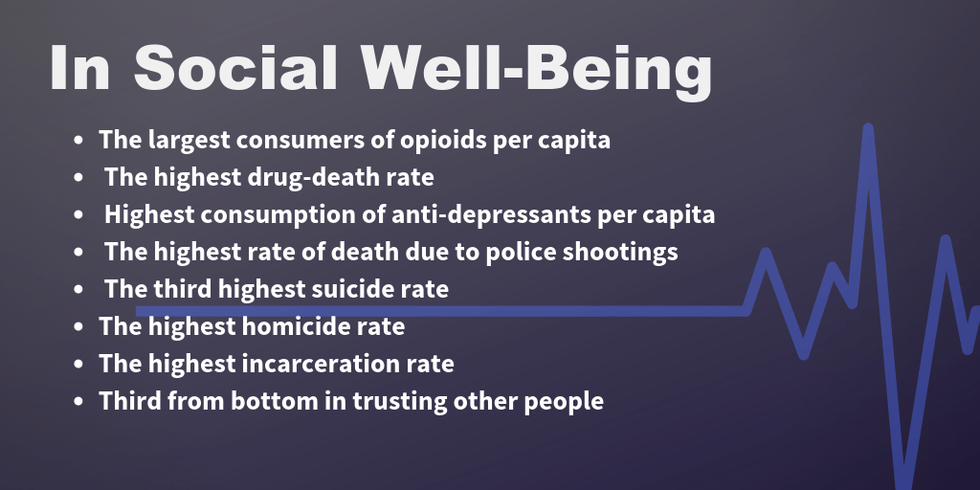
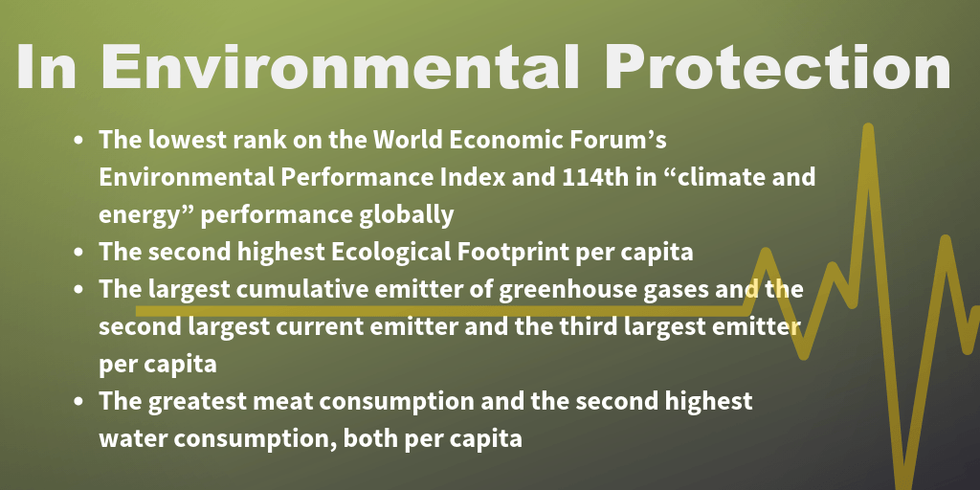
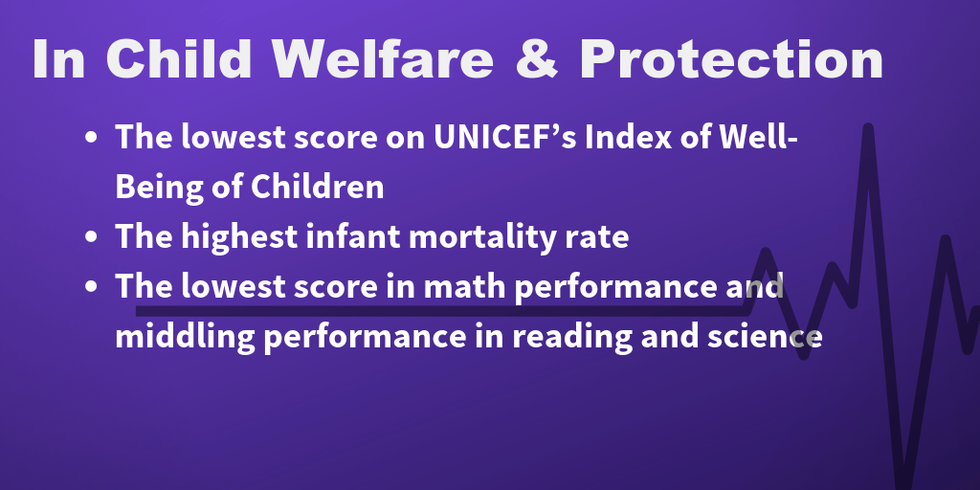
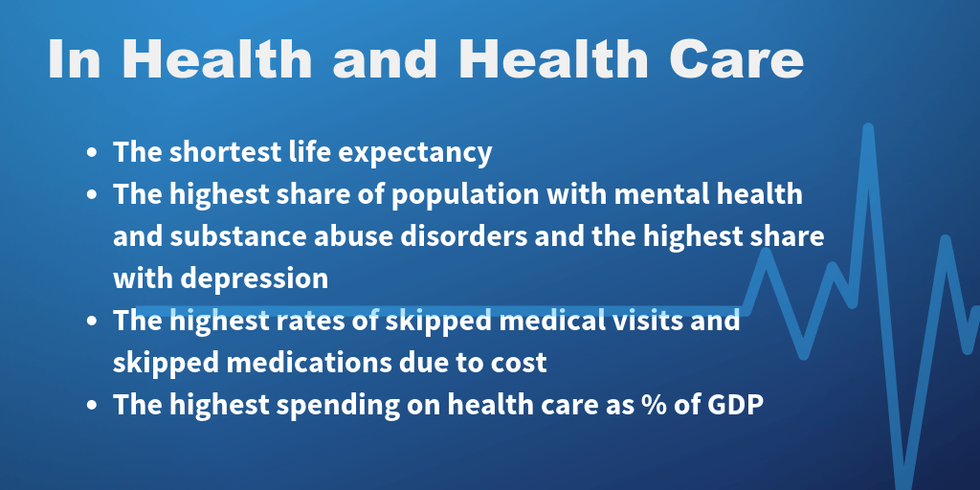
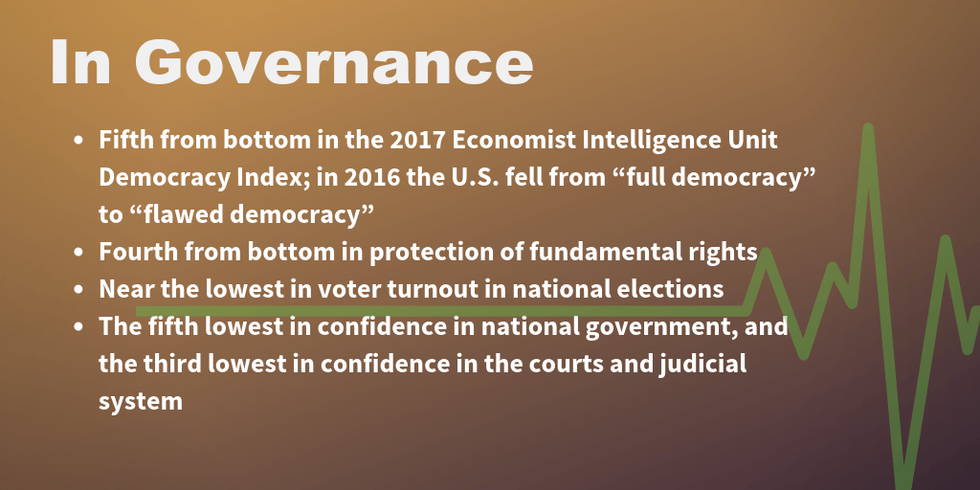
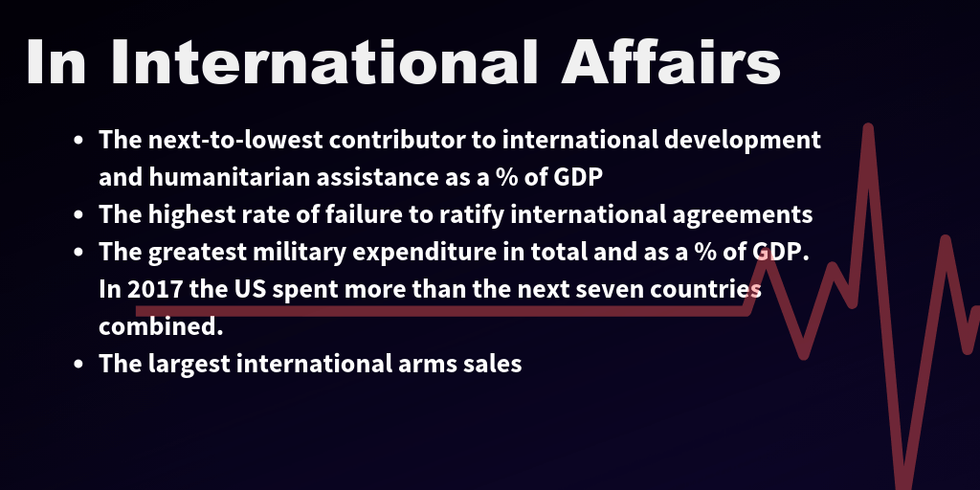
The United States is a rich nation by conventional measures. "The world's highest standard of living" was once frequently heard. The United States is indeed first in average household income per capita, but we fall to sixth in median household income. Getting closer to the heart of the matter, the U.S. falls to thirteenth on the United Nations' Human Development Index, which looks at education and longevity as well as purchasing power. When we examine the detailed conditions of life and living in America, our sad situation is more fully revealed. In a comparison with nineteen other OECD countries, thought to be our peers, recent studies indicate that the United States now has:
In Economic Well-Being
References:
In Gender and Women's Issues
References:
In Social Well-Being
References:
In Environmental Protection
References:
In Child Welfare and Education
References:
In Health and Health Care
References:
In Governance
References:
In International Affairs
References:
Sarah Baehr and Conor Ploeger, both associated with the Vermont Law School, assisted with the research and preparation of these data sets.
In 2015, 21 young people sued the U.S. government for promoting the fossil fuel industry even when it was aware of the dangers of climate change. In Juliana v. United States, the youths accused the government of endangering their future well-being thereby violating the government's public trust responsibility and their constitutional rights.
The U.S. government has repeatedly tried to stop this case from moving to trial. Courts, including the U.S. Supreme Court, have denied or refused to rule on government challenges. The case is currently before the U.S. Ninth Circuit Court of Appeals on yet another motion to dismiss.
The suit centers on whether the government actively promoted the use of fossil fuels despite being aware of evidence that such action endangered the future of the planet. The youths, represented by the nonprofit Our Children's Trust, retained experts to contribute supporting reports for the suit, including from environmental lawyer and climate policy expert James Gustave Speth. He reviewed what each administration from Carter to Trump knew about climate change and alternative energy and what actions were taken. Speth concluded in his report, which was filed in 2018, that every administration "continued full-throttle support for the development and use of fossil fuels." This pattern is "the greatest dereliction of civic responsibility in the history of the Republic," he wrote.
Speth's advocacy for alternative energy pathways spans four decades. Under President Jimmy Carter, he headed the U.S. Council on Environmental Quality, which recommended pursuing renewable energy and energy conservation as means to reduce the threat of climate change. He is a founder of the Natural Resource Defense Council and the World Resources Institute and served as administrator of the United Nations Development Programme. He is currently a senior fellow at the Vermont Law School, the Democracy Collaborative, and the Tellus Institute, and a former dean of the Yale School of Forestry and Environmental Studies.
This interview has been condensed and edited for clarity.
Fran Korten: The U.S. government seems very intent not only on winning the youths' lawsuit, but also on the trial not moving forward at all.
Gus Speth: The whole strategy of the government now for three years has been to prevent the trial from happening. I think they don't want the spotlight put on all this information or on the threats to the well-being of this new generation, which is going to absorb all the shock of our neglect. It is important that the lawsuit is brought by young people, because it really makes everyone face the reality of the challenge. I just hope and pray that the case gets to trial. I think it will be a landmark in public education. And it could lead to a decision that would really galvanize action.
Korten: As you reviewed four decades of government knowledge and action on climate change, what did you conclude?
Speth: Every administration I looked at did a great deal to promote the continued use of fossil fuels at a very high level. No president has looked at that fossil fuel use curve and said, "You know, we have got to bend it down and get out of this business." The percentage of U.S. energy that fossil fuels provides only went from about 90 percent with Carter to about 80 percent today.
Korten: You led the U.S. Council on Environmental Quality under Carter. Many of us remember Carter advocating turning down the heat and wearing sweaters. And he put solar panels on the White House. Do you feel Carter was personally convinced of the dangers of climate change way back in the late 1970s?
Speth: I think he believed that the federal government had to assert itself as a leader in energy policy and energy directions. He felt he had to reduce oil imports, which had skyrocketed in the period before him. That led to a whole series of actions to promote alternatives to imported oil, including greater use of domestic coal. But he repeated over and over that the long-term solution depended on developing renewable energy. He championed our Council on Environmental Quality report about what the U.S could do on solar and other renewables. And he set a national goal for the year 2000 of 20 percent of energy coming from renewables. He deeply believed in an energy future that was primarily one of renewable energy resources with a sharp increase in energy efficiency and conservation.
I know from speaking with him personally and from his public remarks that he understood the risks of climate change.
Korten: Let's turn to Reagan. What happened to concern about renewables and climate change when Reagan came in?
Speth: Well, there really were two Reagans in this era. One was the initial Reagan, in which he had a very antienvironmental crew--James Watt at the Interior Department and Anne Gorsuch at EPA, among them.
The country was not crazy then, and there were good Republicans as well as good Democrats. People like John Chafee, a great Republican senator from Rhode Island. They pushed for the appointment of credible people--Bill Ruckelshaus at EPA and then his successor, Lee Thomas. Throughout much of the later Reagan administration, EPA and others put out numerous reports on the seriousness of the climate issue. Really good reports. The Department of Energy had a strong research program on it.
But Reagan didn't pay any attention to them. His administration just went full bore for more fossils fuels. The '80s were also the time when we first had compelling scientific evidence linking the theory of global warming to changes actually happening on Earth. This was brought forth in the testimony of [NASA scientist] James Hansen in 1982, 1986, and 1988. Three times he went to the Hill and testified, each time with more alarm that the Earth was changing due to the carbon dioxide buildup.
Korten: When did serious government opposition to action on climate change develop?
Speth: The opposition began to form during President George Herbert Walker Bush's administration. It didn't have to be too overt at that time, but it was very successful. It had top people within the White House who ensured that almost everything Bill Reilly at EPA would try to do on this issue would get squelched. Around this time, Exxon began its shift away from being a source of credible information on climate to supporting climate change denial, as documented by InsideClimate News in its report The Road Not Taken.
Korten: And when did climate change become so divisive in the broad public?
Speth: Ironically, an important shift occurred during the Clinton-Gore administration. They came in with a determination to make the issue a public concern. Al Gore had been a leader on climate. The polling suggests that their efforts tended to increase Democratic support slightly but that Republican voter support for climate action went in exactly the opposite direction. The Democrats and the Republicans diverged further, and that increased over time, driven by several factors, including a well-funded disinformation campaign taken from the tobacco playbook.
Behind all this is ideological opposition to government action, the great power of the fossil fuel industry, and America's vast economic insecurity.
Korten: What president do you feel did the most to act on climate?
Speth. I think Obama did the most. His policymakers were developing regulations about methane that Trump quickly axed. They had a clean power plan that Trump's been trying to get rid of. They put in fairly aggressive fuel economy standards for automobiles. But even if you add up the things that Obama was doing toward the end of his administration, they still would do less than the cap-and-trade plan that passed the U.S. House in the early years of his administration but failed to pass in the Senate.
Meanwhile, the Obama administration was rigorously promoting fossil fuels.
Korten: Writing your report for the young people's lawsuit forced you to reimmerse yourself in years of data about the increasing urgency of climate change accompanied by very little action. How was it emotionally for you to review all of that history of missed chances?
Speth: It was a very hard thing to deal with. I have said to people that this is the saddest story ever told, because the consequences are so huge and so long-lasting and so devastating. And we knew what we should have done. There were people in every administration who knew that what they were doing was wrong. So it made me sad, and it made me mad. It was also sobering in the sense that the climate activists had tried, we really tried.
Thousands and thousands of the smartest people in our country have pushed hard for 40 years, and to see so little actually accomplished is disturbing. We're up against the huge power of the fossil fuel industry; the extraordinary ideological opposition to the federal government doing anything important; money going into disinformation campaigns that people readily bought into. And it's still going on.
It is a sure sign in my view that we need to change the system of political economy in which we are struggling. It's sobering, as I say. But not discouraging, because we're still fighting.
Korten: Where do you think we are now on this issue in terms of public sentiment?
Speth: I actually believe that in terms of public awareness and getting something moving finally, we may have turned a corner.
It's going to be a hard slog. But with all the events that have brought public awareness forward--fires and floods and much more--and the number of cities and governors who are now acting, something has changed within the past year or two. Progressive momentum on the issue has begun. But it has a long way to go. We are in such a hole and have so much power arrayed against action. There's still so much misunderstanding and manipulated denialism.
Korten: What do you think ordinary citizens can do to help address climate change?
Speth: The important thing is for people to redouble their efforts. Now that we've got a fighting chance, we really have to fight.
We all should be engaged with a Green New Deal. I think one reason the idea is getting so much attention is that it is not just about climate and the environment. They are seeing the connections with other issues--the need to deal with impacted communities and create a huge new jobs programs and have a major infusion of finance into renewables and efficiencies and all kinds of retrofits. Bringing these issues together has created some real momentum.
Among other things, Green New Deal proponents see no problem with the government having the capacity to spend money into the economy to get these things done--quantitative easing for the planet, not just for the big banks. Lord knows where it's all going to go. Opposition is already building.
Above all, to deal with the climate issue, we need a powerful movement of movements. And we need to get a lot more "in the streets" about it--a fusion of progressive forces that is activist and rambunctious and full of spunk and determination.
A broad coalition of community groups along with prominent leaders from the nation's top civil rights, environmental, and indigeneous people's movements on Friday sent a joint letter to the U.S. Department of Justice demanding a federal investigation into allegations that oil giant ExxonMobil knew about the role fossil fuels played in driving climate change since the 1970s but concealed that information--and later sought to discredit those issuing warnings--in order to protect its own financial interests.
"Anyone who's lived through 25 years of phony climate debate, or who's seen the toll climate change is already taking on the most vulnerable communities, has been seething at these revelations."
-- Bill McKibben, 350.orgAddressed to Attorney General Loretta Lynch, the letter cites recent reporting by the Los Angeles Times and Inside Climate News--both of which offered devastating details into the manner and scope of the decades-long public deceit--and argues that a DOJ probe is warranted to determine whether criminal charges should be brought against the energy behemoth.
"Given the damage that has already occurred from climate change--particularly in the poorest communities of our nation and our planet--and that will certainly occur going forward, these revelations should be viewed with the utmost apprehension," the letter states. "They are reminiscent--though potentially much greater in scale--than similar revelations about the tobacco industry."
Kicked off by the investigative reporting and spearheaded by 350.org co-founder Bill McKibben--who staged a one-person civil disobedience action earlier this month to draw attention to the issue--the call for a federal investigation has been growing over recent weeks.
"Despite Exxon's wealth and power, people were eager to sign on to this statement," McKibben said on Friday. "Anyone who's lived through 25 years of phony climate debate, or who's seen the toll climate change is already taking on the most vulnerable communities, has been seething at these revelations. It reminds me of the spirit at the start of the Keystone battle."
Just over two weeks ago, U.S. Reps. from California Ted Lieu (D-Los Angeles) and Mark DeSaulnier (D-Walnut Creek) also wrote a letter to Lynch demanding an investigation and specifically called for RICO statutes to be used to determine whether or not the behavior of Exxon constituted a criminal conspiracy.
"If these allegations against Exxon are true, then Exxon's actions were immoral," Lieu and DeSaulnier wrote to the attorney general. "We request the DOJ investigate whether ExxonMobil's actions were also illegal."
Initiating a public petition campaign to bolster their call for the DOJ probe, McKibben sent a letter to members of 350.org on Friday morning in which he stated "very few things truly piss me off," but that in his mind it seems that no corporation has ever "done anything bigger and badder" than what ExxonMobil has done in this case.
"Just think how much would be different if Exxon had told the truth," he continued. "We wouldn't fully have solved global warming but we'd be well on the way--there would have been no 25 year phony pretend debate. There'd be a lot more solar panels, and a lot less carbon in the air. There'd be a lot more green jobs, and a lot fewer communities, most of them low income and communities of color, dealing with the terrible health impacts of pollution. None of you would have had to fight simply to get climate change taken seriously; instead we'd all be hard at work on solutions."
That, of course, is not how the last four decades have played out and for that, he stated, "I think we should be angry."
The full text of Friday's letter and list of signatories follows:
Dear Attorney General Lynch,
As leaders of some of the nation's environmental, indigenous peoples and civil rights groups, we're writing to ask that you initiate a federal probe into the conduct of ExxonMobil. New revelations in the Los Angeles Times and the Pulitzer-prize-winning InsideClimate News strongly suggest that the corporation knew about the dangers of climate change even as it funded efforts at climate denial and systematically misled the public.
Given the damage that has already occurred from climate change--particularly in the poorest communities of our nation and our planet--and that will certainly occur going forward, these revelations should be viewed with the utmost apprehension. They are reminiscent--though potentially much greater in scale--than similar revelations about the tobacco industry.
These journalists have provided a remarkable roadmap to this corporation's potential misconduct. We would ask that you follow that map wherever it may lead, employing all the tools at your disposal to uncover the truth.
Signed,
Margie Alt, Executive Director of Environment America
Kenny Ausubel, Nina Simons, Founders of Bioneers
Sally Bingham, President and Founder of Interfaith Power and Light
May Boeve, Bill McKibben, Founders of 350.org
Michael Brune, Executive Director of Sierra Club
Robert Bullard, Author and John Muir Award winner, 2013
Andrea Carmen, Executive Director of International Indian Treaty Council
Faith Gemmill, Executive Director of REDOIL (Resisting Environmental Destruction on Indigenous Lands)
Tom Goldtooth, Executive Director of Indigenous Environmental Network
James Hansen, Director, Climate Science, Awareness and Solutions Program, Columbia University Earth Institute
Reverend Fletcher Harper, Executive Director of Greenfaith
David Helvarg, Executive Director of Blue Frontier
Gene Karpinski, President of League of Conservation Voters
Jane Kleeb, Bold Nebraska
Steve Kretzmann, Executive Director and Founder of Oil Change International
Fred Krupp, President of Environmental Defense Fund
Winona LaDuke, Executive Director of Honor the Earth
Annie Leonard, Executive Director of Greenpeace USA
RL Miller, President of Climate Hawks Vote
Matt Nelson, Managing Director of Presente.org
Brant Olson, Campaign Director at Climate Truth
Erich Pica, President of Friends of the Earth
Cindy Shogan, Executive Director of Alaska Wilderness League
Reverend Fred Small, President of Creation Coalition
Gus Speth, Former Dean Yale School of Forestry and the Environment
Tom Steyer, Founder of NextGen
Rhea Suh, President of the Natural Resources Defense Council
Vien Truong, Director of Green for All
Joe Uehlein, Executive Director of Labor Network for Sustainability
Tripp Van Noppen, President of Earthjustice
David Yarnold, President of the Audubon Society
Reverend Lennox Yearwood, President of Hip Hop Caucus
Trip Van Nopen, Earth Justice
Rich Stolz, Executive Director of OneAmerica
Resilience Collaborative, LLC
A Philip Randolph Institute
Green America
Energy Action Coalition
Divest Invest Individual
Bean Soup Times
Ecumenical Poverty Initiative
Beats Rhymes & Relief
Freddie Gray Project
Beloved Community Center
Neighbors United of Southeast Greensboro, NC
The Foundation of Women in Hip Hop
The Gathering for Justice/Justice League NYC
J Dilla Foundation
J.A.M.N.
that revelations that the company knew about climate change as early as the 1970s, but chose to mislead the public about the crisis in order to maximize their profits from fossil fuels.

From slavery to Jim Crow to the modern era of mass incarceration, racism and economic dehumanization in America have long been intertwined, argues MIT Professor Phil Thompson in a stunning new short video.
The release is the latest installment of The Next System Project, which describes itself as "an ambitious multi-year initiative aimed at thinking boldly about what is required to deal with the systemic challenges the United States faces now and in coming decades." Co-chaired by scholars Gar Alperovitz and Gus Speth, the project takes on issues from climate crisis to poverty to respond to what they illustrate as widespread "hunger for a new way forward."
Alperovitz and Speth wrote that the initiative tackles "important questions that would need to be addressed in any comprehensive proposal for a next system." For example: "How can we account systematically for the need to undo the legacy of harm inflicted historically on communities of color? What are the specific systemic drivers of racialized mass incarceration, and how can these be dismantled?"
As this latest video shows, racism and economic exploitation--and the way those dynamics have operated throughout U.S. history--are a critical part of the equation.
"African-Americans, going back to before the civil war and the earliest African-American spokespersons and writers and leaders like Frederick Douglass and others argued that the fundamental feature of the American economy was dehumanization," as Professor Thompson explains in the video. "And they also argued you can't have a democratic institution and an economic system that degrades and exploits people."
Praising the new release, actor and director Danny Glover said: "The sad reality is that America became an economic powerhouse through the dehumanization and exploitation of a cheap labor force (slavery, migrant workers, mass incarceration). We must know our history in order to create a better system!"
The following essay first appeared at The Leap, the recently launched blog for the This Changes Everything project:
If you're reading this, chances are you already know that we're facing a profound crisis. It is a crisis that encompasses almost all aspects of national and international life. We are surrounded by tragic failures--environmental, social, economic, and political. Your interest in Naomi Klein's work also suggests that, in addition to recognizing the scale of the challenges we face, you are also interested in finding out how we might address them.
After over forty years of working in the environmental movement, I have come to the conclusion that our largest problems--including climate change--are deeply rooted in our fundamental political-economic system. Working within it to achieve incremental changes, however valuable, will never be enough. Our current system is simply not programmed to secure the well-being of people, place, and planet. Its priorities instead are GDP growth, corporate profits, and the projection of national power--typically military.
If we are to escape the crisis now unfolding around us, we must create a new system of political economy capable of taking us to a very different place, where outcomes that are truly sustainable, equitable, and democratic are commonplace. This is, I believe, the most important task we can engage in at this moment in history.
In an effort to do my part, I have helped to establish an ambitious, multi-year project that aims to bring a range of thinking about systemic alternatives to the forefront. The historian and political economist Gar Alperovitz, based at the Democracy Collaborative, is co-chairing it with me. This project, which we have called the Next System Project, officially launched on March 31st with the release of a statement that outlines the systemic nature of the crisis and calls for systemic solutions. Originally signed by 350 prominent activists, scholars, practitioners, labor leaders, and business people, more than 5,000 others have now added their names in support. 50,000 people have viewed our short film. We have also released a first report, which explains the goals and thinking behind the project in greater depth.
The Next System Project launched this short video today from economist Juliet Schor, explaining the structural links between the inequality and climate crises--and why mindlessly expanding the economy is not the solution.
The good news is that we certainly aren't starting from zero. As the Beautiful Solutions Gallery and Lab wonderfully illustrates, many concrete examples and theoretical models for how we might reach our goal of a healthy, sustainable future already exist. These include campaigns to make the renewable energy transition impactful at many levels of society, including--but not limited to--the public or community ownership of the new sector. Such ownership forms would not only inject some much-needed democracy into our system, but could also contribute to social and economic revitalization. As many are already doing, we need to bring the future into the present, starting in our own communities.
Naomi is certainly right that meeting the climate challenge will require deep, systemic change. As long as society's real priorities remain growing GDP, generating corporate profits, increasing the incomes of those who already have plenty, and sustaining our consumerist lifestyles, addressing climate disruption will be like trying to run up a very fast down escalator. Speaking out about such connections will help to mainstream the debate around the systemic nature of the crisis, which is one of the principal goals of our project.
Over the coming months and years, we at the Next System Project intend to launch a rigorous exploration of solutions, and to share our findings through published reports, working papers, and videos. We also hope to hold conferences, develop activist training materials, and provide other platforms where people can engage and interact with one another. People will be joining this debate at different points, and coming with many different perspectives and experiences. Our efforts will require collaboration with communities already engaged in a wide range of complementary work, which I suspect will include many of you reading this. We already have plans to collaborate with Naomi and her team.
As a first step, and to make contact with us and show your support, please consider signing our statement at thenextsystem.org, and getting involved in the work of the project. I am very excited to see where it will lead. The future is full of possibilities.
Some of the best minds of our generation's left-liberal thinkers and political agitators are busy these days composing and publishing "to-do" lists for Hillary Clinton. Their sincere suggestions are worthy ideas for economic and social reforms, nothing very radical but smart measures that will make life better for lots of people. Raise the minimum wage, pay equity for women, reform college loans, abolish usurious lending, paid vacations for all workers and many more similar proposals.
It's not that these policy advocates are necessarily for Clinton. But if she is to be the Democratic nominee in 2016, they want her to embrace a more ambitious program that might be characterized as a "post-New Democrat" agenda. That is, the stuff her husband dodged when he was the president because these people-friendly propositions were too liberal.
This time, I have a hunch many of these proposals will become part of her program. Hillary Clinton will run on them, reactionary Republicans will denounce her as a big-government liberal and the media will say this Clinton is "running to the left" of the last Clinton. It sounds plausible. If Republicans cooperate by nominating a right-wing nut-bag for president, who knows, she might win.
But here's the real problem: incremental changes may be worthy, but they have no possibility of curing what are the country's deeper maladies (or the world's). The US governing system is experiencing an end-of-era systemic breakdown. Pax America's far-flung military adventures are mired in a bloody denouement. The onward-and-upward economy that sustained broad prosperity for so many years is over. The political system is dysfunctional.
People at large seem to know this. At least many people understand it better than the political elites who run things. The governing classes are in deep denial, still claiming that the right policy strokes can somehow bring back the good times (sort of) without disturbing the status quo and why it broke down.
The problem is that systemic breakdown is still a taboo subject in American politics. Nobody in the mainstream will talk about it, not just Hillary Clinton and possible GOP nominees for 2016 but both the Democratic and Republican parties as well as the deep ranks of powerful movers and shakers and billionaires who manipulate both politicians and government. When the authority figures and influence peddlers are clinging to the lost past, who will step up and speak for the future?
Gar Alperovitz, an historian and democracy advocate on the left, and Gus Speth, a pioneering environmental leader of long standing, are trying to create a new voice--actually many voices--for the future. Activists and thinkers will be drawn from both the academy and the grassroots where communities are dealing directly with the pain and loss people are experiencing in these new circumstances. The core objective is to encourage people to think anew about deeper structural change but also how to make themselves heard amid the dreary evasions of established power.
Speth and Alperovitz call this new collaboration of intellectuals and organizers the Next System Project. Some 350 reform-minded optimists have signed on to participate. They include many thought leaders whose names are familiar to progressives. To name just a few: Juliet Schor, Herman Daly, Noam Chomsky, Leo Girard, Barbara Ehrenreich, Bill McKibben, Frances Fox Piven, Dean Baker, Roberto Mangabeira Unger, David Korten, Michael Albert and Erik Olin Wright. You can read the founding essay here.
"The first thing we are trying to do is make it okay to talk about this subject," Alperovitz explained to me. "Because otherwise people talk about projects and policies rather than asking if there's a systemic crisis and how we can deal with a much larger situation. What would it take to imagine a next system when it is clear now that both corporate capitalism and state socialism are failures?"
The spirit of this venture is captured in the title of Naomi Klein's new book, This Changes Everything: Capitalism vs. The Climate. Or in Gar Alperovitz's new book What Then Must We Do? Straight Talk about the Next American Revolution. Or Gus Speth's new book, America the Possible: Manifesto for a New Economy. I shamelessly mention (without blushing) my own effort published a decade ago, The Soul of Capitalism: Opening Paths to a Moral Economy.
"The project is not about my position or Gus's position," Gar said. "There has to be thoughtful, serious discussion and debate. It's about letting a thousand flowers bloom." The intellectual critiques are already plentiful on the left and are often conflicting or competing with one another. Normally, I am not much interested in "letterhead alliances" that collect scores of organizations to sign endorsements but in reality do not have much muscle. What makes me think this project might be different and might gain real traction is the generous, open-minded tone of the invitation.
The stated purpose is "a concerted effort to break through the national media silence and to radically shift the national dialogue about the future away from narrow debate about policies that do not alter any significant decaying trends, and toward awareness that what must be changed is the nature of the political system itself.
"We believe that it is now imperative to stimulate a broad national debate about how best to conceive possible alternative modes of a very different system capable of delivering genuine democracy and economic equality, individual liberty, ecological sustainability, a peaceful global foreign policy and a thoroughgoing culture of cooperative community based on non-violence and respect for differences of race, gender and sexual preference."
People could build a political party around those ideals, though that's not the idea. Nor can anything so substantial happen until people have developed concrete ways of reorganizing the political system called democracy and the economic system called capitalism. The free-wheeling invention has already started at the grassroots level where suffering and loss are greatest, Alperovitz pointed out, but the process is necessarily slow-moving.
This vision is for the long term, obviously, not for the next electoral season. But it is based on the shared conviction that the US and the world really have entered a new, uncharted era that demands great transformations. Our situation is a little like what happened in the years after the Crash of 1929, but our circumstances are different and more ambiguous, because this time the American system did not collapse totally. "The whole system is decayed," Alperovitz said. "It's not collapse like the 1930s. It's decay. At the top, the systemic reality is stagnation, stalemate and decay."
The prospects are daunting of course but also exciting, invigorating. The range of disorders suggests a wide field of opportunities for deep change, from worker ownership and self-management to an ecological economy that does not derive its so-called "growth" from destroying nature. Small-scale local economic life versus the suffocating monopolies that feed off government and concentrate wealth at the top. The basic virtues of public ownership, from public schools to public utilities, against the torrent of destructive privatizations engineered by the billionaires. The reinvention of social democracy--a country that learns again to defend life and individual freedom, family and community, against the lusts of rapacious capitalism.
The terrain is vast and largely unexplored in our time. It is the undiscovered future--the place we might choose to create for ourselves or if we get our values right. The covering essay for The Next System reads like an intriguing map of the possible. Gus and Gar are like dreamy explorers, beckoning people to come along and help chart this new territory--discover the better country that lies ahead.
Many Americans will turn away, of course, too wounded or too cynical to believe in this promise. It does sound impossible, given the oppressive confinements imposed on us by the power elites. But what other choice do we have? The present system promises to deliver more of the same, more stagnation, stalemate and decay. That is not going to change unless more of us decide we have to try to change it.
It's getting harder and harder to be an optimist. A deep economic crisis has given way to a profoundly unequal recovery. Climate catastrophe is steadily unfolding across the globe. And the work of building a racially inclusive society appears to be stalled -- indeed, in many areas, to be losing ground. All of this in an age of unprecedented technological progress, which has manifestly failed to keep its promises. If there is one saving grace, it is that the pain caused by these interconnected failures make it possible -- for the first time in modern history -- to pose the question of system change in a serious fashion, even in the United States, the faltering heart of global capitalism.
To pose the system question means first and foremost to point out that long, failing trends are anchored far more deeply in political-economic structures than conventional political debate suggests. It is to ask how the system is built, for whom, and how it operates to recurrently produce the decaying outcomes we are experiencing. There is, in fact, no shortage of people today to tell us that something is wrong, that things are built to work for the wealthy, for the white and for those far from the frontlines of climate and social calamity. Such diagnoses are increasingly commonplace and harder and harder to contest.
It is no major leap from such anguished complaints to recognition that the system itself--American corporate capitalism--is generating the outcomes we witness; that we do, indeed, face a systemic challenge, one manifestly not responsive to traditional political approaches and strategies.
But if defining the system question is easy, answering it remains much harder. For decades, the only options for many have seemed to be state socialism, on the one hand, or corporate capitalism, on the other. If we reject the authoritarian and bureaucratic centralism of the former, but find it increasingly difficult to believe that the latter will be able to nurture equality, liberty and democracy, or even able to keep our planet livable, is there any alternative besides cynical resignation and despair?
The traditional strategies that once seemed capable of winning equitable and sustainable social, economic, and ecological outcomes simply no longer work. Labor unions, the core of the traditional progressive power base, have been radically weakened, and could well continue to decline still further under political attack. Corporate power and concentrations of great wealth dominate the democratic process, widening massive gaps in wealth and income, and severely limiting the capacity of the occasional progressive administration to use taxation to meaningfully redistribute wealth or to seriously regulate corporations in many areas. Publicly listed, large-scale corporations, for their part, have little choice but to grow or die, putting more and more pressure on ecological limits.
Efforts to cobble together "solutions" to these challenges for the most part draw upon and reinforce the very same institutional arrangements that caused them in the first place. Virtually none challenge underlying institutional power structures. In short, we face a systemic crisis, not simply political and economic difficulties. Accordingly, we need to discuss, debate and mobilize to achieve systemic solutions.
It is time to begin a real conversation--locally, nationally and at all levels--about what a genuine alternative beyond corporate capitalism and state socialism would look like, and how we would build it. Not too long ago, it was easy to dismiss any talk about "changing the system" as frivolous or impractical, a luxury or a distraction. What we are seeing today is that increasing numbers of people understand that this task has become absolutely necessary. What's become frivolous and distracting is continuing to assume that business as usual is still an option.
It's rare that ideas matter in politics. Usually, what matters is simply the momentum of entrenched power. But every so often, history gives us an opening to something new. When the old stories no longer explain the world around us, when it is obvious to everyone that something is deeply wrong, new ideas can matter, and matter a great deal. Our present time in history appears to be one of those moments. Unless we can seize it, and come together to develop and implement a plausible alternative system, the current downward trajectory of pain and decay will only continue.
There are real alternatives. In precisely those places where the current system has reached a dead end, we see a steadily-building explosion of new proposals and new experiments, new ideas and new activism, and above all a new basis for hope. Worker-owned firms are being developed in many parts of the country. In Boulder, Colorado a powerful movement to take over and municipalize the private utility holds out the promise of actually dealing with local sources of global warming. In several cities variations on the inspiring Mondragon cooperative network approach are being developed.
Strikingly, the recent financial crisis brought de facto nationalization of General Motors, Chrysler and A.I.G, once the largest insurance company in the world. Although all were re-privatized after public bailouts saved them from collapse, what might happen in the next crisis--or the one beyond--is by no means a closed question. Our task is to bring together (and extend and expand upon) the growing number of experiments and new strategies, and then forge a coherent new systemic direction that can help guide us as we build what comes next.
A tall order? Certainly. But history reminds us that easy pessimism is both dis-empowering and often wrong. The Civil Rights Movement, the feminist movement and the movement for marriage equality all began at moments when very little seemed possible. Nor was the collapse of the Berlin Wall and the Soviet Union, or the apartheid regime in South Africa, expected or predicted by conventional views of what was possible at the time.
Many progressives today also forget how marginal today's right-wing ideas were in the decades before 1980. Indeed, the ideas and beliefs currently dominating American politics were once regarded as ridiculous by the mainstream press, politicians and most serious scholars. Serious conservatives, however, saw their opening, and worked self-consciously to develop and propagate their ideas over the long haul. If we can roll up our sleeves and get organized and serious about really tackling the system question, about building a new system of political economy, there are grounds for optimism that deep and far-reaching change is possible.
Recent surveys of public opinion indicate a radical openness to something new just below the surface of conventional media reporting. People between the ages of 18 and 29 slightly favor the word "socialism" over the word "capitalism" (49 percent to 46 percent). In 2012 Merriam Webster, publisher of the widely used online dictionary, noted that the two most looked-up words that year were "socialism" and "capitalism."
Today's young people, of all races and national origins, increasingly recognize that if nothing changes they will likely be worse off than their parents were. Even as the elderly and the middle-aged begin to stir, there's no stronger ally imaginable than a generation realizing that without a next system, they may not have a future.
"It's time to talk about what's next."
"It is time for Americans to think boldly about ... what it will take to move our country to a very different place, one where outcomes that are truly sustainable, equitable, and democratic are commonplace."
Those are the words of academic and author Gar Alperovitz, founder of the Democracy Collaborative, who--alongside veteran environmentalist Gus Speth--this week launched a new initiative called the "Next System Project" which seeks to address the interrelated threats of financial inequality, planetary climate disruption, and money-saturated democracies by advocating for deep, heretofore radical transformations of the current systems that govern the world's economies, energy systems, and political institutions.
As part of the launch, the Next System Project produced this video which features prominent progressive figures such as actor and activist Danny Glover, economist Juliet Schor, 350.org co-founder Bill McKibben, labor rights activist Sarita Gupta, and others:
According to the project's website, the effort is a response to a tangible and widespread "hunger for a new way forward" capable of addressing various social problems by injecting "the central idea of system change" into the public discourse. The goal of the project--described as an ambitious multi-year initiative--would be to formulate, refine, and publicize "comprehensive alternative political-economic system models" that would, in practice, prove that achieving "superior social, economic and ecological outcomes" is not just desirable, but possible.
"By defining issues systemically," the project organizers explain, "we believe we can begin to move the political conversation beyond current limits with the aim of catalyzing a substantive debate about the need for a radically different system and how we might go about its construction. Despite the scale of the difficulties, a cautious and paradoxical optimism is warranted. There are real alternatives. Arising from the unforgiving logic of dead ends, the steadily building array of promising new proposals and alternative institutions and experiments, together with an explosion of ideas and new activism, offer a powerful basis for hope."
The mission statement of the project--articulated in a short document titled It's Time to Face the Depth of the Systemic Crisis We Confront (pdf)--has been endorsed by an impressive list of more than 350 contemporary journalists, activists, academics, and thought leaders from various disciplines who all agree the current political and economic system is serving the interests of "corporate profits, the growth of GDP, and the projection of national power" while ignoring the needs and wellbeing of people, communities, ecosystems and the planet as a whole.
The statement addresses the dire crisis that now confronts humanity, but also marks the important element of optimism which undergirds the project. It reads, in part:
The good news is that the inability of traditional politics and policies to address fundamental challenges has fueled an extraordinary amount of experimentation in communities across the United States--and around the world. It has also generated an increasing number of sophisticated and thoughtful proposals for transformative change. Together these developments suggest that it is possible to build a new and better America beyond the failed systems of the past and present. [...]
It is time for Americans to think boldly about what is required to deal with the systemic difficulties facing the United States. It is time to explore genuine alternatives and new models--"the next system." It is time to debate what it will take to move our country to a very different place, one where outcomes that are truly sustainable, equitable, and democratic are commonplace.
As part of the official launch, the team behind the project published a kick-off report--titled The New System Project: New Political-Economic Possibilities for the 21st Century (pdf)--which lays out the problems and the proposed set of solutions in more detail. Key goals of the project, as listed in the report, include:
Next month, as part of the project's public engagement strategy, key members and supporters--including Alperovitz and Speth--will participate in an online webinar in order to expand the conversation about these ideas with people across the country.
According to Alperovitz and Speth, bringing people together around these ideas is one of the key aspects of the new project. As they note in an essay published on Common Dreams, "If we can roll up our sleeves and get organized and serious about really tackling the system question, about building a new system of political economy, there are grounds for optimism that deep and far-reaching change is possible."
Let the conversation begin.
James Gustave Speth garnishes reflections on his many accomplishments with self-deprecating humor.
And the man who helped establish two influential environmental organizations, piloted a United Nations agency, and served in the Carter White House wants you to know he got his share of rejections.
After longing to become Jimmy Carter's Environmental Protection Agency chief, Speth wound up steering the wonkier Council on Environmental Quality instead, for example.
When his accomplishments -- like co-founding the Natural Resources Defense Council and launching the World Resources Institute -- come up, he rattles off the names of other folks who pitched in.
"We are carried forward by others -- generous, caring, hard-working, and often loving people, angels by the river," Speth writes. "I deserve only a sliver of whatever credit is due."
Speth's new memoir draws its title from that poetic passage. Angels by the River conveys his memories of growing up bright, rambunctious, and white in segregated Orangeburg, South Carolina. That heritage still echoes in Speth's lilting Southern accent after more than half a century of living north of the Mason-Dixon line.
Impeccable manners aren't the sole reason Speth won't brag about his accomplishments. The big picture troubles him.
"A specter is haunting American environmentalism -- the specter of failure," Speth writes. Despite the emergence of influential green groups, "the prospect of a ruined planet is now very real."
Thirty-five years after he managed (as part of a great team, of course) to get a U.S. president to make history by calling for action on global warming, Speth is dismayed by the nation's failure to avert a climate disaster.
The latest United Nations climate findings back him up with head-smacking clarity.
A new Intergovernmental Panel on Climate Change report amounts to a deadline for the entire human race. We can either stop making the climate change by the end of this century, or accept that life as we know it won't be possible anymore.
To sidestep "substantial species extinction, global and regional food insecurity, consequential constraints on common human activities, and limited potential for adaptation," the UN climate report calls for people, industry, and utilities to mainly rely on renewable energy options by 2050. It also says we must pull the plug completely on oil, natural gas, and coal by 2100.
The world can't wean itself off fossil fuels, Speth explains, until governments put a price on the clouds of carbon spewed by vehicles, factories, power plants, and mega-farms.
Making polluters pay could raise billions of dollars to invest in averting the doomsday future climate scientists predict. Ramping up the gas tax to fund a renewable energy revolution instead of highway construction would mark a good start. The gas tax has been parked at just at just 18.4 cents per gallon since 1993.
"For more than three decades even non-geniuses like myself have known, or could easily have known, not only the gravity of the climate challenge but also more or less what to do about it," Speth writes."Little has been done...The end result is beyond pathetic."
There's no fixing the climate without tackling everything else that ails the United States and the rest of the world, he concludes in Angels by the River. It will take a new economy and an inclusive political system that can work for everyone and the planet -- instead of systematically catering to the whims of billionaires and corporations.
What should Big Green do better?
Speth calls for "a new environmentalism" that will press for systemic change. It will challenge "consumerism and commercialism" because "there is no meaning to be found at the mall."
He has, in other words, shed the mantle of a mainstream green leader.
"America's economic and political system has failed us all," Gus Speth declares. "For our children and grandchildren, we must dream up a new America and breathe life into it."