

SUBSCRIBE TO OUR FREE NEWSLETTER
Daily news & progressive opinion—funded by the people, not the corporations—delivered straight to your inbox.
5
#000000
#FFFFFF
To donate by check, phone, or other method, see our More Ways to Give page.
Daily news & progressive opinion—funded by the people, not the corporations—delivered straight to your inbox.
When a Republican operative tells Democrats to continue being good losers, don't buy it.
The Washington Post, conveyor of the conventional wisdom, has just printed a telling testament to how Beltway culture functions. It is an op-ed by Stuart Stevens, a former Republican political consultant who has purportedly seen the light and has now denounced the GOP. In the wake of Donald Trump’s campaign, we’ve seen a fair number of people like Stevens warn us about their former party (as if we needed a reminder), and they’ve gone on to form organizations like the Lincoln Project, of which Stevens is senior advisor.
An unusually large number of these converts are political consultants—and they make up the bulk of the Lincoln Project’s leadership. For those of us who have worked in government and tried to stay honest, political consultants represent the lowest form of animal life in the Beltway ecosystem; we regarded them with about as much affection as we reserve for the invasive Burmese Python. For a consultant like Stevens to have moral qualms about the behavior of politicians is as remarkable as a drug dealer cutting public service announcements about preventing substance abuse.
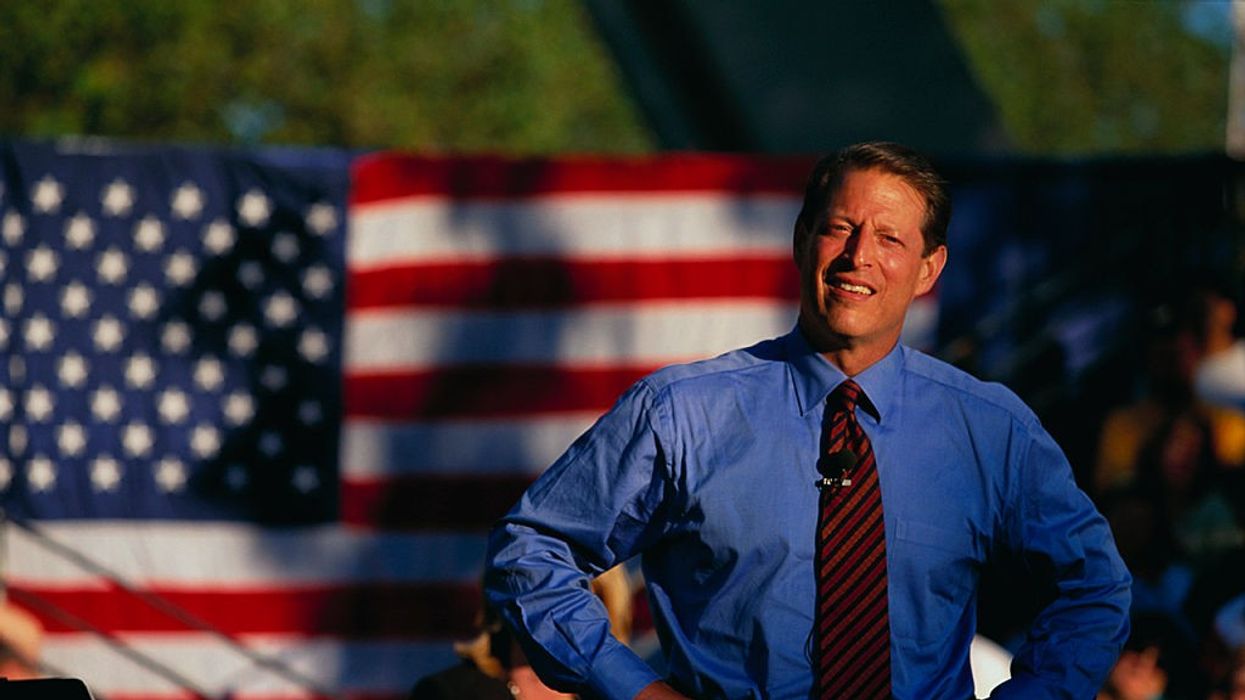
Stevens tells us that we should look with fond respect on Al Gore, the presidential candidate who so gracefully conceded the 2000 election despite having more popular votes and despite the fact that Florida, where the election was decided, was legitimately in play even as the Supreme Court issued its diktat that George W. Bush had won the election.
It is by no means clear that Gore lost that election. It is by no means certain that the U.S. Supreme Court, a court now widely seen as illegitimate and out of control, was acting in a nonpartisan manner even then.
Gore, says Stevens, did the decent thing by conceding the election gracefully, so unlike the crude vulgarians around Donald Trump in 2020. Gore represented the spirit of civic democracy, now under threat by MAGA. That’s easy to say for Stevens, who profited from his relationship with the Bush administration.
But might we suppose that the maintenance of a healthy democracy should require a little more controversy, a little more getting one’s hands dirty, even a little more rancor, especially if one’s cause is just? It is by no means clear that Gore lost that election. It is by no means certain that the U.S. Supreme Court, a court now widely seen as illegitimate and out of control, was acting in a nonpartisan manner even then. It is definitely not assured that George W. Bush’s brother Jeb, who happened to be governor of the state in contention, was averse to putting his thumb on the scale.
Stevens doesn’t mention any of that, or the fact that the then-chief justice, William Rehnquist, had a daughter seeking a prospective Bush administration job (she got it). And Clarence Thomas, whose wife, Ginni, author of so much recent mischief, was then employed by the Heritage Foundation to vet job seekers in the hoped-for Bush presidency.
Perhaps the Gore campaign should have been a bit more elbows-out, demanding recusal of Rehnquist and Thomas as a condition of accepting the jurisdiction of a court to decide an election rather than the normal method of a supervised recount. What might then have happened lurches, of course, into counterfactual territory, but there is no such thing as historical determinism: the flow of events is contingent on real people making actual decisions.
What would have been more important for the future well-being of the United States: Al Gore setting an example of gentlemanly civic behavior, as Stevens insists, or the Gore campaign doing whatever it took, within the bounds of honesty and legality, to transform his popular mandate into an electoral-college mandate?
It is quite possible that future historians will judge 9/11 and its extended fallout as an inflection point for the United States as significant as the Civil War, even though its consequences are less obvious. September 11, 2001 set in motion a chain of events that has still not played out, with each event a seismic shock destabilizing the country.
Any honest examination of 9/11 must begin with the fact that the Bush administration was hardly less than willfully negligent in failing to protect the country, with the August 6, 2001 president’s daily brief titled “Bin Laden determined to strike in U.S.” being Exhibit A for the prosecution. Bush’s response to the briefers was “you’ve covered your ass,” after which he played golf and cut brush at his summer ranch for almost a month.
It is hardly wild speculation to think that Gore, an Armed Services Committee member in the Senate before becoming vice president for eight years, might have reacted differently and put the appropriate agencies on alert, just as the Clinton administration had done when it foiled the so-called millennial bomb plot. Gore’s qualifications were certainly deeper than Bush’s, whose only previous acquaintance with national security was going AWOL from an air national guard unit.
As it was, 9/11 with its xenophobic revenge fantasies, hubris turned to grief on the stony soil of the Middle East, financial roulette where the billionaires always win, and color-coded threat warnings made a large swath of the American people functionally mentally ill.
No 9/11 means no Global War on Terror, a two-decade exercise in grandiose futility that thoroughly ruined two countries, gave rise to ISIS, and cost an estimated $8 trillion. And no Bush tax cuts, which instantly transformed a budget surplus into the large and intractable deficits that Republicans incessantly complain about (at least when they don’t control the White House).
Further idle speculation, but would Gore have let the foxes run the chicken coup as Bush did with respect to financial regulation? The whole spectacle of liar mortgage loans, synthetic CDOs, and massive credit default swaps resulted in perhaps the most predictable financial collapse in history, resulting in three years of lost growth that can never be recouped, more deficits, blighted lives, and increased public cynicism.
Without all of that, there may have been no public clamor for a dictator, and consequently no violent attempt to overthrow the Constitution. As it was, 9/11 with its xenophobic revenge fantasies, hubris turned to grief on the stony soil of the Middle East, financial roulette where the billionaires always win, and color-coded threat warnings made a large swath of the American people functionally mentally ill. Some even gush with enthusiasm at the prospect of dictatorial rule. Trump may go, but they will latch onto some other charlatan as a substitute Jesus-figure to worship. The rest of us will likely have to deal with all of this for the rest of our lives.
Beltway culture, which has been gradually “wired” to be Republican since the 1980s, apparently thinks all the disasters of the last two decades have been worth it, because it preserved the political parties in their scripted roles: Republicans as the rule-breaking but lovable Cool Kids, and Democrats as the gentlemanly losers.
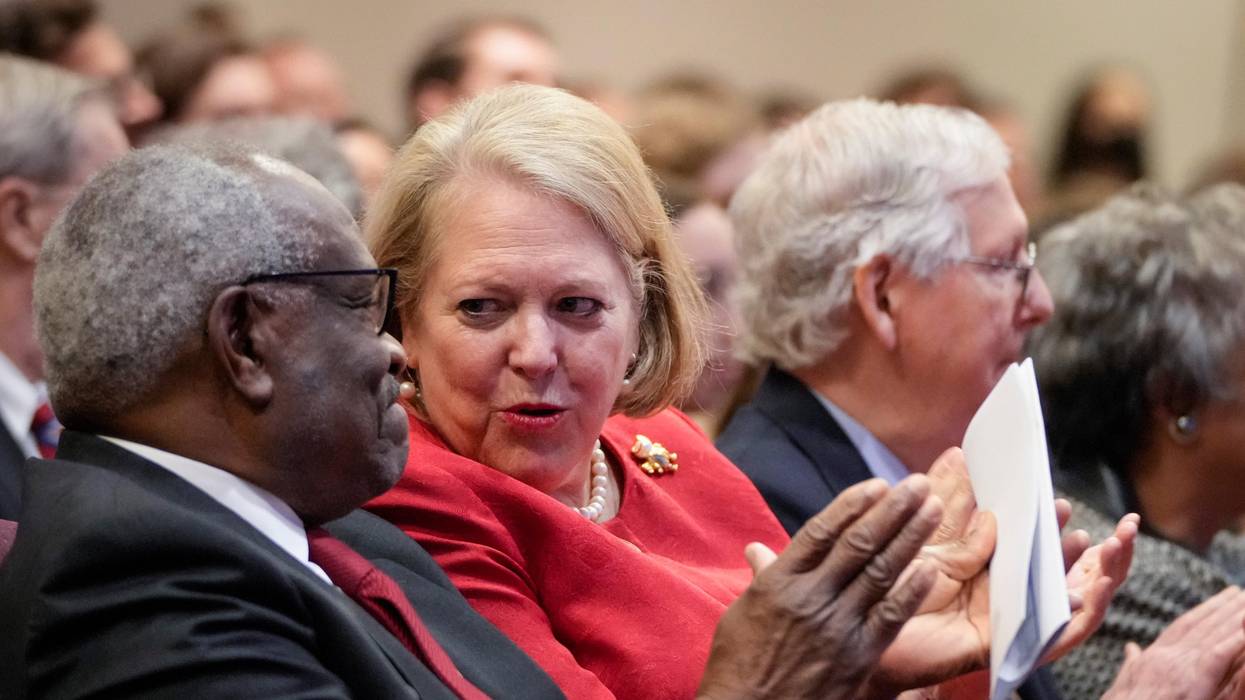
Democracy defenders expressed anger and consternation Friday after The Washington Post revealed that Ginni Thomas--the right-wing activist and wife of Associate U.S. Supreme Court Justice Clarence Thomas--pushed Arizona state lawmakers to invoke a dubious legal theory advocated by her husband in order to help then-President Donald Trump reverse his 2020 presidential election loss.
"The conflict of interest between Ginni and Clarence Thomas has never been greater."
"Ginni Thomas' involvement in the seditious conspiracy to overturn the will of the American people poses a conflict of interest that Congress can no longer ignore," said Sean Eldrige, founder and president of the pro-democracy advocacy group Stand Up America.
"Justice Thomas violated his oath to 'faithfully and impartially' administer justice by failing to recuse himself in cases related to the 2020 presidential election," he added. "No one should be above the law--not even Supreme Court justices. "It's time to demand accountability from the highest court in the land. Congress should act immediately to pass a code of ethics for the Supreme Court."
Emails obtained by the Post show that Ginni Thomas emailed Arizona House Speaker Rusty Bowers (R-25) and state Rep. Shawnna Bolick (R-20)--who advocates empowering legislators to void the will of voters--urging them to disregard President Joe Biden's victory and replace the state's electors with a "clean slate."
Echoing the "Big Lie" that Democrats rigged the 2020 contest, Thomas--who also sent numerous emails to Mark Meadows, Trump's chief of staff, urging him to push to overturn the election--implored the lawmakers to "do your constitutional duty" by using their "power to fight back against fraud."
A later audit of Arizona's election that Trump supporters said would prove it was "stolen" concluded there was no fraud--and that Biden actually won the state by more votes than the official count.
Thomas told the Arizona lawmakers that the power to choose electors was "yours and yours alone," an apparent reference to "independent state legislature theory" (ISLT). The Brennan Center for Justice describes ISLT as a "baseless" concept "making the rounds in conservative legal circles" that posits congressional elections can only be regulated by a state's lawmakers, not its judiciary--or even its constitution.
"While Clarence was applying the 'independent state legislature doctrine' from the bench, Ginni was using the exact same theory to try to overturn the 2020 election," wrote Slate senior writer Mark Joseph Stern. "Just breathtaking corruption."
"The conflict of interest between Ginni and Clarence Thomas has never been greater," he added.
Thomas has embraced ISLT in cases of vital importance to the future of U.S. democracy, including two in which a majority of justices affirmed the right of courts to intervene when state legislatures engage in partisan rigging of congressional district maps.
In one of the cases, Moore v. North Carolina, Thomas joined right-wing Justices Brett Kavanaugh, Samuel Alito, and Neil Gorsuch in a dissent arguing that the state's Supreme Court may have violated the Constitution by overruling state lawmakers.
Progressive politicians and advocates have been calling for Thomas' resignation or impeachment over his failure to recuse himself from cases involving the deadly January 6, 2021 attack on the United States Capitol by supporters of Trump's "Big Lie."
Thomas was the lone dissenter in January as the justices rejected Trump's bid to block the release of presidential records to the congressional committee investigating the January 6 insurrection.
More recently, Thomas' response to widespread public anger over the leaked Supreme Court draft opinion indicating the likely voiding of reproductive rights via reversal of Roe v. Wade has also raised eyebrows.
Opining that Americans "are becoming addicted to wanting particular outcomes, not living with the outcomes we don't like," Thomas asserted that the nation's highest court "can't be an institution that can be bullied into giving you just the outcomes you want."
This isn't the first time the Thomases have been accused of an election-related conflict of interest.
As the U.S. Supreme Court heard arguments in Bush v. Gore, a case that would decide the results of the inconclusive 2000 presidential election, Ginni Thomas admitted to soliciting resumes from prospective officials in what would be the George W. Bush administration after her husband and four other justices--three of them also accused of conflicts of interest--ruled in the Republican nominee's favor.
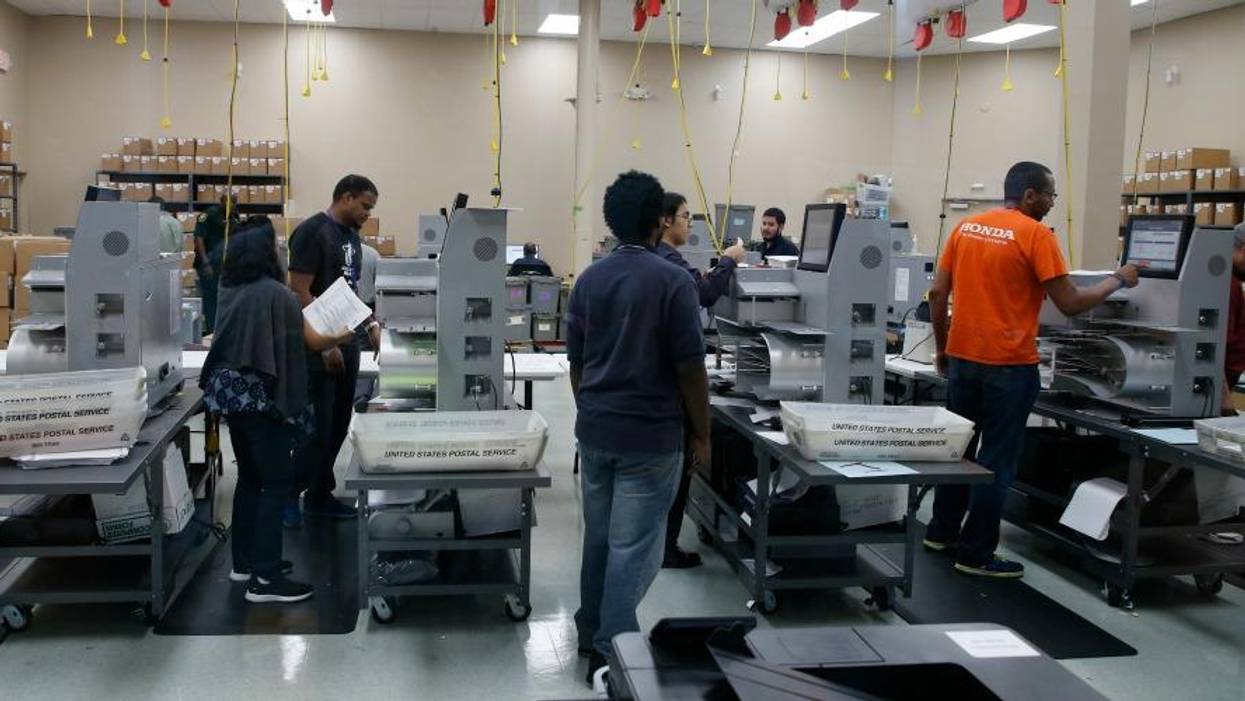
As his gubernatorial race headed for a recount, Florida Democrat Andrew Gillum withdrew his concession speech from last Tuesday, noting that while his fate in the election may not change after the votes are recounted, the integrity of the country's democratic process will be severely undermined if Republicans succeed in ending the process of counting every vote cast by Floridians.
"I am replacing my earlier concession with an unapologetic and uncompromised call to count every vote," Gillum said in a news conference Saturday afternoon. "We don't just get the opportunity to stop counting votes because we don't like the direction in which the vote tally is heading. That is not democratic and that is certainly not the American way."
Secretary of State Ken Detzner officially called for recounts of Florida's gubernatorial and Senate races after a noon deadline passed for all 67 of the state's counties' unofficial vote tallies, with both races deemed too close to call.
As of the noon deadline, Republican Rick Scott--currently the Florida governor--led Democratic Sen. Bill Nelson by only .15 percent, with about 12,500 more votes in the race fior Nelson's seat. In the gubernatorial election, Republican Ron DeSantis led Gillum by .41 percent of the vote.
"The outcome of this election will have consequences beyond who wins and who loses. How we handle this election and this process will have reverberations for democracy for an entire generation of voters." --Florida gubernatorial candidate Andrew GillumBoth margins of victory triggered an automatic machine recount, to be completed by this coming Thursday. Should either race still have less than a .25 margin after the first recount, a manual recount will be completed.
The recounts followScott's claim that "unethical liberals" were trying to "steal" the election. Scott as well as President Donald Trump called the continued tallying into question, with the governor telling sheriffs to "watch for any violations during the recount process."
Republicans' accusations of fraud by Broward County election officials come despite the fact that the state sent objective observers to supervise the vote-counting on election night. The supervisors have stated that no fraud or covering up of votes took place.
Gillum called the GOP's allegations a form of voter intimidation, liable to keep new voters from taking part in the democratic process in future elections.
"The outcome of this election will have consequences beyond who wins and who loses," the Tallahassee mayor said. "How we handle this election and this process will have reverberations for democracy for an entire generation of voters."
"Voter suppression," he added, "can show up in that first time voter, the one who entered this process so enthusiastic and so excited about the opportunity to go out there and participate in the democratic process, to let their voices be heard--only to hear their president, their governor, their United States senator throw out unsubstantiated claims of fraud and calls and choruses to stop the counting of the votes."
At The Intercept on Saturday, Jon Schwartz urged Gillum and other Democrats locked in close, still-undetermined election races to fight Republican efforts to undercut the counting of votes -- unlike presidential candidate Al Gore, who did not not ask for a statewide manual recount after a re-tallying of votes was halted in December 2000, stating his hope that his concession could help the country find "new common ground."
Citing the National Opinion Research Center's recount of Florida's votes in November 2001, Schwartz wrote, "First, we know that Al Gore won Florida in 2000. If a full, fair statewide recount had taken place, he would have become president. Second, Gore lost largely because, unlike Bush, he refused to fight with all the tools available to him."
Republican operative Roger Stone told the Daily Beast Friday, "many of my friends" are in Florida demonstrating against the vote counts, recalling the Trump associate's organizing of the "Brooks Brothers riots" in 2000 in which Republicans violently protested the state's recount.
"Already the GOP is gearing up for the same kind of direct, physical intimidation of vote counts in support of their legal strategy," wrote Schwartz. "Staffers at the Broward County election headquarters have requested police protection from Republican activists who've shown up at their offices addled by Trumpian conspiracy theories about vote fraud."
"Every house of faith, every synagogue, every church, needs to be out in the streets with serious, non-violent action, on a message of 'don't let them steal your vote' ... that we must have the right and freedom to vote," union organizer and author Jane McAlevey told The Intercept.

Fox News Channel has been recognized since its inception in 1996, when it was established by Republican operative Roger Ailes, as a right-leaning news source. But a new study published in the American Economic Review shows just how influential the channel is when it comes to changing viewers' minds, causing them to shift to the right on political issues--and even influencing election outcomes in ways that the outlet's more liberal counterparts don't.
Researchers at Emory and Stanford universities found that watching only three minutes of Fox News coverage per week would make Democratic and centrist voters one percent more likely to vote Republican in the 2008 election.
According to the study, this means that if Fox News hadn't existed in 2004, George W. Bush would have captured nearly four fewer percentage points, making John Kerry the popular vote winner. In 2008, Barack Obama would have won in a landslide if it weren't for Fox, capturing 60 percent of the vote, with John McCain winning 6.34 percent fewer votes.
Notably, the research shows that Fox appears driven by its ability to shift its viewership to the right even more than it's guided by its bottom line. According to Vox, the study finds "that Fox isn't setting its ideology where it ought to, to maximize its viewership. It's much more conservative than is optimal from that perspective. But it's pretty close to the slant that would maximize its persuasive power--that would result in the largest rightward movement among viewers. CNN, by contrast, matched its political stances pretty closely to the viewer-maximizing point, showing less interest in operating as a political agent."
CNN and MSNBC are also not as effective at shaping viewers' opinions. "Fox is substantially better at influencing Democrats than MSNBC is at influencing Republicans," said the authors of the study. While Fox was able to convince 58 percent of Democratic viewers to vote for Bush in 2000, and persuaded sizable minorities of Democrats to vote Republican in the following two elections, MSNBC did not have the same effect on conservative viewers in the same elections.
Fox News Channel "is consistently more effective at converting viewers than is MSNBC which has corresponding estimated persuasion rates of just 16 percent, 0 percent, and 8 percent," said the study.
The study confirms earlier research done after Fox was introduced in 1996, including a 2007 report from Berkeley which found "a significant effect of the introduction of Fox News on the vote share in Presidential elections between 1996 and 2000...Fox News convinced 3 to 28 percent of its viewers to vote Republican."
The newest research confirms what many critics already suspected about Fox News: that it's pushed conservative ideals and Republican agendas since its beginning, serving as a tool used by the GOP establishment to shift viewers to the right--and even swing elections.
The study did not analyze Fox's impact on the 2016 election, but according to a Pew Research poll taken in January, Fox News was the most-watched news source among Trump voters during the campaign, with 40 percent of his supporters relying on the channel for their news.
If politics is governed by an iron law, it is its very unpredictability. Citizens and commentators all see as through a glass darkly. We can and must make generalizations about politics. Nonetheless, the patterns we discern are at best rough approximations of a world that is itself subject to unexpected shocks and disruptions. The corollary of systemic unpredictability is that there is no politics without risk.
Many progressives reading this column are planning to vote for Al Gore today in order to stave off the grave risks of a Bush presidency. I understand and respect their fears, but I would ask them to recognize that their actions are themselves fraught with risks. The largely unspoken background of this election is a set of interrelated legal, economic, and political uncertainties. My reading of these risks and uncertainties leads me to advocate what I regard as the least risky course, a vote for Ralph Nader.
Gore's liberal defenders suggest that a vote for Nader is a middle class indulgence. The poor as well as future Social Security beneficiaries stand to lose the most with a Bush win. Yet Gore more than any other member of the Clinton Administration championed unnecessarily draconian welfare "reforms." These fail to support the transition to work desired by most welfare recipients.
In addition, Social Security, our most popular and successful anti-poverty program, faces the threat of "reform" in part because of Clinton-Gore rhetoric. The Administration continues to popularize the absurd notion of looming Social Security shortfalls. Social Security will fail only if US economic growth tumbles to levels unprecedented in modern times.
If the economy were to weaken appreciably, Gore's frequently reiterated commitment to stay the course of debt reduction in the face of all odds would compound the crisis. Our economic future would be especially bleak with a Democratic President insisting on Federal austerity during a deepening recession. Clinton convinced many Congressional Democrats to accept trade legislation about which many harbored inner doubts--with negative consequences for American labor. Gore efforts to disarm the traditional Democratic belief in the importance of public capital formation during troubled times would entail even more deleterious consequences. I'd prefer tax cuts even for the wealthy to a Coolidge style austerity when the economic chips are down.
Women are also portrayed as threatened by likely Bush appointees to the Supreme Court. These concerns may, however, reflect an exaggeration of the role and predictability of the courts. If progressives' goal is full equality for all women, more than formal legal standards are necessary. Even the noblest standards cannot be guaranteed simply by court appointments. If abortion is to remain "safe, legal, and rare" for all women, a complete range of reproductive and health services must be available. Although the legal right to abortion has been largely maintained during the Clinton years, effective access to full reproductive and health services has continued to shrink. I believe continued reliance on the courts to guarantee such access is risky. Unfortunately, that strategy is likely to persist as long as progressives think they can count on "lesser evil" centrist Democrats and their judicial appointees to assure their goals.
The largest risks in our decision today are political. As I write this column, Ralph Nader hovers around five percent in most national polls. Given the typical limits of poll samples, Nader's five percent might mean anything from two to eight percent. Some Progressives worry that in swing states like Maine, votes for Nader will tip the national election to Bush. I believe progressives ought also to consider the consequences of a Nader failure to achieve the five percent threshold.
If Nader receives five percent nationally, Greens will qualify for millions in matching campaign contributions for a 2004 presidential run. The quality of any future presidency depends more on the the political landscape than on the inner character of the incumbent. Bush's conservativsm will never become compassionate nor will Gore ever morph into a genuine populist without a credible Left opposition four years from now.
A Nader failure to attain five percent not only diminishes the progressive presence in politics, it also vindicates the exclusionary strategy endorsed by centrist Democrats. Not willing even to debate the merits of "lesser evil" politics, Gore's allies denied Nader an opportunity even to attend debates hosted by their corporate- sponsored debate commission. Our "Public" Broadcasting System then added insult to injury by offering free air time only to the corporate- sponsored candidates.
For me, the risks involved in lending further legitimacy to a corporate- dominated political process outweigh even the dangers of a Bush presidency. That progressives have to confront such wrenching choices is itself a commentary on how far our "two party" system has fallen.
Come election day, millions may vote for George W. Bush and Al Gore while not believing in them. Doubtlessly, some will vote for one of these two enthusiastically, but sometimes it seems neither of these candidates has inspired many beyond their immediate family and those on their campaign payroll. Many unimpassioned voters would consider backing a third party candidate, like consumer advocate Ralph Nader - or Pat Buchanan or the Libertarian or Natural Law candidates. But voters are scared.
Many are frightened that Gore will win - so they plan to vote for Bush; many others are afraid that Bush will win - so they're looking at voting for Gore. Are we becoming a nation that votes its fears rather than its hopes and convictions? A vote should be a statement of what someone believes - and indeed millions will do that come November 7. However, many feel sidelined, their heart tells them to vote for a third party candidate, but their head tells them to go for the "lesser of two evils."
Even with these shackles there are solutions - if people really do think it through. One answer is suggested by the group Citizens for Strategic Voting, which is taking out ads in newspapers urging people in states in which Gore or Bush does not have a chance of winning to vote for Ralph Nader. People could thus vote for Green Party candidate Nader without feeling they are helping whichever of the major party candidates they want to keep out of the White House. This is of course because the president is elected by winning a majority of the electoral college and the candidate who wins a given state gets all the electoral votes from that state. And if Nader gets 5 percent of the popular vote, as Ross Perot did in 1996, the Green Party gets federal money in 2004.
Good enough. But what if you live in one of those "swing states," (like Florida, Louisiana, Missouri, New Mexico, Ohio, Tennessee, Michigan, Oregon, Washington) or if you don't believe the polls?
Here's a sure-fire solution - if you are close to (and trust) someone who is on the other side of the two party divide in your state.
Say a husband plans to vote for Gore since he thinks Bush is dim. His wife plans to vote for Bush because she thinks Gore is deceitful. If they both - in the their hearts would like to vote for some third party candidate - they can do so, by trusting each other and both voting for the third party candidate.
If they had just gone along with the husband voting for Gore and the wife voting for Bush, in effect they would cancel out each other's vote. But if they both vote for a third party candidate, they can magnify their votes. For example, if instead of one for Gore and the other for Bush they both voted for Nader, they would not change the balance between Gore and Bush, but they would give Nader two votes. Instead of "wasting" their votes (by canceling out each other), they would double their vote by giving both to the candidate they truly want. They would vote their conviction without helping whichever politician they least want. Of course, people can do this with any third party candidate, and indeed, with any two third party candidates (a husband can vote for one third party candidate, the wife for a different one). This would send a strong signal that people are not satisfied with the major parties.
A would-be Republican voting for Nader is not as unlikely as it might seem to some. Nader's attraction comes largely from his intelligence and integrity. In his address at the Green Party convention, he welcomed "authentic conservatives" - as opposed to "corporatists." He stands for community, for family, for accountability - as well as for social justice, the environment and peace. He stands against abusive power, whether by corporations - or the government.
This "vote swap" option is exercised by politicians all the time. One congressman votes for another's dam project in return for a vote for his military base. Maybe it's about time that the public used such tactics.
So there are solutions. People don't need to feel bound by the "lesser of two evil argument." Step one: vote your convictions; Step two: figure out what's happening in your state and vote with your head; Step three: find a friend, relative or co-worker who was planning on voting for the other "less of two evils," make a pact and double your heart instead of canceling out each other on election day.
Are progressives irresponsible in supporting Ralph Nader? Won't they enable a Bush presidency, just as liberals' aversion to Hubert Humphrey helped elect Richard Nixon? As a Nader voter, I accept the importance of this question. Nonetheless, I am not convinced that progressives today must support Al Gore to avert social catastrophe.
I am more impressed by the similarities than the differences between the major candidates. Furthermore, I believe any election analysis that merely juxtaposes positions misleads us. Promises are made during campaigns, but the most important result of an election is the forces mobilized both for and against the incoming administration. In 1992, Bill Clinton promised to "put people first" by rebuilding the nation's infrastructure. He won a bare plurality of the vote and the undying hatred of the bond market. He quickly backed off and became a born again fiscal conservative.
Both George W. Bush and Gore are ardent supporters of corporate globalism. Gore's devotion in the face of evidence that global capitalism weakens workers' bargaining position and degrades the environment speaks volumes about his candidacy. Just as significantly, in the post-Cold War era both Gore and Bush promise to increase military spending and confine debate to the best Star Wars option.
Bush and Gore do differ on Social Security and tax policy. Bush would privatize part of Social Security. He would cut capital gains and estate taxes further. Both steps would exacerbate our gaping inequalities and make our prosperity even more dependent on market fluctuations.
These would be dangerous steps, but we must ask why these themes resonate. Ten years ago, any Republican touting Social Security privatization would invite disaster. Unfortunately, the Clinton administration has done so good a job selling the absurd notion that Social Security is fiscally unsound that a majority now believe it won't be around when they retire. These dire prognoses are, however, based on projected rates of national growth slower than those of the Depression era. Should these projections prove correct, Social Security shortfalls will be among the least of our difficulties.
The administration's response to this pseudo problem is to "lock up" the growing budget surplus in order to save Social Security. These funds are, of course, not actually stored in a separate vault but are used to pay off government debt. Though paying down the debt may sound like a worthy idea, its consequence is that social investment in schools, energy- efficient transit systems and basic research is neglected. The much touted productivity gains of the last few years owe more to past government development of the computer and the Internet than to Bill Gates. Unfortunately, current austerity only diminishes future seed corn.
A Gore presidency would face continued worries about Social Security -- and probably in the context of an economy less robust than the past two years. Having sworn off activist government, it will likely need to embrace some combination of Social Security cuts, partial privatization and tax breaks for the rich in order to stave off media criticism.
Looking at our politics over the last quarter century, two trends stand out: 1) a shrinking electorate, and 2) the gradual erosion of working-class support for the Democratic Party. As Ray Teixeira and Joel Rogers have argued in a new book, high school-educated clerical, service sector, and factory workers are the real swing voters in American politics. A quarter century of economic stagnation and social conflict have caused some of these voters to move right. Economic decline at the end of the Bush administration gave Clinton's campaign a chance to regain some, but his trade agenda and botched health care initiatives leave the Democrats a weakened presidential party facing a hostile Congress.
A victorious Bush may be able to push Social Security "reforms," but he will likely bring few Democrats along and he will tag his party as responsible for the consequences. Nor will he, unlike Clinton or Gore, be able to mobilize the many Democrats any administration needs to enact more "free trade" deals.
Neither party attracts an effective majority of the population. A Nader candidacy is good for our politics even if it means a Bush victory. Nader is the only candidate who combines progressive reforms of international commerce, universal health care, reproductive rights and a positive role for government in providing necessary social capital. Democrats in power will never address these concerns unless they face the threat of losing voters to someone who will.
The very presence in the race of a well-known third-party nominee will also force a long overdue discussion of the laws and semi-official practices that sustain the two party monopoly. Paradoxically, Nader could also force Gore to advance more progressive initiatives He may also excite more liberal voters and thus benefit congressional Democrats. Al Gore's greatest enemy isn't Ralph Nader or George W. Bush. It is the unimaginative centrism that currently passes for political wisdom.