

SUBSCRIBE TO OUR FREE NEWSLETTER
Daily news & progressive opinion—funded by the people, not the corporations—delivered straight to your inbox.
5
#000000
#FFFFFF
To donate by check, phone, or other method, see our More Ways to Give page.
Daily news & progressive opinion—funded by the people, not the corporations—delivered straight to your inbox.

"Trump is breaking the law and flouting a court order by handing the fossil fuel industry and polluters this blank check to kill millions of migratory birds," one advocate said.
The Trump administration moved on Friday to weaken protections for migratory birds threatened by industrial activities, including oil and gas operations.
Acting Solicitor of the U.S. Department of the Interior (DOI) Gregory Zerzan restored an opinion from the first Trump administration that the Migratory Bird Treaty Act (MBTA) "does not apply to the accidental or incidental taking or killing of migratory birds," despite the fact that this opinion was already ruled illegal in federal court.
"Trump is breaking the law and flouting a court order by handing the fossil fuel industry and polluters this blank check to kill millions of migratory birds," said Tara Zuardo, a senior campaigner at the Center for Biological Diversity. "The United States has lost billions of birds over the past 50 years, and that decline will accelerate horrifically because of this callous, anti-wildlife directive. No one voted to slaughter hummingbirds, cranes, and raptors, but this is the reality of Trump's illegal actions today."
"We're not going to succeed in addressing the crisis facing birds and other wildlife if we let this and other historic rollbacks stand."
The new directive comes as birds in the U.S. are under threat, with their numbers falling by around 30% since 1970. A number of factors are responsible for this decline, among them the climate emergency, habitat loss, falling insect populations, window strikes, and outdoor cats. However, conservationists told The New York Times that industrial activities would be a greater threat if not for the protection the law provides.
For example, Zuardo told the Times that if U.S. President Donald Trump's interpretation of the law had been in effect following BP's Deepwater Horizon oil spill in 2010—which likely killed over 1 million birds—the company would not have been charged the around $100 million in fines that went to support bird conservation after the disaster.
Friday's directive is part of an ongoing effort over the course of both Trump administrations to weaken the MBTA so that it only targets the purposeful killing of birds, dropping enforcement against accidents such as as oil spills, drownings in uncovered oil pits, trappings in open mining pipes, and collisions with power lines or communication towers.
In 2017, lead Interior Department lawyer Daniel Jorjani issued an initial legal opinion claiming the MBTA only covered purposeful killings. This interpretation was struck down by a federal court in 2020, which argued that the act's "clear language" put it in "direct conflict" with the Trump opinion.
This didn't stop the Trump administration from issuing a final rule attempting to enshrine its interpretation of the MBTA at the end of Trump's first term, which was widely decried by bird advocates.
"We're not going to succeed in addressing the crisis facing birds and other wildlife if we let this and other historic rollbacks stand," Erik Schneider, policy manager for the National Audubon Society, said at the time.
However, months into the presidency of Joe Biden, DOI principal deputy solicitor Robert T. Anderson withdrew the initial 2017 Trump administration opinion after an appeals court, following the request of the U.S. government, dismissed the Trump administration's earlier appeal of the 2020 court decision.
"The lower court decision is consistent with the Department of the Interior's long-standing interpretation of the MBTA," Anderson wrote.
Later, the Biden administration also reversed the formal Trump-era rule weakening the MBTA.
Now, in his second term, Trump is coming for the birds again. The Biden-era withdrawal was one of 20 Biden-era opinions that the Trump DOI suspended in March. It was then officially revoked and withdrawn on Friday.
In justifying its decision, Trump's DOI cited the president's January 20 executive order "Unleashing American Energy," which calls on federal agencies to "suspend, revise, or rescind all agency actions identified as unduly burdensome," making it clear the weakening of protections is largely intended to benefit the fossil fuel and mining industries.

"We can see the fingerprints of Project 2025 across each of the majority's appropriations bills," said Democratic Rep. Rosa DeLauro.
A leading House Democrat on Wednesday accused her Republican colleagues of hijacking the government funding process to pursue a "MAGA Project 2025 Agenda" that aims to further roll back abortion rights, cut education programs, and attack workers and the planet.
"House Republicans are unable and unwilling to govern," said Rep. Rosa DeLauro (D-Conn.), the ranking member of the House Appropriations Committee. "House Democrats are at the table ready to negotiate. The quicker House Republicans realize their extremist agenda cannot become law, the quicker we can get down to the business of the American people."
"This year should have been easier than last. We began the 2025 process—weeks after successfully passing the final 2024 bills—with a top line in place, yet Republicans reneged on it," DeLauro continued. "They wrote partisan bills to further their Trump MAGA Project 2025 Agenda instead of working with Democrats to pass bills that could become law. At every turn, the Republicans are making abortion illegal, eliminating federal support for public education, undermining workers, and disarming America in the face of the climate crisis."
In recent weeks, House Republicans have put forth government funding bills for fiscal year 2025 that would slash the Education Department's budget by $11 billion, curb funding for the understaffed Social Security Administration, and assail climate agencies while boosting offshore drilling and other destructive practices—all of which is consistent with the Heritage Foundation-led Project 2025 agenda.
"Project 2025 advocates for climate and environmental arson. And we can see exactly where the majority has taken its cues from the climate catastrophe manifesto in this bill."
At least 140 people who worked in the administration of former President Donald Trump, the GOP's 2024 presidential nominee, helped craft Project 2025, according to CNN.
The House GOP's appropriations bills stand no chance of becoming law with Democrats controlling the Senate and the White House, but they have offered a preview of what the right-wing party is likely to do if it wins control of Congress and Trump secures another term in November.
Currently, Republicans "find themselves in a stalemate of their own doing," The Washington Post reported Thursday, "even after House Speaker Mike Johnson (R-La.) pledged to pass all 12 bills before their monthlong break from Washington in August." So far, the House has only passed five of the 12 bills.
On Tuesday, following hours of debate, House Republicans abruptly pulled a federal energy and water funding bill from the floor and the party's leadership decided to begin August recess a week early, starting on Thursday. Politico reported that the withdrawn bill would have revoked the Energy Department's pause on new permit approvals for liquefied natural gas exports and "cut funding for efficiency and renewable energy programs."
House Republicans were able to pass funding legislation for the Interior Department and Environmental Protection Agency (EPA) on Wednesday. Just one Democrat, Rep. Vicente Gonzalez (D-Texas), voted for the bill, which is dead on arrival in the Senate.
As E&E News reported:
The legislation's $38.5 billion top line is about $72 million below the fiscal 2024 level. EPA's budget would shrink by $1.8 billion, with significant cuts to agency programs focused on science and technology, environmental justice, and chemical risk reviews. The Superfund cleanup program and the Diesel Emissions Reduction Program would see higher budget lines.
Interior funding would drop by $42 million, in part because of cuts to offices such as the Bureau of Land Management, the Bureau of Ocean Energy Management, and the National Park Service.
In a floor speech earlier this week opposing the legislation, DeLauro said that "rather than making sound investments to protect our air and water, preserve our National Parks, and ensure the environment we all share and live in remains clean and protected, the majority's bill benefits the most egregious polluters and climate science deniers, jeopardizes public health and safety, hinders our responses to the climate crisis, and endangers rural and low-income communities."
"This disastrous proposal did not come out of nowhere," she continued. "This is explicitly where the majority wants to take the country. Project 2025 is the Trump MAGA Republican agenda to take over the government and destroy our rights and freedoms. But it is not just a document on a website—we can see the fingerprints of Project 2025 across each of the majority's appropriations bills."
"In short, Project 2025 advocates for climate and environmental arson," DeLauro added. "And we can see exactly where the majority has taken its cues from the climate catastrophe manifesto in this bill."

Critics of a House appropriations bill that guts environmental agencies warn it's a sign of what the Republicans will do if they retake the Senate and the presidency next year.
Democrats and watchdog groups reacted with outrage on Friday as a U.S. House environmental subcommittee led by Republicans approved an appropriations bill that would reduce funding for two federal agencies and limit their ability to protect the environment.
The House Appropriations Interior, Environment, and Related Agencies Subcommittee voted to advance a bill to weaken the regulatory capacities of the Department of the Interior and the Environmental Protection Agency (EPA), cutting funding for conservation, climate action, national parks, and environmental justice initiatives.
"This bill sticks a finger in the eye of the American people who care deeply about clean air, climate change, endangered species, and responsible use of public lands," said Greta Anderson, deputy director of Western Watersheds Project. "It's a nasty wishlist to defund the priorities of protecting a livable future."
The fiscal year 2025 bill proposes a 20% cut to the EPA's annual budget, from $9.2 billion to $7.4 billion, including a $749 million cut to state and tribal assistance grants. It also proposes reductions to many Interior agency budgets, including a $210 million cut to the National Park Service and a $144 million cut to the U.S. Fish and Wildlife Service.
Taking aim at the government's ability to regulate industry, most of the Republicans' spending allocations are below fiscal year 2024 and almost all of them are below the amount requested by the Biden administration.
Rep. Chellie Pingree (D-Maine), the subcommittee's ranking Democrat, said in a statement that the proposed EPA cut was "irresponsible" and that she was "greatly disappointed and frustrated" by the bill, which "completely disregards the reality of a warming planet and ignores the need for us to do more, not less."
Pingree's Democratic colleague, Rep. Rosa DeLauro (D-Conn.), the ranking member of the full appropriations committee, agreed.
The bill "promotes dirty energy, taking the side of fossil fuel companies and those who deny the scientific reality rather than address the escalating risk to our economy and national security presented by the changing climate and growing number of extreme weather events," DeLauro said in the statement.
Critics of the bill also objected to the large number of "poison-pill" riders that seek to undo Biden administration rules and undermine the Endangered Species Act by naming specific animals for which listing can't be funded. Per a Trump-era Interior rule, the legislation also delists most gray wolf populations from the ESA.
"This proposal is a hatchet job of disastrous proportion that in an unprecedented scale, targets our nation's most imperiled species and the law saving them from extinction," Robert Dewey, vice president of government relations at Defenders of Wildlife, said in a statement.
The Republicans' bill includes proposed reductions to funding for clean water infrastructure projects, which Food and Water Watch (FWW) said was a step in the wrong direction—water and sewer systems need huge infusions of money just to meet current water quality standards.
"The proposed cuts would leave many with unsafe water and exacerbate the nation’s water affordability crisis, adding more pressure on household water bills at a time when families are already grappling with soaring costs for essential services," Mary Grant, a FWW campaign director, said in a statement, calling safe water "non-negotiable."
Grant said that to safeguard Americans' clean water from "foolishly political annual appropriations battles," Congress should pass the Water Affordability, Transparency, Equity, And Reliability (WATER) Act—a call she also made last year, when the same subcommittee advanced a similar bill.
The full appropriations committee will consider the bill on July 9. If the bill passes through the committee and then the full chamber, as last year's version did, it's unlikely to make headway in the Democratic-controlled U.S. Senate. However, critics of the bill warned that it's a sign of what the Republicans will do if they retake the Senate and the presidency.
Earlier this month, presumptive Republican nominee Donald Trump said that he plans to gut federal agencies dealing with climate, such as the Interior Department. A union of EPA workers rebuked Trump for the remarks.

"Our lawsuit is another stand for the Gulf ecosystem, its nearby communities, and all wildlife that continue to suffer at the hands of Big Oil," said Friends of the Earth's legal director.
Faced with a rapidly warming world that is hurtling toward terrifying tipping points, climate groups on Monday filed a lawsuit over the Biden administration's five-year plan for offshore drilling in the Gulf of Mexico—and so did the fossil fuel industry.
Both suits target the 2024-29 National Outer Continental Shelf Oil and Gas Leasing Program. When the plan was finalized in December, the U.S. Department of the Interior highlighted that it features the fewest lease sales in history—just three—and the Inflation Reduction Act ties offshore wind development to continued oil and gas leasing.
Despite scientists' warnings about continued fossil fuel extraction and use, the American Petroleum Institute, an industry trade group, is fighting for more lease sales. API senior vice president and general counsel Ryan Meyers on Monday claimed that the Biden administration "has used every tool at its disposal to restrict access to vast energy resources in federal waters."
Meanwhile, green groups argue that the administration hasn't gone far enough in terms of tackling the fossil fuel-driven climate emergency and delivering on the campaign promises of Democratic President Joe Biden, who is seeking reelection in November.
"It is time for us to transition away from these industries, not enable further drilling in the years to come."
“Fossil fuel development is untenable if we want a livable future," declared Brettny Hardy, an attorney with Earthjustice, which is representing the climate groups. "The oil and gas industry is already sitting on 9 million acres of undeveloped leases. They certainly are not entitled to more."
"Although we acknowledge the government's focus on climate impacts with the release of this five-year offshore leasing plan, we are taking legal action today because we are concerned about how it will jeopardize the health of overburdened communities," Hardy explained.
Kristen Schlemmer of Bayou City Waterkeeper in Houston stressed that in her city and "along the Texas Gulf Coast, the stakes are high."
"More fossil fuels means more carbon emissions, which means more intense hurricanes hitting the inadequately guarded petrochemical infrastructure that is already in place," she said. "It is time for us to transition away from these industries, not enable further drilling in the years to come."
In addition to emphasizing the dangers of what Oceana campaign director Joseph Gordon called a "deadly cycle of drilling and spilling," the climate and Gulf groups represented by Earthjustice also slammed the API suit, which Brad Sewell of the Natural Resources Defense Council described as "unfounded and unwarranted."
Pete Stauffer, ocean protection manager at the Surfrider Foundation, argued that the industry suit "belies the fact that new offshore drilling is broadly unpopular and is not needed to meet our nation's energy needs," noting that the administration's plan "was informed by nearly a million public comments" against new extraction in U.S. waters.
Friends of the Earth legal director Hallie Templeton said that "we are not surprised by this industry challenge, given its track record of suing every time the Biden administration makes any attempt to break free from fossil fuels."
"Our lawsuit is another stand for the Gulf ecosystem, its nearby communities, and all wildlife that continue to suffer at the hands of Big Oil," Templeton added.
The other groups joining the green groups' challenge to the five-year plan are Healthy Gulf, Sierra Club, and Turtle Island Restoration Network. According to Reuters, both lawsuits were filed in the U.S. Court of Appeals for the District of Columbia.
The competing legal battles were launched as 21 protesters with the youth-led Sunrise Movement were arrested on Monday for blockading Biden's reelection campaign headquarters in Delaware and demanding that he declare a climate emergency.
The president has faced criticism for not only declining to declare a climate emergency and continuing fossil fuel lease sales but also skipping the United Nations summit late last year and supporting the Willow oil project and Mountain Valley Pipeline.
Biden has also come under fire for backing the expansion of the liquefied natural gas industry, though his administration won praise from green groups last month for halting approvals for LNG exports to non-Fair Trade Agreement countries—a move that former President Donald Trump, the Republican front-runner, has vowed to reverse if he is elected later this year.

"The current killing regimes in Idaho, Montana, and Wyoming put wolves at obvious risk of extinction in the foreseeable future, and this core population is key to wolf survival in the West."
Two coalitions of conservation groups on Wednesday filed notices of their intent to sue the U.S. government for not granting federal endangered or threatened species protections to gray wolves in the northern Rocky Mountains or across the western United States.
The notices, sent to U.S. Secretary of the Interior Deb Haaland and Fish and Wildlife Service Director Martha Williams, give the FWS 60 days to change its finding that Endangered Species Act (ESA) protections for the region's wolves are "not warranted," or face two lawsuits. The agency's finding was
announced last week and published in the Federal Register Wednesday.
Since a congressional legislative rider and court battles stripped the area's wolves of ESA protections over a decade ago, states have stepped up their killing efforts while local and national groups have fought to protect the animals—including with a pair of petitions calling on FWS to reconsider the issue, which led to the service's latest finding.
"It's beyond frustrating that federal officials are harming wolf recovery by denying wolves in the northern Rockies the powerful federal protections they deserve," declared Andrea Zaccardi, carnivore conservation legal director at the Center for Biological Diversity, which has partnered with the Humane Society of the United States, Humane Society Legislative Fund, and the Sierra Club.
"Unlike the Fish and Wildlife Service, we refuse to sanction the annual slaughter of hundreds of wolves."
"Unlike the Fish and Wildlife Service, we refuse to sanction the annual slaughter of hundreds of wolves," she continued. "Allowing unlimited wolf killing sabotages decades of recovery efforts in the northern Rockies, as well as those in neighboring West Coast and southern Rockies states."
Nick Gevock, Sierra Club field organizer for the northern Rockies, specifically called out FWS for failing to recognize the impacts of policies in Idaho and Montana, asserting that "the regimens these states have pursued are reminiscent of the 1800s effort to eradicate wolves, and they have no place in modern wildlife management."
In recent years, Montana legislators have
advanced various measures opposed by conservationists and experts, including a "bounty program" law to reimburse hunters and trappers for their expenses. In Idaho, the state can use taxpayer money to hire private contractors to kill wolves, and there is no limit on how many wolf tags hunters can obtain.
"Nearly 30 years after wolves were reintroduced to Yellowstone National Park, wolves in the region are once again in danger of extinction," said Margie Robinson, staff attorney for wildlife at the Humane Society of the United States. "The U.S. Fish and Wildlife Service must make decisions that protect precious native wildlife for generations to come, rather than allowing states to cater to trophy hunters, trappers, and ranchers."
Yellowstone stretches across parts of Idaho and Montana but is largely in Wyoming, which has come under fire for designating gray wolves as "predatory animals" across much of the state, meaning they can be killed without a license.
Members of the coalition represented by the Western Environmental Law Center (WELC) also blasted all three states' policies. Erik Molvar, a wildlife biologist and executive director of the Western Watersheds Project, warned that "the current killing regimes in Idaho, Montana, and Wyoming put wolves at obvious risk of extinction in the foreseeable future, and this core population is key to wolf survival in the West."
Both coalitions argue that the FWS ignored "the best available science" and should not rely on the states' wolf tallies. Molvar said that "even if the states' population estimates were defensible—and they aren't, according to recent scientific analyses—the feds are underestimating the extinction agendas of anti-wolf state governments and the small and tentative state of recovering wolf populations elsewhere in the West."
Brooks Fahy, executive director of Predator Defense, also part of the WELC coalition, stressed that "Idaho, Montana, and Wyoming have become the poster children for what happens when politics trumps science."
"They are cruelly driving wolves in the northern Rockies to extinction via wanton shooting, trapping, snaring, even driving over them with a snowmobile," Fahy said. "Science shows us the importance of intact pack structures. Each family member has a vital role to play and they grieve each loss."
Joining the Molvar and Fahy's groups are the Alliance for the Wild Rockies, Friends of the Clearwater, International Wildlife Coexistence Network, Nimiipuu Protecting Our Environment, Protect the Wolves, Trap Free Montana, WildEarth Guardians, and Wilderness Watch.
"It's deeply concerning to hear that the U.S. Fish and Wildlife Service has decided not to list gray wolves, a sacred species to Native Americans in the western U.S., under the Endangered Species Act, while ignoring traditional sacred religious beliefs of traditional Native Americans," said Roger Dobson of Protect the Wolves.
"It's important to protect these intelligent and family-oriented predators to maintain ecosystem health, and to protect Native American sacred religious beliefs," Dobson added. "Hopefully, the service will take steps to address the problems with their determination before it's too late for these native wildlife species, before violating Indigenous religious beliefs."
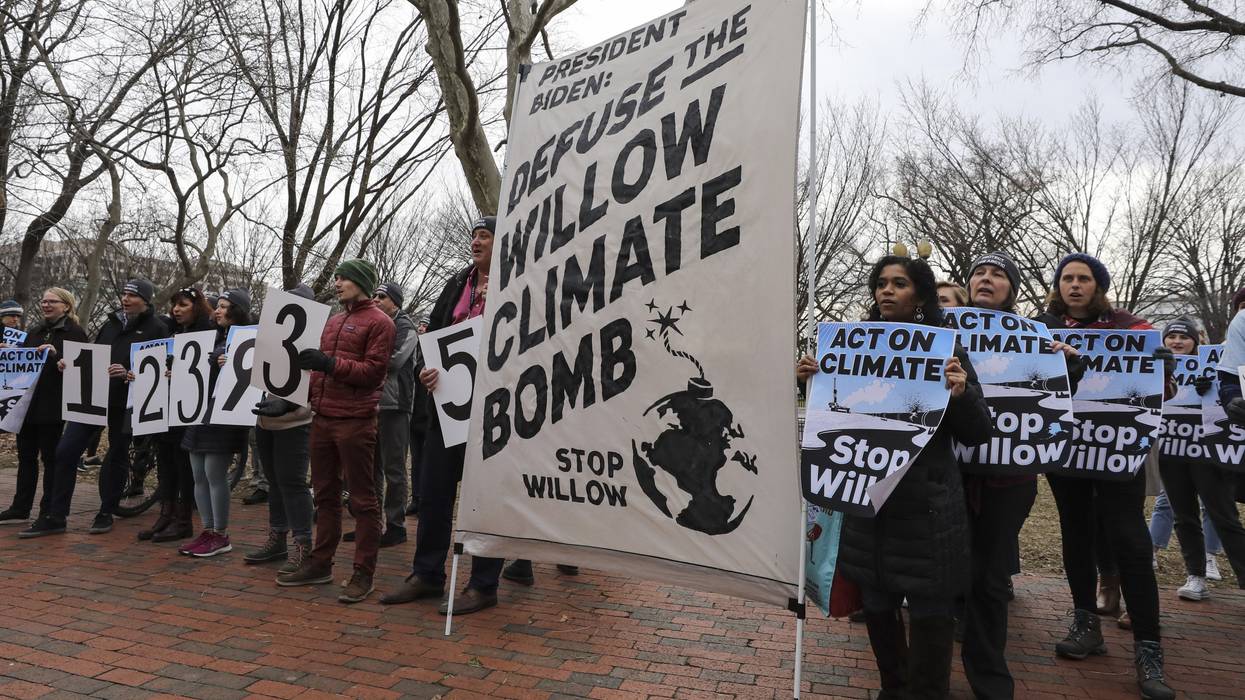
"We will do everything within our power to protect the climate, wildlife, and people from this dangerous carbon bomb," said one opponent.
Climate campaigners on Tuesday remained resolute in their fight against ConocoPhillips' Willow oil project in Alaska—even after a federal judge declined to issue a preliminary injunction sought by environmental and Indigenous groups behind a pair of legal challenges.
"It's heartbreaking that ConocoPhillips has been allowed to break ground on Willow before the court has fully assessed whether the project is lawful," said Kristen Monsell, a senior attorney at the Center for Biological Diversity, in a statement.
"But this case isn't over, and we'll keep fighting to protect struggling Arctic wildlife and our climate from this disastrous project," Monsell vowed. "We're hopeful we'll get the Willow project's approval thrown out once again."
After the Biden administration last month controversially approved the 30-year Big Oil project, two coalitions of advocacy organizations swiftly filed separate lawsuits in the U.S. District Court for the District of Alaska.
One case is led by the Center for Biological Diversity, Defenders of Wildlife, Earthjustice, Friends of the Earth, Greenpeace USA, and Natural Resources Defense Council; the other was filed by Trustees for Alaska on behalf of Alaska Wilderness League, Environment America, Northern Alaska Environmental Center, Sierra Club, Sovereign Iñupiat for a Living Arctic, and the Wilderness Society.
"Allowing ConocoPhillips to bulldoze forward with construction of the largest oil and gas project on public lands before the lawsuits are settled is needlessly destructive."
In a 44-page order on Monday, U.S. District Judge Sharon Gleason—an appointee of former President Barack Obama—denied both coalitions' requests that the court halt construction.
"The court has weighed the environmental harm posed by the proposed winter 2023 construction activities against the economic damages, benefits to most subsistence users, and the state and federal legislative pronouncements of the public interest that would be impacted by a preliminary injunction prohibiting these construction activities at this time, and concludes that the balance of the equities and the public interest tip sharply against preliminary injunctive relief," she wrote. "The court has further determined that plaintiffs have not established that irreparable injury to their members is likely if winter 2023 construction activities proceed."
A spokesperson for ConocoPhillips said in a statement to CNN that "with this decision from the federal district court, we are able to immediately begin construction activities."
Trustees for Alaska lead staff attorney Bridget Psarianos noted that "the district court found in our prior 2020 lawsuit that winter road construction and gravel mining would do immediate and permanent harm to land and the community of Nuiqsut. It's no different this time."
"This is heartbreaking for all who want to protect local communities and prevent more devastating climate impacts in the Arctic and around the world," the lawyer added. "We will do everything we can to protect the region while the merits of our case get heard."
Those behind the other case were similarly disappointed but determined. Greenpeace USA climate campaign director Natalie Mebane declared that "allowing ConocoPhillips to bulldoze forward with construction of the largest oil and gas project on public lands before the lawsuits are settled is needlessly destructive."
Still, "we remain undeterred," said Defenders of Wildlife Alaska Program director Nicole Whittington-Evans. "We remain committed to protecting the western Arctic and look forward to the court's full consideration of the Willow project, including its impacts to polar bears threatened with extinction and massive carbon emissions that will worsen the climate crisis for decades to come."
President Joe Biden has faced intense criticism over his administration greenlighting Willow despite the climate campaign promises that helped him win in 2020. Green groups called the approval a "betrayal" and some Democrats on Capitol Hill warned that it "destroys our climate goals and undermines international climate ambition," leaving an "oil stain" on Biden's legacy.
"Although the White House and Department of Interior were not persuaded to stop Willow despite the advocacy of more than 5 million individuals, we are now using the power of the law to restore some balance," said Erik Grafe, deputy managing attorney in Earthjustice's Alaska regional office. "While this particular round of the legal challenge did not produce the outcome we had hoped for, our court battle continues."
"We will do everything within our power to protect the climate, wildlife, and people from this dangerous carbon bomb," Grafe pledged. "Climate scientists have warned that we have less than seven years to get it right on climate change, and we cannot afford to lock in three decades of oil drilling that will only serve to open the door to more fossil fuel extraction."
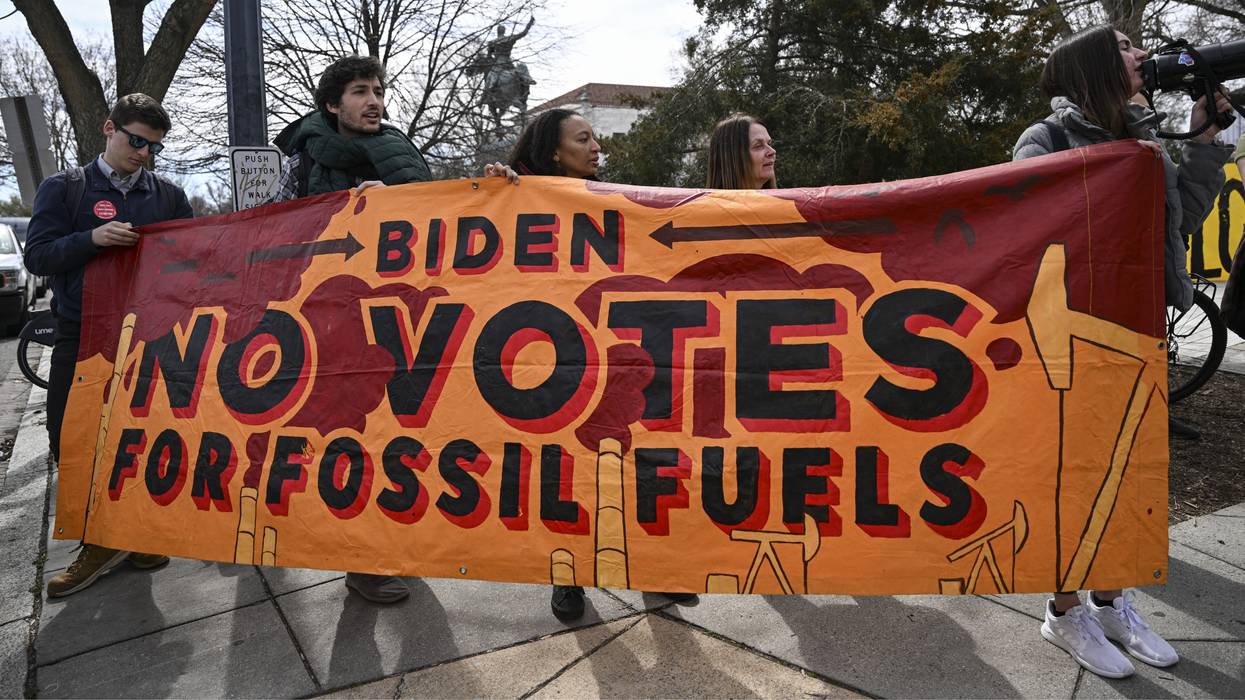
The administration's approval of the Willow oil project in Alaska communicates a disconnect from reality and a disregard for the people who elected him.
The sun was beating down and my ears were ringing. My hands gripped the megaphone as we chanted, "No more drilling, no more drilling, no more drilling on federal lands!" The words we chanted were President Joe Biden's verbatim, a broken promise made on the campaign trail in 2020. Just over a week after approving a massive oil drilling plan in the Arctic called the Willow project, President Biden hosted a conservation summit at the Department of the Interior. Youth climate justice organizers from Zero Hour protested alongside allied organizations outside the summit for hours, determined not to let Biden forget his broken promise. Administration officials and the president himself entered and left the building, pretending to ignore us and our demands, but we didn't quiet down. We don't plan to stop protesting the outrageous decision any time soon.
The conservation summit also came a day after the latest Intergovernmental Panel on Climate Change (IPCC) report was released, warning that this is our last chance for governments to stop fossil fuels to meet key planetary warming thresholds. The audacity of the Biden administration to host an environmental summit just after taking action that locks us into further dependence on fossil fuels is a striking example of just how out-of-touch the administration is. The week before the Willow project was approved, #StopWillow went viral online and a Change.org petition against the project gathered nearly 2.5 million signatures. In-person protests erupted in places from the White House to the Stephen Colbert show where Vice President Kamala Harris was a guest. And yet, the administration has continued to stand by its unconscionable decision.
I have been organizing and advocating for climate action since I was 15 years old, and politicians being deaf to public demands is nothing new to me. But as I stood outside the president's summit that day, it felt like a slap in the face.
I refuse to fall victim to climate doom, because the truth is we can still save our planet as we know it.
President Biden will never know what it's like to be a young person growing up in the middle of the climate crisis. Seeing news like the IPCC report back to back with government-sanctioned fossil fuel approval, it's no wonder many young people like me are disillusioned and riddled with climate anxiety and despair. Every day we are careening towards a dark and uncertain future, as we watch the waters rise around us and deadly disasters become regular occurrences. Words cannot describe how demoralizing it is to see our representatives side with fossil fuels again and again, stubbornly chaining us to a corrupt and antiquated industry that has no concern for the future of humanity.
I refuse to fall victim to climate doom, because the truth is we can still save our planet as we know it. The IPCC was clear about that too: If greenhouse gas emissions peak now, we have a chance to keep the planet under 1.5°C of warming. Scientists warn that at 1.5°C, we will see the most catastrophic effects of climate change. From coastal cities going underwater to widespread food scarcity from crop failures, humanity will face challenges we can't even fathom. I became a climate justice organizer because I was determined not to let our planet and futures be stolen from us by the fossil fuel industry. The only way we'll achieve a livable future is if our president carries that philosophy as well.
President Biden needs youth and climate justice organizers on his side too. I worked hard organizing youth to vote for Biden in 2020 even though I myself was too young to vote. I remember the relief and hope I felt when he won, promising to cut emissions by 50% by 2030. But Biden has not been the climate president he claims to be, and has taken actions that undermine his emission reduction goals. On top of the Willow project, the Biden administration approved 6,430 permits to drill for oil and gas on public lands in its first two years, a higher rate than the Trump administration.
There is no middle ground when it comes to fighting the climate crisis anymore: We either stop all new fossil fuels or we don't. Approving new fossil fuel projects at this point is absurd: We need to be actively shutting down current projects. President Biden's decision on the Willow project is the opposite of what conventional science dictates. It communicates a disconnect from reality and a disregard for the people who elected him. Time has run out for a both-sides approach: President Biden must choose one or the other, fossil fuels or our future. By approving the Willow project, it is clear which side he is on.
In a blow to environmentalists calling on the Obama administration to keep fossil fuels in the ground, a judge on Tuesday struck down as unlawful the new rule meant to regulate fracking on federal lands.
The decision from Judge Scott Skavdahl of the District Court of Wyoming "is a major loss for the administration, which worked for years to update its oil and natural gas drilling regulations to account for dramatic increases and innovations in fracking," The Hill reports.
The rules released in March 2015 were blasted at the time as "toothless" and "nothing more than a giveaway to the oil and gas industry." But Skavdahl, siding with industry groups and some western states, said the Bureau of Land Management (BLM)—which resides within the federal Department of the Interior—lacked the authority to implement even these loophole-ridden rules.
"Congress has not delegated to the Department of Interior the authority to regulate hydraulic fracturing," Skavdahl wrote in his opinion (pdf), which was published late Tuesday. "The BLM's effort to do so through the Fracking Rule is in excess of its statutory authority and contrary to law."
Previously, Skavdahl placed a temporary injunction on the fracking rule, which remains under the 10th Circuit Court of Appeals review.
And that is where Bill Snape, senior counsel at the Center for Biological Diversity, believes the final determination will be made. Describing Skavdahl's ruling as "illogical" and "absurd," Snape told Common Dreams the fracking rule "will prevail" before the three judges of the 10th Circuit.
"How could it not?" he wondered. "We're just supposed to allow this detrimental act to sully our public lands?"
Lena Moffitt, director of the Sierra Club's Beyond Dirty Fuels campaign, agreed.
"It has been clear all along that the Bureau of Land Management has the authority to safeguard our health and our environment from the dangers of fracking," she said in a statement on Wednesday. "Our hope remains that the full 10th Circuit will continue its review of the case and uphold this rule."
Indeed, in a brief filed to the 10th Circuit just this week, BLM lawyers and their environmental allies argued (pdf) that both "the plain language and history" of federal law grant the agency power over development and environmental protection on federal lands.
Far from being "an unlawful federal power grab," as opponents have argued, the fracking regulations are "simply a long-overdue update of BLM's rules to address the recent hydraulic fracturing boom," the brief states.
The government could appeal Tuesday's ruling.