

SUBSCRIBE TO OUR FREE NEWSLETTER
Daily news & progressive opinion—funded by the people, not the corporations—delivered straight to your inbox.
5
#000000
#FFFFFF
To donate by check, phone, or other method, see our More Ways to Give page.
Daily news & progressive opinion—funded by the people, not the corporations—delivered straight to your inbox.

"We can't put a nuclear warhead on a teacher's desk in real life, but with AR we can make you see it there. It puts the cost of these decisions in the room where your kids learn, at the scale where you can actually feel it."
A new educational campaign is using augmented reality technology to help American students understand the true costs of possessing and maintaining a massive stockpile of nuclear weapons.
Up in Arms, a campaign started by Ben & Jerry's co-founder Ben Cohen to increase support for slashing the bloated US defense spending budget, has teamed with nonprofit media lab Amplifier to create Class Dismissed, a new initiative that gives students in K-12 classrooms a jarring visual representation of nuclear weapons.
"This is a campaign about tradeoffs," Classed Dismissed states on its website. "By placing full-scale representations of nuclear weapons into classrooms, gyms, libraries, and schoolyards, the project makes national spending priorities visible at human scale. As federal military budgets expand, domestic programs are squeezed year after year. While hundreds of billions flow into Cold War–era weapons, schools are left with overcrowded classrooms, aging buildings, and fewer teachers and support staff."
The campaign emphasizes that the weapons students will see depicted on their devices through augmented reality are "not hypothetical," but instead reflect "real weapons programs and real costs, translated through comparisons drawn from public reporting and nonpartisan budget analysis."
Aaron Huey, founder of Amplifier and creative director for Class Dismissed, said the campaign decided to use augmented reality technology to accomplish "things that are physically impossible but politically necessary."
"We can't put a nuclear warhead on a teacher's desk in real life, but with AR we can make you see it there," said Huey. "It puts the cost of these decisions in the room where your kids learn, at the scale where you can actually feel it."
The Congressional Budget Office (CBO) in 2025 projected that plans by the US Department of Defense and Department of Energy to "operate, sustain, and modernize current nuclear forces and purchase new forces" will cost $946 billion through 2034, an average of $95 billion per year.
"That total includes $357 billion to operate and sustain current and future nuclear forces and other supporting activities," CBO explained. "$309 billion to modernize strategic and tactical nuclear delivery systems and the weapons they carry; $72 billion to modernize facilities and equipment for the nuclear weapons laboratory complex; $79 billion to modernize command, control, communications, and early-warning systems; and $129 billion to cover potential additional costs in excess of projected budgeted amounts estimated using historical cost growth."

"This is not defense, it's deception—an illusion of safety. The Pentagon has spent hundreds of billions of dollars over the last several decades proving that this freaking thing doesn't work."
Critics of the 'Golden Dome' missile defense shield program championed by US President Donald Trump gathered on the National Mall in Washington, DC on Wednesday to ridicule and condemn the wasteful military program, which experts warn will never work as promised but will plow billions of taxpayer dollars into the coffers of the weapons industry.
Ben Cohen, co-founder of Ben & Jerry’s ice cream and found of the anti-war group Up In Arms, led the event which included the unveiling of an art installation—complete with a statue of Trump holding a golden umbrella filled with holes, urinating missiles, and running water—to represent the "unworkable space shield" known as the Golden Dome, a space-based missile defense shield that varying studies estimate could cost from $540 billion to a mind-blowing $6 trillion over 20 years to operate.
With the DC event taking place on April 1, Cohen told those gathered that the problem with the Golden Dome is that "it's not a prank," but rather a real program that Trump is trying pursue despite its deep and obvious flaws.
"Sure, you know, an invisible shield that protects you from any possible threat, is a nice idea," said Cohen, "but it's full of holes."
"This is not defense, it's deception—an illusion of safety," Cohen continued. "The Pentagon has spent hundreds of billions of dollars over the last several decades proving that this freaking thing doesn't work, but it's just such an attractive fantasy that it's being pulled out of the trash bins of history to soak the taxpayer once again."
"It's another one of the harebrained ideas that pops out of our president's head every now and then, but the Hole-in-Dome [statue] demonstrates that he's all wet on this one," said Cohen. "The other thing the Hole-in-Dome demonstrates is that our country is under water—we are drowning in debt. And wasting another $4 trillion on a holey dome ain't gonna help, especially when we need that money for Social Security, affordable housing, and healthcare."
The overall message, he said, was that "if we don't stop this boondoggle, we're sunk."
Dr. Igor Moric, a research physicist at the Princeton Program on Science and Global Security, also spoke at the event, explaining how the Golden Dome system—despite Trump's unfounded claims that it will be able to shield the American people from future ballistic missile attacks—runs up against fundamental scientific limits.
“The United States has been building ballistic missile defense, a magical shield against nuclear weapons for over 80 years,” Moric said. “The reality is ballistic missile defense does not work, it cannot work, and it will not work. Space-based missile defense, as envisioned by the Golden Dome, cannot work because of known physical and technological realities limiting what it can do."
According to the Up In Arms website, "Golden Dome would be an enormously expensive system that would not provide an effective defense. It would instead fuel an arms race that would reduce US and international security, and increase the risk of nuclear war."
Dr. Ira Helfand, co-founder of Physicians for Social Responsibility and the Back from the Brink campaign, noted that even "optimistic scenarios" of success by a Golden Dome system would not prevent catastrophic consequences, warning that even if the system could intercept 80% of incoming weapons, tens of millions of Americans could still be killed in a large-scale nuclear attack.
“This system does not protect the American people,” he says. “The attempt to build this system will fuel the arms race and torpedo efforts to actually get rid of [nuclear] weapons."
Other speakers focused on the need to use precious tax dollars not for unrealistic and unworkable weapons like Golden Dome, but rather to invest in social programs—including education, Social Security, healthcare, and affordable housing—that the nation desperately needs.
“The Golden Dome is not golden for the people of the United States or the world,” said former Ohio state senator Nina Turner, who also spoke at the event.
People in Cleveland and other US cities, Turner said, would “much rather have the money that is being wasted on a pipe dream and a fantasy invested in lifting them and their children out of poverty.”
“There is a connection between this foolishness and folly and the reason we can't have nice things in the United States of America," added Turner. "They tell us they can't afford universal healthcare, but they can afford this!"
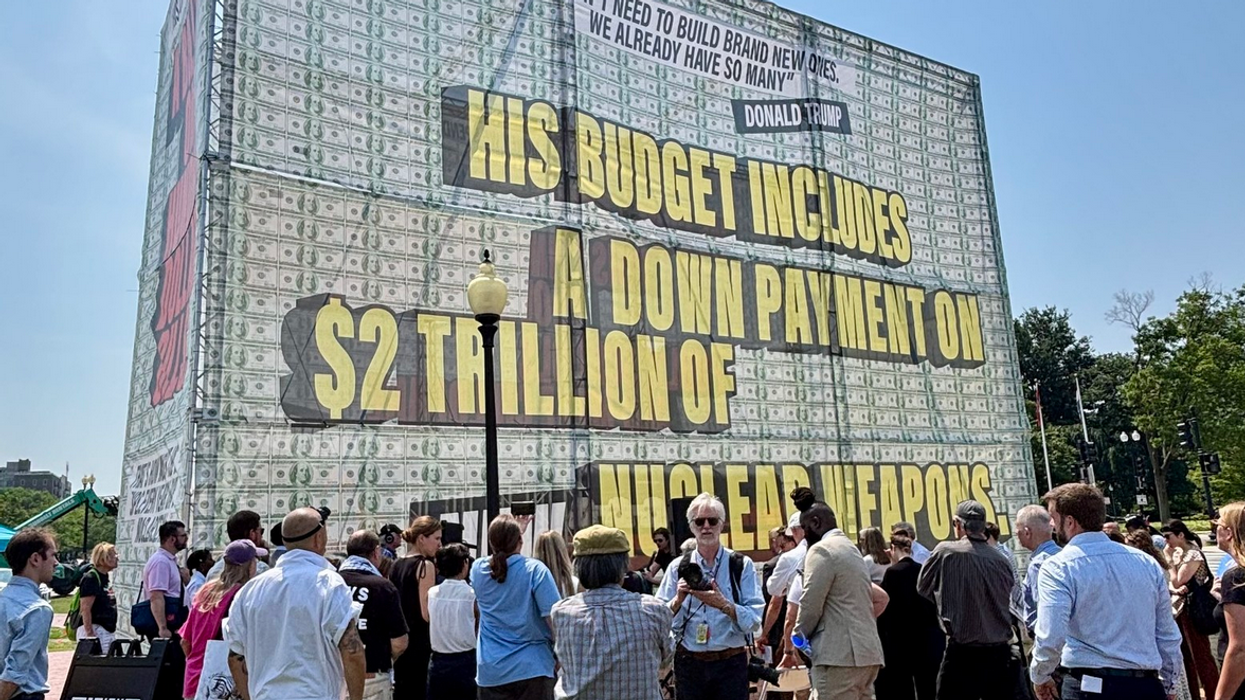
"If we take half the money budgeted for the Pentagon and invested in the things people need and want," said Ben Cohen, "the American Dream can become a reality again."
Joined by retired military officers and national security experts, Ben & Jerry's co-founder Ben Cohen on Thursday launched a campaign targeting the nearly $900 billion Pentagon budget and the $100 billion spent on nuclear weapons and "to get our country to start funding the American Dream instead of the death of millions of people."
Standing near Union Station in Washington, D.C. beside a towering sculpture showing what $100 billion looks like, supporters of the Up in Arms campaign—a planned four-year public education and advocacy project "to bring common sense to the Department of Defense and the country's budgetary bottom line"—chanted, "Money for the poor, not nuclear war!"
"There will be no peace, there will be no security, until we start using our resources to provide for the needs of our people at home and around the world," Cohen said at the event. "And we have the money to do it, at no additional taxpayer expense. If we take half the money budgeted for the Pentagon and invested in the things people need and want, the American Dream can become a reality again."
The peace group Ploughshares, which moderated a press conference for the launch of Up in Arms, said that the faux-$100 billion installation could be the tallest protest structure ever erected in Washington, D.C.
"This is a structure that represents the $100 billion that our country spends each year on nuclear weapons," Cohen said while standing in front of the tower and embracing Medea Benjamin, the co-founder of the peace group CodePink. "Fifty percent of that is for a whole new generation of nuclear weapons."
"Ice cream not bombs!" Benjamin said next. "Ice cream not nuclear weapons!"
The $100 billion figure includes spending on modernizing the nuclear arsenal, supporting its infrastructure, and addressing legacy issues like nuclear waste.
"Congress could make it easier for Americans to buy homes and save on gas or they could tackle the opioid epidemic–but those are clearly NOT their priorities," Up in Arms says on its website. "We have all the money we need to create a good life for all Americans. For half the money we spend on nuclear bombs, we could stop poisoning kids with lead, provide funding for public schools, and make childcare affordable."
Former U.S. military officers-turned-peace defenders Dennis Laich, Lawrence Wilkerson, Ann Wright, Karen Kwiatkowski, William Astore, and Dennis Fritz, as well as FBI whistleblower Coleen Rowley and former CIA officer Ray McGovern, are taking part in the Up in Arms campaign.
"We're here today to say we don't want our money spent this way, we want our money spent… on things that keep people alive, not on things that kill people," said Wright, a former U.S. Army colonel and current member of the Eisenhower Media Network and Veterans Against Genocide.
"We're up in arms and down on these damn nuclear weapons," she added, "and We the People have to be able to go to each one of these congresspeople and say, 'We don't care how much money you're getting from all of these companies that make a killing out if killing with these nuclear weapons.'"
Laich, a former U.S. Army general also with the Eisenhower Media Network, noted that the U.S. military budget "is larger than the next 10 countries combined, and what do we get for it?"
"Since World War II, we tied in Korea, we lost in Vietnam, we won the first Gulf War, we lost in Iraq, and we lost in Afghanistan," he said. "They always say we have the greatest military on earth; I don't buy it."
President Donald Trump is proposing a record $1 trillion Pentagon budget for fiscal year 2026 while backing legislation that would dramatically slash spending on vital social programs in order to fund a massive tax break that would overwhelmingly benefit the rich and corporations.
On Friday, the International Campaign to Abolish Nuclear Weapons—which earned the 2017 Nobel Peace Prize for spearheading the landmark Treaty on the Prohibition of Nuclear Weapons—published an analysis showing the world's nine nuclear powers spent a combined baseline $100 billion on their arsenals last year, an 11% increase from 2023. The United States alone accounted for well over half of that amount.
Cohen is a longtime anti-war activist. Last month, he was arrested after disrupting a Senate hearing, shouting, "Congress kills poor kids in Gaza by buying bombs and pays for it by kicking kids off Medicaid in the U.S." as he was hauled off by police.
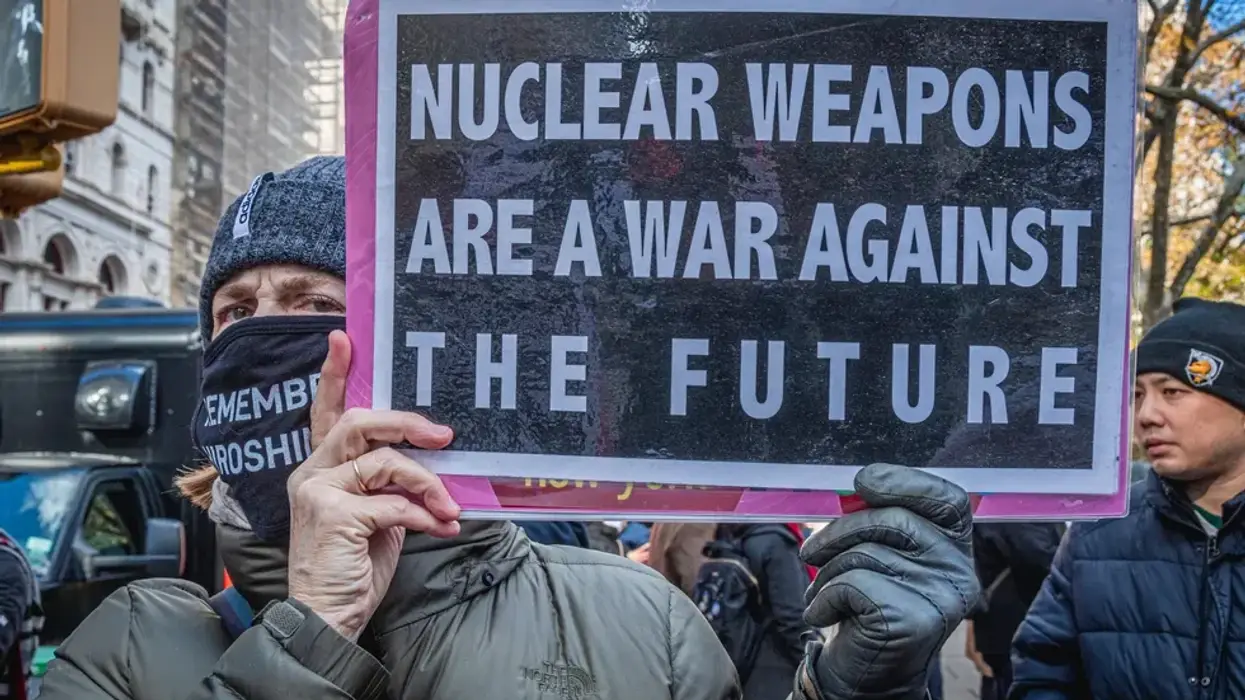
New analysis reveals that global nuclear weapons spending "could feed all of the 345 million people currently facing the most severe levels of hunger globally, including starvation, for nearly two years."
The world's nine nuclear-armed nations spent more than $100 billion on their atomic arsenals last year—up 11% from 2023—with the United States accounting for both the largest share and biggest increase in expenditures, a report published Friday by the International Campaign to Abolish Nuclear Weapons reveals.
The new ICAN analysis identifies a $9.9 billion increase in global nuclear weapons spending in 2024, with the U.S.—the only country to ever carry out a nuclear attack on another nation—spending $56.8 billion, more than the combined expenditures of the eight other countries with nukes. In addition to the U.S., Russia, China, France, the United Kingdom, India, Pakistan, Israel, and North Korea have nuclear arsenals. The $5.3 billion annual spending increase by the U.S. was also more than any other nuclear power.
All that spending on doomsday weapons padded the profits of major arms makers. According to the report:
In 2024, at least twenty-six companies working on nuclear weapons development and maintenance held significant contracts for their work. These companies earned at least $43.5 billion in the year and hold at least $463 billion in outstanding contracts. In 2024, new contracts worth around $20 billion were awarded to these companies. The companies identified in this report paid lobbyists in France and the United States more than $128 million to represent their interests last year. They also had 196 meetings with high-level U.K. officials including 18 with the prime minister's office in 2024.
"Nuclear-armed countries could have paid the United Nations' budget 28 times with what they spent to build and maintain nuclear weapons in 2024," the report states. "They could feed all of the 345 million people currently facing the most severe levels of hunger globally, including starvation, for nearly two years."
Noting that "98 countries have signed, ratified, or acceded" to the Treaty on the Prohibition of Nuclear Weapons (TPNW), ICAN—which was awarded the 2017 Nobel Peace Prize for its work on the landmark accord—asserted that "it is up to each government, and the citizens of that country, to decide which path they will choose."
ICAN asserted that the stakes are higher than at any time in a generation.
"With two major wars involving nuclear-armed states in Ukraine and Gaza, as well as nuclear tensions escalating between India and Pakistan and on the Korean Peninsula, the risk that nuclear weapons could be used in combat is widely regarded as the highest it has been since the Cold War and possibly ever," the group warned Friday in a separate statement. "In response, the nuclear-armed states are clinging to the doctrine of deterrence which is based on brinkmanship and the threat to use nuclear weapons, exacerbating the risk of conflict."
Susi Snyder, ICAN program coordinator and report co-author, said Friday that the global crisis of nuclear proliferation and out-of-control spending can be solved, but that "doing so means understanding the vested interests fiercely defending the option for nine countries to indiscriminately murder civilians."
"The good news," she added, "is a majority are going in another direction. Ninety-eight states, supported by over 700 civil society organizations, have either signed, ratified, or directly acceded to the... TPNW that came into force four years ago."
This year's ICAN report highlighted the "hidden costs" of nuclear weapons.
"It's an affront to democracy that citizens and lawmakers in countries that boast of their democratic credentials are not allowed to know that nuclear weapons from other countries are based on their soil or how much of their taxes is being spent on them," ICAN policy and research coordinator and report co-author Alicia Sanders-Zakre said. "It is time for these democratically elected leaders to heed the call of their people to remove nuclear weapons from their countries and work for their total elimination."
Responding to the report, Oliver Meier, policy and research director at the European Leadership Network, a London-based think tank, said, "At a time when better transparency and accountability of nuclear weapon states range high on the agenda of many non-nuclear weapon states, the absolute secrecy and lack of engagement on the costs of Russian and NATO nuclear sharing arrangements are an anachronism."
"In democratic societies, legislators and other stakeholders must have opportunities to review these arrangements, including relevant expenditure," he added.
The day before ICAN published the report, Ben Cohen, co-founder of Ben & Jerry's ice cream, was joined by retired military officers and national security experts in Washington, D.C. for the launch of Up In Arms, a four-year campaign "to bring common sense to the Department of Defense and the country's budgetary bottom line."
"There will be no peace, there will be no security, until we start using our resources to provide for the needs of our people at home and around the world," said Cohen. "And we have the money to do it, at no additional taxpayer expense. If we take half the money budgeted for the Pentagon and invested in the things people need and want, the American Dream can become a reality again."

"Please speak up forcefully and demand an end to this madness before there is no one left to save," said one advocacy group.
Human rights defenders implored U.S. lawmakers to speak out against the far-right government of fugitive Israeli Prime Minister Benjamin Netanyahu as it ramps up its 588-day assault and siege on the Gaza Strip, where at least 115 Palestinians were killed by Israel Defense Forces strikes on Friday amid worsening mass starvation.
The Council on American-Islamic Relations (CAIR), the largest U.S. Muslim advocacy group, on Friday sent an open letter authored by its director of government affairs, Robert S. McCaw, urging every member of Congress to "please vocally speak out against the start of the Israeli government's plan to 'occupy and flatten' Gaza while herding any surviving Palestinians into camps before eventually expelling them from their land."
Hundreds of Palestinians have been killed in recent days as Israeli forces pressed ahead with Operation Gideon's Chariots, a plan to conquer and indefinitely occupy all of Gaza and ethnically cleanse much of its population, possibly to make way for Jewish recolonization of the strip as advocated by numerous Israeli government officials.
Local and international media reported that at least 115 Palestinians including children were killed by Israeli attacks since dawn Friday, with air, artillery, and tank strikes concentrated in Beit Lahia and the Jabalia refugee camp in northern Gaza.
"Netanyahu has declared that there is 'no way' Israel will stop the war, even if all hostages are released, and he has vowed to completely reoccupy Gaza and force remaining Palestinians off their land," McCaw wrote. "His Cabinet has formally approved a full-scale ground invasion and permanent military occupation of the Gaza Strip. One senior Israeli minister openly stated that Gaza will be 'completely destroyed.'"
"This is it. Now or never. We implore you to condemn Netanyahu's plan, demand a permanent end to this genocidal war, and pledge to oppose further weapons sales to the Israeli government unless its human rights abuses stop," the letter continues. "As long as the Israeli government believes it will continue to receive unlimited American financial, military, and diplomatic support, Netanyahu has no reason to risk his grip on power by changing course."
Israeli and international critics accuse Netanyahu of risking the lives of 23 living hostages still being held by Hamas by prolonging the war in a bid to forestall a reckoning in his criminal corruption trial.
"Netanyahu has made clear what he plans to do: destroy Gaza and ethnically cleanse the Palestinian people, even if it means starving and slaughtering the Israeli hostages along with them," CAIR said."There is no more time left to sit on the sidelines, make symbolic statements, or hope something better willhappen."
"Netanyahu has made clear what he plans to do: destroy Gaza and ethnically cleanse the Palestinian people."
"Children are being blown to pieces every single hour with American weapons," the group noted. "Babies arestarving to death while food rots at the Gaza border. Mothers and fathers are dying with them, and theIsraeli captives held in Gaza are at risk of starving to death or being killed by the Israeli government'sindiscriminate bombing campaign."
"Please speak up forcefully and demand an end to this madness before there is no one left to save," the letter implores.
Earlier this week, Ben Cohen, co-founder of the Ben & Jerry's ice cream company, was arrested after disrupting a Senate hearing, shouting, "Congress kills poor kids in Gaza by buying bombs and pays for it by kicking kids off Medicaid in the U.S." as he was hauled off by police.
"Congress and the senators need to ease the siege," Cohen added. "They need to let food into Gaza. They need to let food to starving kids!"
The latest Integrated Food Security Phase Classification (IPC) report, published Monday, states that 244,000 people in Gaza are now in Phase 5, defined as such "an extreme deprivation of food" that "starvation, death, destitution, and extremely critical levels of acute malnutrition are or will likely be evident."
At least scores of Palestinians—including a minimum of 57 children and 14 elders—have died of severe malnutrition combined with lack of medical care throughout Gaza, United Nations experts and human rights groups said in recent days.
Already suffering under an Israeli blockade imposed in 2007 after Hamas took power in the coastal enclave, Gazans have been ravaged by hunger and illness due to the "complete siege" imposed by Israel immediately after the Hamas-led October 7, 2023 attack. The siege was tightened on March 2, when Israel stopped all lifesaving supplies—including food, medicine, fuel, and cooking gas—from entering the strip.
Israel's blockade, use of starvation as a weapon of war, killing or wounding of more than 187,000 Palestinians—including thousands missing and feared dead and buried beneath rubble—mass forced displacement of more than 2 million Gazans, and eliminationist statements by Israeli leaders and others are all being reviewed in The Hague as part of the South Africa-led genocide case against Israel currently before the International Court of Justice.
Netanyahu and former Israeli Defense Minister Yoav Gallant are also wanted by the International Criminal Court, also in The Hague, for alleged war crimes and crimes against humanity including murder and forced starvation.
Also on Friday, CAIR welcomed a resolution signed by 27 Democratic and two Independent U.S. senators calling on the administration of President Donald Trump to "use all available diplomatic tools" to secure an end to Israel's assault on Gaza, the hostages' release, and a lifting of the siege in order to allow "urgent delivery of humanitarian aid to address the needs of civilians."
While many Israelis and their supporters around the world deny that there is mass starvation in Gaza, both Trump and Mike Huckabee, his ambassador to Israel, have acknowledged that Palestinians are starving. On the final day of his Mideast tour Friday, Trump said in Abu Dhabi, United Arab Emirates that "a lot of people are starving" in Gaza, and "we're going to get that taken care of."
However, Huckabee recently admitted that a U.S.-Israeli plan to deliver limited humanitarian aid to parts of Gaza would initially only feed around 60% of the population. The United Nations and humanitarian groups operating in Gaza have rejected the plan.

"It is vitally important that we in the American Jewish community add our voices to all those refusing to entertain this insidious plan," one rabbi said of Trump's proposal.
Over 350 rabbis and dozens of Jewish public figures on Thursday placed a full-page advertisement in The New York Times protesting President Donald Trump's proposal to force all Palestinians out of the Gaza Strip and take over the coastal enclave recently decimated by U.S.-armed Israeli forces.
"Trump has called for the removal of all Palestinians from Gaza," the ad states. "Jewish people say NO to ethnic cleansing!"
The ad then lists the hundreds of people who signed on, including V (formerly Eve Ensler), Peter Beinart, Judith Butler, Molly Crabapple, Ben Cohen, Ilana Glazer, Tavi Gevinson, Nan Goldin, Naomi Klein, and Joaquin, Rain, and Summer Phoenix.
"Donald Trump—like Pharaoh in the Bible—seems to believe he is God with authority to rule, own, and dominate our country and the world," said Rabbi Yosef Berman of New Synagogue Project in Washington, D.C., a signatory to the Times ad.
"Jewish teaching is clear: Trump is not God and cannot take away Palestinians inherent dignity or steal their land for a real estate deal," Berman continued. "Trump's desire to ethnically cleanse Palestinians from Gaza is morally abhorrent. Jewish leaders reject Trump's attempts to wring profit from displacement and suffering and must act to stop this heinous crime."
Glazer, a comedian and actor, similarly stressed that "we, Jews, and all of us who care about basic human rights, must speak up and stand up to ensure Palestinians remain on their land, so they can rebuild their homes and lives in Gaza after the genocidal destruction they have endured. All of our safety is intertwined."
Today's NY Times. We, too, #SayNoToEthnicCleansing! So proud of our ED, R' @mhughesrob.bsky.social (+ board member Rabbi Andrea London), among the hundreds of Jewish clergy, professionals, lay leaders who signed on. Add your support at www.saynotoethniccleansing.org - click "sign on" in URH corner.
[image or embed]
— Partners for Progressive Israel (@partners4israel.bsky.social) February 13, 2025 at 9:59 AM
Israel faces a genocide case at the International Court of Justice for its 15-month military response to the Hamas-led October 7, 2023 attack. The Israeli assault killed more than 61,000 Palestinians in Gaza, according to estimates by local officials. A fragile cease-fire took effect last month.
After Hamas threatened to suspend the release of additional hostages over Israeli violations of the deal—which prompted Israel to threaten more violence, seemingly backed by Trump—the group said Thursday it would free three captives this weekend.
The ad in the Times on Thursday is just part of the growing opposition to Trump's proposal to kick Palestinians out of Gaza and turn the territory into what he claimed could be the "Riviera of the Middle East." Polling published Wednesday by Data for Progress shows that a majority of Americans are against the United States seizing control of Gaza, and nearly 7 in 10 oppose sending U.S. troops for the takeover.
A coalition of over 100 groups led by A New Policy—founded by Biden administration officials who resigned in protest—and the Quaker organization Friends Committee on National Legislation said Monday that they "decry and oppose any effort or initiative, and any calls for, the forcible displacement of Palestinians from Gaza, and support the joint statement of Egypt, Jordan, Saudi Arabia, the United Arab Emirates, Qatar, the Palestinian Authority, and the Arab League that similarly rejected any such steps."
The Guardian reported Thursday that Cody Edgerly, director of the In Our Name Campaign and one of the organizers of the Times ad, pointed to Trump's relationship with Israeli Prime Minister Benjamin Netanyahu, saying that it came at "a critical time as political redlines that were once thought immovable are rapidly shifting as the Trump-Netanyahu alliance takes hold again."
It has been "heartening to witness such a rapid outpouring of support from across the denominational and political spectrum," added Edgerly. "Our message to Palestinians is that you are not alone, our attention has not wavered, and we are committed to fighting with every breath we have to stop ethnic cleansing in Gaza."
Every day, more and more Jewish leaders break from decades of silence to reject ethnic cleansing. Thank you to these 350 rabbis using your voices in this moment to oppose Trump’s plans in Gaza and #SayNoToEthnicCleansing. #GazaIsNotForSale
[image or embed]
— Jews For Racial & Economic Justice (@jfrejnyc.bsky.social) February 13, 2025 at 8:13 AM
Beinart, editor-at-large of Jewish Currents and author of Being Jewish After the Destruction of Gaza: A Reckoning, said in a statement that "as someone who loves the American Jewish community, and lives my life in the American Jewish community, and could not imagine another way of living. It is utterly horrifying to see the degree to which people who enjoy great legitimacy and respect in our community are willing to support something that would be considered one of the greatest crimes of the 21st century."
Another signatory to the ad, Rabbi Toba Spitzer of Congregation Dorshei Tzedek in Newton, Massachusetts, said that "it is vitally important that we in the American Jewish community add our voices to all those refusing to entertain this insidious plan."
Nazi leader Adolf Hitler's "dream of making Germany 'Judenrein,' 'cleansed of Jews,' led to the slaughter of our people," Spitzer added. "We know as well as anyone the violence that these kinds of fantasies can lead to. It is time to make the cease-fire permanent, bring all of the hostages home, and join in efforts to rebuild Gaza for the sake of and with the people who live there."
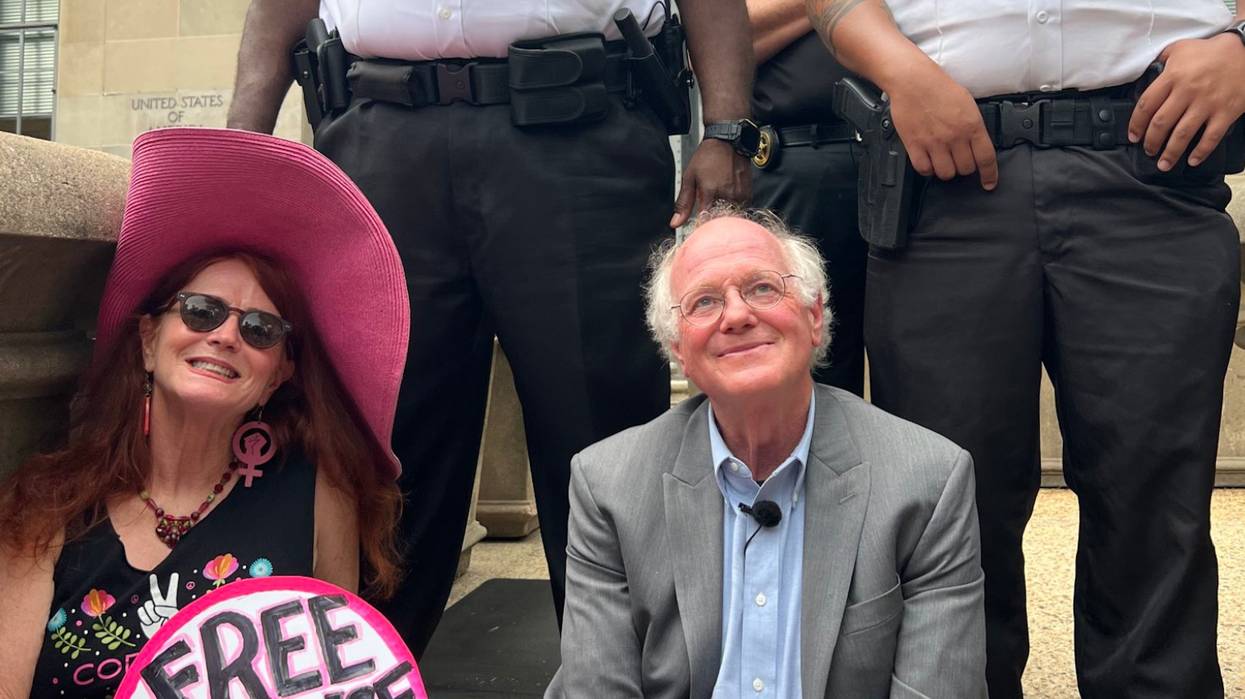
"It seems to me," said Ben Cohen, "that, right now, unless things change, and unless we change them, freedom of the press is going up in smoke."
Ben Cohen, the co-founder of the ice cream company Ben & Jerry's, and Jodie Evans, who co-founded the peace group CodePink, were arrested Thursday outside Department of Justice headquarters in Washington, D.C. for blocking an entrance to the building to protest the U.S. government's prosecution of WikiLeaks publisher Julian Assange.
Cohen and Evans were arrested while other demonstrators chanted slogans demanding freedom for Assange, the 52-year-old Australian facing extradition from the United Kingdom to the U.S., where he has been charged with Espionage Act violations and could be imprisoned for up to 175 years if convicted on all counts.
"It's outrageous. Julian Assange is nonviolent. He is presumed innocent. And yet somehow or other, he has been imprisoned in solitary confinement for four years."
"It's outrageous. Julian Assange is nonviolent. He is presumed innocent. And yet somehow or other, he has been imprisoned in solitary confinement for four years. That is torture," Cohen said during the protest. "He revealed the truth, and for that he is suffering, and... we need to do whatever we can to help him, and to help preserve democracy, which is based on freedom of the press."
"It seems to me that, right now, unless things change, and unless we change them, freedom of the press is going up in smoke," Cohen asserted before lighting an effigy of the Bill of Rights in four places.
"One for each year that... Assange has been held in solitary confinement," he explained.
Evans asked, "Why do we have freedom of the press?"
"Because there needs to be someone reporting the truth about the violence of power," she said. "When you don't have freedom of the press and no one's telling the truth, it weaponizes your capacity to feel, to have compassion and empathy."
"If you don't have the full story and if your heart is being manipulated with lies, then we're all lost," Evans added. "How can we have peace in the world if we're just drowning in lies?"'
According to the United Nations Working Group on Arbitrary Detention, Assange has been arbitrarily deprived of his freedom since he was arrested on December 7, 2010. Since then he has been held under house arrest, confined for seven years in the Ecuadorean Embassy in London while he was protected by the administration of former Ecuadorean President Rafael Correa, and jailed in Belmarsh Prison, where he is now.
After a U.K. court last month rejected Assange's appeal against his extradition order to the United States, press freedom groups renewed calls for U.S. President Joe Biden to drop the charges against him.