

SUBSCRIBE TO OUR FREE NEWSLETTER
Daily news & progressive opinion—funded by the people, not the corporations—delivered straight to your inbox.
5
#000000
#FFFFFF
To donate by check, phone, or other method, see our More Ways to Give page.
Daily news & progressive opinion—funded by the people, not the corporations—delivered straight to your inbox.
The Republican legislative package "would leave the financial system dramatically weaker and make future bank failures and publicly financed bailouts more likely," warned one advocacy group.
A broad coalition of advocacy organizations and labor unions warned Tuesday that Republican legislation currently moving through the US House of Representatives would deregulate Wall Street giants and increase the risk of another financial disaster under the guise of aiding community banks.
"This dangerous bank deregulation package would undermine core safeguards and supervision, push risk into the shadows, and make the next publicly financed bailout more likely," an alliance of 28 advocacy groups wrote in a letter to members of Congress. "Further deregulation is especially alarming at a time when financial regulatory agencies are under political attack, pursuing industry-friendly agendas, and starved of resources, and when there is effectively no oversight of financial markets."
Proponents of the GOP's Main Street Capital Access Act (HR 6955), which is backed by major bank lobbying organizations and some Democratic lawmakers, characterize the bill as an effort to bolster small financial institutions by reducing their regulatory burdens. Oscar Valdés Viera, senior policy analyst for private equity and capital markets at Americans for Financial Reform, said that's a ruse.
"Instead of providing meaningful relief from sky high credit card interest rates and late fees, this bill just lets big banks off the hook by weakening oversight, enacting carve-outs and exemptions from banking laws, and creating a pathway for banks to block commonsense regulatory safeguards that could reduce the likelihood and severity of financial crises," said Valdés Viera. "HR 6955 would automatically raise major regulatory thresholds, weaken bank examiners tools, create new avenues to contest supervisory and enforcement decisions, reduce meaningful competition review for many bank mergers, and expand merchant banking arrangements that blur the line between banking and commerce."
"The House majority is pushing a package of risky bank deregulation that is just another giveaway to Wall Street banks when the Congress should be laser focused on the affordability crisis," Valdés Viera said.
The advocacy coalition's letter urging lawmakers to block the legislative package—which could receive a vote in the House as early as Tuesday afternoon—points specifically to Sections 201-204 of the measure. The language in those sections, the coalition warned, "would raise statutory thresholds, extend 'tailoring' well beyond genuinely small and simple banks, and hard-wire automatic future threshold increases."
"As a result, fewer institutions, activities, and risks would remain within baseline guardrails even as the financial system grows more complex and interconnected," the coalition wrote. "The combined effect would be higher leverage and risk-taking, thinner cushions against losses, and weaker prudential standards. It would return the financial system to a pre-2008 pattern in which risk migrates out of view, problems build for years at midsize and large institutions, and the public is left holding the bag when those institutions fail."
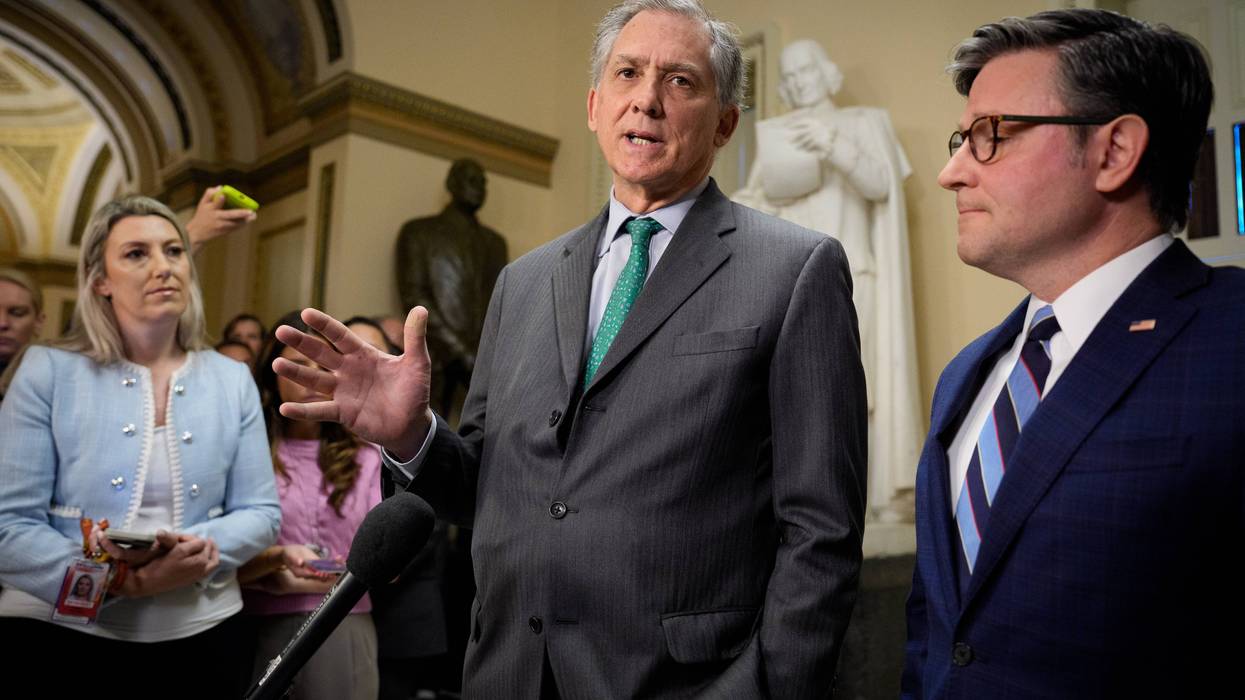
The Main Street Capital Access Act, sponsored by Rep. French Hill (R-Ark.)—a major beneficiary of finance industry campaign cash—cleared the House Rules Committee on Monday. Punchbowl reported that Rep. Bill Foster (D-Ill.), the ranking member of the House Financial Services Committee's subcommittee on financial institutions, is urging his Democratic colleagues to support the legislation, despite opposition from the top Democrat on the committee, Rep. Maxine Waters (D-Calif.).
"HR 6955 is Wall Street deregulation hiding as a community bank bill," Waters said in her testimony before the House Rules Committee on Monday. "This bill lets even more of these large banks escape critical safeguards risking more failures. In fact, the sponsors of this bill were so zealous to raise thresholds, they increased one threshold that will aid bad actors who commit fraud against a bank."
"Instead of letting Wall Street put Americans and our economy at risk again," said Waters, "we should be working together to address the affordability crisis caused by Trump’s failed economic policies and endless war with Iran."

“At a time of extreme and growing inequality," said one critic, "today’s proposals will drain lending away from Main Street families’ needs and priorities and further enrich the already wealthy on Wall Street."
The Trump administration and Federal Reserve unveiled proposals Thursday that would significantly reduce capital requirements for the largest banks in the United States, potentially setting the stage for another financial industry collapse as the US-Israeli war on Iran destabilizes the global economy and jacks up prices for consumers.
Under the new rules proposed by the Fed, Federal Deposit Insurance Corporation, and Office of the Comptroller of the Currency, large banks would have to hold nearly 5% less capital on average. The advocacy organization Better Markets noted that the proposals—combined with other deregulatory actions taken by the Trump administration and the Fed over the past year—would return Wall Street banks' capital requirements "to the irresponsibly low 2007 levels they had just before the 2008 crash."
“At a time of extreme and growing inequality, when tens of millions of Americans are struggling to pay their bills, today’s proposals will drain lending away from Main Street families’ needs and priorities and further enrich the already wealthy on Wall Street and the top 10% of Americans they focus on serving," Dennis Kelleher, the president of Better Markets, said in a statement. "The banking agencies’ proposals to loosen capital rules are a victory for Wall Street lobbying, and claims to the contrary are nothing more than an attempt to mislead the American people."
Fed Gov. Michael Barr, who was nominated by former President Joe Biden, was the central bank board's lone dissenting voice against the new rules, a product of years of aggressive Wall Street lobbying for less stringent regulations in the wake of the Great Recession.
"Today's proposals, if adopted, would harm the resilience of banks and the US financial system," Barr warned in a statement. "There are suggestions that liquidity requirements could also be reduced. Additionally, Federal Reserve supervisory staff have been cut by over 30%, and supervisory practices have been weakened. Banking is built on trust. I worry greatly that these actions are rapidly eroding that trust."
The new deregulatory package, which will be subject to a 90-day public comment period before it's finalized, comes as President Donald Trump is waging an expensive and deadly war on Iran with no end in sight and attacking social programs at home, from Medicaid to nutrition assistance.
“With private credit markets cratering, AI transforming the workforce, and Trump’s Iran war threatening the world economy, we need healthy, resilient, well-capitalized banks," said Bartlett Naylor, an economist for the consumer advocacy group Public Citizen. "Lessons learned after millions lost their jobs, homes, and savings following the 2008 megabank crash must not be ignored."
"Trump’s bank regulators propose to tear at the already tissue-thin layer of solvency levels at the nation’s banks," said Naylor. "Lowering solvency standards won’t generate more loans; it will only send banks closer to failure."
Matt Stoller, an anti-monopoly researcher and author of the BIG newsletter, wrote that the juxtaposition of a quagmire in Iran, Wall Street deregulation, and millions of Americans losing health insurance "tells the story" of the Trump administration.
Today's WSJ front page tells the story of the Trump admin.
#1: Hegseth Says ‘No Time Set’ on Ending Operations in Iran
#2: U.S. Regulators Propose More Lenient Capital Rules for Big Banks
#3: Millions of Americans Are Going Uninsured Following Expiration of ACA Subsidies pic.twitter.com/26jKsQuNc4
— Matt Stoller (@matthewstoller) March 19, 2026
The effort to curb banks' capital requirements was spearheaded by Fed Vice Chair for Supervision Michelle Bowman, a Trump appointee whose nomination last year was criticized by watchdogs as a "gift to the banking industry."
Kelleher of Better Markets said Thursday that "such counterproductive, shortsighted, and wrongheaded rulemaking isn’t a surprise given that the interests of Wall Street’s biggest banks are driving the priorities at the banking agencies, rather than facts, merit, and the public interest."
"The worst is at the Federal Reserve, where the senior regulatory staff comes from Wall Street’s top DC lobbyist (the Bank Policy Institute), Goldman Sachs, and one of Wall Street’s top law firms (a former partner is now the director responsible for supervising and regulating his recent Wall Street clients)," Kelleher observed. "That’s why mindless deregulation, especially for the biggest Wall Street banks, is at the top of the agenda, just as it was in the years before the 2008 crash."

Democrats have an opportunity "to raise the volume on bank reform and accountability—and be seen as challenging power on behalf of everyday people," the poll showed.
The largest U.S. bank collapse since the 2008 financial meltdown has left Americans especially eager for Congress to rein in Wall Street—and impatient with the power the financial sector has over lawmakers, according to polling released Monday.
A month after Silicon Valley Bank (SVB) failed following its decision to invest $91 billion of its deposits in long-term Treasury bonds before their value plummeted as the Federal Reserve raised interest rates, progressive think tank Data for Progress joined the Progressive Change Institute in polling 1,215 likely voters about the bank and banking regulations.
Nearly 7 in 10 respondents said they were "very" or "somewhat" concerned about the health of the banking industry following SVB's collapse, and 82% said they supported Congress taking action to strengthen banking rules in order to avoid another failure.
More than 70% said they would support the reinstatement of "critical banking rules" that were rolled back in 2018. Those rules weakened regulations for banks with between $50 billion to $250 billion in assets, and Sen. Elizabeth Warren (D-Mass.) and Rep. Katie Porter (D-Calif.) said last month that their repeal was a major driver of SVB's collapse as they introduced the Secure Viable Banking Act to impose the rules once again.
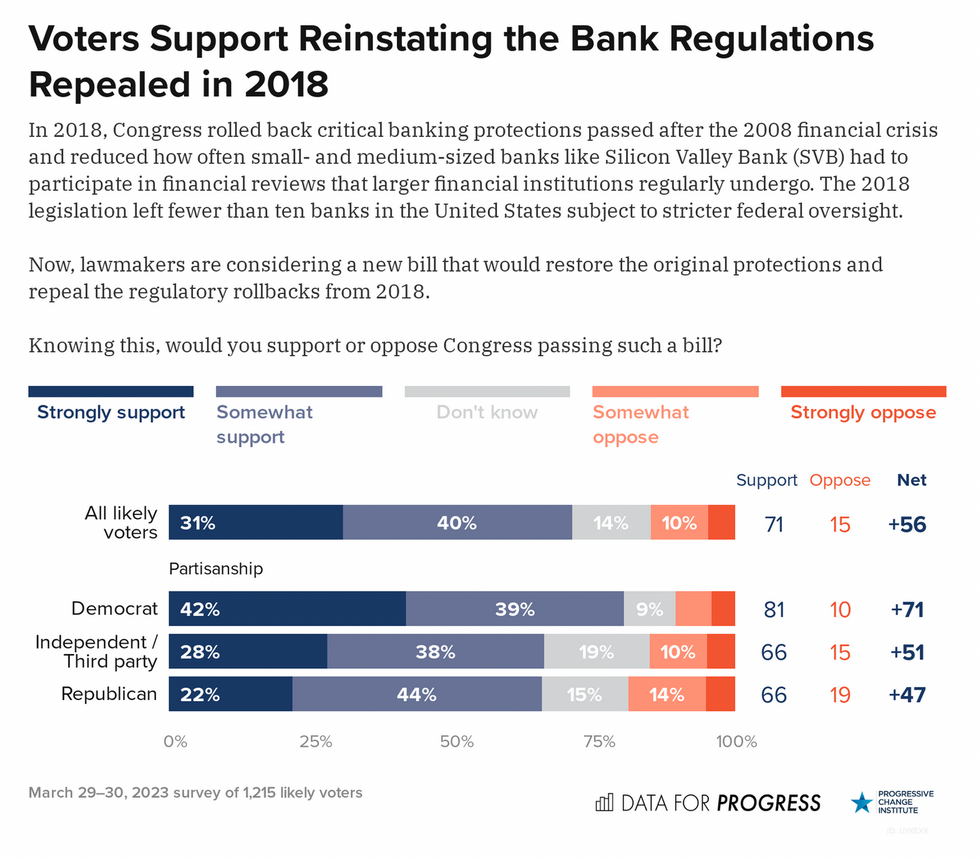
The Biden administration said after the collapse that it would take steps including creating an emergency fund to make sure all SVB deposits were covered and demanded that executives be held accountable for bonuses that were handed out in the hours before the bank failed, but 90% of respondents told Data for Progress that they had heard little or nothing about the proposed reforms.
"While voters strongly support reforms in the banking sector and the actions taken by the Biden administration in the wake of SVB's collapse, these results signal that the administration has room to expand communication on the subject and claim this issue for Democrats," said Data for Progress.
The organization noted that likely voters were more supportive of President Joe Biden's plan when told the administration had created an "emergency fund" than when the fund was described as a "bailout" and when they were told that SVB's client base, made up largely of "billionaire tech investors and multimillion-dollar companies," had been helped by the fund.
The poll indicates, said the Progressive Change Campaign Committee, that Democratic leaders have an opportunity "to raise the volume on bank reform and accountability—and be seen as challenging power on behalf of everyday people."

Jerome Powell "has failed," said Sen. Elizabeth Warren. "I don't think he should be Chairman of the Federal Reserve."
Sen. Elizabeth Warren this weekend called on federal officials to investigate the causes of recent bank failures and urged President Joe Biden to fire Federal Reserve Chair Jerome Powell, whom she has criticized for intensifying financial deregulation and imposing job- and wage-destroying interest rate hikes.
Asked on Sunday by Chuck Todd of NBC's "Meet the Press" about the possibility of Powell imposing yet another interest rate hike despite ongoing market turmoil, Warren (D-Mass.) said, "I've been in the camp for a long time that these extraordinary rate increases that he has taken on, these extreme rate increases, are something that he should not be doing."
Powell "has a dual mandate," said Warren. "Yes, he is responsible for dealing with inflation, but he is also responsible for employment. And what Chair Powell is trying to do, and he has said fairly explicitly, is that they are trying to, in effect, slow down the economy so that, this is by the Fed's own estimate, two million people will lose their jobs. And I believe that is not what the chair of the Federal Reserve should be doing."
Since the Covid-19 pandemic and Russia's invasion of Ukraine disrupted international supply chains—rendered fragile by decades of neoliberal globalization—powerful corporations in highly consolidated industries have taken advantage of these and other crises such as the bird flu outbreak to justify profit-boosting price hikes that far outpace the increased costs of doing business.
"Raising interest rates doesn't do anything to solve" a cost-of-living crisis driven primarily by "price gouging, supply chain kinks, [and] the war in Ukraine," Warren said Sunday. "All it does is put millions of people out of work."
"Jay Powell... has had two jobs. One is to deal with monetary policy, one is to deal with regulation. He has failed at both."
Powell, an ex-investment banker, was first appointed by then-President Donald Trump in 2018 and reappointed by Biden in 2021. Warren noted that she opposed Powell's nomination in both cases "because of his views on regulation and what he was already doing to weaken regulation."
"But I think he's failing in both jobs, both as the oversight and manager of these big banks, which is his job, and also what he's doing with inflation," said Warren.
Asked by Todd if Biden should fire Powell, Warren said: "My views on Jay Powell are well-known at this point. He has had two jobs. One is to deal with monetary policy, one is to deal with regulation. He has failed at both."
"Would you advise President Biden to replace him?" Todd inquired.
"I don't think he should be Chairman of the Federal Reserve," the Massachusetts Democrat responded. "I have said it as publicly as I know how to say it. I've said it to everyone."
Meanwhile, in a Saturday letter, Warren asked Richard Delmar, Tyler Smith, and Mark Bialek—respectively the deputy inspector general of the Treasury Department, acting inspector general of the Federal Deposit Insurance Corporation (FDIC), and inspector general of the Fed's board of governors—to "immediately open a thorough, independent investigation of the causes of the bank management and regulatory and supervisory problems that resulted in this month's failure of Silicon Valley Bank (SVB) and Signature Bank (Signature) and deliver preliminary results within 30 days."
Until the Treasury Department, the Fed, and the FDIC "intervened to guarantee billions of dollars of deposits," the second- and third-biggest bank failures in U.S. history "threatened economic contagion and severe damage to the banking and financial systems," Warren noted. "The bank's executives, who took unnecessary risks or failed to hedge against entirely foreseeable threats, must be held accountable for these failures."
"But this mismanagement was allowed to occur because of a series of failures by lawmakers and regulators," Warren continued.
In 2018, several Democrats joined Republicans in approving Sen. Mike Crapo's (R-Idaho) Economic Growth, Regulatory Relief, and Consumer Protection Act, which weakened the Dodd-Frank Wall Street Reform and Consumer Protection Act passed in the wake of the 2008 financial crisis. Crapo's deregulatory measure, signed into law by Trump, loosened federal oversight of banks with between $50 billion and $250 billion in assets—a category that includes SVB and Signature.
"As officials sought to develop a plan responding to SVB's failure, Chair Powell muzzled regulators from any public mention of the regulatory failures that occurred under his watch."
Moreover, the Fed under Powell's leadership "initiated key regulatory rollbacks," Warren wrote Saturday, echoing criticisms that she and financial industry watchdogs voiced earlier in the week. "And the banks' supervisors—particularly the Federal Reserve Bank of San Francisco, which oversaw SVB—missed or ignored key signals about their impending failure."
It is "critical that your investigation be completely independent and free of influence from the bank executives or regulators that were responsible for action that led to these bank failures," Warren stressed. "I am particularly concerned that you avoid any interference from Fed Chair Jerome Powell, who bears direct responsibility for—and has a long record of failure involving—regulatory and supervisory matters involving these two banks."
"I have already asked Chair Powell to recuse himself from the Fed's internal investigation of this matter, but he has not yet responded to this request," wrote Warren. The progressive lawmaker said "this silence is troubling" in light of recent reporting that "as officials sought to develop a plan responding to SVB's failure, Chair Powell muzzled regulators from any public mention of the regulatory failures that occurred under his watch."
"Bank regulators and Congress must move quickly to close the gaps that allowed these bank failures to happen, and your investigation will provide us important insight as we take steps to do so," added Warren, who has introduced legislation to repeal a vital provision of the Trump-era bank deregulation law enacted five years ago with bipartisan support.
In appearances on three Sunday morning talk shows, Warren doubled down on her demands for an independent investigation into recent bank failures, stronger financial regulations, and punishing those responsible.
After lawmakers from both parties helped Trump fulfill his campaign promise to weaken federal oversight of the banking system, Powell "took a flamethrower to the regulations, saying, 'I'm doing this because Congress let me do it,'" Warren told ABC's "This Week" co-anchor Jonathan Karl. "And what happened was exactly what we should have predicted, and that is the banks, these big, multi-billion-dollar banks, loaded up on risk; they boosted their short-term profits; they gave themselves huge bonuses and big salaries; and they exploded their banks."
"When you explode a bank, you ought to be banned from banking forever."
"When you explode a bank, you ought to be banned from banking forever," said Warren, who acknowledged that criminal charges could be coming. "The Department of Justice has opened an investigation. I think that's appropriate for them to do. We'll see where the facts take them. But we've got to take a close look at this."
Not only did former SVB chief executive officer Greg Becker, who lobbied aggressively for the 2018 bank deregulation law, sell millions of dollars of shares as recently as late last month, but until federal regulators took control of the failed bank on March 10, he was on the board of directors at the San Francisco Fed—the institution responsible for overseeing SVB.
On Saturday, Independent Sen. Bernie Sanders of Vermont announced that he plans to introduce legislation "to end this conflict of interest by banning big bank CEOs from serving on Fed boards."
"We've got to say overall that we can't keep repeating this approach of weakening the regulation over the banks, then stepping in when these giant banks get into trouble," Warren said Sunday, arguing for stronger federal oversight to prevent the need for bailouts.

Depositors in small and medium-sized banks are now fleeing to the safety of JPMorgan and other giant banks that have been deemed "too big to fail" because the government bailed them out in 2008.
Former Silicon Valley Bank CEO Greg Becker sold $3.6 million worth of shares on February 27, just days before the bank disclosed a large loss that triggered its stock slide and collapse. Over the previous two years, Becker sold nearly $30 million of stock.
But Becker won't rake in the most from this mess. Jamie Dimon, chair and CEO of JPMorgan Chase, the biggest Wall Street bank, will likely make much more.
That's because depositors in small and medium-sized banks are now fleeing to the safety of JPMorgan and other giant banks that have been deemed "too big to fail" because the government bailed them out in 2008.
Last Friday afternoon, the deputy Treasury secretary, Wally Adeyemo, met with Dimon at his office in New York. He asked Dimon whether the failure of Silicon Valley Bank could spread to other banks. "There's a potential," Dimon responded. Presumably, Dimon knew such contagion would mean vastly more business for JPMorgan. In a note to clients on Monday, bank analyst Mike Mayo wrote that JPMorgan in particular is "battle-tested" in volatile markets and "epitomizes" how the largest U.S. banks have shed risk since the 2008 financial crisis. "Recent industry developments should further its ability to gather core funding and act as a source of strength."
Recall that the 2008 financial crisis generated a gigantic shift of assets to the biggest Wall Street banks, with the result that JPMorgan and the other giants became far bigger. In the early 1990s, the five largest banks had accounted for only 12% of U.S. bank deposits. After the crisis, they accounted for nearly half.
After this week, they'll be even bigger.
Their giant size has already given them a huge but hidden federal subsidy estimated to be $83 billion annually—a premium that investors and depositors willingly pay to these enormous banks in the form of higher fees and lower returns, because they're too big to fail. Some of this hidden federal subsidy goes into the pockets of bank executives. Last year alone, Dimon earned $34.5 million. (Greg Becker is a piker by comparison.)
The 2008 financial crisis generated a gigantic shift of assets to the biggest Wall Street banks, with the result that JPMorgan and the other giants became far bigger. After this week, they'll be even bigger.
Jamie Dimon was at the helm in 2008 when JPMorgan received $25 billion from the federal government to help stem the financial crisis brought on largely by the careless and fraudulent lending practices of JPMorgan and other big banks. Dimon earned $20 million that year.
In March 2009, President Obama summoned Dimon and other top bank executives to the White House and warned them that "my administration is the only thing between you and the pitchforks." But Obama never publicly rebuked Dimon or the other big bankers. When asked about the generous pay Dimon and other Wall Street CEOs continued to rake in, Obama defended them as "very savvy businessmen" and said he didn't "begrudge peoples' success or wealth. That's part of the free market system."
What free market system? Taxpayers had just bailed out the banks, and the bank CEOs were still raking in fat paychecks. Yet 8.7 million Americans lost their jobs, causing the unemployment rate to soar to 10%. Total U.S. household net worth dropped by $11.1 trillion. Housing prices dropped by a third nationwide from their 2006 peak, causing some 10 million people to lose their homes.
Rather than defend those CEO paychecks, Obama might have demanded, as a condition of getting bailed out, that the banks help underwater homeowners on Main Street.
Another sensible proposal would have been to let bankruptcy judges restructure shaky home mortgages so that borrowers didn't owe as much and could remain in their homes. Yet the big banks, led by Dimon, opposed this. They thought they'd do better by squeezing as much as possible out of distressed homeowners, and then collecting as much as they could on foreclosed homes. In April 2008, Dimon and the banks succeeded: The Senate formally voted down a bill that would have allowed bankruptcy judges to modify mortgages to help financially distressed homeowners.
In the run-up to the 2020 election, Dimon warned against policies that Bernie Sanders and AOC were then advocating, including Medicare for All, paid sick leave, and free public higher education. Dimon said they amounted to "socialism." "Socialism," he wrote, "inevitably produces stagnation, corruption, and often worse—such as authoritarian government officials who often have an increasing ability to interfere with both the economy and individual lives—which they frequently do to maintain power," adding that socialism would be "a disaster for our country."
Dimon also warned against "over-regulation" of banking, cautioning that in the next financial crisis, big institutions like JPMorgan wouldn't be able to provide the lending they did during the last crisis. "When the next real downturn begins, banks will be constrained—both psychologically and by new regulations—from lending freely into the marketplace, as many of us did in 2008 and 2009. New regulations mean that banks will have to maintain more liquidity going into a downturn, be prepared for the impacts of even tougher stress tests, and hold more capital," he wrote.
But as was demonstrated again this past week, American capitalism needs strict guardrails. Otherwise, it is subject to periodic crises that summon bailouts. The result is socialism for the rich while everyone else is subject to harsh penalties: Bankers get bailed out, and the biggest banks and bankers do even better. Yet average people who cannot pay their mortgages lose their homes. Meanwhile, almost 30 million Americans still lack health insurance, most workers who lose their job aren't eligible for unemployment insurance, most have no paid sick leave, child labor is on the rise, and nearly 51 million households can't afford basic monthly expenses such as housing, food, child care, and transportation.
Is it any wonder that so many Americans see the system as rigged against them? Is it surprising that some of them become susceptible to dangerous snake-oil peddled by demagogues?
"You have to be hard-core committed to mindless free-market fundamentalism—or truly in thrall to your donors—to insist there's no need for new regulations after Silicon Valley Bank," said one critic.
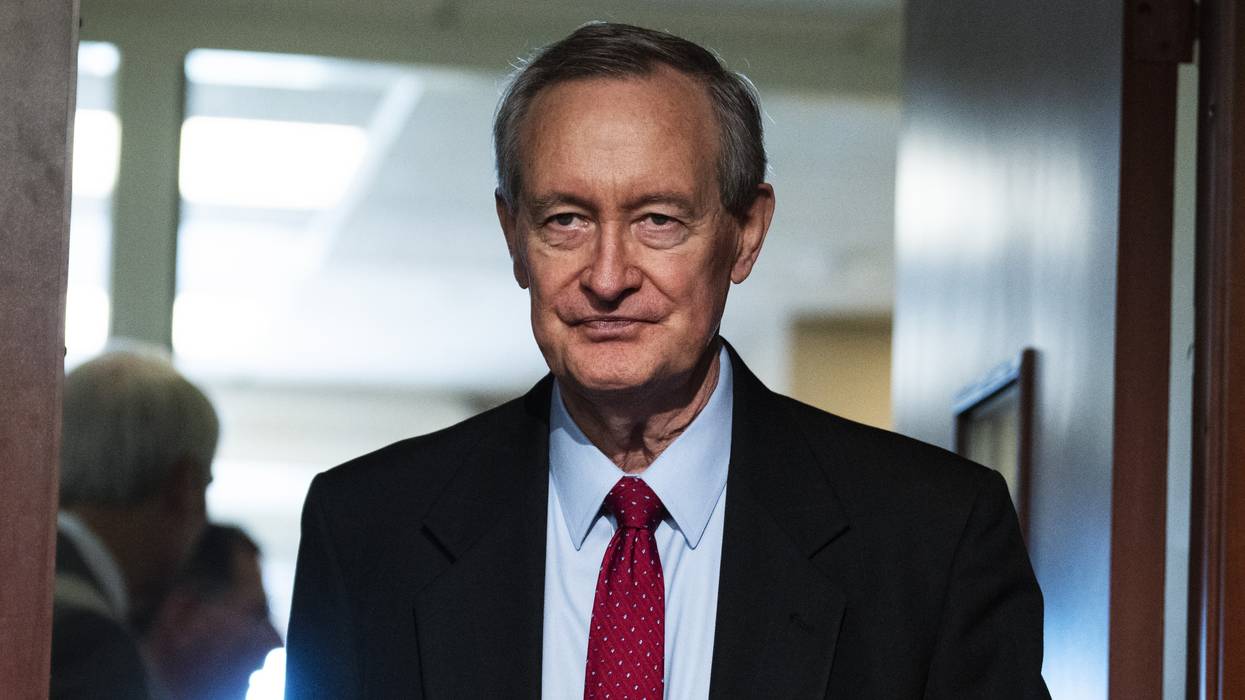
Republican Sen. Mike Crapo, the lead author of a 2018 bank deregulation law that weakened key guardrails designed to prevent another financial crisis, insisted this week that there is "no need" to impose more strict rules following two of the largest bank collapses in U.S. history.
"There is no need for regulatory reform," said Crapo, who chaired the Senate Banking Committee when Congress passed the 2018 law despite vocal warnings from experts that it would destabilize the banking sector. Dozens of Democrats supported the measure.
In a Fox Business appearance on Tuesday, the Idaho Republican deflected blame for the failures of Silicon Valley Bank and Signature Bank, both of which were in the category of firms that saw regulatory relief thanks to the 2018 law.
"The fact is that President Biden—through all of the spending that he did in the last Congress and the last two years—has driven inflation up to the point where wage earners have to get a 14.8% wage increase just to hold even with this kind of inflation," said Crapo. "And when the Fed responded to push interest rates up, that's what caused a liquidity crisis for these two banks."
While analysts agree that the Fed's aggressive interest rate hikes are at least partly to blame for the collapse of SVB and Signature Bank, they also argue that the 2018 law's removal of enhanced capital requirements and stress tests for banks with between $50 billion and $250 billion in assets—reforms implemented by the post-financial crisis Dodd-Frank Act—also played a significant role.
"You have to be hard-core committed to mindless free-market fundamentalism—or truly in thrall to your donors—to insist there's no need for new regulations after Silicon Valley Bank," wrote Robert Weissman, the president of Public Citizen. (Crapo received more than $880,000 in donations from the securities and investment industry between 2017 and 2022, according to OpenSecrets.)
In effect, the 2018 law ( S.2155) removed the "systemically important" designation and the associated regulations from SVB and Signature Bank—a change that didn't stop the Fed and the Biden administration from rushing in to backstop the financial system and prevent "contagion" after the firms collapsed.
"Congress gave regulators permission to take their eyes off of these mid-sized regional banks."
SVB's announcement last week that it sold its bond portfolio at a major loss and was trying to raise funds led venture capitalists to advise startups—SVB's primary clientele—to withdraw their money, setting off a bank run that ultimately resulted in the firm's failure and takeover by regulators.
"The federal government then stepped in to guarantee the deposits, a dramatic move designed to prevent the panic from spreading to other banks," HuffPost's Arthur Delaney noted Wednesday. "But this kind of intervention... was not supposed to be necessary. The enhanced prudential standards under Dodd-Frank include liquidity requirements that would have automatically covered Silicon Valley Bank if Congress hadn't relaxed the law in 2018."
As former FDIC attorney Todd Phillips told The Washington Post earlier this week, "Congress gave regulators permission to take their eyes off of these mid-sized regional banks."
Hilary Allen, a law professor at American University, similarly observed that the 2018 law "did indeed reduce regulatory requirements for banks like Silicon Valley Bank."
"While it is impossible to say categorically that legislative rollback equals the bank’s collapse," Allen added, "it does seem that it made it more likely."
The Fed, as then-central bank governor Lael Brainard lamented in 2019, proceeded to take the Republican-authored law and run with it, further weakening safeguards against financial chaos.
"I see little benefit to the banks or the system from the proposed reduction in core resilience that would justify the increased risk to financial stability in the future," Brainard said in a statement at the time.
On Tuesday, dozens of lawmakers led by Sen. Elizabeth Warren (D-Mass.) and Rep. Katie Porter (D-Calif.) introduced legislation that would repeal the section of the 2018 law that relaxed regulations for banks with less than $250 billion in assets.
In a floor speech, Warren said that "both SVB and Signature Bank suffered from a toxic mix of poor risk management and weak supervision."
"If Congress and the Federal Reserve had not rolled back key provisions of Dodd-Frank, these banks would have been subject to stronger liquidity and capital requirements to help withstand financial shocks," Warren continued. "These threats never should have been allowed to materialize. Now, we must prevent them from occurring again by reversing the dangerous bank deregulation of the Trump era."

Sen. Elizabeth Warren said a 2018 law backed by Republicans and dozens of Democrats allowed banks to "load up on risk to boost their profits," endangering "our entire economy."
Sen. Elizabeth Warren and Rep. Katie Porter unveiled legislation Tuesday to repeal the section of a Trump-era law that weakened regulations for banks with between $50 billion to $250 billion in assets, a move that experts and lawmakers have blamed for the collapse of Silicon Valley Bank and the resulting turmoil.
"In 2018, I rang the alarm bell about what would happen if Congress rolled back critical Dodd-Frank protections: banks would load up on risk to boost their profits and collapse, threatening our entire economy—and that is precisely what happened," Warren (D-Mass.) said in a statement. "President Biden called on Congress to strengthen the rules for banks, and I'm proposing legislation to do just that by repealing the core of Trump's bank law."
That law, authored by Sen. Mike Crapo (R-Idaho) and backed by dozens of Democrats, raised the asset threshold for more stringent regulations to $250 billion or higher, exempting firms such as Silicon Valley Bank (SVB)—a major venture capital lender that controlled around $212 billion—from enhanced liquidity requirements and more frequent federal stress tests imposed on banks considered "systemically important."
SVB's leadership specifically lobbied for the higher threshold, insisting the tougher regulations were unnecessary even as experts and lawmakers raised concerns that gutting them would increase the risk of bank failures and cascading effects on the financial system.
"Americans deserve to know their money is safe when they deposit it in the bank," Porter (D-Calif.) said Tuesday. "In 2018, politicians rolled back critical regulations protecting Americans' deposits—ignoring warnings from financial experts in favor of Wall Street special interests. I'm calling on Congress to restore commonsense guardrails that keep corporate greed in check and restore confidence in our financial system."
Titled the Secure Viable Banking (SVB) Act, Warren and Porter's legislation would place more stringent regulations on institutions like Silicon Valley Bank by reviving safeguards for firms with between $50 billion and $250 billion in assets.
Facing backlash from Warren and others for glaring oversight failures, the Federal Reserve is considering stronger regulations for banks with between $100 billion and $250 billion in assets, Reuters reported late Tuesday.
Warren and Porter introduced their bill with the support of 31 Democrats in the House and 17 members of the Senate Democratic caucus, including Sens. Bernie Sanders (I-Vt.) and Ed Markey (D-Mass.).
"Taxpayers should not have to pay for the mistakes and mismanagement of big bank executives," Markey said in a statement. "The American people should have confidence in their financial institutions, and that starts with undoing Trump-era deregulation so that we can ensure a collapse like we saw last week never happens again."
Notably absent from the list of co-sponsors were the Democrats who helped Republicans usher the bill through Congress in 2018, often misleadingly arguing that the measure was chiefly about providing relief for "community banks."
In the Senate, 16 Democrats and Sen. Angus King (I-Maine) supported the bill, giving Republicans the votes they needed to overcome the chamber's legislative filibuster.
One of the Democratic supporters, Mark Warner of Virginia, defended the 2018 law over the weekend, telling ABC News that he believes it "put in place an appropriate level of regulation on mid-sized banks" and that "these mid-sized banks needed some regulatory relief."
The Lever reported last week that SVB chief Greg Becker held a fundraiser for Warner in 2016.
"The bank’s political action committee also donated a total of $10,000 to Warner’s campaigns in the 2016 and 2018 election cycles," the outlet noted.
Sen. Jon Tester (D-Mont.), another major backer of the 2018 law, held a fundraiser in Silicon Valley earlier this week, just days after SVB collapsed.
It was, as Martin O'Malley said, a very different debate from the Republicans': no racist remarks, not immigrant-bashing, no attacks on women, no clowning or pandering to religious bigotry, and a much more serious policy discussion.
In their closing remarks, Bernie Sanders and Hillary Clinton summed up voters' choice.
Bernie told the CNN audience what very few candidates, he noted, would admit:
"Nobody up here, certainly no Republican, can address the major crises affecting our country, unless millions of people begin to stand up to the billionaire class that has so much power over our economy and our political life."
Asked how he would get anything done in Washington, he replied that it would take a massive grassroots movement to retake power from corporations and politicians who are content with historic income inequality, deregulated banks, a disempowered labor movement, increasing child poverty and receding opportunity for the great majority of people.
Hillary Clinton took the opposite tack. When asked if she was a centrist or a progressive, she replied, "I'm a progressive. But I'm a progressive who likes to get things done."
In her closing remarks, she drove that point home:
"What you have to ask yourself is, 'Who amongst us has the vision for actually making the changes that are going to improve the lives of the American people? Who has the tenacity and the ability and the proven track record of getting that done?'
In other words, do you believe Jim Webb, who told Sanders, rather patronizingly, "Bernie, I don't think the revolution's going to come, and I don't think the Congress is going to pay for a lot of this stuff." Or are you with Sanders' supporters, millions of whom are taking a flyer on the socialist candidate who is, contrary to all expectations, one of the top two contenders in the Democratic contest for President of the United States? Caution and idealism are both defensible positions.
What was remarkable about Tuesday night's debate was that the socialist candidate only improved his stature. The more conservative candidates are going nowhere. Webb, who emphasized his Vietnam War record and the man he killed in combat, did nothing to boost his chances. Chafee turned in a late-night comedy skit with his ridiculous answer that he ought not be held accountable for his vote on bank deregulation since his father had just died and he was new to the Senate. O'Malley at least seemed prepared. But Bernie is still going strong. Neither Ralph Nader nor Dennis Kucinich, recent standard-bearers for the left, increased their stature with their Presidential campaigns. But Sanders is bringing a lot of people along, and he is making a dent in the American sense of what's possible in politics, largely because the issues he talks about--yawning inequality, a corrupt political system, and grotesque injustice for the poor and working class--are now impossible to ignore.
That said, Hillary Clinton is a formidable debater and a formidable candidate. She appeared the clear winner in the debate, drawing applause lines for her explicit advocacy for women's rights and family leave, and with a strong and much-appreciated statement of support for the LGBT community. Bernie will have a hard time contending with her. Under fire for her Iraq vote, and her hawkish position on Syria, she sounded poised and thoughtful and better prepared, with a better grasp of the nuances of foreign policy, than any of the other candidates.
On Black Lives Matter, all of the candidates answered correctly when a viewer asked, "Do black lives matter, or do all lives matter?" Bernie went first and, after being burned for failing to adequately address black voters' concerns, strongly articulated the case for black lives. (But to put the candidates' sophistication on this issue in perspective, my eight-year-old, who was watching the debate with me answered first: "That's just dumb to say 'all lives matter,' because white people are not the people who are dying.")
Democrats get an awful lot of credit for plain common sense in the current political environment.
CNN's Anderson Cooper gets a lot of credit, too, for asking tough questions, but he did not hesitate to bring on the cheese: Enough about economic collapse and whether we live in a democracy, right before going to a commercial break, he announced the next round of questions would reveal which of the candidates had smoked dope. Stay tuned! Sanders actually made the dope question worthwhile, pointing out the injustice of long sentences for nonviolent drug offenders when Wall Street criminals go free. The other candidates concurred, except for Hillary, who demurred that the issue of legalization still needs more study.
Hillary held up under attack for her vote on the Iraq war, which Chafee and Sanders pointed out was based on transparent lies. She brushed off her change of heart on Wall Street regulation and free trade agreements. She made a bold, forward-leaning appeal to women by refuting the suggestion that we can't afford family leave, and by shifting the topic to the Republicans' outrageous attack on Planned Parenthood--just one of many big applause lines she hit (the other candidates earned far fewer enthusiastic responses.)
The headline of the evening was Sanders's comment to Hillary: "The American people are sick and tired of hearing about your damn emails," which earned a lasting ovation, a huge smile from Clinton, and a cacophony of social media chatter.
Hillary walked away with first prize. But the most significant win of the evening was for those millions of people in the Sanders revolution who continue to be inspired by a candidate who speaks seriously and credibly about building a movement to retake our democracy.
That was worth tuning in for.