SUBSCRIBE TO OUR FREE NEWSLETTER
Daily news & progressive opinion—funded by the people, not the corporations—delivered straight to your inbox.
5
#000000
#FFFFFF
To donate by check, phone, or other method, see our More Ways to Give page.
Daily news & progressive opinion—funded by the people, not the corporations—delivered straight to your inbox.
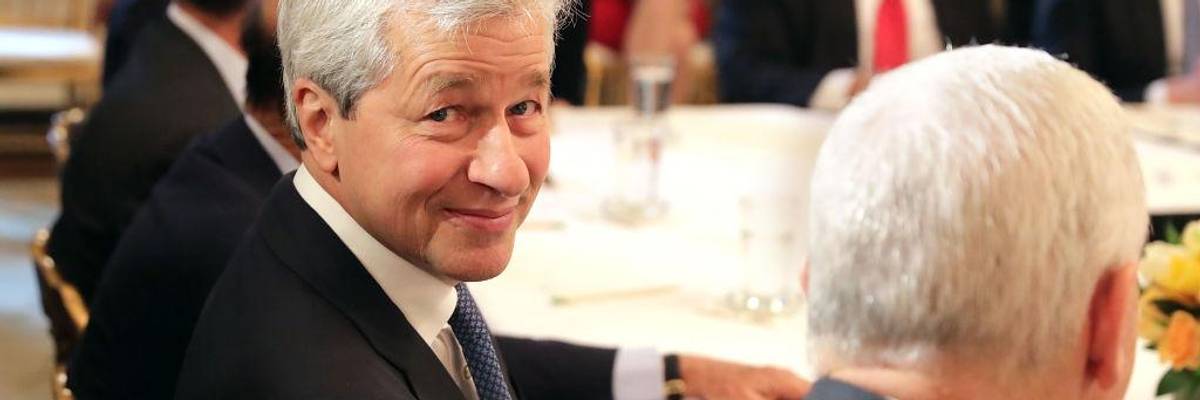
JPMorgan Chase CEO Jamie Dimon attends an event at the White House on February 3, 2017 in Washington, D.C.
Depositors in small and medium-sized banks are now fleeing to the safety of JPMorgan and other giant banks that have been deemed "too big to fail" because the government bailed them out in 2008.
Former Silicon Valley Bank CEO Greg Becker sold $3.6 million worth of shares on February 27, just days before the bank disclosed a large loss that triggered its stock slide and collapse. Over the previous two years, Becker sold nearly $30 million of stock.
But Becker won't rake in the most from this mess. Jamie Dimon, chair and CEO of JPMorgan Chase, the biggest Wall Street bank, will likely make much more.
That's because depositors in small and medium-sized banks are now fleeing to the safety of JPMorgan and other giant banks that have been deemed "too big to fail" because the government bailed them out in 2008.
Last Friday afternoon, the deputy Treasury secretary, Wally Adeyemo, met with Dimon at his office in New York. He asked Dimon whether the failure of Silicon Valley Bank could spread to other banks. "There's a potential," Dimon responded. Presumably, Dimon knew such contagion would mean vastly more business for JPMorgan. In a note to clients on Monday, bank analyst Mike Mayo wrote that JPMorgan in particular is "battle-tested" in volatile markets and "epitomizes" how the largest U.S. banks have shed risk since the 2008 financial crisis. "Recent industry developments should further its ability to gather core funding and act as a source of strength."
Recall that the 2008 financial crisis generated a gigantic shift of assets to the biggest Wall Street banks, with the result that JPMorgan and the other giants became far bigger. In the early 1990s, the five largest banks had accounted for only 12% of U.S. bank deposits. After the crisis, they accounted for nearly half.
After this week, they'll be even bigger.
Their giant size has already given them a huge but hidden federal subsidy estimated to be $83 billion annually—a premium that investors and depositors willingly pay to these enormous banks in the form of higher fees and lower returns, because they're too big to fail. Some of this hidden federal subsidy goes into the pockets of bank executives. Last year alone, Dimon earned $34.5 million. (Greg Becker is a piker by comparison.)
The 2008 financial crisis generated a gigantic shift of assets to the biggest Wall Street banks, with the result that JPMorgan and the other giants became far bigger. After this week, they'll be even bigger.
Jamie Dimon was at the helm in 2008 when JPMorgan received $25 billion from the federal government to help stem the financial crisis brought on largely by the careless and fraudulent lending practices of JPMorgan and other big banks. Dimon earned $20 million that year.
In March 2009, President Obama summoned Dimon and other top bank executives to the White House and warned them that "my administration is the only thing between you and the pitchforks." But Obama never publicly rebuked Dimon or the other big bankers. When asked about the generous pay Dimon and other Wall Street CEOs continued to rake in, Obama defended them as "very savvy businessmen" and said he didn't "begrudge peoples' success or wealth. That's part of the free market system."
What free market system? Taxpayers had just bailed out the banks, and the bank CEOs were still raking in fat paychecks. Yet 8.7 million Americans lost their jobs, causing the unemployment rate to soar to 10%. Total U.S. household net worth dropped by $11.1 trillion. Housing prices dropped by a third nationwide from their 2006 peak, causing some 10 million people to lose their homes.
Rather than defend those CEO paychecks, Obama might have demanded, as a condition of getting bailed out, that the banks help underwater homeowners on Main Street.
Another sensible proposal would have been to let bankruptcy judges restructure shaky home mortgages so that borrowers didn't owe as much and could remain in their homes. Yet the big banks, led by Dimon, opposed this. They thought they'd do better by squeezing as much as possible out of distressed homeowners, and then collecting as much as they could on foreclosed homes. In April 2008, Dimon and the banks succeeded: The Senate formally voted down a bill that would have allowed bankruptcy judges to modify mortgages to help financially distressed homeowners.
In the run-up to the 2020 election, Dimon warned against policies that Bernie Sanders and AOC were then advocating, including Medicare for All, paid sick leave, and free public higher education. Dimon said they amounted to "socialism." "Socialism," he wrote, "inevitably produces stagnation, corruption, and often worse—such as authoritarian government officials who often have an increasing ability to interfere with both the economy and individual lives—which they frequently do to maintain power," adding that socialism would be "a disaster for our country."
Dimon also warned against "over-regulation" of banking, cautioning that in the next financial crisis, big institutions like JPMorgan wouldn't be able to provide the lending they did during the last crisis. "When the next real downturn begins, banks will be constrained—both psychologically and by new regulations—from lending freely into the marketplace, as many of us did in 2008 and 2009. New regulations mean that banks will have to maintain more liquidity going into a downturn, be prepared for the impacts of even tougher stress tests, and hold more capital," he wrote.
But as was demonstrated again this past week, American capitalism needs strict guardrails. Otherwise, it is subject to periodic crises that summon bailouts. The result is socialism for the rich while everyone else is subject to harsh penalties: Bankers get bailed out, and the biggest banks and bankers do even better. Yet average people who cannot pay their mortgages lose their homes. Meanwhile, almost 30 million Americans still lack health insurance, most workers who lose their job aren't eligible for unemployment insurance, most have no paid sick leave, child labor is on the rise, and nearly 51 million households can't afford basic monthly expenses such as housing, food, child care, and transportation.
Is it any wonder that so many Americans see the system as rigged against them? Is it surprising that some of them become susceptible to dangerous snake-oil peddled by demagogues?
Dear Common Dreams reader, It’s been nearly 30 years since I co-founded Common Dreams with my late wife, Lina Newhouser. We had the radical notion that journalism should serve the public good, not corporate profits. It was clear to us from the outset what it would take to build such a project. No paid advertisements. No corporate sponsors. No millionaire publisher telling us what to think or do. Many people said we wouldn't last a year, but we proved those doubters wrong. Together with a tremendous team of journalists and dedicated staff, we built an independent media outlet free from the constraints of profits and corporate control. Our mission has always been simple: To inform. To inspire. To ignite change for the common good. Building Common Dreams was not easy. Our survival was never guaranteed. When you take on the most powerful forces—Wall Street greed, fossil fuel industry destruction, Big Tech lobbyists, and uber-rich oligarchs who have spent billions upon billions rigging the economy and democracy in their favor—the only bulwark you have is supporters who believe in your work. But here’s the urgent message from me today. It's never been this bad out there. And it's never been this hard to keep us going. At the very moment Common Dreams is most needed, the threats we face are intensifying. We need your support now more than ever. We don't accept corporate advertising and never will. We don't have a paywall because we don't think people should be blocked from critical news based on their ability to pay. Everything we do is funded by the donations of readers like you. When everyone does the little they can afford, we are strong. But if that support retreats or dries up, so do we. Will you donate now to make sure Common Dreams not only survives but thrives? —Craig Brown, Co-founder |
Former Silicon Valley Bank CEO Greg Becker sold $3.6 million worth of shares on February 27, just days before the bank disclosed a large loss that triggered its stock slide and collapse. Over the previous two years, Becker sold nearly $30 million of stock.
But Becker won't rake in the most from this mess. Jamie Dimon, chair and CEO of JPMorgan Chase, the biggest Wall Street bank, will likely make much more.
That's because depositors in small and medium-sized banks are now fleeing to the safety of JPMorgan and other giant banks that have been deemed "too big to fail" because the government bailed them out in 2008.
Last Friday afternoon, the deputy Treasury secretary, Wally Adeyemo, met with Dimon at his office in New York. He asked Dimon whether the failure of Silicon Valley Bank could spread to other banks. "There's a potential," Dimon responded. Presumably, Dimon knew such contagion would mean vastly more business for JPMorgan. In a note to clients on Monday, bank analyst Mike Mayo wrote that JPMorgan in particular is "battle-tested" in volatile markets and "epitomizes" how the largest U.S. banks have shed risk since the 2008 financial crisis. "Recent industry developments should further its ability to gather core funding and act as a source of strength."
Recall that the 2008 financial crisis generated a gigantic shift of assets to the biggest Wall Street banks, with the result that JPMorgan and the other giants became far bigger. In the early 1990s, the five largest banks had accounted for only 12% of U.S. bank deposits. After the crisis, they accounted for nearly half.
After this week, they'll be even bigger.
Their giant size has already given them a huge but hidden federal subsidy estimated to be $83 billion annually—a premium that investors and depositors willingly pay to these enormous banks in the form of higher fees and lower returns, because they're too big to fail. Some of this hidden federal subsidy goes into the pockets of bank executives. Last year alone, Dimon earned $34.5 million. (Greg Becker is a piker by comparison.)
The 2008 financial crisis generated a gigantic shift of assets to the biggest Wall Street banks, with the result that JPMorgan and the other giants became far bigger. After this week, they'll be even bigger.
Jamie Dimon was at the helm in 2008 when JPMorgan received $25 billion from the federal government to help stem the financial crisis brought on largely by the careless and fraudulent lending practices of JPMorgan and other big banks. Dimon earned $20 million that year.
In March 2009, President Obama summoned Dimon and other top bank executives to the White House and warned them that "my administration is the only thing between you and the pitchforks." But Obama never publicly rebuked Dimon or the other big bankers. When asked about the generous pay Dimon and other Wall Street CEOs continued to rake in, Obama defended them as "very savvy businessmen" and said he didn't "begrudge peoples' success or wealth. That's part of the free market system."
What free market system? Taxpayers had just bailed out the banks, and the bank CEOs were still raking in fat paychecks. Yet 8.7 million Americans lost their jobs, causing the unemployment rate to soar to 10%. Total U.S. household net worth dropped by $11.1 trillion. Housing prices dropped by a third nationwide from their 2006 peak, causing some 10 million people to lose their homes.
Rather than defend those CEO paychecks, Obama might have demanded, as a condition of getting bailed out, that the banks help underwater homeowners on Main Street.
Another sensible proposal would have been to let bankruptcy judges restructure shaky home mortgages so that borrowers didn't owe as much and could remain in their homes. Yet the big banks, led by Dimon, opposed this. They thought they'd do better by squeezing as much as possible out of distressed homeowners, and then collecting as much as they could on foreclosed homes. In April 2008, Dimon and the banks succeeded: The Senate formally voted down a bill that would have allowed bankruptcy judges to modify mortgages to help financially distressed homeowners.
In the run-up to the 2020 election, Dimon warned against policies that Bernie Sanders and AOC were then advocating, including Medicare for All, paid sick leave, and free public higher education. Dimon said they amounted to "socialism." "Socialism," he wrote, "inevitably produces stagnation, corruption, and often worse—such as authoritarian government officials who often have an increasing ability to interfere with both the economy and individual lives—which they frequently do to maintain power," adding that socialism would be "a disaster for our country."
Dimon also warned against "over-regulation" of banking, cautioning that in the next financial crisis, big institutions like JPMorgan wouldn't be able to provide the lending they did during the last crisis. "When the next real downturn begins, banks will be constrained—both psychologically and by new regulations—from lending freely into the marketplace, as many of us did in 2008 and 2009. New regulations mean that banks will have to maintain more liquidity going into a downturn, be prepared for the impacts of even tougher stress tests, and hold more capital," he wrote.
But as was demonstrated again this past week, American capitalism needs strict guardrails. Otherwise, it is subject to periodic crises that summon bailouts. The result is socialism for the rich while everyone else is subject to harsh penalties: Bankers get bailed out, and the biggest banks and bankers do even better. Yet average people who cannot pay their mortgages lose their homes. Meanwhile, almost 30 million Americans still lack health insurance, most workers who lose their job aren't eligible for unemployment insurance, most have no paid sick leave, child labor is on the rise, and nearly 51 million households can't afford basic monthly expenses such as housing, food, child care, and transportation.
Is it any wonder that so many Americans see the system as rigged against them? Is it surprising that some of them become susceptible to dangerous snake-oil peddled by demagogues?
Former Silicon Valley Bank CEO Greg Becker sold $3.6 million worth of shares on February 27, just days before the bank disclosed a large loss that triggered its stock slide and collapse. Over the previous two years, Becker sold nearly $30 million of stock.
But Becker won't rake in the most from this mess. Jamie Dimon, chair and CEO of JPMorgan Chase, the biggest Wall Street bank, will likely make much more.
That's because depositors in small and medium-sized banks are now fleeing to the safety of JPMorgan and other giant banks that have been deemed "too big to fail" because the government bailed them out in 2008.
Last Friday afternoon, the deputy Treasury secretary, Wally Adeyemo, met with Dimon at his office in New York. He asked Dimon whether the failure of Silicon Valley Bank could spread to other banks. "There's a potential," Dimon responded. Presumably, Dimon knew such contagion would mean vastly more business for JPMorgan. In a note to clients on Monday, bank analyst Mike Mayo wrote that JPMorgan in particular is "battle-tested" in volatile markets and "epitomizes" how the largest U.S. banks have shed risk since the 2008 financial crisis. "Recent industry developments should further its ability to gather core funding and act as a source of strength."
Recall that the 2008 financial crisis generated a gigantic shift of assets to the biggest Wall Street banks, with the result that JPMorgan and the other giants became far bigger. In the early 1990s, the five largest banks had accounted for only 12% of U.S. bank deposits. After the crisis, they accounted for nearly half.
After this week, they'll be even bigger.
Their giant size has already given them a huge but hidden federal subsidy estimated to be $83 billion annually—a premium that investors and depositors willingly pay to these enormous banks in the form of higher fees and lower returns, because they're too big to fail. Some of this hidden federal subsidy goes into the pockets of bank executives. Last year alone, Dimon earned $34.5 million. (Greg Becker is a piker by comparison.)
The 2008 financial crisis generated a gigantic shift of assets to the biggest Wall Street banks, with the result that JPMorgan and the other giants became far bigger. After this week, they'll be even bigger.
Jamie Dimon was at the helm in 2008 when JPMorgan received $25 billion from the federal government to help stem the financial crisis brought on largely by the careless and fraudulent lending practices of JPMorgan and other big banks. Dimon earned $20 million that year.
In March 2009, President Obama summoned Dimon and other top bank executives to the White House and warned them that "my administration is the only thing between you and the pitchforks." But Obama never publicly rebuked Dimon or the other big bankers. When asked about the generous pay Dimon and other Wall Street CEOs continued to rake in, Obama defended them as "very savvy businessmen" and said he didn't "begrudge peoples' success or wealth. That's part of the free market system."
What free market system? Taxpayers had just bailed out the banks, and the bank CEOs were still raking in fat paychecks. Yet 8.7 million Americans lost their jobs, causing the unemployment rate to soar to 10%. Total U.S. household net worth dropped by $11.1 trillion. Housing prices dropped by a third nationwide from their 2006 peak, causing some 10 million people to lose their homes.
Rather than defend those CEO paychecks, Obama might have demanded, as a condition of getting bailed out, that the banks help underwater homeowners on Main Street.
Another sensible proposal would have been to let bankruptcy judges restructure shaky home mortgages so that borrowers didn't owe as much and could remain in their homes. Yet the big banks, led by Dimon, opposed this. They thought they'd do better by squeezing as much as possible out of distressed homeowners, and then collecting as much as they could on foreclosed homes. In April 2008, Dimon and the banks succeeded: The Senate formally voted down a bill that would have allowed bankruptcy judges to modify mortgages to help financially distressed homeowners.
In the run-up to the 2020 election, Dimon warned against policies that Bernie Sanders and AOC were then advocating, including Medicare for All, paid sick leave, and free public higher education. Dimon said they amounted to "socialism." "Socialism," he wrote, "inevitably produces stagnation, corruption, and often worse—such as authoritarian government officials who often have an increasing ability to interfere with both the economy and individual lives—which they frequently do to maintain power," adding that socialism would be "a disaster for our country."
Dimon also warned against "over-regulation" of banking, cautioning that in the next financial crisis, big institutions like JPMorgan wouldn't be able to provide the lending they did during the last crisis. "When the next real downturn begins, banks will be constrained—both psychologically and by new regulations—from lending freely into the marketplace, as many of us did in 2008 and 2009. New regulations mean that banks will have to maintain more liquidity going into a downturn, be prepared for the impacts of even tougher stress tests, and hold more capital," he wrote.
But as was demonstrated again this past week, American capitalism needs strict guardrails. Otherwise, it is subject to periodic crises that summon bailouts. The result is socialism for the rich while everyone else is subject to harsh penalties: Bankers get bailed out, and the biggest banks and bankers do even better. Yet average people who cannot pay their mortgages lose their homes. Meanwhile, almost 30 million Americans still lack health insurance, most workers who lose their job aren't eligible for unemployment insurance, most have no paid sick leave, child labor is on the rise, and nearly 51 million households can't afford basic monthly expenses such as housing, food, child care, and transportation.
Is it any wonder that so many Americans see the system as rigged against them? Is it surprising that some of them become susceptible to dangerous snake-oil peddled by demagogues?