

SUBSCRIBE TO OUR FREE NEWSLETTER
Daily news & progressive opinion—funded by the people, not the corporations—delivered straight to your inbox.
5
#000000
#FFFFFF
To donate by check, phone, or other method, see our More Ways to Give page.
Daily news & progressive opinion—funded by the people, not the corporations—delivered straight to your inbox.
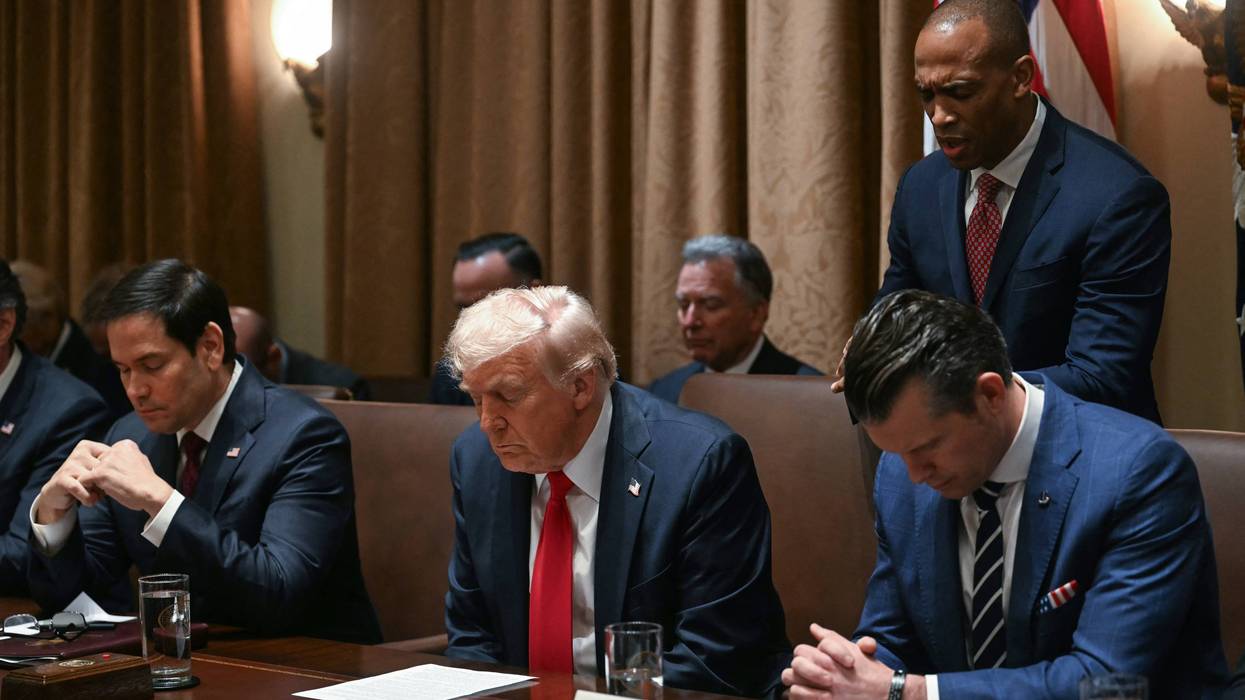
“If President Trump and his allies truly cared about America’s legacy of religious freedom, they would be celebrating church-state separation as the unique American invention that has allowed religious diversity to flourish."
An all-day prayer event scheduled for Sunday on the National Mall is set to feature evangelical Protestant leaders as well as top White House and Republican Party officials as speakers, and is being promoted as a celebration of "thanksgiving" as well as an opportunity for participants to learn about the founding of the nation as the 250th anniversary of its independence approaches.
In reality, said Rachel Laser, president and CEO of Americans United for Separation of Church and State, the "National Jubilee of Prayer, Praise, and Thanksgiving" appears to be a "Jubilee of Christian Nationalism"—with evangelical Christians making up three-quarters of the scheduled speakers, despite the fact that they account for just a quarter of Americans overall.
“If President Trump and his allies truly cared about America’s legacy of religious freedom, they would be celebrating church-state separation as the unique American invention that has allowed religious diversity to flourish in our country," said Laser. "Instead, they continue to threaten this foundational principle by advancing a Christian nationalist crusade to impose one narrow version of Christianity on all Americans."
The event, which is partly funded by taxpayer dollars earmarked for the nation's 250th anniversary, will feature Christian musical performers organized around three "pillars" that are labeled as "miracles" a Christian God bestowed on America, “personal testimonies of God’s healing,” and a "unified moment of rededication."
At a webinar last month, Rev. Paula White-Cain, who serves as a faith adviser to the White House, said the event is "really truly rededicating the country to God.”
The idea that the founders of the United States intended the country to be a Christian one has long been a fixation of evangelical Christian leaders, despite the lack of evidence for such a claim.
“Look at the document," Princeton University history professor Kevin Kruse told The Washington Post, referring to the Constitution. "The only rules they wrote about religion were ones that keep religion at arm’s length. No establishment, no limits on free exercise, no religious test for office... There’s a difference between saying America is a nation with many Christians in it and that America is a nation dedicated to Christianity and defined by it."
Robert Jones, president of the Public Religion Research Institute, told the Post that about a third of Americans currently report that they have no religious affiliation, making the US more religiously diverse than it's ever been.
“We proudly celebrate 250 years of American independence from kings who ruled over both church and state," said Laser. "For 250 years, America has been marching toward the promise of a country where all people can be free to live as themselves and believe as they choose, as long as they don’t harm others. Christian nationalists threaten that promise by undermining church-state separation, a pillar of our democracy."
The jubilee, which will also feature an 18-wheeler "Freedom Truck" featuring educational content made by the right-wing group PragerU and the Christian school Hillsdale College, comes after numerous displays of religiosity from the Trump administration.
Even many of the president's supporters on the Christian right were aghast at an artificial intelligence-generated image he posted last month on social media, appearing to depict him as a Christ figure. Defense Secretary Pete Hegseth, who is set to speak at the jubilee, has spoken about the US-Israeli war on Iran as Christian crusade and has hosted evangelical worship services at the Pentagon, while Agriculture Secretary Brooke Rollins wrote, "He is Risen indeed!" in an Easter email to federal employees that recounted the biblical story of the resurrection.
Robert Weissman, co-president of government watchdog Public Citizen, noted that the corporate sponsors of Freedom 250, the public-private partnership that's organizing the 250th anniversary, "may want to curry favor with the Trump administration."
The sponsors, including John Deere, Oracle, and Lockheed Martin, "should be forced to answer whether they support the extreme agenda they are celebrating," he said.
“This outrageous event makes a mockery of a core constitutional tenet of American life, the separation of church and state, essentially promoting a particular flavor of white evangelical protestantism as state-sponsored religion,” said Weissman. “This self-proclaimed day of thanksgiving torpedoes the best of American traditions—inclusivity and diversity—and has no place being connected to the US government."
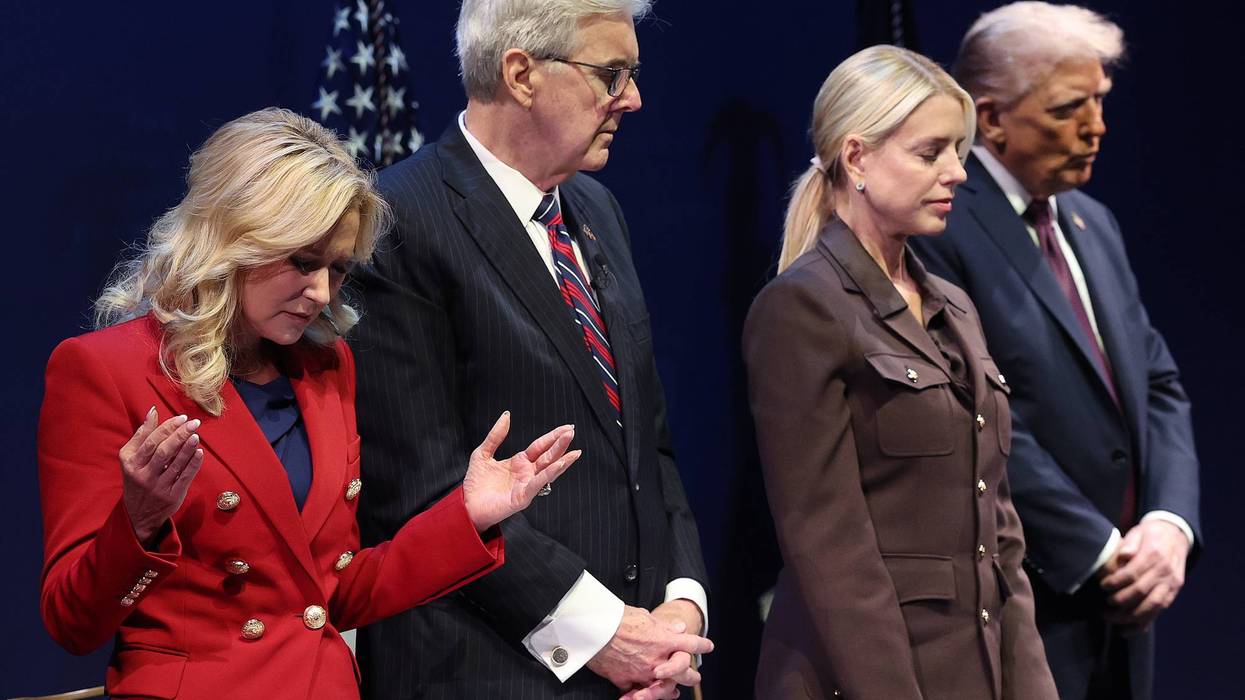
"The Religious Liberty Commission isn't about protecting religious liberty for all; it's about rejecting our nation's religious diversity and prioritizing one narrow set of conservative 'Judeo-Christian' beliefs," said one critic.
"Religious freedom for some is religious freedom for none."
That's what Rev. Paul Brandeis Raushenbush, president and CEO of Interfaith Alliance, said in a Monday statement as faith groups filed a federal lawsuit in the Southern District of New York over President Donald Trump's so-called Religious Liberty Commission.
Since Trump launched the commission last year, critics have warned that its true intent is to advance a Christian nationalist agenda. Brandeis Raushenbush, his alliance, Hindus for Human Rights, Muslims for Progressive Values, and the Sikh American Legal Defense and Education Fund renewed that argument in the complaint, which names Trump, US Attorney General Pam Bondi, the Department of Justice, the commission, and its leader, Mary Margaret Bush, as defendants.
"The government has no right to pick and choose which religious beliefs to promote, and which to marginalize," said Brandeis Raushenbush. "The Trump administration has failed to uphold our country's proud religious freedom tradition, and we will hold them accountable. Today's lawsuit is our recommitment to fight for religious liberty for all with every tool available to us."
The complaint argues that "the composition and operations of the commission violate the Federal Advisory Committee Act (FACA)," which Congress enacted in 1972 "to curb the executive branch's reliance on superfluous, secretive, and biased 'advisory committees.'" Under the law, "every advisory committee must meet public transparency requirements, be in the public interest, be fairly balanced among competing points of view, and be structured to avoid inappropriate influence by special interests."
"While this body is ostensibly designed to defend 'religious liberty for all Americans' and celebrate 'religious pluralism' it actually represents only a single 'Judeo-Christian' viewpoint," the complaint states. "It held its first three meetings at the Museum of the Bible and has closed its meetings with a Christian prayer 'in Jesus' name.'"
"Only one of its members is not Christian, and the Christian members do not represent the full diversity of the Christian faith," the filing continues. "The commission's meetings have repeatedly referenced the belief that the United States was founded as a 'Judeo-Christian nation' and the membership reflects that viewpoint. All members of the commission advocate for increased religiosity, and specifically their brand of 'Judeo-Christian' religiosity, in public life."
"The commission's members have promoted the primacy of a Judeo-Christian worldview in the public sphere, advocated for discrimination against minority groups under the guise of 'religious liberty,' and otherwise supported policies that threaten religious freedom for all those who do not conform to their particular worldview," the document details.
Ria Chakrabarty, senior policy director of Hindus for Human Rights, said Monday that "by stacking this Religious Liberty Commission with a narrow set of voices and hiding the commission's work from the public eye, the Trump administration is evading the transparency and balance that federal law requires."
"Hindus for Human Rights is proud to stand with our multifaith partners to defend a pluralistic democracy where Hindus, Muslims, Sikhs, Jews, Christians, Buddhists, and nonreligious people all belong as equals," she added.
A commission that claims “religious liberty” while excluding Muslims, Hindus, Buddhists, Sikhs—and nonreligious Americans—isn’t protecting freedom. It’s narrowing it.We’re challenging this commission in court. democracyforward.org/news/press-r...
[image or embed]
— Hindus For Human Rights (@hfhr.bsky.social) February 9, 2026 at 10:21 AM
Ani Zonneveld, president and founder of Muslims for Progressive Values, noted that "as a Muslim American organization, we have seen firsthand how elevating a singular religion above others, especially in a country as religiously diverse as the United States, leads to the oppression and possible persecution of minority faiths."
The plaintiffs are represented by Democracy Forward, which has filed over 150 lawsuits against the Trump administration since the president returned to power last year, and the decades-old Americans United for Separation of Church and State—whose president and CEO, Rachel Laser, stressed that "the Religious Liberty Commission isn't about protecting religious liberty for all; it's about rejecting our nation's religious diversity and prioritizing one narrow set of conservative 'Judeo-Christian' beliefs."
Blasting the commission's public meetings as "a vivid example of this favoritism," Laser added that its "true purpose and operations can't be squared with America's constitutional promise of church-state separation."
Specifically, Laser's group and other advocates of church-state separation have long pointed to the establishment clause of the First Amendment to the US Constitution, which bars government from making any "law respecting an establishment of religion."
"Since the nation's founding, the values of religious liberty and pluralism have been central to the American identity. These values are now under accelerated attack," declared Perryman, who's also on the Interfaith Alliance board. "The fatally flawed way this commission was assembled makes clear that the outcome isn't just un-American, it's against the law."
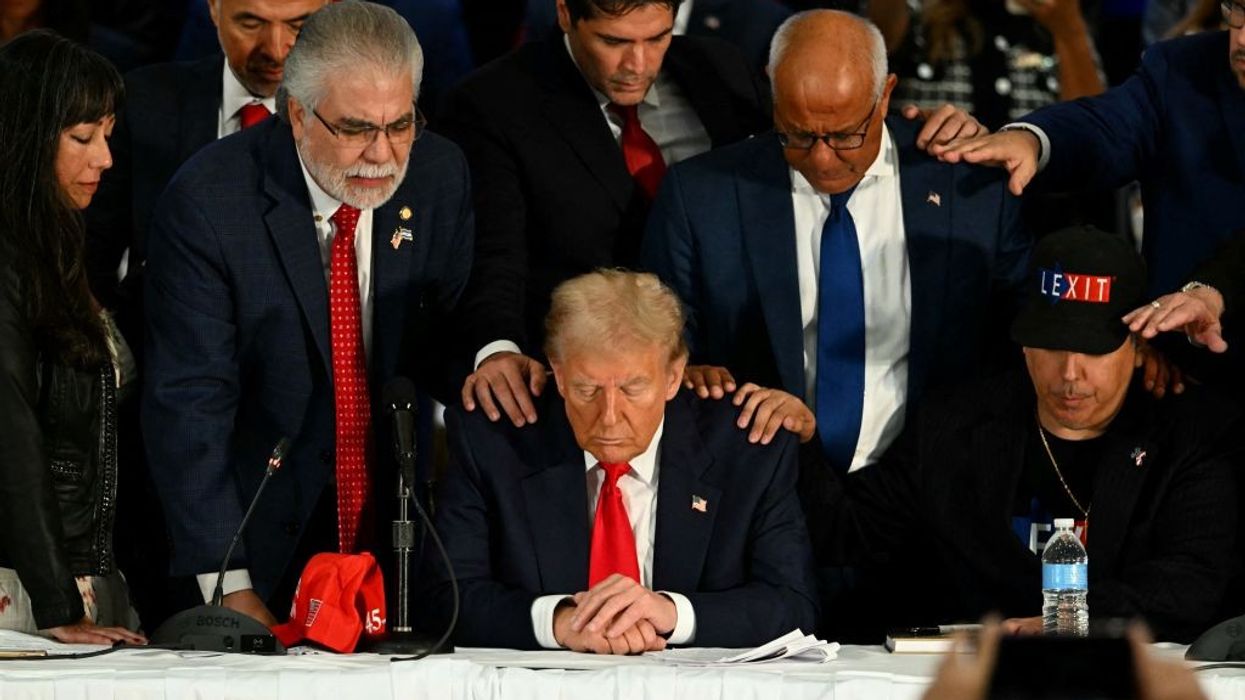
One critic warned that the Trump-created Religious Liberty Commission is "working to obliterate church-state separation, turn public schools into Sunday schools and misuse religious freedom as a license to discriminate."
Church-state separation advocates on Monday issued new warnings about the Religious Liberty Commission established by US President Donald Trump earlier this year.
Ahead of the commission's meeting that took place on Monday morning at the Museum of the Bible in Washington, DC, Rachel Laser, president and CEO of Americans United for Separation of Church and State, argued that Americans should be particularly worried by the commission's focus on public education.
"Yet again, President Trump's Religious Liberty Commission demonstrated that its true purpose is to advance a Christian Nationalist agenda and impose one narrow religious view on the nation’s public school children," Laser said.
Laser went on to highlight some of the featured speakers at the gathering, including one teacher who has said she's engaged in "spiritual warfare" against the LGBTQ+ rights movement and a former high school football coach whom the US Court of Appeals for the Ninth Circuit found created "a deceitful narrative" about coercing his players to pray with him.
Laser went on to charge that "the majority of speakers at today’s hearing are affiliated with Christian Nationalist organizations," which she said were "working to obliterate church-state separation, turn public schools into Sunday schools, and misuse religious freedom as a license to discriminate." She further said the commission was "an outright assault on our country’s promise of church-state separation."
Laurel Burchfield, advocacy director for Mainstream Coalition, also warned about the commission's ambitions in an editorial published earlier this year by The Missouri Independent.
In addition to citing the concerns raised by Laser about the commission's effort to influence public school curriculum, Burchfield argued that it would also attempt to "rewrite history" to justify false claims that the US was founded as an exclusively "Christian nation."
She also said that the commission has ambitions to "promote religion in all parts of American culture, politics, and public life."
Monday's Religious Liberty Commission meeting began with a tribute to slain right-wing activist and Christian nationalist Charlie Kirk, before moving on to a series of panels whose stated goal is to "understand the historic landscape of religious liberty in the educational setting, recognize present threats to religious liberty in education, and identify opportunities to secure religious liberty in this context for the future."
"These individuals were hand-selected for holding a worldview that advances the Christian Nationalist agenda and threatens any religious beliefs that fall outside of this ideology," said Burchfield.
"As multiple courts have reaffirmed, the First Amendment safeguards the rights of individuals to choose whether and how they engage with religion, and that protection extends to every classroom," said one lawyer.
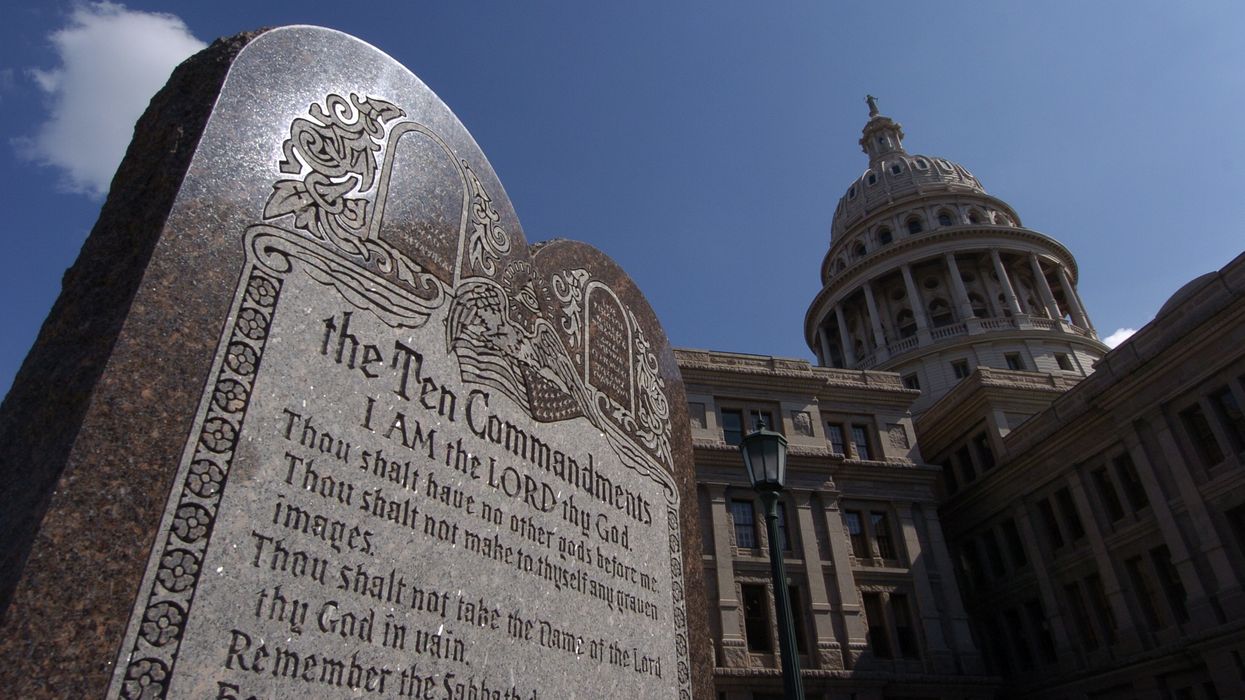
The battle over Texas' Senate Bill 10 continued on Monday, with families in the state filing a federal lawsuit to block the display of a Protestant Christian version of the Ten Commandments in a "conspicuous place" in every public school classroom.
"This lawsuit, brought on behalf of a new group of Texas families, underscores a critical principle: Public schools across the state must uphold—not undermine—the constitutional protections afforded to every student," said Jon Youngwood, global co-chair of the litigation department at Simpson Thacher & Bartlett LLP, which represents the plaintiffs.
"As multiple courts have reaffirmed, the First Amendment safeguards the rights of individuals to choose whether and how they engage with religion, and that protection extends to every classroom," Youngwood continued.
The new complaint, filed in the Western District of Texas, explains that "last month, this district court ruled that SB 10 is 'plainly unconstitutional' and likely violates the Establishment and Free Exercise Clauses of the First Amendment... And in June, the US Court of Appeals for the 5th Circuit held the same regarding a Louisiana statute similar to SB 10."
"Despite these precedents, the defendant school districts have pressed forward with actually posting SB 10 displays in classrooms, or have confirmed they will do so shortly—even after receiving a letter from plaintiffs' counsel," the filing explains.
"All students—regardless of their race or religious background—should feel accepted and free to be themselves in Texas public schools."
After US District Judge Fred Biery, an appointee of former President Bill Clinton, issued a preliminary injunction against SB 10 last month, Republican Texas Attorney General Ken Paxton, who is running for US Senate, said that only the school districts involved in that case are affected and all others must abide by the law. Paxton also appealed the previous decision to the 5th Circuit.
With the latest filing, the families are seeking a declaratory judgment that SB 10 is unconstitutional. In both Texas cases, the plaintiffs are represented by not only Simpson Thacher but also Americans United for Separation of Church and State, the state and national ACLU, and the Freedom From Religion Foundation.
"This lawsuit is a continuation of our work to defend the First Amendment and ensure that government officials stay out of personal family decisions," said Chloe Kempf, staff attorney at the ACLU of Texas. "All students—regardless of their race or religious background—should feel accepted and free to be themselves in Texas public schools."
The families behind this latest filing have various beliefs. Nichole Manning, for example, called SB 10 "a calculated step to erode the separation of church and state and the right for my family to exercise our nonreligious beliefs."
Another plaintiff, Lenee Bien-Willner, said that "forcing religion, any religion, on others violates my Jewish faith."
"It troubles me greatly to have Christian displays imposed on my children," she said. "Not only is the text not aligned with Judaism, but the commandments should be taught in the context of a person's faith tradition. State-sponsored religion, however, does not belong in the public classroom."
Even some Christians are opposed to the Texas law. Plaintiff Rev. Kristin Klade said that "as a devout Christian and a Lutheran pastor, the spiritual formation of my children is a privilege I take more seriously than anything else in my life."
"The mandated Ten Commandments displays in my children's public school impede my ability to 'train up my child in the way he should go' (Proverbs 22:6)," she said. "I address questions about God and faith with great care, and I emphatically reject the notion that the state would do this for me."
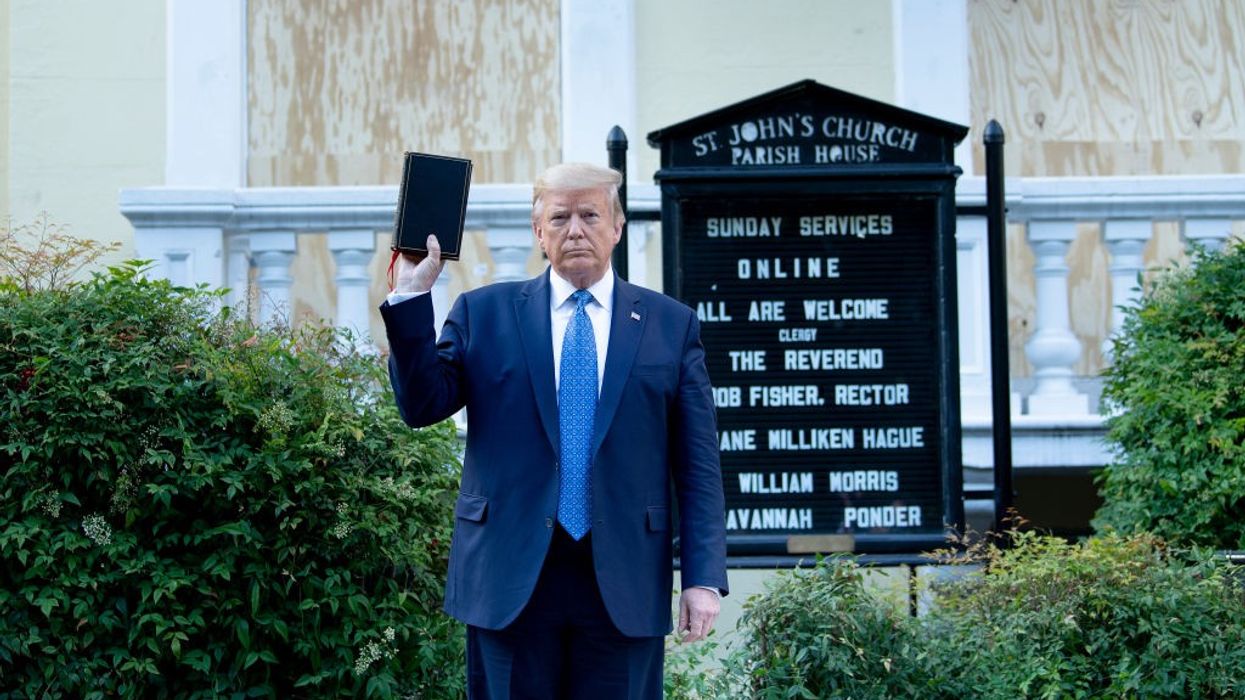
"President Trump is using religion to promote his self-aggrandizement and political agenda, all the while perpetuating the lie that America is a Christian nation and that religion is under attack," said one critic.
Proponents of separating church and state on Monday decried US President Donald Trump's pledge to protect prayer in public schools, warning that the administration is advancing the agenda of far-right Christian nationalists seeking to impose their religious beliefs upon everyone.
Speaking at a meeting of the president's so-called Religious Liberty Commission at the Museum of the Bible in Washington, DC, Trump announced upcoming Department of Education guidance "protecting the right to prayer in our public schools, and it's total protection."
"We're defending our rights and restoring our identity as a nation under God," Trump said. "To have a great nation, you have to have religion. I believe that so strongly. As president, I will always defend our glorious heritage, and we will protect the Judeo-Christian principles of our founding."
The president added that it is "ridiculous" that the nation's public school students are "indoctrinated with anti-religious propaganda, and some are even punished for their religious beliefs."
Trump also launched his "America Prays" initiative, which asks the faithful to "join with at least 10 people to meet each week for one hour to pray" for the country.
In response to the president's speech, the Freedom From Religion Foundation (FFRF) said on social media: "We've never been 'one nation under God.' There's nothing to restore. Our true identity is freedom of conscience—the right to believe in any faith, or none at all."
"A great nation isn't built on religion—it's built on equality, liberty, and justice for all," FFRF added. "Our strength comes from We The People, not belief in a god."
Rachel Laser, president of the group Americans United for Separation of Church and State, said in a statement that Monday's event "once again demonstrated that this commission isn't about religious liberty; it's about rejecting the nation's religious diversity and prioritizing one set of Christian beliefs."
"From the professions of Christian faith to the chorus of 'amens' during Christian prayers to the exclusively Christian speakers this morning, this government hearing was more like a church service," Laser noted. "Once again, President Trump is using religion to promote his self-aggrandizement and political agenda, all the while perpetuating the lie that America is a Christian nation and that religion is under attack."
Laser continued:
The Trump administration is advancing this Christian nationalist agenda with the launch of his 'America Prays' initiative, which calls on Americans to pray for our country. People who care about religious freedom don't need to be told when or how to pray; they need leaders who are committed to separation of church and state.
At a hearing focused on religious freedom and public schools, the commission ignored the most serious threats. From mandates to display the Ten Commandments and teach from the Bible to Christianity-infused curriculum and the installation of school chaplains, Christian nationalists and their political allies are trying to impose their personal religious beliefs on America's public school children.
"Our country's promise of church-state separation means that families—not politicians or public school officials—get to decide how and when children engage with religion," Laser added. "Yet many of the organizations represented at today's meeting and members of the Religious Liberty Commission have tried to undermine this fundamental American principle and turn our public schools into Sunday schools."
Monday's event came as some GOP-led states push forward with plans for more overt displays of religiosity in public schools. Most notably, Texas Attorney General Ken Paxton—a US Senate candidate—is urging schools to display the Ten Commandments in spite of a federal judge's recent injunction on a law requiring the Judeo-Christian religious and ethical directives to be displayed in all classrooms.
Paxton is also urging all schools "to begin the legal process of putting prayer back in the classroom and recommending the Lord's Prayer for students."
Responding to Paxton's push, gun control advocate Fred Guttenberg said last week on social media: "Hey Ken, many have said that you committed adultery. Shouldn't you worry about your own morality before imposing this on others? Looks like you are using religion for personal gain."
Recent polls have shown a significant drop in the number of Americans who identify as Christian in recent decades, an all-time low in belief in "God," and a steady overall decline in religiosity among younger Americans.
"Children's religious beliefs should be instilled by parents and faith communities, not politicians and public schools," said a Texas rabbi who sued the state over the law.
A federal judge on Wednesday shot down a Texas law that would have mandated all public school classrooms across the state display the Ten Commandments.
As reported by local news station KSAT, US District Judge Fred Biery of the United States District Court for the Western District of Texas issued a preliminary injunction, ruling that the state's law crossed the line from education to proselytizing on behalf of a specific sect of Christianity.
Noting that "the Ten Commandments set out in Texas's Ten Commandments law differs from the version observed by some Protestant faiths, and most adherents of the Catholic and Jewish faiths," Biery argued that the law violated the First Amendment of the United States Constitution, which states that Congress shall make no law respecting the establishment of a religion.
Biery imagined the uproar that would ensue if the city of Hamtramck, Michigan, which is majority Muslim, passed a law mandating that all public schools post passages from the Quran in all classrooms. He then argued that such a law would be just as unconstitutional as the Texas Ten Commandments law.
"While 'We the people' rule by a majority, the Bill of Rights protects the minority Christians in Hamtramck and those 33% of Texans who do not adhere to any of the Christian denominations," he wrote.
The judge also argued that the classroom displays "are likely to pressure the [students] into religious observance, meditation on, veneration, and adoption of the state's favored religious scripture, and into suppressing expression of their own religious or nonreligious background and beliefs while at school."
Organizations that advocate for the separation of church and state were quick to praise Biery's decision to strike down the law, which had been due to go into effect on September 1.
Tommy Buser-Clancy, senior staff attorney at the ACLU of Texas, said that the ruling affirmed that the state cannot coerce any Texans into adopting a particular religious faith.
“Today's ruling is a major win that protects the constitutional right to religious freedom for Texas families of all backgrounds," he said. "The court affirmed what we have long said: Public schools are for educating, not evangelizing."
Rabbi Mara Nathan, one of the plaintiffs who sued to get the law overturned, welcomed the ruling and stated that "children's religious beliefs should be instilled by parents and faith communities, not politicians and public schools."
Freedom From Religion Foundation co-president Annie Laurie Gaylor similarly said that "religious instruction must be left to parents, not the state, which has no business telling anyone how many gods to have, which gods to have or whether to have any gods at all."
Rachel Laser, president and CEO of Americans United for Separation of Church and State, hailed the ruling and said that it sends a "strong and resounding message across the country that the government respects the religious freedom of every student in our public schools."

"The Trump administration's radical reinterpretation of this federal law is a flagrant, self-serving attack on church-state separation that threatens our democracy," said one supporter of the Johnson Amendment.
As The New York Times reported on how an Easter dinner may have given "Christian conservatives their most significant victory involving church political organizing in 70 years," over 1,000 charitable nonprofits on Wednesday collectively urged President Donald Trump not to allow churches to endorse political candidates.
A provision of the U.S. tax code named for former President Lyndon B. Johnson conditions tax-exempt status on an organization not participating or intervening in campaigns for public office. However, in a bid to settle a federal lawsuit earlier this month, the Internal Revenue Service (IRS) proposed an exemption for houses of worship.
As the proposed exception to the Johnson Amendment awaits court approval, groups including the American Humanist Association, Americans United for Separation of Church and State (AU), Freedom From Religion Foundation, Independent Sector, Interfaith Alliance, National Council of Nonprofits, and Public Citizen on Wednesday launched the sign-on letter to Trump.
"For more than 70 years, it has ensured that all tax-exempt charitable nonprofits—including houses of worship—do not become conduits for partisan politics, protecting public trust in religious institutions and preserving the integrity of elections," the letter says of the Johnson Amendment. "Weakening the provision threatens to erode public trust, risk policy capture by special interests, and dilute regulatory oversight."
The letter warns that "if the court approves this settlement, houses of worship would be subject to intense political pressure to engage in electoral politics from downballot races and primaries to the presidency, distracting them from their missions. It would also create a loophole for the political donors to enjoy tax-deductible donations for their political campaign contributions, exploiting houses of worship for political gains."
As Public Citizen co-president Lisa Gilbert put it in a Wednesday statement, "We are witnessing in real-time the creation of a new and dangerous dark money channel."
The coalition warned that "weakening the Johnson Amendment would jeopardize the integrity of the entire nonprofit community," not just houses of worship.
"This is not a matter of religious freedom or speech. It is about fundamentally reshaping how political money flows through our system," the letter states. "Charitable nonprofits are among the last institutions where people from all walks of life come together to tackle local challenges. Undermining the legal safeguards that preserve their neutrality could seriously erode public trust and compromise the sector's ability to carry out its mission."
The groups urged the Trump administration "to immediately end its attempt to ignore the Johnson Amendment, reaffirm clear limits on partisan politicking in houses of worship, ensure impartial enforcement across sectors, and protect civil society."
Although the IRS already often does not enforce the Johnson Amendment against houses of worship, killing it has long been "one of the biggest political goals for conservative Christian activists," as the Times detailed Wednesday.
The Times reported that Robert Jeffress, pastor of First Baptist Dallas, attended an April dinner with the president and evangelist Billy Graham's son, Franklin Graham. According to the newspaper:
At Mr. Trump's request, Mr. Jeffress' church sent the White House Faith Office a seven-page letter outlining what it called "wrongful weaponization" of the law and the "unlawful targeting of our church." The letter, obtained by The New York Times, included recommended actions, and a mention of a Texas lawsuit, which offered a vehicle to declare that the law was wrong.
Three months later, conservative Christians scored a major victory.
In a signal of how the new letter may be received, a White House spokesperson told the Times that "President Trump is very proud of this victory for leaders of faith across the country protecting their First Amendment rights."
Still, nonprofits that oppose weakening the Johnson Amendment are working on various fronts to stop the settlement. In addition to promoting the letter, AU has requested to intervene in the case in the U.S. District Court for the Eastern District of Texas.
"This long-standing, commonsense rule protects the integrity of both our elections and nonprofits, including houses of worship. The majority of Americans don't want their charities and churches embroiled in the corrupting influence of partisan politics," the group's president and CEO, Rachel Laser, said Wednesday.
"The Trump administration's radical reinterpretation of this federal law is a flagrant, self-serving attack on church-state separation that threatens our democracy by plunging houses of worship into partisan battles," Laser added. "AU is committed to fight the administration's brazen ploy to use our houses of worship as political campaign tools."
The letter comes two days after the Trump administration issued a memo allowing federal employees to proselytize in the workplace, widely seen as another move to further erode the separation of church and state. Responding on social media, the American Humanist Association said that "this is what Christian Nationalism looks like."

"President Trump and his Christian nationalist allies are once again exploiting religion to boost their own political power," said the head of Americans United for Separation of Church and State.
Americans United for Separation of Church and State on Thursday took a step toward blocking a proposed settlement that would officially allow churches to endorse U.S. political candidates and retain their nonprofit, tax-exempt status.
The advocacy group's move came in response to a proposed settlement to a lawsuit brought by the National Religious Broadcasters and Intercessors for America and two Christian churches—Sand Springs Church and First Baptist Church Waskom—against the provision of the federal tax code that blocks such endorsements, the Johnson Amendment.
Rather than fully scrapping the policy named for former President Lyndon B. Johnson, the plaintiffs and Internal Revenue Service (IRS) on Monday filed a proposed settlement that would create an exception for houses of worship. Although the proposal would formalize a common practice, it was widely blasted as "dangerous for democracy."
Americans United (AU) is now requesting intervenor status in the case, writing to the U.S. District Court for the Eastern District of Texas—which can approve or reject the settlement—that "defendants have taken the consequential step of abandoning the defense of a federal law that has safeguarded our democracy for decades."
"The majority of Americans—including faith leaders, evangelical Christians, and Republicans—don't want their churches embroiled in the corrupting influence of partisan politics."
The filing explains that "as defendant-intervenor, Americans United will provide a critical perspective, including timely arguments opposing the proposed consent decree, that will otherwise be absent from this case and that will support this court's duty to reject entry of unlawful consent decrees."
"By preventing religious and other 501(c)(3) organizations from intervening in political campaigns, the Johnson Amendment protects their financial independence, ensuring that they are not corrupted by money and led astray from their intended missions," the document states. "That consideration applies to houses of worship and other religious entities just as much as to other nonprofits, and is in keeping with the fundamental principle underlying the separation of church and state: Religious freedom is best preserved by keeping religion apart from the corrupting influences of politics."
Ending the restriction on churches—which is rarely enforced by the IRS—has long been a priority for President Donald Trump. During his first term, in his 2017 address to the National Prayer Breakfast, he vowed to "get rid of and totally destroy the Johnson Amendment and allow our representatives of faith to speak freely and without fear of retribution."
AU president and CEO Rachel Laser said in a Friday statement that "the Trump administration's radical reinterpretation of the Johnson Amendment is a flagrant, self-serving attack on church-state separation that threatens our democracy by favoring houses of worship over other nonprofits and inserting them into partisan politics."
"President Trump and his Christian Nationalist allies are once again exploiting religion to boost their own political power. We're intervening in this case so we can urge the court to reject the administration's latest gambit to rewrite the law," Laser continued. "Americans United has long supported the Johnson Amendment because it protects the integrity of both our elections and nonprofit organizations, including houses of worship."
"The majority of Americans—including faith leaders, evangelical Christians, and Republicans—don't want their churches embroiled in the corrupting influence of partisan politics," she added. "Weakening this law would undermine houses of worship and nonprofits by transforming them into political action committees, flooding our elections with even more dark money."

"Holy shit, a real masks-off moment," said one professor. "The divide between church and state is already falling. The divide between church and political group will disappear."
"This is another dark day for our democracy."
That's what American Humanist Association (AHA) executive director Fish Stark said in a Tuesday statement responding to a move from U.S. President Donald Trump's administration to allow houses of worship to endorse political candidates.
When former President Lyndon B. Johnson was a senator, he introduced a provision of the U.S. tax code that bans organizations from participating or intervening in campaigns for public office as a condition for keeping their nonprofit, tax-exempt status.
The National Religious Broadcasters and Intercessors for America and two Christian churches—Sand Springs Church and First Baptist Church Waskom—wanted a federal court in Texas to strike down the Johnson Amendment. Instead, according to a Monday filing from the plaintiffs and Internal Revenue Service intended to settle the case, the IRS created a formal exception for houses of worship.
Noting the definitions of participate and intervene, the filing states that "bona fide communications internal to a house of worship, between the house of worship and its congregation, in connection with religious services, do neither of those things, any more than does a family discussion concerning candidates."
"Thus, communications from a house of worship to its congregation in connection with religious services through its usual channels of communication on matters of faith do not run afoul of the Johnson Amendment as properly interpreted," the document continues.
R.I.P. The Johnson Amendment, 1954-2025
[image or embed]
— Robert Downen (@robertdownen.bsky.social) July 8, 2025 at 12:16 PM
While the court could reject the plan laid out by the Trump IRS and plaintiffs in this case, observers responded to the settlement document by declaring the 1954 Johnson Amendment "essentially overturned" and "effectively DEAD."
Like many critics of the decision, the court filing acknowledges that its new interpretation "is in keeping with the IRS' treatment of the Johnson Amendment in practice," as the agency "generally has not enforced the Johnson Amendment against houses of worship for speech concerning electoral politics in the context of worship services."
Also highlighting that "it's been clear that many churches were both collecting tax deductions while engaging in partisan politics, so this merely formalizes the practice," Don Moynihan, a professor of public policy at the University of Michigan, wrote on social media, "Holy shit, a real masks-off moment."
"There is already a problem of political operations pretending to be churches," he added, citing 2022 ProPublica reporting. "The divide between church and state is already falling. The divide between church and political group will disappear."
Christa Brown—whose memoir Baptistland tells the story of abuse she endured in her Texas childhood church—said that "churches were already doing this but now it's going to get a lot worse. Bad for the country, dangerous for democracy, and terrible for the separation of church and state. Inevitably, heaps of dark money will now get funneled through churches to influence elections."
AHA's Stark issued a similar warning, saying that "the Johnson Amendment, though weakened over the years by lax enforcement, is the small but mighty dam standing in the way of a torrent of dark money influencing our elections. Now that the Trump administration has opened the door to pastors and houses of worship explicitly backing candidates for office, all bets are off."
"There will be little to stop billionaires from funneling money through churches to buy our elections—and they will get a tax write-off for doing it, all subsidized by American taxpayers," Stark continued. "Weakening the Johnson Amendment to consolidate political power has long been a priority for Christian nationalists—and now they have the megaphone they've been waiting for for decades."
Americans United for Separation of Church and State president and CEO Rachel Laser said Tuesday that "the Trump administration's radical reinterpretation of the Johnson Amendment is a brazen attack on church-state separation that threatens our democracy by favoring houses of worship over other nonprofits and inserting them into partisan politics. It's President Trump and his Christian nationalist allies' signature move: exploiting religion to boost their own political power."
"For more than 70 years, the Johnson Amendment has reflected the will of the American people, the majority of whom want to protect the integrity of our elections and shield our houses of worship from the corrupting influences of partisan politicking," Laser added, urging the court "to reject the administration's latest gambit to rewrite the law through the judicial system."
Trump’s IRS just declared churches can endorse political candidates from the pulpit.This move upends a core protection for church-state separation, AND erodes the freedom and independence of churches.www.nytimes.com/2025/07/07/u...
[image or embed]
— Guthrie Graves-Fitzsimmons (@guthriegf.bsky.social) July 7, 2025 at 9:16 PM
Diane Yentel, president and CEO of the National Council of Nonprofits, also criticized the "deeply concerning" court filing for "furthering an assault on the bedrock principle that charitable organizations must remain nonpartisan in law, fact, and purpose in order to serve their missions and communities."
"This action—long sought by President Trump—is not about religion or free speech, but about radically altering campaign finance laws," Yentel argued. "The decree could open the floodgates for political operatives to funnel money to their preferred candidates while receiving generous tax breaks at the expense of taxpayers who may not share those views."
Some political leaders also weighed in. Congressman Jared Huffman (D-Calif.) said that "this is really bad. The merger of tax-exempt conservative churches with the MAGA Republican Party is complete. It started with endless rightwing attacks on the IRS, leading to partisan political operations like Family Research Council posing as 'churches,' and now this. American taxpayers are now subsidizing both partisan (mainly GOP) politics and religion."
California state Sen. Sasha Renée Pérez (D-25) concluded that "if churches can make political endorsements and make political donations, they can pay taxes."

A nonprofit that supports public education and nine Oklahoma residents on Monday filed a lawsuit to stop the state from sponsoring and funding the St. Isidore of Seville Catholic Virtual School, the first religious charter school in the United States.
A legal challenge has been
brewing since the Oklahoma Statewide Virtual Charter School Board approved the online institution in a 3-2 vote last month. St. Isidore, a "collaborative effort between the Archdiocese of Oklahoma City and the Diocese of Tulsa" intended to provide "a quality Catholic education" to children statewide, is set to open for the 2024-25 academic year.
"Religious liberty allows us to worship according to our faith. But forcing Oklahomans to fund religious teachings with their tax dollars is not religious freedom. It is state-sponsored religion, which violates the Oklahoma Constitution and the Oklahoma Charter Schools Act," said Misty Bradley, chair of the Oklahoma Parent Legislative Action Committee (OKPLAC), in a statement.
"Governmental sanctioning of a religious charter school drives a stake in the heart of religious liberty and seeks to eviscerate the fundamental precept of the separation of church and state," added Bradley, whose group has joined faith leaders, parents, and public education advocates in challenging the Oklahoma board's recent approval of St. Isidore.
The plaintiffs are represented by the ACLU, Americans United for Separation of Church and State (AU), Education Law Center, and Freedom From Religion Foundation, who are assisted by Oklahoma-based counsel Odom & Sparks PLLC and J. Douglas Mann.
As Daniel Mach and Heather L. Weaver, respectively the director and a senior staff attorney at the ACLU Program on Freedom of Religion and Belief, explained in a Monday blog post:
Oklahoma's public school system includes both brick-and-mortar and virtual charter schools. State statutory provisions and the state constitution require these schools and all other public schools to remain open to all students—regardless of race, ethnicity, socioeconomic class, religion, LGBTQ status, disability, or any other characteristic—and to teach a nonreligious curriculum. St. Isidore of Seville Catholic Virtual School will do neither...
In its application, St. Isidore asserts that it... will participate "in the evangelizing mission of the church." To that end, the school's application makes clear that it will discriminate in admissions and student discipline, as necessary to satisfy the Catholic Church's religious beliefs. This means that students could be denied admission or punished based on their religion, sexual orientation, gender identity, or other failures to comply with Catholic doctrine. St. Isidore even refused to certify that it will not discriminate against students with disabilities if accommodating a student would violate Catholic beliefs. The school also plans to discriminate in employment.
"I am invested in secular public schools because I believe in the Oklahoma Constitution and a founding principle of our nation: Religious freedom can only be preserved if the state does not establish or support any religion," said plaintiff Leslie Briggs.
Briggs is the legal director of Oklahoma Appleseed Center for Law and Justice, and she and her wife have a child who will soon enter public schools. She added that "I also find state-sanctioned discrimination abhorrent and refuse to accept my tax dollars being used to promote discrimination against children and families that look like mine."
Other plaintiffs include a mother of two children on the autism spectrum, a parent of a public school student with disabilities, and a reverend who is also the great-grandson of a former Chilocco Indian Agricultural School resident.
Plaintiff Brenda Lené, founder and operator of the Facebook group "Oklahoma Education Needs/Donations" and parent of a child in public school, warned that "giving public tax dollars to a school like St. Isidore not only opens the door to discrimination, but it also takes even more funding from our secular public schools and teachers, which will have a disastrous effect on the already underfunded public education system and create more financial inequality."
St. Isidore is expected to cost taxpayers more than $26 million over its first five years of operation, according to The Oklahoman.
The newspaper noted conflicting comments from a representative for local Catholic leaders and the Republican state attorney general:
"News of a suit from AU comes as no surprise since they have indicated early in this process their intentions to litigate," said Brett Farley, a lobbyist representing the diocese and archdiocese. "We remain confident that the Oklahoma court will ultimately agree with the U.S. Supreme Court's opinion in favor of religious liberty."
The nation's high court recently ruled private schools could receive public funds from school voucher programs and government grants. Attorney General Gentner Drummond, disagreeing with his predecessor John O'Connor, argued these cases have "little precedential value" to charter school law and no legal history exists to prove charter schools are private.
Drummond had called out the Oklahoma Statewide Virtual Charter School Board after the June vote, declaring that "the approval of any publicly funded religious school is contrary to Oklahoma law and not in the best interest of taxpayers."
"It's extremely disappointing that board members violated their oath in order to fund religious schools with our tax dollars. In doing so, these members have exposed themselves and the State to potential legal action that could be costly," he said.
The Oklahoman reported that after a 3-1 vote last week, the conservative Christian law firm Alliance Defending Freedom will represent the board in the case, as Drummond has withdrawn his office's legal services for matters related to St. Isidore.
Though filed in state court—specifically, in the District Court of Oklahoma County—the case is expected to draw attention from across the country. It comes after the U.S. Supreme Court last month declined to hear a challenge to a federal appeals court ruling that charter schools receiving public funds, like traditional public schools, must abide by the national Constitution and law.
"A school that claims to be simultaneously public and religious would be a sea change for American democracy," AU president and CEO Rachel Laser said Monday. "It's hard to think of a clearer violation of the religious freedom of Oklahoma taxpayers and public school families than the state establishing a public school that is run as a religious school."
"We're witnessing a full-on assault on church-state separation and public education—and religious public charter schools are the next frontier," Laser stressed. "America needs a national recommitment to church-state separation."