SUBSCRIBE TO OUR FREE NEWSLETTER
Daily news & progressive opinion—funded by the people, not the corporations—delivered straight to your inbox.
5
#000000
#FFFFFF
To donate by check, phone, or other method, see our More Ways to Give page.
Daily news & progressive opinion—funded by the people, not the corporations—delivered straight to your inbox.
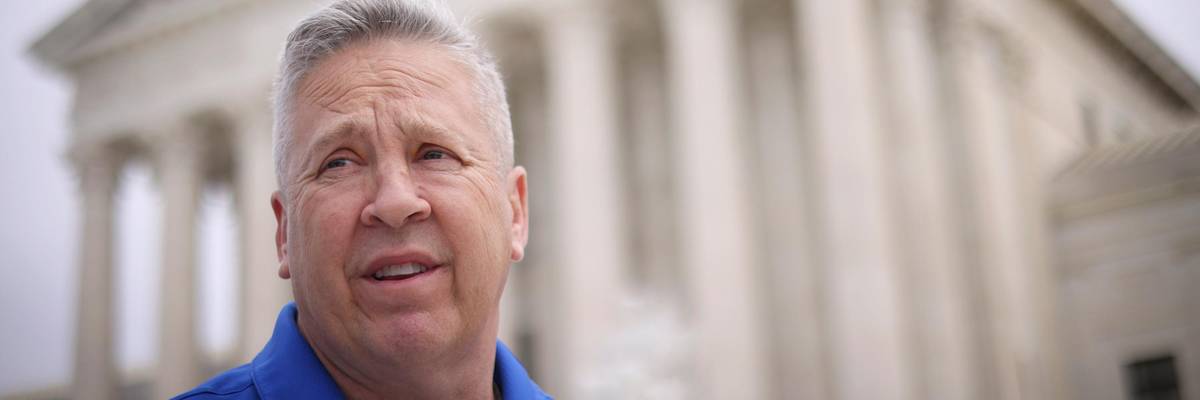
Former Bremerton High School assistant football coach Joe Kennedy answers questions after his legal case, Kennedy v. Bremerton School District, was argued before the Supreme Court on April 25, 2022 in Washington, D.C. (Photo: Win McNamee/Getty Images)
A U.S. Supreme Court ruling on Monday offered "another example" of the court's "conservative supermajority continuing its politicized agenda," said the head of one of the nation's largest teachers unions as the decision overturned decades of precedent which prohibited educators from leading students in religious displays.
"It is disappointing that today's decision erodes protections for public school students to learn and grow free of coercion."
In Kennedy v. Bremerton School District, which concerned a coach who led prayers on the 50-yard line of a Washington state high school's football field, the court's right-wing majority ruled that the coach's prayers were protected under the First Amendment and that school officials who asked him to stop were not acting in the interest of the nation's bedrock laws separating church and state.
The three liberal justices dissented, saying "the court now charts a different path" after decades of affirming that "school officials leading prayer is constitutionally impermissible."
"This decision does a disservice to schools and the young citizens they serve, as well as to our nation's long-standing commitment to the separation of church and state," Justice Sonia Sotomayor wrote in the minority opinion.
The decision comes just two decades after the court reaffirmed that prayer in schools violated the separation of church and state, ruling in Santa Fe Independent School District v. Department of Education in 2000.
"Today's decision took a wrecking ball to the critical separation of church and state, and with it the legitimacy of the highest court in the land," said Rep. Jared Huffman (D-Calif.).
Observers noted that the case was complicated by the fact that lawyers for Joe Kennedy, who coached football in Bremerton, Washington, claimed Kennedy prayed privately and silently despite the fact that a photo included in Sotomayor's opinion showed the coach leading students in prayer.
Last year, a judge on the U.S. Court of Appeals for the Ninth Circuit found that Kennedy's lawyers had created "a deceitful narrative" about the case, which the six right-wing justices accepted Monday.
Judge Milan D. Smith, Jr. of the Ninth Circuit found that Kennedy "prayed out loud in the middle of the football field... surrounded by players, members of the opposing team, parents, a local politician, and members of the news media with television cameras recording the event, all of whom had been advised of Kennedy's intended actions through the local news and social media."
Meanwhile, Kennedy's team claimed the coach "offered his prayers quietly while his students were otherwise occupied," as the majority wrote in its opinion Monday.
"One of the amazing things about the Coach Kennedy case, which has rendered the establishment clause's separation of church and state basically moot, is that to accomplish this the majority embraced a version of the facts that's demonstrably false," said Guardian columnist Moira Donegan.
The Bremerton school board asked Kennedy to stop involving students in his prayers in 2015, saying "his stature as a leader and role model meant that students felt forced to participate, whatever their religion and whether they wanted to or not," according to the New York Times.
The court, said Becky Pringle, president of the National Education Association (NEA) "stretched the record to reach the wrong conclusion" in the case.
"The Constitution should protect public school students from being coerced into religious activity," said Pringle. "The court's decision here does the opposite: it ignores the real-life pressure and coercion that students will feel when school officials stage public religious observances in class or at school events."
The ACLU, which filed an amicus brief in support of the school district, said the high court's ruling on Monday "tramples the religious freedom of students who may not share the preferred faith of their coaches and teachers."
"The freedom to hold beliefs that differ from those with authority has been a founding principle of our country," said Taylor Darling, senior staff attorney with the ACLU of Washington. "It is disappointing that today's decision erodes protections for public school students to learn and grow free of coercion."
The county where Kennedy coached "is a religiously diverse community and students reported they felt coerced to pray," added Darling. "One player explained he participated against his own beliefs for the fear of losing playing time if he declined. This decision strains the separation of church and state--a bedrock principle of our democracy--and potentially harms our youth."
The National Council of Jewish Women (NCJW) noted that the Kennedy ruling represents the third time this term that the Supreme Court has "deeply undermined constitutional law regarding church-state separation."
"As Jews in America, we know intimately that religion-state separation is essential to our ability to live and thrive," said Jody Rabhan, chief policy officer for the NCJW.
"No student should have to choose between their religious freedom and being part of school activities. But today's ruling in Kennedy v. Bremerton could force children enrolled in public schools to do just that," said Rabhan. "The Court is dismantling the wall between religion and state, and the impact on people--especially children who practice a minority religion or no religion--cannot be overstated."
Dear Common Dreams reader, It’s been nearly 30 years since I co-founded Common Dreams with my late wife, Lina Newhouser. We had the radical notion that journalism should serve the public good, not corporate profits. It was clear to us from the outset what it would take to build such a project. No paid advertisements. No corporate sponsors. No millionaire publisher telling us what to think or do. Many people said we wouldn't last a year, but we proved those doubters wrong. Together with a tremendous team of journalists and dedicated staff, we built an independent media outlet free from the constraints of profits and corporate control. Our mission has always been simple: To inform. To inspire. To ignite change for the common good. Building Common Dreams was not easy. Our survival was never guaranteed. When you take on the most powerful forces—Wall Street greed, fossil fuel industry destruction, Big Tech lobbyists, and uber-rich oligarchs who have spent billions upon billions rigging the economy and democracy in their favor—the only bulwark you have is supporters who believe in your work. But here’s the urgent message from me today. It's never been this bad out there. And it's never been this hard to keep us going. At the very moment Common Dreams is most needed, the threats we face are intensifying. We need your support now more than ever. We don't accept corporate advertising and never will. We don't have a paywall because we don't think people should be blocked from critical news based on their ability to pay. Everything we do is funded by the donations of readers like you. When everyone does the little they can afford, we are strong. But if that support retreats or dries up, so do we. Will you donate now to make sure Common Dreams not only survives but thrives? —Craig Brown, Co-founder |
A U.S. Supreme Court ruling on Monday offered "another example" of the court's "conservative supermajority continuing its politicized agenda," said the head of one of the nation's largest teachers unions as the decision overturned decades of precedent which prohibited educators from leading students in religious displays.
"It is disappointing that today's decision erodes protections for public school students to learn and grow free of coercion."
In Kennedy v. Bremerton School District, which concerned a coach who led prayers on the 50-yard line of a Washington state high school's football field, the court's right-wing majority ruled that the coach's prayers were protected under the First Amendment and that school officials who asked him to stop were not acting in the interest of the nation's bedrock laws separating church and state.
The three liberal justices dissented, saying "the court now charts a different path" after decades of affirming that "school officials leading prayer is constitutionally impermissible."
"This decision does a disservice to schools and the young citizens they serve, as well as to our nation's long-standing commitment to the separation of church and state," Justice Sonia Sotomayor wrote in the minority opinion.
The decision comes just two decades after the court reaffirmed that prayer in schools violated the separation of church and state, ruling in Santa Fe Independent School District v. Department of Education in 2000.
"Today's decision took a wrecking ball to the critical separation of church and state, and with it the legitimacy of the highest court in the land," said Rep. Jared Huffman (D-Calif.).
Observers noted that the case was complicated by the fact that lawyers for Joe Kennedy, who coached football in Bremerton, Washington, claimed Kennedy prayed privately and silently despite the fact that a photo included in Sotomayor's opinion showed the coach leading students in prayer.
Last year, a judge on the U.S. Court of Appeals for the Ninth Circuit found that Kennedy's lawyers had created "a deceitful narrative" about the case, which the six right-wing justices accepted Monday.
Judge Milan D. Smith, Jr. of the Ninth Circuit found that Kennedy "prayed out loud in the middle of the football field... surrounded by players, members of the opposing team, parents, a local politician, and members of the news media with television cameras recording the event, all of whom had been advised of Kennedy's intended actions through the local news and social media."
Meanwhile, Kennedy's team claimed the coach "offered his prayers quietly while his students were otherwise occupied," as the majority wrote in its opinion Monday.
"One of the amazing things about the Coach Kennedy case, which has rendered the establishment clause's separation of church and state basically moot, is that to accomplish this the majority embraced a version of the facts that's demonstrably false," said Guardian columnist Moira Donegan.
The Bremerton school board asked Kennedy to stop involving students in his prayers in 2015, saying "his stature as a leader and role model meant that students felt forced to participate, whatever their religion and whether they wanted to or not," according to the New York Times.
The court, said Becky Pringle, president of the National Education Association (NEA) "stretched the record to reach the wrong conclusion" in the case.
"The Constitution should protect public school students from being coerced into religious activity," said Pringle. "The court's decision here does the opposite: it ignores the real-life pressure and coercion that students will feel when school officials stage public religious observances in class or at school events."
The ACLU, which filed an amicus brief in support of the school district, said the high court's ruling on Monday "tramples the religious freedom of students who may not share the preferred faith of their coaches and teachers."
"The freedom to hold beliefs that differ from those with authority has been a founding principle of our country," said Taylor Darling, senior staff attorney with the ACLU of Washington. "It is disappointing that today's decision erodes protections for public school students to learn and grow free of coercion."
The county where Kennedy coached "is a religiously diverse community and students reported they felt coerced to pray," added Darling. "One player explained he participated against his own beliefs for the fear of losing playing time if he declined. This decision strains the separation of church and state--a bedrock principle of our democracy--and potentially harms our youth."
The National Council of Jewish Women (NCJW) noted that the Kennedy ruling represents the third time this term that the Supreme Court has "deeply undermined constitutional law regarding church-state separation."
"As Jews in America, we know intimately that religion-state separation is essential to our ability to live and thrive," said Jody Rabhan, chief policy officer for the NCJW.
"No student should have to choose between their religious freedom and being part of school activities. But today's ruling in Kennedy v. Bremerton could force children enrolled in public schools to do just that," said Rabhan. "The Court is dismantling the wall between religion and state, and the impact on people--especially children who practice a minority religion or no religion--cannot be overstated."
A U.S. Supreme Court ruling on Monday offered "another example" of the court's "conservative supermajority continuing its politicized agenda," said the head of one of the nation's largest teachers unions as the decision overturned decades of precedent which prohibited educators from leading students in religious displays.
"It is disappointing that today's decision erodes protections for public school students to learn and grow free of coercion."
In Kennedy v. Bremerton School District, which concerned a coach who led prayers on the 50-yard line of a Washington state high school's football field, the court's right-wing majority ruled that the coach's prayers were protected under the First Amendment and that school officials who asked him to stop were not acting in the interest of the nation's bedrock laws separating church and state.
The three liberal justices dissented, saying "the court now charts a different path" after decades of affirming that "school officials leading prayer is constitutionally impermissible."
"This decision does a disservice to schools and the young citizens they serve, as well as to our nation's long-standing commitment to the separation of church and state," Justice Sonia Sotomayor wrote in the minority opinion.
The decision comes just two decades after the court reaffirmed that prayer in schools violated the separation of church and state, ruling in Santa Fe Independent School District v. Department of Education in 2000.
"Today's decision took a wrecking ball to the critical separation of church and state, and with it the legitimacy of the highest court in the land," said Rep. Jared Huffman (D-Calif.).
Observers noted that the case was complicated by the fact that lawyers for Joe Kennedy, who coached football in Bremerton, Washington, claimed Kennedy prayed privately and silently despite the fact that a photo included in Sotomayor's opinion showed the coach leading students in prayer.
Last year, a judge on the U.S. Court of Appeals for the Ninth Circuit found that Kennedy's lawyers had created "a deceitful narrative" about the case, which the six right-wing justices accepted Monday.
Judge Milan D. Smith, Jr. of the Ninth Circuit found that Kennedy "prayed out loud in the middle of the football field... surrounded by players, members of the opposing team, parents, a local politician, and members of the news media with television cameras recording the event, all of whom had been advised of Kennedy's intended actions through the local news and social media."
Meanwhile, Kennedy's team claimed the coach "offered his prayers quietly while his students were otherwise occupied," as the majority wrote in its opinion Monday.
"One of the amazing things about the Coach Kennedy case, which has rendered the establishment clause's separation of church and state basically moot, is that to accomplish this the majority embraced a version of the facts that's demonstrably false," said Guardian columnist Moira Donegan.
The Bremerton school board asked Kennedy to stop involving students in his prayers in 2015, saying "his stature as a leader and role model meant that students felt forced to participate, whatever their religion and whether they wanted to or not," according to the New York Times.
The court, said Becky Pringle, president of the National Education Association (NEA) "stretched the record to reach the wrong conclusion" in the case.
"The Constitution should protect public school students from being coerced into religious activity," said Pringle. "The court's decision here does the opposite: it ignores the real-life pressure and coercion that students will feel when school officials stage public religious observances in class or at school events."
The ACLU, which filed an amicus brief in support of the school district, said the high court's ruling on Monday "tramples the religious freedom of students who may not share the preferred faith of their coaches and teachers."
"The freedom to hold beliefs that differ from those with authority has been a founding principle of our country," said Taylor Darling, senior staff attorney with the ACLU of Washington. "It is disappointing that today's decision erodes protections for public school students to learn and grow free of coercion."
The county where Kennedy coached "is a religiously diverse community and students reported they felt coerced to pray," added Darling. "One player explained he participated against his own beliefs for the fear of losing playing time if he declined. This decision strains the separation of church and state--a bedrock principle of our democracy--and potentially harms our youth."
The National Council of Jewish Women (NCJW) noted that the Kennedy ruling represents the third time this term that the Supreme Court has "deeply undermined constitutional law regarding church-state separation."
"As Jews in America, we know intimately that religion-state separation is essential to our ability to live and thrive," said Jody Rabhan, chief policy officer for the NCJW.
"No student should have to choose between their religious freedom and being part of school activities. But today's ruling in Kennedy v. Bremerton could force children enrolled in public schools to do just that," said Rabhan. "The Court is dismantling the wall between religion and state, and the impact on people--especially children who practice a minority religion or no religion--cannot be overstated."