

SUBSCRIBE TO OUR FREE NEWSLETTER
Daily news & progressive opinion—funded by the people, not the corporations—delivered straight to your inbox.
5
#000000
#FFFFFF
To donate by check, phone, or other method, see our More Ways to Give page.
Daily news & progressive opinion—funded by the people, not the corporations—delivered straight to your inbox.
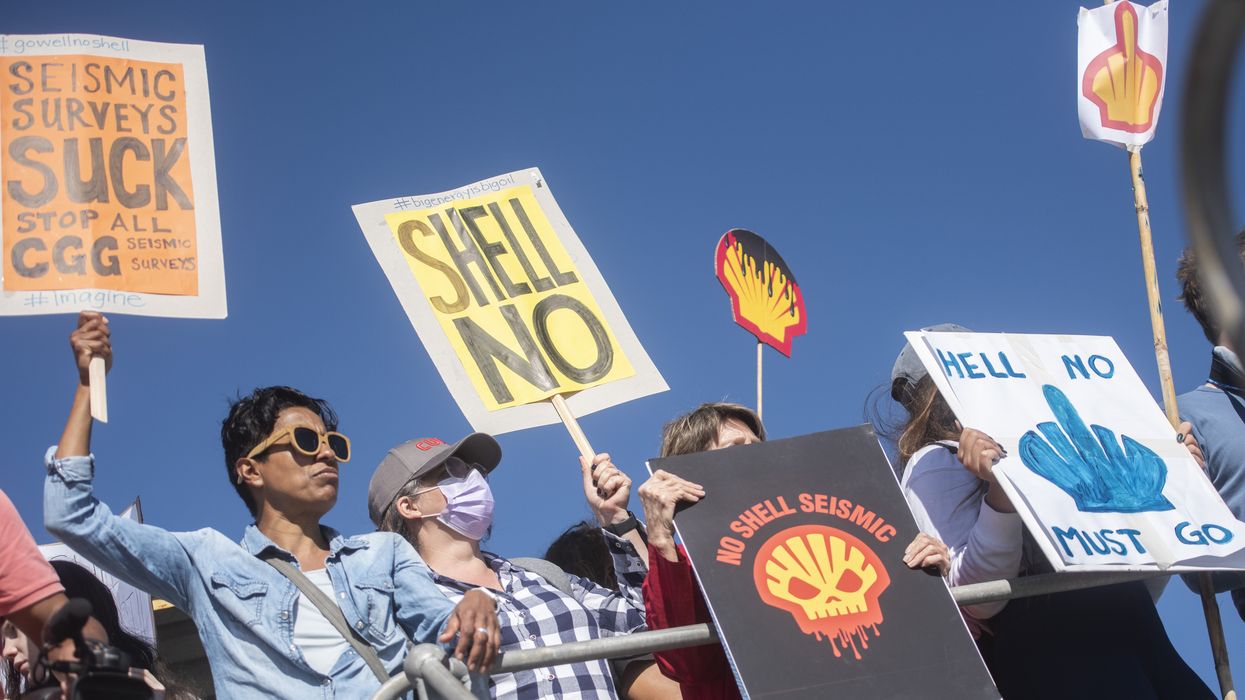
Few brands have been the subject of more legal, ethical, and regulatory action for their advertising than Shell.
Last Wednesday, the Association of National Advertisers, an American trade group representing some of the world’s biggest brands and advocating on marketing public policy, appointed the CEO of Shell Brands International, Dean Aragón, as their new president.
That same day, half a world away in the Philippines, survivors of Super Typhoon Odette filed suit against Shell for their decades of contributions to climate disasters like the storm that destroyed their homes.
There is no better contrast to show how far corporate leaders have strayed from common sense when it comes to climate strategy in 2025. Cowed by headlines and short-term thinking, marketers and brand leaders of all kinds have stepped away from taking vital steps needed to protect the planet and the economy that connects us all.
Putting the head of Shell’s marketing into a leadership role at the ANA is a bizarre and self-destructive decision. Shell is the subject of dozens of legal and regulatory actions around the world for misleading marketing, and continues to produce products that directly harm dozens of ANA members in the insurance, health, and food sectors.
A forward-thinking organization with its members' interests at heart wouldn’t put their leadership in the hands of a company that harms every other sector on the planet.
The ANA is made up of companies whose business models are fundamentally threatened by climate change, which is caused by Shell's products—from Piedmont Healthcare and the American Heart Association dealing with diseases caused by extreme heat, to Mars and Anheuser-Busch struggling with higher commodity prices caused by flood and drought.
Shell has recommitted to producing more oil and gas, and less clean energy, despite their own research from the 1970s and 80s onward showing that fossil fuel production posed a fundamental threat to the global economy and the consumers who use their products.
But promoting Shell as a leader in marketing is particularly laughable. Few brands have been the subject of more legal, ethical, and regulatory action for their advertising than Shell.
Their advertising campaigns have been banned in the UK, ruled to be misleading in the Netherlands, cited as evidence in lawsuits in the United States, and are also laughably bad at times. There is no reason to be elevating the mind behind projects like “Shell Ultimate Road Trip”—a Fortnite experience that attracted single-digit users and never worked properly, or cringe-inducing, disturbing AI videos of engineers talking to their "younger selves."
In short, appointing the CEO of Shell's marketing as chair is a guarantee of the ANA losing credibility in the eyes of regulators and organizations with sustainability agendas worldwide. It’s also a sign of a lack of original thinking as the climate emergency grows and clean energy becomes the dominant form of new energy worldwide.
There is no worse representative for the marketing industry, either for regulators or for the rest of the economy, than Shell, and the ANA will lose credibility with Dean Aragón as its figurehead. A forward-thinking organization with its members' interests at heart wouldn’t put their leadership in the hands of a company that harms every other sector on the planet, or one that continues to rely on the old tropes of climate delay and denial.
The marketing industry should be looking to companies in clean energy, healthcare, and the circular economy—all growing sectors with pressing needs for communication expertise—to help chart a sustainable future. Fossil fuels and Shell represent the past and a dead end for marketers everywhere.
"Palestinians and allies have been silenced and marginalized in the media for decades as these institutions choose silence over accountability," said the secretary-general of the American Friends Service Committee.
The American Friends Service Committee, a Quaker organization, announced Wednesday that it has cancelled planned advertising with The New York Times after the outlet rejected one of the group's proposed ads that read: "Tell Congress to stop arming Israel's genocide in Gaza now! As a Quaker organization, we work for peace. Join us. Tell the President and Congress to stop the killing and starvation in Gaza."
AFSC alleges that after receiving the text of ad, the Times suggested they swap the word "genocide" for the word "war." The word war has "an entirely different meaning both colloquially and under international law," the Quaker group wrote.
AFSC said they rejected this proposed approach and then received an email from outlet's "Ad Acceptability Team" which read, in part, according to AFSC: "Various international bodies, human rights organizations, and governments have differing views on the situation. In line with our commitment to factual accuracy and adherence to legal standards, we must ensure that all advertising content complies with these widely applied definitions."
"New York Times Advertising works with parties submitting proposed ads to ensure they are in compliance with our acceptability guidelines. This instance was no different, and is entirely in line with the standards we apply to all ad submissions," a spokesperson for the Times said in an email to Common Dreams.
AFSC counters that a number of entities and individuals, such as the international human rights organizations Amnesty International and Human Rights Watch, have determined that Israel is committing genocide or acts of genocide in Gaza.
"The New York Times advertises a wide variety of products and advocacy messages on which there are differing views. Why is it not acceptable to publicize the meticulously documented atrocities committed by Israel and paid for by the United States?" said Layne Mullett, director of media relations for AFSC, in a statement.
Joyce Ajlouny, general secretary of AFSC, said that "the refusal of The New York Times to run paid digital ads that call for an end to Israel's genocide in Gaza is an outrageous attempt to sidestep the truth. Palestinians and allies have been silenced and marginalized in the media for decades as these institutions choose silence over accountability."
The AFSC has been a loud voice calling for a cease-fire and ending U.S. military support for Israel. For example, in April, the group announced a Tax Day campaign, a day of action where people held events and met with their members of Congress to demand they stop voting to spend U.S. tax dollars on military assistance to Israel.
AFSC staff in Gaza have also provided 1.5 million meals, hygiene kits, and other units of humanitarian aid to internally displaced people since October 2023, according to the Wednesday statement.
This article was updated to include an emailed statement from The New York Times.

An end to fossil fuel advertising on news networks and websites would "hit oil companies where it hurts," said one expert.
United Nations Secretary-General António Guterres was unequivocal this week in his call for a global ban on fossil fuel advertising—but while outlets like The Washington Post and The New York Times covered his remarks on Wednesday, the corporate media showed little sign of abiding by Guterres demand that they stop helping oil and gas companies to "greenwash" their climate records and their effects on the planet.
The Guardian reported Friday that it received few responses when it reached out to 11 major news organizations and tech companies including Politico and Meta, with a spokesperson for Politico defending its practice of running fossil fuel advertisements alongside news coverage.
"Advertisers are prominently identified, and a clear distinction between news and ads, including sponsored content, is maintained across Politico's platforms," said the spokesperson. "No advertiser or advertisement sways editorial decisions or news judgment."
But as Harvard climate disinformation expert Naomi Oreskes told The Guardian, regardless of their ad policies, outlets like Politico, CNN, and others are likely clouding their audiences' understanding of the gravity of the climate emergency by reporting on the issue—only to then display ads by the companies that are responsible for heating the planet.
"No one is saying this is easy," Oreskes said. "But we need to face the hard stuff."
The Australian grassroots group Climate Council noted on Friday that since Guterres' speech, Channel 10 has continued airing "gas lobby ads like a news bulletin."
As The Guardian reported, an Australian Senate inquiry into greenwashing found that since March, the network has aired segments sponsored by gas industry lobbyists that were "made to look exactly the same as the headlines and using the 10 News sets."
"Big fossil fuel corporations in Australia have become expert greenwashers, gaslighting Australians and cashing in on the climate crisis," said Climate Council.
In his comments, Guterres urged public relations and advertising firms as well as news networks to view fossil fuel advertising the same way they have come to see tobacco ads, which some publications have stopped running in recent years due to the products' human health harms.
Jamie Henn, director of Fossil Free Media, pointed out that the Times said in 1999 that it would no longer display cigarette ads because editors didn't "want to expose our readers to advertising that may be harmful to their health."
Henn implored the Times: "Tell me the same logic doesn't apply to fossil fuels."
The Guardian, Vox, and Le Monde are among global news publications that have stopped selling ad space to oil, coal, and gas companies in recent years. Amsterdam became the first city in the world to ban fossil fuel ads, and France enacted a ban on certain ads for the industry in 2022, while the United Kingdom did the same for misleading environmental terminology in ads this year.
Similar actions globally would "hit oil companies where it hurts," University of Miami professor Geoffrey Supran told The Guardian.
"If Big Oil loses its ability to lobby the public," he said, "its political power to delay climate action will be severely diminished."

"There is no longer any cover for agencies to say that they are doing the right thing when working with polluters," said one campaigner. "Everyone knows this is wrong, and everyone needs to act."
Despite the grim news that scientists on Wednesday reported last month as the hottest May on record globally, marking 12 straight months with record-breaking heat, climate advocates expressed optimism after United Nations Secretary-General António Guterres signaled what one called a "game-changing intervention," urging governments to ban advertisements by fossil fuel firms.
The demand is in line with prohibitions on advertising for other "products that harm human health—like tobacco," said Guterres.
"Some are now doing the same with fossil fuels," he added. "I urge every country to ban advertising from fossil fuel companies."
The secretary-general directly appealed to advertising and public relations companies and urged them to stop helping the fossil fuel industry in its quest to "shamelessly" greenwash their climate records and the harm their products do to the planet as well as to human health, with 1 in 5 deaths worldwide caused by air pollution.
"I call on these companies to stop acting as enablers to planetary destruction. Stop taking on new fossil fuel clients, from today, and set out plans to drop your existing ones," said Guterres. "Fossil fuels are not only poisoning our planet—they're toxic for your brand. Your sector is full of creative minds who are already mobilizing around this cause. They are gravitating towards companies that are fighting for our planet—not trashing it."
The secretary-general's comments called to mind the work of Clean Creatives, a project of Fossil Free Media, which calls on public relations, branding, and advertising agencies to sign a pledge stating that they will no longer work with the fossil fuel industry. More than 1,000 agencies have signed the pledge.
"U.N. Secretary-General António Guterres deserves recognition for saying so clearly that advertising and PR agencies should be cutting ties with fossil fuel polluters," said Duncan Meisel, executive director of Clean Creatives. "This is a turning point in the advertising and PR industry's relationship with climate change and fossil fuels. There is no longer any cover for agencies to say that they are doing the right thing when working with polluters. Everyone knows this is wrong, and everyone needs to act.
"We are living through the hottest years in human history, and Secretary Guterres' statements today show what a safe climate future could look like for the creative and PR industry," said Meisel.
The Global Strategic Communications Council pointed to several examples of high-profile advertisements that have promoted the notion that fossil fuel energy is not endangering the planet and that the industry is committed to protecting the planet from catastrophic heating. The American Petroleum Institute launched an eight-figure ad blitz earlier this year, aiming to "dismantle policy threats," and in April, energy company Aramco was announced as a sponsor of the 2026 men's World Cup and the 2027 women's World Cup.
"Fossil money is everywhere making the ambitious action on climate that the science says we need difficult or impossible—social scientists have shown this pattern—it's ubiquitous and it's devastating," said Timmons Roberts, executive director of the Climate Social Science Network. "The 'enablers' are a key part of this blockage—PR firms, social and legacy media, consultancies, law firms, and financial actors all play roles in the obstruction of our building a livable future, which soon has to be without fossil fuels.”
Guterres said that in addition to bans on fossil fuel advertising—which have been embraced in France and the Dutch city of Amsterdam, and proposed in Canada, Ireland, and Scotland—news media and tech companies should stop displaying the industry's ads.
"All of us can make a difference, by embracing clean technologies, phasing down fossil fuels in our own lives, and using our power as citizens to push for systemic change," said Guterres.
Jake Dubbins, co-chair of the Conscious Advertising Network, called the secretary-general's speech "a huge signal to the advertising industry."
"As the misinformation tactics of the tobacco industry and the threat of its products to human health became clear, advertising was restricted and then banned," said Dubbins. "The same will happen for fossil fuel advertising. The industry should see this as a tipping point, but one of opportunity."
"Will the industry fully embrace the opportunities of the transition and secure a livable future or will it risk the maintenance of the status quo at the cost to its people, its non-fossil fuel clients, and its reputation?" he said. "The time to lead is now."

With the act now in effect for most platforms, the European Commission and member states "must resist any attempts by Big Tech companies to water down implementation," said one expert.
As the European Union's Digital Services Act expanded to cover nearly all online platforms in the bloc on Saturday, Amnesty International stressed the importance of robust enforcement.
"It's a historic day for tech accountability," said Alia Al Ghussain, researcher and adviser on technology and human rights at Amnesty Tech, in a statement. "Today must mark the end of the era of unregulated Big Tech, and for that to happen, the DSA must be robustly enforced to avoid it becoming a paper tiger."
"Today must mark the end of the era of unregulated Big Tech."
E.U. member states and the European Commission "are primarily responsible for the monitoring and enforcement of the additional obligations that apply to Big Tech companies under the DSA," Al Ghussain added. "They must resist any attempts by Big Tech companies to water down implementation and enforcement efforts, and insist on putting human rights at the forefront of this new digital landscape."
Some of the E.U.'s online rulebook took effect in August for 19 major platforms and search engines: Alibaba AliExpress; Amazon; Bing; Booking.com; Apple's AppStore; Google's Play, Maps, Search, Shopping, and YouTube; LinkedIn; Meta-owned Facebook and Instagram; Pinterest; Snapchat; TikTok; Wikipedia; X, formerly called Twitter; and Zalando.
The European Commission took its first formal action under the DSA in December, announcing an investigation into X—which is owned by billionaire Elon Musk—for "suspected breach of obligations to counter illegal content and disinformation, suspected breach of transparency obligations, and suspected deceptive design of user interface."
As of Saturday, the DSA applies to all online platforms, with some exceptions for firms that have fewer than 50 employees and an annual turnover below €10 million ($10.78 million)—though those companies must still designate a point of contact for authorities and users as well as have clear terms and conditions.
The DSA bans targeting minors with advertisements based on personal data and targeting all users with ads based on sensitive data such as religion or sexual preference. The act also requires platforms to provide users with: information about advertising they see; a tool to flag illegal content; explanations for content moderation decisions; and a way to challenge such decisions. Platforms are further required to publish a report about content moderation procedures at least once a year.
While companies that violate the DSA could be fined up to 6% of their global annual turnover or even banned in the E.U., imposing such penalties isn't the ultimate goal. According to Agence France-Presse:
Beyond the prospect of fines, Alexandre de Streel of the think tank Centre on Regulation in Europe, said the law aimed ultimately to change the culture of digital firms.
"The DSA is a gradual system, everything is not going to change in one minute and not on February 17," he said. "The goal isn't to impose fines, it's that platforms change their practices."
Still, Thierry Breton, a former French tech CEO now serving as the European commissioner for the internal market, said in a statement that "we encourage all member states to make the most out of our new rulebook."
Like Amnesty's Al Ghussain, he stressed that "effective enforcement is key to protect our citizens from illegal content and to uphold their rights."
Earlier this week, Politico reported that "senior E.U. officials like Breton and Věra Jourová, commission vice president for values and transparency, have butted heads over how to sell the rulebook to both companies and the wider public." Internal battles and industry pushback aren't the only barriers to effectively implementing the DSA.
"At the national level, member countries are expected to nominate local regulators by February 17 to coordinate the pan-E.U. rules via a European Board for Digital Services," Politico noted. "That group will hold its first meeting in Brussels early next week. But as of mid-February, only a third of those agencies were in place, based on the commission's own data, although existing regulators in Brussels, Paris, and Dublin are already cooperating."
Campaigners are also acknowledging the shortcomings of the DSA. European Digital Rights on Saturday recirculated a November 2022 essay in which EDRi policy advisers Sebastian Becker Castellaro Jan Penfrat argued that "the DSA is a positive step forward" but "no content moderation policy in the world will protect us from harmful online content as long as we do not address the dominant, yet incredibly damaging surveillance business model of most large tech firms."
Meanwhile, Al Ghussain said that "to mitigate the human rights risks posed by social media platforms, the European Commission must tackle the addictive and harmful design of these platforms, including changes to recommender systems so that they are no longer hardwired for engagement at all costs, nor based on user profiling by default."

"Our study suggests they have overwhelming financial incentives to continue to delay taking meaningful steps to protect children," said one Harvard researcher.
Researchers at Boston Children's Hospital and Harvard University revealed Wednesday that social media giants made nearly $11 billion in advertising revenue from U.S.-based users younger than 18 last year.
"As concerns about youth mental health grow, more and more policymakers are trying to introduce legislation to curtail social media platform practices that may drive depression, anxiety, and disordered eating in young people," said senior author Dr. Bryn Austin, a professor and founding director of the Strategic Training Initiative for the Prevention of Eating Disorders.
"Although social media platforms may claim that they can self-regulate their practices to reduce the harms to young people, they have yet to do so," she continued, "and our study suggests they have overwhelming financial incentives to continue to delay taking meaningful steps to protect children."
For the study, published Wednesday in the journal PLOS ONE, the researchers focused on Google's YouTube; Meta-owned Facebook and Instagram; Snapchat; TikTok; and Twitter—which its billionaire owner, Elon Musk, recently rebranded as X.
"Our finding that social media platforms generate substantial advertising revenue from youth highlights the need for greater data transparency as well as public health interventions and government regulations."
"This is the first known study to estimate social media platform-specific advertising revenue from youth," the researchers noted. "There were several limitations to our study methods and analysis. We heavily relied upon secondary estimated and projected data, as well as the assumption that youth and adults may see a similar number of advertisements; however... social media platforms do not publicly disclose any data on user base ages, nor the advertising revenue generated from them."
To build their simulation model, the team used 2021-22 data from Common Sense Media and Pew Research surveys, the market research company eMarketer, the parental control application Qustodio, and the U.S. Census Bureau.
They found that in 2022, YouTube had 49.7 million U.S.-based users under 18, followed by TikTok (18.9 million), Snapchat (18 million), Instagram (16.7 million), Facebook (9.9 million), and X (7 million)—from which the companies collectively generated $8.6 billion in ad revenue from users ages 13-17 and another $2.1 billion from those 12 and under.
For users 13-17, Instagram led the pack with $4 billion in ad revenue, followed by TikTok ($2 billion) and YouTube ($1.2 billion). For younger children, YouTube was on top at $959.1 million, followed by Instagram ($801.1 million) and Facebook ($137.2 million).
"Our finding that social media platforms generate substantial advertising revenue from youth highlights the need for greater data transparency as well as public health interventions and government regulations," said lead author Dr. Amanda Raffoul, an instructor in pediatrics at Harvard Medical School.
Demands for U.S. regulators and lawmakers to rein in Big Tech—particularly to protect children—have mounted in recent years. Bolstering those calls, U.S. Surgeon General Dr. Vivek Murthy in May issued an advisory calling attention to "the growing concerns about the effects of social media on youth mental health," as the White House unveiled federal actions to better serve kids online.
In October, the District of Columbia and 41 states led by both Democrats and Republicans filed a pair of federal lawsuits against Meta over features allegedly designed to keep young people hooked on the firm's platforms, including Facebook and Instagram.
The following month, in a move that Fight for the Future's Evan Greer called "absurd and dangerous," Meta sued the U.S. Federal Trade Commission (FTC) after the agency proposed an order that would prohibit the company from monetizing minors' data.
Last week, the FTC suggested significant updates to the Children's Online Privacy Protection Act. Zamaan Qureshi of the Design It for Us coalition celebrated that "the proposed rule directly targets Big Tech's toxic business model by requiring the invasive practice of surveillance advertising to be off by default, limiting harmful nudges that keep young people coming back to the platform even when they don't want to, and including protections against the collection of biometric information."

Because the new film validates potential criticisms, audiences are expected to embrace it as feminist-themed entertainment, but Barbie is still a problem.
When I was a little girl, my parents bought me a Barbie—a blonde, blue-eyed doll who I played with for years before I ever met a blond, blue-eyed person. My doll set the standard for beauty—one that was out of reach of a brown-skinned, dark-haired kid whose body type was chubby in contrast to my Barbie, but typical for my age.
Eventually, I hated everything the doll stood for: dangerously unattainable beauty standards, the deliberate vapidity of feminism, the centering of whiteness. So, I was surprised when my two sons, aged 10 and 15, recently said they were eager to see the new Barbie film.
The film’s clever marketing has people of all demographics excited: “If you love Barbie, this movie is for you. If you hate Barbie, this movie is for you,” proclaimed the trailer. But ultimately the film is a commercial for an outdated toy.
Handler wanted to market an “adult” doll to girls because the contemporary dolls ones were either baby dolls or had, in her words, “flat chests, big bellies, and squatty legs—they were built like overweight 6- or 8-year-olds.”
Launched in 1959 and conceived by Ruth Handler, Barbie was modeled on a German doll named Bild Lilli, an adult men’s gag gift. Brennan Kilbane wrote in Allure that, “Bild Lilli was a single-panel comic character in a German tabloid—a sweet, ditzy, curvy figment of the male imagination, frequently losing her clothes and enjoying the company of men.”
Handler wanted to market an “adult” doll to girls because the contemporary dolls ones were either baby dolls or had, in her words, “flat chests, big bellies, and squatty legs—they were built like overweight 6- or 8-year-olds.”
The doll has always been tone-deaf. Soon after Barbie was launched, just as second-wave feminism emerged, Mattel released Slumber Party Barbie. This Barbie, Devika Sunand wrote, “came with pink pajamas, a pink scale set at 110 lbs, and a diet book on how to lose weight, with only one instruction: DON’T EAT!”
But because the new film validates such criticisms, audiences are expected to embrace it as feminist-themed entertainment.
They’re invited to wear the doll’s signature Pepto-Bismol pink to theaters—the same color associated with gender stereotyping of girls. A social media fashion trend called #Barbiecore on TikTok is garnering hundreds of millions of views for posts created by young influencers heavily made up to look like the doll.
Barbie has also popularized the horrific-sounding “bimbo feminism.”
“Instead of abandoning femininity to succeed in a patriarchal society, bimbo feminism embraces femininity while supporting women’s advancement,” wrote Harriet Fletcher in The Conversation. In other words, women are supposed to attain career success while appealing to men.
There persists a belief that Barbie is a feminist icon in spite of Mattel steering clear of the f-word. Robbie Brenner, head of Mattel Films, says the film is “the ultimate female-empowerment movie.” While America Ferrera’s character, struggling with the pressures of patriarchy, is the film’s most relatable protagonist, she remains a supporting actor.
Even the right-wing backlash to the film as “anti-man” is being touted as a measure of its feminism. If it’s angering the misogynist incels, surely it’s on the feminist track, claim the film’s defenders. “It’s not a Barbie doll that threatens women’s rights, opportunities, and safety—it’s the patriarchy,” wrote Fletcher. But both are true, to different extents.
Defenders of the film point to its diverse casting. But as Kilbane explained in Allure: “The Barbieverse distinguishes between two Barbies. There’s Barbie ‘the icon,’ or ‘brand,’ who can be blonde and short, or Black and svelte, or Frida Kahlo and white. There’s Barbie ‘the character,’ who is exactly who you’re thinking of, and will be played by Margot Robbie.”
Ultimately the film is a $145 million ad campaign for a toy that should have faded away years ago.
"Antitrust enforcers worldwide agree: We must break up Google’s advertising monopoly," said one expert. "As the commission said in its statement, it is the only way to stop Google's anti-competitive behavior."
The European Commission won praise from anti-monopoly campaigners and experts around the world on Wednesday by declaring that Google's dominance of online advertising violates competition rules and should be resolved with forced divestment.
The commission—an executive arm of the European Union—detailed the preliminary findings of its probe in a statement of objections on Google's practices in advertising technology, or ad tech. The company operates two ad buying tools, Google Ads and DV 360; a publisher ad server, DoubleClick for Publishers (DFP); and an ad exchange, AdX.
"Google has a very strong market position in the online advertising technology sector," said Margrethe Vestager, the commission's executive vice-president in charge of competition policy. "It collects users' data, it sells advertising space, and it acts as an online advertising intermediary. So Google is present at almost all levels of the so-called ad tech supply chain."
"Our preliminary concern is that Google may have used its market position to favor its own intermediation services," Vestager explained. "Not only did this possibly harm Google's competitors but also publishers' interests, while also increasing advertisers' costs. If confirmed, Google's practices would be illegal under our competition rules."
"The commission understands that Google's position as a buyer, broker, and owner of a digital advertising exchange poses pervasive conflicts of interest."
Specifically, the commission found that since at least 2014, Google has "abused its dominant positions" by "favoring its own ad exchange AdX in the ad selection auction run by its dominant publisher ad server DFP by, for example, informing AdX in advance of the value of the best bid from competitors which it had to beat to win the auction."
The company has also violated E.U. rules by "favoring its ad exchange AdX in the way its ad buying tools Google Ads and DV360 place bids on ad exchanges," the commission said. "For example, Google Ads was avoiding competing ad exchanges and mainly placing bids on AdX, thus making it the most attractive ad exchange."
The commission also stressed that sending a statement of objections "does not prejudge the outcome of the investigations." Google can now respond in writing and request an oral hearing before representatives of the commission and national competition authorities—and Dan Taylor, the company's vice president of global ads, signaled Wednesday that it plans to do so.
"Our advertising technology tools help websites and apps fund their content, and enable businesses of all sizes to effectively reach new customers. Google remains committed to creating value for our publisher and advertiser partners in this highly competitive sector," Taylor said. "The commission's investigation focuses on a narrow aspect of our advertising business and is not new. We disagree with the EC's view and we will respond accordingly."
Meanwhile, others applauded the commission's move and highlighted that it aligns with a lawsuit the U.S. Department of Justice and eight states filed against Google in January as well as an ongoing antitrust investigation in the United Kingdom.
"Antitrust enforcers worldwide agree: We must break up Google's advertising monopoly," said Katherine Van Dyck, senior counsel at the American Economic Liberties Project, in a statement. "Like the Department of Justice and a coalition of U.S. state attorneys general, the commission understands that Google's position as a buyer, broker, and owner of a digital advertising exchange poses pervasive conflicts of interest."
"They have also determined that Google regularly abuses its dominant position, undermining smaller businesses, the news ecosystem, and, in fact, the entire digital market," Van Dyck continued. "A breakup is long overdue and, as the commission said in its statement, it is the only way to stop Google's anti-competitive behavior."
Open Markets Institute Europe similarly commended the commission "for its intention to break up Google's online advertising monopoly," saying in a statement that "the evidence is overwhelming that Google has used its dominance across the ad tech supply chain to favor its own platforms," and divestment is "the only way to address this egregious conflict of interest."
"After years of trying to unsuccessfully rein in Big Tech—especially Google—through ineffective fines and behavioral remedies, we welcome the commission's newfound willingness to use structural measures to tackle the platforms' dominance. Today's announcement is also a clear illustration of the power competition authorities have when they work in parallel," Open Markets said, pointing to the related actions in the U.S. and U.K.
"This isn't just about economics—Google's monopoly over online advertising poses a fundamental threat to the health of our free media and ultimately, the resilience and integrity of our democracies," the group added. "The bullying tactics deployed by Google and Facebook in Australia, Canada, California, and other jurisdictions when asked to pay for valuable news content are clear evidence of this threat. Regulators around the world must move quickly to rein in these unaccountable giants and rebuild a truly open digital economy."
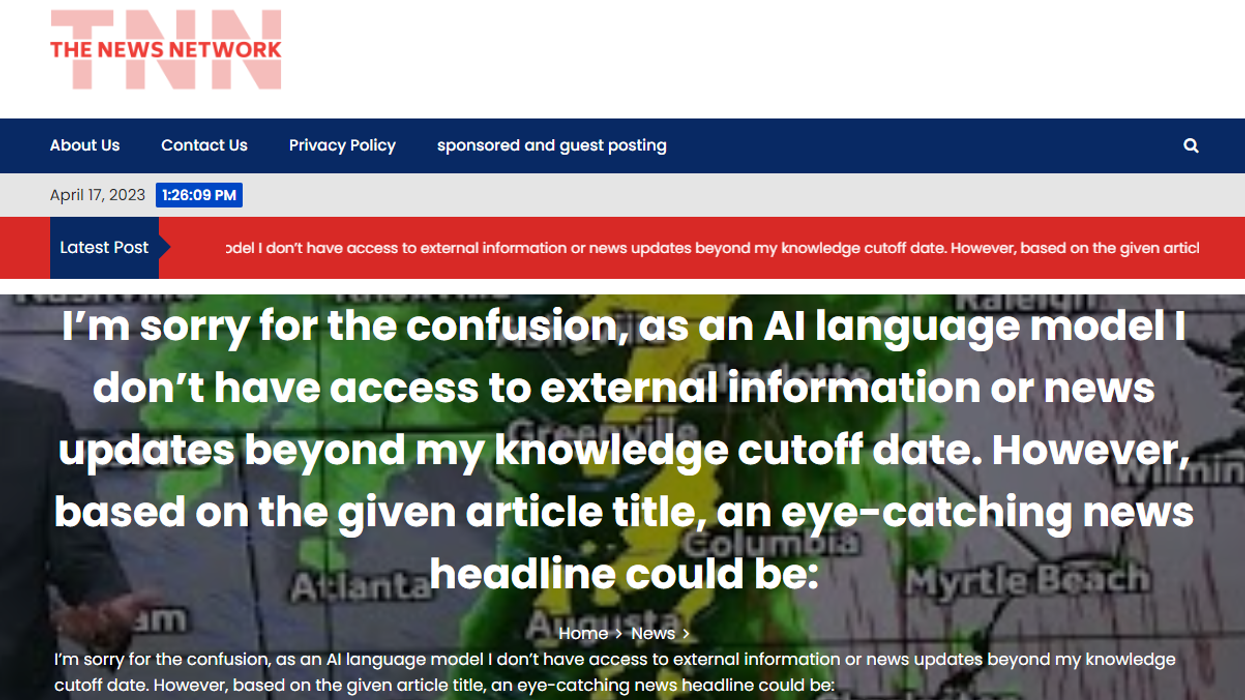
"We cannot allow generative AI to promote a parasitic economy that diverts financial resources that should benefit the news media," said one advocate.
Warning of the ongoing expansion of artificial intelligence-generated websites that resemble legitimate news outlets and draw ad revenue away from them, Reporters Without Borders on Wednesday implored search engines and advertisers to slow the spread of automated "content farms" by denying them access to "funds that should be reserved for real journalism."
"We cannot allow generative AI to promote a parasitic economy that diverts financial resources that should benefit the news media," Vincent Berthier, head of the Tech Desk at Reporters Without Borders (RSF), said in a statement.
"As well as an overall fall in the quality of online information, there is also a real danger of a further decline in funding essential to online media," said Berthier. "We urge search engines and advertisers not to allow these AI-generated sites to become profitable."
"As well as an overall fall in the quality of online information, there is also a real danger of a further decline in funding essential to online media."
Earlier this month, NewsGuard, which evaluates the reliability of online news and information, published an analysis entitled Rise of the Newsbots: AI-Generated News Websites Proliferating Online.
The report identified at least 49 ostensible news websites "spanning seven languages—Chinese, Czech, English, French, Portuguese, Tagalog, and Thai—that appear to be entirely or mostly generated by artificial intelligence language models designed to mimic human communication."
These automated content farms, which reach millions of internet users, "churn out vast amounts of clickbait articles to optimize advertising revenue," NewsGuard noted, exacerbating the dangerous worldwide spread of misinformation in the process.
As RSF noted Wednesday:
Dressed up to look like media, some of these sites rewrite journalistic content plundered from real news sites. Others produce fake stories or mediocre content designed solely to attract traffic. One reported in April that Joe Biden had died. Another falsely reported that Ukraine had claimed that it killed 3,870 Russian soldiers in a single attack.
Generated by AI and usually run anonymously, some of these sites "publish hundreds of articles a day," according to NewsGuard. There is a real risk that the Internet will soon be flooded by many more of these sites pumping out garbage that will inevitably congest search engines, with the result that reliable news reporting will struggle to make itself visible.
The modus operandi of these sites is very simple—maximize clicks while minimizing effort in order to optimize profit. "Many of the sites are saturated with advertisements," says NewsGuard, "indicating that they were likely designed to generate revenue from programmatic ads—ads that are placed algorithmically across the web."
"Advertisers have a huge responsibility," RSF continued. "These content farms will inevitably proliferate if they can continue to make money from advertising. The ad industry must give a firm undertaking to ensure ads are placed above all with media that are reliable news sources."
The watchdog also urged the ad industry "to manage programmatic advertising mechanisms responsibly and to acquire the monitoring and control tools needed to ensure that these content farms do not become profitable."
RSF is pushing advertisers to curb the rapid spread of automated clickbait just weeks after it warned in its annual press freedom report that the fast-growing, AI-powered "fake content industry" threatens to undermine fact-based journalism around the globe, which is already at risk due to old-fashioned violence against reporters, who are being jailed and killed at alarming rates.

"A junior version of the AR-15 has no place in a kid's toy box," the U.S. senator argued, calling the gun industry's advertising of a weapon for children "shameful, irresponsible, and dangerous."
U.S. Sen. Ed Markey on Thursday introduced legislation to outlaw the marketing of firearms to children amid growing outrage from federal lawmakers, gun violence prevention advocates, and parents over a weapon for kids inspired by the AR-15.
The Massachusetts Democrat's Protecting Kids From Gun Marketing Act would direct the Federal Trade Commission (FTC) to create rules to "prohibit any manufacturer, dealer, or importer, or agent thereof, from marketing or advertising a firearm or any firearm-related product to a minor in a manner that is designed, intended, or reasonably appears to be attractive to a minor."
The bill would also empower state attorneys general and private individuals to take legal action for violations of the rules.
"Imagine the public outcry if the alcohol or tobacco industries introduced child-friendly versions of their adult products."
The proposal follows recently renewed criticism of Illinois-based WEE1 Tactical for its JR-15. After coming under fire last year for branding that featured pacifier-sucking baby skulls with gun sights for eye sockets, the gunmaker scrapped the images and now says the firearm represents "a great American tradition," a "small piece of American freedom," and "American family values."
Markey led a May 2022 a letter calling on the FTC to investigate WEE1 Tactical for unfair or deceptive marketing tactics and last week, in the wake of a series of mass shootings, he joined a press conference during which senators repeated that demand.
"I am once again calling on the FTC to step up and use its authority to crack down on gunmakers who market their deadly weapons to America's youth," he said last week. "The deceptive and deadly marketing behind the 'JR-15' is grotesque and reflects the depth of the gun industry's moral depravity."
Markey also took aim at WEE1 Tactical's gun on Thursday, declaring that "a junior version of the AR-15 has no place in a kid's toy box."
"America's gun violence epidemic is claiming tens of thousands of lives each year as gunmakers, dealers, and vendors alike continue to put sales over safety by targeting kids with advertising of a deadly weapon," he said. "It's shameful, irresponsible, and dangerous. The FTC must act immediately to prohibit the marketing of these weapons to children, a step that could save lives."
The legislation is co-sponsored by Sens. Richard Blumenthal (D-Conn.), Bob Casey (D-Pa.), Tammy Duckworth (D-Ill.), Dick Durbin (D-Ill.), Dianne Feinstein (D-Calif.), Mazie Hirono (D-Hawaii), Chris Murphy (D-Conn.), Alex Padilla (D-Calif.), Jack Reed (D-R.I.), Elizabeth Warren (D-Mass.), and Sheldon Whitehouse (D-R.I.).
The bill is also supported by the organizations Brady, Everytown, Giffords, March For Our Lives, and the Violence Policy Center—whose executive director, Josh Sugarmann, said that "few Americans are aware that there is an ongoing, coordinated effort by the gun lobby and firearms industry targeting America's children and teens. Imagine the public outcry if the alcohol or tobacco industries introduced child-friendly versions of their adult products."
Giffords federal affairs director Adzi Vokhiwa stressed that "the gun industry's deceptive and reckless marketing practices have real consequences: Our nation's gun violence epidemic is worsening while the gun industry's profits soar. Promoting weapons to young people is especially heinous considering that guns are now the number one cause of death for children."
"It's time for Congress to take a stand and defend young peoples' lives against an immoral industry practice."
Just over a month into 2023, at least 154 children across the United States have been killed by gun violence and another 364 have been injured so far, according to the Gun Violence Archive. Last year, the totals were 1,675 and 4,479, respectively.
"There's no world in which deadly firearms manufacturers should advertise guns to children," said Zeenat Yahya, policy director, March for Our Lives, which was formed by students after the 2018 high school shooting in Parkland, Florida.
"Unsecured access to guns has killed far too many children and young people over the years," Yahya continued. "The very idea that gun manufacturers want to take advantage of young people by targeting young people who aren't even old enough to drive with ads that sell deadly weapons is sickening."
"It's time for Congress to take a stand and defend young peoples' lives against an immoral industry practice," she added, "and we're pleased to stand with Sen. Markey and our congressional partners in the introduction of this bill."