SUBSCRIBE TO OUR FREE NEWSLETTER
Daily news & progressive opinion—funded by the people, not the corporations—delivered straight to your inbox.
5
#000000
#FFFFFF
To donate by check, phone, or other method, see our More Ways to Give page.
Daily news & progressive opinion—funded by the people, not the corporations—delivered straight to your inbox.
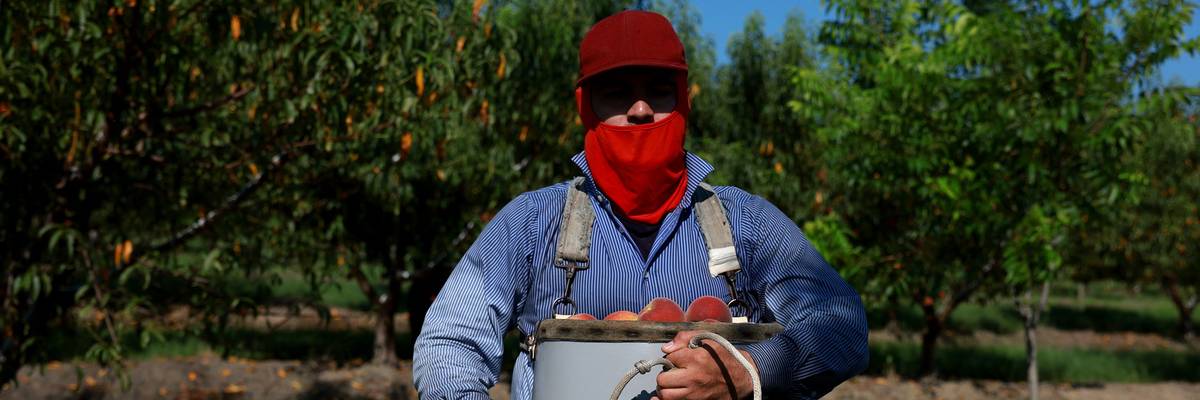
A worker harvests peaches off the trees at Pearson Farm on July 24, 2023 in Fort Valley, Georgia.
Currently, no federal standard exists, and only five states—California, Colorado, Minnesota, Oregon, and Washington—have statewide heat safety requirements.
Ronald Silver II, a sanitation worker in Baltimore, won’t be spending this Labor Day weekend with his family. On August 2, during a sweltering 100°F heatwave, Silver died while working a shift in a city garbage truck.
His death was preventable. In July, following worker complaints, Baltimore’s Inspector General (IG) reviewed conditions in the city’s Department of Public Works. Employees, the IG found, “do not have adequate access to water, ice, or fans to combat intense summer heat,” as reported by The Baltimore Sun.
This problem goes far beyond Baltimore. Every year, tens of millions of U.S. workers in both indoor and outdoor settings face the dangers of extreme heat.
As our planet continues to warm, our workplaces will become even hotter.
Climate change means rising global temperatures and also increased humidity, which interferes with the evaporation of sweat, the body’s natural cooling mechanism. And because temperatures are also now higher at night, it’s more difficult for workers to recover by resting up and cooling down after long hours.
The consequences are severe. Heat exhaustion and heat stroke, which develop with little warning, are becoming more common. Baltimore’s medical examiner found that Silver died from hyperthermia, the most severe form of heat stroke, which can lead to multiple, fatal organ failures.
Public Citizen projects that extreme heat kills about 2,000 workers annually, and another 170,000 suffer heat-related injuries and illnesses. These numbers are certainly an underestimate, as heat may contribute to heart attacks or respiratory failures that are not always recorded as heat-related.
As we observe Labor Day, a holiday intended to honor American workers, it’s clear that we need basic heat protections. Currently, no federal standard exists, and only five states—California, Colorado, Minnesota, Oregon, and Washington—have statewide heat safety requirements. In the remaining 45 states, which account for 80% of the U.S. population, workers are out of luck.
Despite the danger, some employers continue to resist the implementation of a heat standard, arguing that it would be burdensome or costly. However, this shortsighted stance is actually bad for business.
According to one scientific estimate, lost productivity due to heat-related illness, for outdoor workers alone, costs the U.S. economy more than $90 billion a year. Most importantly, protecting workers from extreme heat not only boosts productivity, it saves lives. Ignoring basic safety measures devalues the very people who drive our economy.
Here’s the good news: Workers are looking out for themselves.
First, a process is underway to create a federal heat standard. That’s because the Biden administration is responding to demands for a heat standard, spurred by a petition from unions, public health groups, and safety advocates—including my organization, the National Council for Occupational Safety and Health (National COSH). A proposed nationwide standard, which requires employers to provide training on how to recognize heat illness as well as delivering access to rest, water, and shade, was introduced in July and will soon be open for public comment.
Getting new federal regulations in place takes a while, and will face inevitable legal challenges from employers. Workers are not willing to risk getting sick or dying during more summers of grueling heat.
That’s why labor and safety groups are also successfully advocating for new local and state heat safety rules. In California, a new standard now protects 1.4 million indoor workers, who were previously excluded. The Arizona Heat Coalition has secured local ordinances in Phoenix, Tucson, and Pima County, mandating access to rest, shade, and water for contractors. This includes workers at Phoenix’s Sky Harbor Airport, where temperatures can exceed 110°F.
Meanwhile, in Maryland, a proposed statewide heat safety standard, developed with input from National COSH advisors, has been published and will likely be in effect by next summer. Safety expert Jordan Barab notes that if such a standard had been in place this summer, Ronald Silver might still be alive: “He would have had access to water and rest breaks. If he had gotten sick anyway, his trained co-workers would have immediately recognized the signs of heat illness and implemented the emergency response program.”
As our planet continues to warm, our workplaces will become even hotter. Here’s a prediction that’s more reliable than any weather report: Workers will continue to turn up the heat, demanding action to save lives from employers and elected officials.
Dear Common Dreams reader, It’s been nearly 30 years since I co-founded Common Dreams with my late wife, Lina Newhouser. We had the radical notion that journalism should serve the public good, not corporate profits. It was clear to us from the outset what it would take to build such a project. No paid advertisements. No corporate sponsors. No millionaire publisher telling us what to think or do. Many people said we wouldn't last a year, but we proved those doubters wrong. Together with a tremendous team of journalists and dedicated staff, we built an independent media outlet free from the constraints of profits and corporate control. Our mission has always been simple: To inform. To inspire. To ignite change for the common good. Building Common Dreams was not easy. Our survival was never guaranteed. When you take on the most powerful forces—Wall Street greed, fossil fuel industry destruction, Big Tech lobbyists, and uber-rich oligarchs who have spent billions upon billions rigging the economy and democracy in their favor—the only bulwark you have is supporters who believe in your work. But here’s the urgent message from me today. It's never been this bad out there. And it's never been this hard to keep us going. At the very moment Common Dreams is most needed, the threats we face are intensifying. We need your support now more than ever. We don't accept corporate advertising and never will. We don't have a paywall because we don't think people should be blocked from critical news based on their ability to pay. Everything we do is funded by the donations of readers like you. When everyone does the little they can afford, we are strong. But if that support retreats or dries up, so do we. Will you donate now to make sure Common Dreams not only survives but thrives? —Craig Brown, Co-founder |
Ronald Silver II, a sanitation worker in Baltimore, won’t be spending this Labor Day weekend with his family. On August 2, during a sweltering 100°F heatwave, Silver died while working a shift in a city garbage truck.
His death was preventable. In July, following worker complaints, Baltimore’s Inspector General (IG) reviewed conditions in the city’s Department of Public Works. Employees, the IG found, “do not have adequate access to water, ice, or fans to combat intense summer heat,” as reported by The Baltimore Sun.
This problem goes far beyond Baltimore. Every year, tens of millions of U.S. workers in both indoor and outdoor settings face the dangers of extreme heat.
As our planet continues to warm, our workplaces will become even hotter.
Climate change means rising global temperatures and also increased humidity, which interferes with the evaporation of sweat, the body’s natural cooling mechanism. And because temperatures are also now higher at night, it’s more difficult for workers to recover by resting up and cooling down after long hours.
The consequences are severe. Heat exhaustion and heat stroke, which develop with little warning, are becoming more common. Baltimore’s medical examiner found that Silver died from hyperthermia, the most severe form of heat stroke, which can lead to multiple, fatal organ failures.
Public Citizen projects that extreme heat kills about 2,000 workers annually, and another 170,000 suffer heat-related injuries and illnesses. These numbers are certainly an underestimate, as heat may contribute to heart attacks or respiratory failures that are not always recorded as heat-related.
As we observe Labor Day, a holiday intended to honor American workers, it’s clear that we need basic heat protections. Currently, no federal standard exists, and only five states—California, Colorado, Minnesota, Oregon, and Washington—have statewide heat safety requirements. In the remaining 45 states, which account for 80% of the U.S. population, workers are out of luck.
Despite the danger, some employers continue to resist the implementation of a heat standard, arguing that it would be burdensome or costly. However, this shortsighted stance is actually bad for business.
According to one scientific estimate, lost productivity due to heat-related illness, for outdoor workers alone, costs the U.S. economy more than $90 billion a year. Most importantly, protecting workers from extreme heat not only boosts productivity, it saves lives. Ignoring basic safety measures devalues the very people who drive our economy.
Here’s the good news: Workers are looking out for themselves.
First, a process is underway to create a federal heat standard. That’s because the Biden administration is responding to demands for a heat standard, spurred by a petition from unions, public health groups, and safety advocates—including my organization, the National Council for Occupational Safety and Health (National COSH). A proposed nationwide standard, which requires employers to provide training on how to recognize heat illness as well as delivering access to rest, water, and shade, was introduced in July and will soon be open for public comment.
Getting new federal regulations in place takes a while, and will face inevitable legal challenges from employers. Workers are not willing to risk getting sick or dying during more summers of grueling heat.
That’s why labor and safety groups are also successfully advocating for new local and state heat safety rules. In California, a new standard now protects 1.4 million indoor workers, who were previously excluded. The Arizona Heat Coalition has secured local ordinances in Phoenix, Tucson, and Pima County, mandating access to rest, shade, and water for contractors. This includes workers at Phoenix’s Sky Harbor Airport, where temperatures can exceed 110°F.
Meanwhile, in Maryland, a proposed statewide heat safety standard, developed with input from National COSH advisors, has been published and will likely be in effect by next summer. Safety expert Jordan Barab notes that if such a standard had been in place this summer, Ronald Silver might still be alive: “He would have had access to water and rest breaks. If he had gotten sick anyway, his trained co-workers would have immediately recognized the signs of heat illness and implemented the emergency response program.”
As our planet continues to warm, our workplaces will become even hotter. Here’s a prediction that’s more reliable than any weather report: Workers will continue to turn up the heat, demanding action to save lives from employers and elected officials.
Ronald Silver II, a sanitation worker in Baltimore, won’t be spending this Labor Day weekend with his family. On August 2, during a sweltering 100°F heatwave, Silver died while working a shift in a city garbage truck.
His death was preventable. In July, following worker complaints, Baltimore’s Inspector General (IG) reviewed conditions in the city’s Department of Public Works. Employees, the IG found, “do not have adequate access to water, ice, or fans to combat intense summer heat,” as reported by The Baltimore Sun.
This problem goes far beyond Baltimore. Every year, tens of millions of U.S. workers in both indoor and outdoor settings face the dangers of extreme heat.
As our planet continues to warm, our workplaces will become even hotter.
Climate change means rising global temperatures and also increased humidity, which interferes with the evaporation of sweat, the body’s natural cooling mechanism. And because temperatures are also now higher at night, it’s more difficult for workers to recover by resting up and cooling down after long hours.
The consequences are severe. Heat exhaustion and heat stroke, which develop with little warning, are becoming more common. Baltimore’s medical examiner found that Silver died from hyperthermia, the most severe form of heat stroke, which can lead to multiple, fatal organ failures.
Public Citizen projects that extreme heat kills about 2,000 workers annually, and another 170,000 suffer heat-related injuries and illnesses. These numbers are certainly an underestimate, as heat may contribute to heart attacks or respiratory failures that are not always recorded as heat-related.
As we observe Labor Day, a holiday intended to honor American workers, it’s clear that we need basic heat protections. Currently, no federal standard exists, and only five states—California, Colorado, Minnesota, Oregon, and Washington—have statewide heat safety requirements. In the remaining 45 states, which account for 80% of the U.S. population, workers are out of luck.
Despite the danger, some employers continue to resist the implementation of a heat standard, arguing that it would be burdensome or costly. However, this shortsighted stance is actually bad for business.
According to one scientific estimate, lost productivity due to heat-related illness, for outdoor workers alone, costs the U.S. economy more than $90 billion a year. Most importantly, protecting workers from extreme heat not only boosts productivity, it saves lives. Ignoring basic safety measures devalues the very people who drive our economy.
Here’s the good news: Workers are looking out for themselves.
First, a process is underway to create a federal heat standard. That’s because the Biden administration is responding to demands for a heat standard, spurred by a petition from unions, public health groups, and safety advocates—including my organization, the National Council for Occupational Safety and Health (National COSH). A proposed nationwide standard, which requires employers to provide training on how to recognize heat illness as well as delivering access to rest, water, and shade, was introduced in July and will soon be open for public comment.
Getting new federal regulations in place takes a while, and will face inevitable legal challenges from employers. Workers are not willing to risk getting sick or dying during more summers of grueling heat.
That’s why labor and safety groups are also successfully advocating for new local and state heat safety rules. In California, a new standard now protects 1.4 million indoor workers, who were previously excluded. The Arizona Heat Coalition has secured local ordinances in Phoenix, Tucson, and Pima County, mandating access to rest, shade, and water for contractors. This includes workers at Phoenix’s Sky Harbor Airport, where temperatures can exceed 110°F.
Meanwhile, in Maryland, a proposed statewide heat safety standard, developed with input from National COSH advisors, has been published and will likely be in effect by next summer. Safety expert Jordan Barab notes that if such a standard had been in place this summer, Ronald Silver might still be alive: “He would have had access to water and rest breaks. If he had gotten sick anyway, his trained co-workers would have immediately recognized the signs of heat illness and implemented the emergency response program.”
As our planet continues to warm, our workplaces will become even hotter. Here’s a prediction that’s more reliable than any weather report: Workers will continue to turn up the heat, demanding action to save lives from employers and elected officials.