SUBSCRIBE TO OUR FREE NEWSLETTER
Daily news & progressive opinion—funded by the people, not the corporations—delivered straight to your inbox.
5
#000000
#FFFFFF
To donate by check, phone, or other method, see our More Ways to Give page.
Daily news & progressive opinion—funded by the people, not the corporations—delivered straight to your inbox.
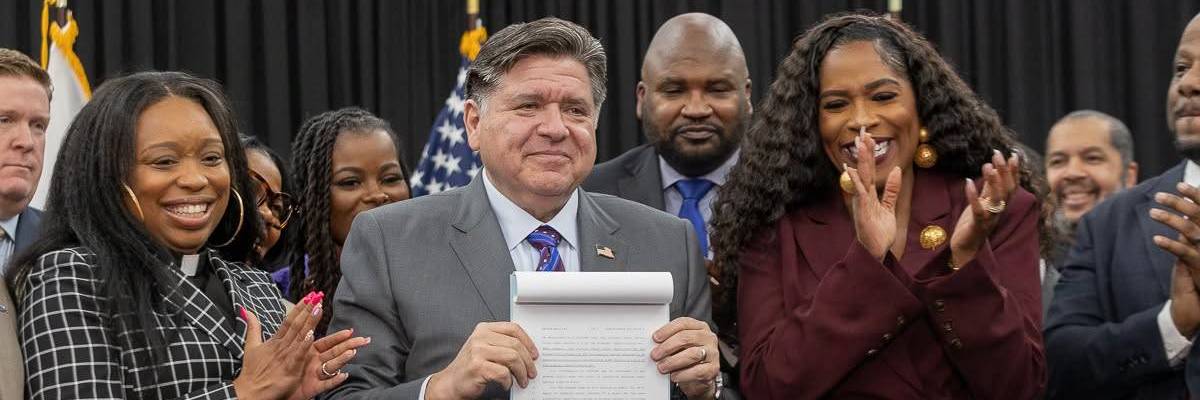
Illinois Gov. JB Pritzker and community organizers celebrate the signing of the Clean Slate Act in January 2026.
As corrupt leaders advance efforts to weaken democratic oversight and centralize power, we must activate our own agenda.
This Juneteenth arrives at a moment when many of the hard-fought gains of the civil rights movement feel undeniably fragile. The Supreme Court’s recent Louisiana v. Callais decision gave state lawmakers the green light to reduce Black voting power by redrawing congressional maps. Meanwhile, the SAVE America Act and other proof-of-citizenship efforts propose new burdens for millions of eligible voters—especially voters of color who are more likely to face difficulty accessing required records.
As Black Americans, this should concern us deeply. For years after the ratification of the 15th Amendment, our ancestors had to overcome poll taxes, literacy tests, grandfather clauses, and constant threats of violence to participate in our democracy. When Fannie Lou Hamer attempted to register to vote in Mississippi, she was fired from her job and forced from her home; Amzie Moore endured years of harassment and retaliation for helping Black Mississippians register to vote and build political power. But despite these hardships, they persevered.
Which is why one question continues to trouble me as a Black pastor and grassroots organizer: How did we move from a generation willing to risk everything for political participation to an overwhelming number of people believing participation doesn't matter?
Research shows that most Americans feel political leaders are out-of-touch with ordinary people, reflecting a deep and widespread sense that politics is reserved for an elite few. But we must remember that politics is simply the process of shaping the world around us—and by that definition, we are all politicians.
Organizing reminds people that change has always come from ordinary people deciding they have a stake in their own future.
At my organization, Live Free Illinois, we embrace our identities as politicians in our own right. For instance, in January, we successfully organized Gov. JB Pritzker to sign the Clean Slate Act, a transformational public safety bill that removes barriers to employment, housing, and education opportunities for people with past convictions. It took nearly five years of tireless organizing, but our bill crossed the finish line—and became a law with $5.6 million in funding to implement it. This victory makes clear that politics does not only belong to some unreachable class of leaders; it belongs to the people willing to organize and demand change.
Our ancestors did not organize because they believed the government was perfect. They organized because they understood that power would not listen unless it was confronted. They built churches, mutual aid networks, civic organizations, and political movements because they knew that liberation required disciplined collective action. That lesson is just as relevant today. The authoritarian forces seeking to diminish our democratic participation are counting on our exhaustion, our cynicism, and our disengagement. We cannot afford to give them any of those things.
That responsibility does not begin and end at the ballot box. It lives in church fellowship halls where neighbors gather to address violence in their communities, in voter registration drives after Sabbath, and in the courage of ordinary people who demand better from those in power. This may not look like the politics we’ve been taught to disdain, but they are among the most powerful political acts we can undertake. It is how our communities can transform shared concerns into lasting change.
I have spoken with many parishioners who have felt overwhelmed by the challenges facing our community. But when I encourage them to organize—to gather their neighbors, advance shared priorities, and demand accountability—something shifts. They begin to recognize that the power they were searching for was already in their hands. Organizing reminds people that change has always come from ordinary people deciding they have a stake in their own future.
Juneteenth is a timely reminder that our democracy demands more than participation; it demands organization. As corrupt leaders advance efforts to weaken democratic oversight and centralize power, we must activate our own agenda—and hold elected officials accountable to it. The future of our communities depends on whether we are willing to embrace that responsibility.
Dear Common Dreams reader, It’s been nearly 30 years since I co-founded Common Dreams with my late wife, Lina Newhouser. We had the radical notion that journalism should serve the public good, not corporate profits. It was clear to us from the outset what it would take to build such a project. No paid advertisements. No corporate sponsors. No millionaire publisher telling us what to think or do. Many people said we wouldn't last a year, but we proved those doubters wrong. Together with a tremendous team of journalists and dedicated staff, we built an independent media outlet free from the constraints of profits and corporate control. Our mission has always been simple: To inform. To inspire. To ignite change for the common good. Building Common Dreams was not easy. Our survival was never guaranteed. When you take on the most powerful forces—Wall Street greed, fossil fuel industry destruction, Big Tech lobbyists, and uber-rich oligarchs who have spent billions upon billions rigging the economy and democracy in their favor—the only bulwark you have is supporters who believe in your work. But here’s the urgent message from me today. It's never been this bad out there. And it's never been this hard to keep us going. At the very moment Common Dreams is most needed, the threats we face are intensifying. We need your support now more than ever. We don't accept corporate advertising and never will. We don't have a paywall because we don't think people should be blocked from critical news based on their ability to pay. Everything we do is funded by the donations of readers like you. When everyone does the little they can afford, we are strong. But if that support retreats or dries up, so do we. Will you donate now to make sure Common Dreams not only survives but thrives? —Craig Brown, Co-founder |
This Juneteenth arrives at a moment when many of the hard-fought gains of the civil rights movement feel undeniably fragile. The Supreme Court’s recent Louisiana v. Callais decision gave state lawmakers the green light to reduce Black voting power by redrawing congressional maps. Meanwhile, the SAVE America Act and other proof-of-citizenship efforts propose new burdens for millions of eligible voters—especially voters of color who are more likely to face difficulty accessing required records.
As Black Americans, this should concern us deeply. For years after the ratification of the 15th Amendment, our ancestors had to overcome poll taxes, literacy tests, grandfather clauses, and constant threats of violence to participate in our democracy. When Fannie Lou Hamer attempted to register to vote in Mississippi, she was fired from her job and forced from her home; Amzie Moore endured years of harassment and retaliation for helping Black Mississippians register to vote and build political power. But despite these hardships, they persevered.
Which is why one question continues to trouble me as a Black pastor and grassroots organizer: How did we move from a generation willing to risk everything for political participation to an overwhelming number of people believing participation doesn't matter?
Research shows that most Americans feel political leaders are out-of-touch with ordinary people, reflecting a deep and widespread sense that politics is reserved for an elite few. But we must remember that politics is simply the process of shaping the world around us—and by that definition, we are all politicians.
Organizing reminds people that change has always come from ordinary people deciding they have a stake in their own future.
At my organization, Live Free Illinois, we embrace our identities as politicians in our own right. For instance, in January, we successfully organized Gov. JB Pritzker to sign the Clean Slate Act, a transformational public safety bill that removes barriers to employment, housing, and education opportunities for people with past convictions. It took nearly five years of tireless organizing, but our bill crossed the finish line—and became a law with $5.6 million in funding to implement it. This victory makes clear that politics does not only belong to some unreachable class of leaders; it belongs to the people willing to organize and demand change.
Our ancestors did not organize because they believed the government was perfect. They organized because they understood that power would not listen unless it was confronted. They built churches, mutual aid networks, civic organizations, and political movements because they knew that liberation required disciplined collective action. That lesson is just as relevant today. The authoritarian forces seeking to diminish our democratic participation are counting on our exhaustion, our cynicism, and our disengagement. We cannot afford to give them any of those things.
That responsibility does not begin and end at the ballot box. It lives in church fellowship halls where neighbors gather to address violence in their communities, in voter registration drives after Sabbath, and in the courage of ordinary people who demand better from those in power. This may not look like the politics we’ve been taught to disdain, but they are among the most powerful political acts we can undertake. It is how our communities can transform shared concerns into lasting change.
I have spoken with many parishioners who have felt overwhelmed by the challenges facing our community. But when I encourage them to organize—to gather their neighbors, advance shared priorities, and demand accountability—something shifts. They begin to recognize that the power they were searching for was already in their hands. Organizing reminds people that change has always come from ordinary people deciding they have a stake in their own future.
Juneteenth is a timely reminder that our democracy demands more than participation; it demands organization. As corrupt leaders advance efforts to weaken democratic oversight and centralize power, we must activate our own agenda—and hold elected officials accountable to it. The future of our communities depends on whether we are willing to embrace that responsibility.
This Juneteenth arrives at a moment when many of the hard-fought gains of the civil rights movement feel undeniably fragile. The Supreme Court’s recent Louisiana v. Callais decision gave state lawmakers the green light to reduce Black voting power by redrawing congressional maps. Meanwhile, the SAVE America Act and other proof-of-citizenship efforts propose new burdens for millions of eligible voters—especially voters of color who are more likely to face difficulty accessing required records.
As Black Americans, this should concern us deeply. For years after the ratification of the 15th Amendment, our ancestors had to overcome poll taxes, literacy tests, grandfather clauses, and constant threats of violence to participate in our democracy. When Fannie Lou Hamer attempted to register to vote in Mississippi, she was fired from her job and forced from her home; Amzie Moore endured years of harassment and retaliation for helping Black Mississippians register to vote and build political power. But despite these hardships, they persevered.
Which is why one question continues to trouble me as a Black pastor and grassroots organizer: How did we move from a generation willing to risk everything for political participation to an overwhelming number of people believing participation doesn't matter?
Research shows that most Americans feel political leaders are out-of-touch with ordinary people, reflecting a deep and widespread sense that politics is reserved for an elite few. But we must remember that politics is simply the process of shaping the world around us—and by that definition, we are all politicians.
Organizing reminds people that change has always come from ordinary people deciding they have a stake in their own future.
At my organization, Live Free Illinois, we embrace our identities as politicians in our own right. For instance, in January, we successfully organized Gov. JB Pritzker to sign the Clean Slate Act, a transformational public safety bill that removes barriers to employment, housing, and education opportunities for people with past convictions. It took nearly five years of tireless organizing, but our bill crossed the finish line—and became a law with $5.6 million in funding to implement it. This victory makes clear that politics does not only belong to some unreachable class of leaders; it belongs to the people willing to organize and demand change.
Our ancestors did not organize because they believed the government was perfect. They organized because they understood that power would not listen unless it was confronted. They built churches, mutual aid networks, civic organizations, and political movements because they knew that liberation required disciplined collective action. That lesson is just as relevant today. The authoritarian forces seeking to diminish our democratic participation are counting on our exhaustion, our cynicism, and our disengagement. We cannot afford to give them any of those things.
That responsibility does not begin and end at the ballot box. It lives in church fellowship halls where neighbors gather to address violence in their communities, in voter registration drives after Sabbath, and in the courage of ordinary people who demand better from those in power. This may not look like the politics we’ve been taught to disdain, but they are among the most powerful political acts we can undertake. It is how our communities can transform shared concerns into lasting change.
I have spoken with many parishioners who have felt overwhelmed by the challenges facing our community. But when I encourage them to organize—to gather their neighbors, advance shared priorities, and demand accountability—something shifts. They begin to recognize that the power they were searching for was already in their hands. Organizing reminds people that change has always come from ordinary people deciding they have a stake in their own future.
Juneteenth is a timely reminder that our democracy demands more than participation; it demands organization. As corrupt leaders advance efforts to weaken democratic oversight and centralize power, we must activate our own agenda—and hold elected officials accountable to it. The future of our communities depends on whether we are willing to embrace that responsibility.