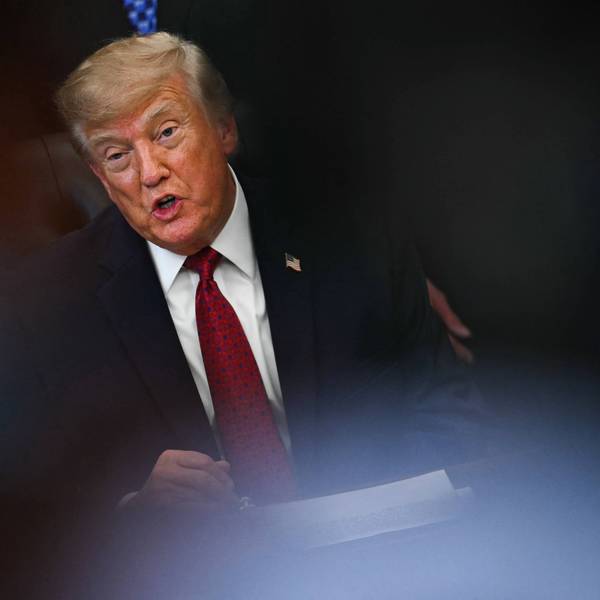

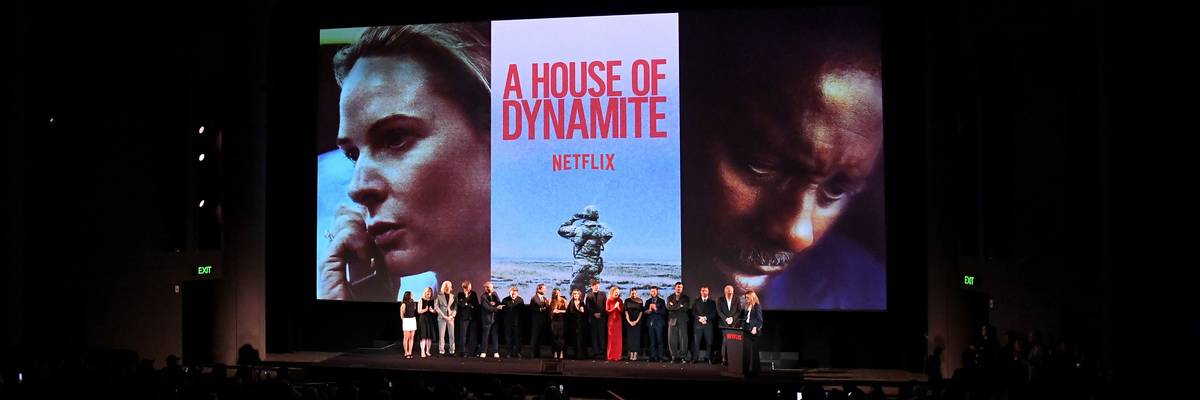
(L-R) Sumaiya Kaveh, Susanne Scheel, Paul N. J. Ottosson, Volker Bertelmann, Kirk Baxter, Jeremy Hindle, Greg Shapiro, Aminah Nieves, Kaitlyn Dever, Kyle Allen, Willa Fitzgerald, Brittany O'Grady, Brian Tee, Jonah Hauer-King, Gabriel Basso, and Tracy Letts attend a special Los Angeles screening of Netflix's A House of Dynamite at The Egyptian Theatre Hollywood on October 9, 2025 in Los Angeles, California.
Picturing Armageddon: US Government Responses to Nuclear War Movies
A feature film based on Annie Jacobson’s terrifying non-fiction book, Nuclear War: A Scenario, is now in pre-production with Dune director Denis Villeneuve at the helm. Looking back at how previous films about nuclear Armageddon have been received may give us a glimpse of how the current administration will respond to it.
In the recent Netflix movie, A House of Dynamite, an intercontinental ballistic missile of unknown origin is detected streaking across the Pacific on a course that, in less than 20 minutes, will turn Chicago to ash. Efforts to shoot the missile down fail, as the ground-based interceptors, or GBIs, miss their target and, as the seconds count down, the president, played by Idris Elba, has only seven minutes to decide how to respond. The consequences of his decision, which the film leaves open, could mean the end of human civilization and even most life on Earth.
What was the official response to the film? A week before it streamed, the Pentagon’s Missile Defense Agency (MDA) produced a memo attacking the film’s credibility. America’s GBIs, they said, are much more accurate than portrayed in the movie, with a 100% success rate. (The Center for Arms control puts that figure at 55% in carefully controlled tests.) And an article published by the West Point-based Modern War Institute argues that the film’s premise is flawed since no adversary would launch just a single missile at the United States.
It was also judged illogical that the president’s choices were limited to “surrender” or “suicide”—the latter meaning all-out nuclear war. The country could absorb the loss (meaning the 10 million inhabitants of Chicago) and respond only after the missile’s source had been determined. Finally, as the MDA memo helpfully pointed out, the plot of A House of Dynamite is “fictional” and “intended for the entertainment of the audience.” In other words, it’s just another disaster movie.
These themes are not new to governmental pronouncements on films about nuclear war. In the 1959 feature On the Beach, Gregory Peck plays the captain of a submarine that is America’s last surviving naval vessel as it docks in Melbourne, Australia after the entire Northern Hemisphere has been wiped out in a nuclear war—and a cloud of deadly radioactive fallout is inexorably making its way south. After a brief stay and with the inevitability of death by radiation poisoning, the crew votes to return to the US and die at home.
Which way will the Trump administration go in response to Nuclear War: A Scenario the movie? If the film is faithful to the book, it should have an even more devastating impact than The Day After.
Two weeks before the film’s worldwide release, the United States Information Agency produced an “Infoguide” stating that the film was “highly fictionalized and contains scientific inaccuracies.” It argued that, because fallout diminishes rapidly, it would only affect countries directly attacked or those nearby. Moreover, shelters and decontamination measures were effective against fallout and, as far away as the Southern Hemisphere, “if any protection at all were needed, an ordinary basement would suffice.” A later Infoguide reporting on the premier noted: “Most critics review [the] film as pure drama and there has been little emphasis on social and political significance.” In other words, no big deal.
Five years later, in 1964, Doctor Strangelove or: How I Learned to Stop Worrying and Love the Bomb, starring Peters Sellers in three different roles, was released. In this dark comedy, a psychotic Air Force General orders the B-52 bombers under his command to attack the Soviet Union, sparking a concerted but unsuccessful effort by the president and his advisers to recall the planes. As a single B-52 gets through and the plane’s pilot rides a nuclear bomb down to its target, it is revealed that the Soviets have a yet-to-be announced “Doomsday Machine” that, upon the country being struck by a nuclear weapon, will automatically trigger the detonation of a massive array of cobalt bombs whose radiation will render the Earth uninhabitable for a century.
Although obviously a farce, the film was panned as “juvenile, offensive, and inaccurate.” As reported in The New Yorker: “An expert at the Institute for Strategic Studies called the events in the film ‘impossible on a dozen counts.’ A former Deputy Secretary of Defense dismissed the idea that someone could authorize the use of a nuclear weapon without the President’s approval: ‘Nothing, in fact, could be further from the truth.’” (These assertions are in doubt following the disclosure of the policy of “pre-delegation,” in force at the time, which gave authority to commanders to deploy nuclear weapons in circumstances where the president could not be reached.)
Two decades later, in the feature film Wargames, Matthew Broderick plays a teenager who successfully hacks into the Pentagon’s supercomputer. Unwittingly, he mistakes its nuclear war command and control function for a computer game—and nearly triggers global thermonuclear war.
This time, the government response was quite different. After viewing the film, President Ronald Reagan asked his chairman of the Joint Chiefs of Staff if something like that could really happen. After a review, the president was told that, not only was the premise of the film realistic, “the problem is much worse than you think.” Fifteen months later, National Security Directive NSD-145 was issued, launching a sweeping governmental effort to improve cybersecurity.
Later in 1983, the television movie The Day After, which reached a record-breaking 100 million viewers, was the first American film to attempt a realistic depiction of the aftermath of a nuclear attack on an American city. The story revolves around a doctor, played by Jason Robards, as he tries to deal with the horrific effects of blast, fire, and radiation on the citizens of Lawrence, Kansas—targeted because of its nearby nuclear missile silos.
In this case, the response was mixed. The White House initially discouraged the making of the film. The Pentagon urged—unsuccessfully—to have the script make clear that the Soviets fired first and later refused to allow the filmmakers to use stock footage of real nuclear detonations. Henry Kissinger criticized the film as “simple minded” and in danger of leading the country to “make policy by scaring ourselves to death.” But the film’s graphic portrayal of the effects on the population of an American city could not be dismissed as easily as some of its predecessors, and Reagan wrote in his diary, “It’s very effective & left me greatly depressed.” It has been argued that the film influenced him to soften his Cold War rhetoric and to meet with Mikhael Gorbachev in Iceland in 1986, where the complete abolition of nuclear weapons was discussed. Unfortunately, that meeting ended without agreement; however, a year later, subsequent negotiations led to the Intermediate-Range Nuclear Forces Treaty, which resulted in the elimination of a whole class of nuclear weapons.
Which way will the Trump administration go in response to Nuclear War: A Scenario the movie? If the film is faithful to the book, it should have an even more devastating impact than The Day After. With today’s sophisticated special effects, it will, no doubt, create hyperrealistic imagery and make the absolute absurdity of nuclear war manifest. But will the administration call it unrealistic, inaccurate, alarmist or just fiction, as with On the Beach, Doctor Strangelove, or A House of Dynamite? Or will they see it as a prompt to take this existential threat seriously and move to reduce or eliminate the world’s nuclear stockpiles?
Regardless of the response, the movie should motivate us all to work to build a constituency for change in order to end the madness and build a saner world.
We are at a crossroads
This country and this world are at a monumental crossroads. In a few short weeks, US voters will have an opportunity to beat back the forces of fascism and confront the billionaires who are rigging the economy, our media system, and our democracy, making it increasingly impossible for ordinary people to get by. We’re not just talking about the election. We’re talking about what must be done once these fascist elements are vanquished from power. We need a bolder set of solutions than what either major party has so far been willing to offer and a working-class movement ready to fight like hell for it. Trump didn't emerge from nowhere. The conditions that fueled MAGA authoritarianism were created by decades of radical neoliberal economic policies and a corrupt political system dominated by corporate interests. They slashed taxes on the super-rich, promising that the benefits would trickle down. They said giveaways to the corporate titans would make life more affordable for the rest of us. It was all bullshit. And when a bitter, betrayed populace searches for someone to blame, right-wing demagogues have little trouble finding scapegoats. People know when they're being lied to, but you won't hear any of this from the corporate media. Only independent journalism—powered and funded by people who believe in building a better world—can deliver truly trustworthy daily news. Our Fall Campaign is underway, and we need your help. To power our newsroom through the rest of the year, we need to raise $125,000 by midnight on October 31. So if you share our vision, please contribute whatever you can to sustain our work. |
In the recent Netflix movie, A House of Dynamite, an intercontinental ballistic missile of unknown origin is detected streaking across the Pacific on a course that, in less than 20 minutes, will turn Chicago to ash. Efforts to shoot the missile down fail, as the ground-based interceptors, or GBIs, miss their target and, as the seconds count down, the president, played by Idris Elba, has only seven minutes to decide how to respond. The consequences of his decision, which the film leaves open, could mean the end of human civilization and even most life on Earth.
What was the official response to the film? A week before it streamed, the Pentagon’s Missile Defense Agency (MDA) produced a memo attacking the film’s credibility. America’s GBIs, they said, are much more accurate than portrayed in the movie, with a 100% success rate. (The Center for Arms control puts that figure at 55% in carefully controlled tests.) And an article published by the West Point-based Modern War Institute argues that the film’s premise is flawed since no adversary would launch just a single missile at the United States.
It was also judged illogical that the president’s choices were limited to “surrender” or “suicide”—the latter meaning all-out nuclear war. The country could absorb the loss (meaning the 10 million inhabitants of Chicago) and respond only after the missile’s source had been determined. Finally, as the MDA memo helpfully pointed out, the plot of A House of Dynamite is “fictional” and “intended for the entertainment of the audience.” In other words, it’s just another disaster movie.
These themes are not new to governmental pronouncements on films about nuclear war. In the 1959 feature On the Beach, Gregory Peck plays the captain of a submarine that is America’s last surviving naval vessel as it docks in Melbourne, Australia after the entire Northern Hemisphere has been wiped out in a nuclear war—and a cloud of deadly radioactive fallout is inexorably making its way south. After a brief stay and with the inevitability of death by radiation poisoning, the crew votes to return to the US and die at home.
Which way will the Trump administration go in response to Nuclear War: A Scenario the movie? If the film is faithful to the book, it should have an even more devastating impact than The Day After.
Two weeks before the film’s worldwide release, the United States Information Agency produced an “Infoguide” stating that the film was “highly fictionalized and contains scientific inaccuracies.” It argued that, because fallout diminishes rapidly, it would only affect countries directly attacked or those nearby. Moreover, shelters and decontamination measures were effective against fallout and, as far away as the Southern Hemisphere, “if any protection at all were needed, an ordinary basement would suffice.” A later Infoguide reporting on the premier noted: “Most critics review [the] film as pure drama and there has been little emphasis on social and political significance.” In other words, no big deal.
Five years later, in 1964, Doctor Strangelove or: How I Learned to Stop Worrying and Love the Bomb, starring Peters Sellers in three different roles, was released. In this dark comedy, a psychotic Air Force General orders the B-52 bombers under his command to attack the Soviet Union, sparking a concerted but unsuccessful effort by the president and his advisers to recall the planes. As a single B-52 gets through and the plane’s pilot rides a nuclear bomb down to its target, it is revealed that the Soviets have a yet-to-be announced “Doomsday Machine” that, upon the country being struck by a nuclear weapon, will automatically trigger the detonation of a massive array of cobalt bombs whose radiation will render the Earth uninhabitable for a century.
Although obviously a farce, the film was panned as “juvenile, offensive, and inaccurate.” As reported in The New Yorker: “An expert at the Institute for Strategic Studies called the events in the film ‘impossible on a dozen counts.’ A former Deputy Secretary of Defense dismissed the idea that someone could authorize the use of a nuclear weapon without the President’s approval: ‘Nothing, in fact, could be further from the truth.’” (These assertions are in doubt following the disclosure of the policy of “pre-delegation,” in force at the time, which gave authority to commanders to deploy nuclear weapons in circumstances where the president could not be reached.)
Two decades later, in the feature film Wargames, Matthew Broderick plays a teenager who successfully hacks into the Pentagon’s supercomputer. Unwittingly, he mistakes its nuclear war command and control function for a computer game—and nearly triggers global thermonuclear war.
This time, the government response was quite different. After viewing the film, President Ronald Reagan asked his chairman of the Joint Chiefs of Staff if something like that could really happen. After a review, the president was told that, not only was the premise of the film realistic, “the problem is much worse than you think.” Fifteen months later, National Security Directive NSD-145 was issued, launching a sweeping governmental effort to improve cybersecurity.
Later in 1983, the television movie The Day After, which reached a record-breaking 100 million viewers, was the first American film to attempt a realistic depiction of the aftermath of a nuclear attack on an American city. The story revolves around a doctor, played by Jason Robards, as he tries to deal with the horrific effects of blast, fire, and radiation on the citizens of Lawrence, Kansas—targeted because of its nearby nuclear missile silos.
In this case, the response was mixed. The White House initially discouraged the making of the film. The Pentagon urged—unsuccessfully—to have the script make clear that the Soviets fired first and later refused to allow the filmmakers to use stock footage of real nuclear detonations. Henry Kissinger criticized the film as “simple minded” and in danger of leading the country to “make policy by scaring ourselves to death.” But the film’s graphic portrayal of the effects on the population of an American city could not be dismissed as easily as some of its predecessors, and Reagan wrote in his diary, “It’s very effective & left me greatly depressed.” It has been argued that the film influenced him to soften his Cold War rhetoric and to meet with Mikhael Gorbachev in Iceland in 1986, where the complete abolition of nuclear weapons was discussed. Unfortunately, that meeting ended without agreement; however, a year later, subsequent negotiations led to the Intermediate-Range Nuclear Forces Treaty, which resulted in the elimination of a whole class of nuclear weapons.
Which way will the Trump administration go in response to Nuclear War: A Scenario the movie? If the film is faithful to the book, it should have an even more devastating impact than The Day After. With today’s sophisticated special effects, it will, no doubt, create hyperrealistic imagery and make the absolute absurdity of nuclear war manifest. But will the administration call it unrealistic, inaccurate, alarmist or just fiction, as with On the Beach, Doctor Strangelove, or A House of Dynamite? Or will they see it as a prompt to take this existential threat seriously and move to reduce or eliminate the world’s nuclear stockpiles?
Regardless of the response, the movie should motivate us all to work to build a constituency for change in order to end the madness and build a saner world.
- Coalition Rips Trump Plan to 'Rubber-Stamp' Nuclear Reactors as Dangerous and Illegal ›
- AI Opted to Use Nuclear Weapons 95% of the Time During War Games: Researcher ›
- Nuclear Propaganda Exposed: The Dirty Truth Behind Government and Industry Claims ›
- Leaked US Intel on Iran Attack Plans Also Confirms Israeli Nuclear Weapons ›
- We Still Have Far to Go to Put the Brakes on the Nuclear Arms Race ›
- Hollywood Rediscovers the Bomb ›
In the recent Netflix movie, A House of Dynamite, an intercontinental ballistic missile of unknown origin is detected streaking across the Pacific on a course that, in less than 20 minutes, will turn Chicago to ash. Efforts to shoot the missile down fail, as the ground-based interceptors, or GBIs, miss their target and, as the seconds count down, the president, played by Idris Elba, has only seven minutes to decide how to respond. The consequences of his decision, which the film leaves open, could mean the end of human civilization and even most life on Earth.
What was the official response to the film? A week before it streamed, the Pentagon’s Missile Defense Agency (MDA) produced a memo attacking the film’s credibility. America’s GBIs, they said, are much more accurate than portrayed in the movie, with a 100% success rate. (The Center for Arms control puts that figure at 55% in carefully controlled tests.) And an article published by the West Point-based Modern War Institute argues that the film’s premise is flawed since no adversary would launch just a single missile at the United States.
It was also judged illogical that the president’s choices were limited to “surrender” or “suicide”—the latter meaning all-out nuclear war. The country could absorb the loss (meaning the 10 million inhabitants of Chicago) and respond only after the missile’s source had been determined. Finally, as the MDA memo helpfully pointed out, the plot of A House of Dynamite is “fictional” and “intended for the entertainment of the audience.” In other words, it’s just another disaster movie.
These themes are not new to governmental pronouncements on films about nuclear war. In the 1959 feature On the Beach, Gregory Peck plays the captain of a submarine that is America’s last surviving naval vessel as it docks in Melbourne, Australia after the entire Northern Hemisphere has been wiped out in a nuclear war—and a cloud of deadly radioactive fallout is inexorably making its way south. After a brief stay and with the inevitability of death by radiation poisoning, the crew votes to return to the US and die at home.
Which way will the Trump administration go in response to Nuclear War: A Scenario the movie? If the film is faithful to the book, it should have an even more devastating impact than The Day After.
Two weeks before the film’s worldwide release, the United States Information Agency produced an “Infoguide” stating that the film was “highly fictionalized and contains scientific inaccuracies.” It argued that, because fallout diminishes rapidly, it would only affect countries directly attacked or those nearby. Moreover, shelters and decontamination measures were effective against fallout and, as far away as the Southern Hemisphere, “if any protection at all were needed, an ordinary basement would suffice.” A later Infoguide reporting on the premier noted: “Most critics review [the] film as pure drama and there has been little emphasis on social and political significance.” In other words, no big deal.
Five years later, in 1964, Doctor Strangelove or: How I Learned to Stop Worrying and Love the Bomb, starring Peters Sellers in three different roles, was released. In this dark comedy, a psychotic Air Force General orders the B-52 bombers under his command to attack the Soviet Union, sparking a concerted but unsuccessful effort by the president and his advisers to recall the planes. As a single B-52 gets through and the plane’s pilot rides a nuclear bomb down to its target, it is revealed that the Soviets have a yet-to-be announced “Doomsday Machine” that, upon the country being struck by a nuclear weapon, will automatically trigger the detonation of a massive array of cobalt bombs whose radiation will render the Earth uninhabitable for a century.
Although obviously a farce, the film was panned as “juvenile, offensive, and inaccurate.” As reported in The New Yorker: “An expert at the Institute for Strategic Studies called the events in the film ‘impossible on a dozen counts.’ A former Deputy Secretary of Defense dismissed the idea that someone could authorize the use of a nuclear weapon without the President’s approval: ‘Nothing, in fact, could be further from the truth.’” (These assertions are in doubt following the disclosure of the policy of “pre-delegation,” in force at the time, which gave authority to commanders to deploy nuclear weapons in circumstances where the president could not be reached.)
Two decades later, in the feature film Wargames, Matthew Broderick plays a teenager who successfully hacks into the Pentagon’s supercomputer. Unwittingly, he mistakes its nuclear war command and control function for a computer game—and nearly triggers global thermonuclear war.
This time, the government response was quite different. After viewing the film, President Ronald Reagan asked his chairman of the Joint Chiefs of Staff if something like that could really happen. After a review, the president was told that, not only was the premise of the film realistic, “the problem is much worse than you think.” Fifteen months later, National Security Directive NSD-145 was issued, launching a sweeping governmental effort to improve cybersecurity.
Later in 1983, the television movie The Day After, which reached a record-breaking 100 million viewers, was the first American film to attempt a realistic depiction of the aftermath of a nuclear attack on an American city. The story revolves around a doctor, played by Jason Robards, as he tries to deal with the horrific effects of blast, fire, and radiation on the citizens of Lawrence, Kansas—targeted because of its nearby nuclear missile silos.
In this case, the response was mixed. The White House initially discouraged the making of the film. The Pentagon urged—unsuccessfully—to have the script make clear that the Soviets fired first and later refused to allow the filmmakers to use stock footage of real nuclear detonations. Henry Kissinger criticized the film as “simple minded” and in danger of leading the country to “make policy by scaring ourselves to death.” But the film’s graphic portrayal of the effects on the population of an American city could not be dismissed as easily as some of its predecessors, and Reagan wrote in his diary, “It’s very effective & left me greatly depressed.” It has been argued that the film influenced him to soften his Cold War rhetoric and to meet with Mikhael Gorbachev in Iceland in 1986, where the complete abolition of nuclear weapons was discussed. Unfortunately, that meeting ended without agreement; however, a year later, subsequent negotiations led to the Intermediate-Range Nuclear Forces Treaty, which resulted in the elimination of a whole class of nuclear weapons.
Which way will the Trump administration go in response to Nuclear War: A Scenario the movie? If the film is faithful to the book, it should have an even more devastating impact than The Day After. With today’s sophisticated special effects, it will, no doubt, create hyperrealistic imagery and make the absolute absurdity of nuclear war manifest. But will the administration call it unrealistic, inaccurate, alarmist or just fiction, as with On the Beach, Doctor Strangelove, or A House of Dynamite? Or will they see it as a prompt to take this existential threat seriously and move to reduce or eliminate the world’s nuclear stockpiles?
Regardless of the response, the movie should motivate us all to work to build a constituency for change in order to end the madness and build a saner world.
- Coalition Rips Trump Plan to 'Rubber-Stamp' Nuclear Reactors as Dangerous and Illegal ›
- AI Opted to Use Nuclear Weapons 95% of the Time During War Games: Researcher ›
- Nuclear Propaganda Exposed: The Dirty Truth Behind Government and Industry Claims ›
- Leaked US Intel on Iran Attack Plans Also Confirms Israeli Nuclear Weapons ›
- We Still Have Far to Go to Put the Brakes on the Nuclear Arms Race ›
- Hollywood Rediscovers the Bomb ›