SUBSCRIBE TO OUR FREE NEWSLETTER
Daily news & progressive opinion—funded by the people, not the corporations—delivered straight to your inbox.
5
#000000
#FFFFFF
To donate by check, phone, or other method, see our More Ways to Give page.
Daily news & progressive opinion—funded by the people, not the corporations—delivered straight to your inbox.
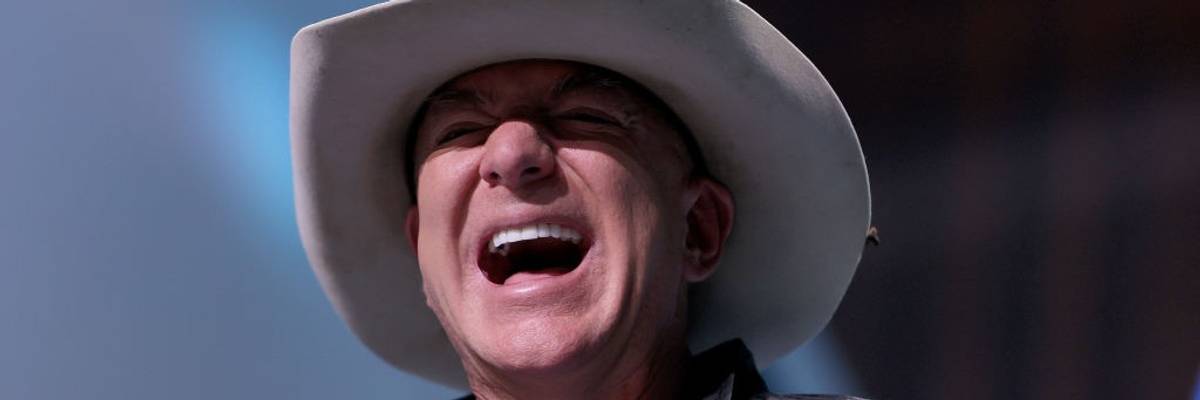
Jeff Bezos laughs during a press conference on July 20, 2021 in Van Horn, Texas.
We should be fearing, not cheering, the prospect of an American trillionaire.
It’s been a full decade now since I first predicted — warned, to be a bit more precise — that America would have its first trillionaire before 2040.
I stand by that warning today. Unfortunately, everything I said ten years ago has aged well. Too well. I explained back then how tax policy was supercharging the accumulation of obscene fortunes in America. Policymakers, I noted, had lifted the lid on wealth accumulation by decreasing taxes on inheritances and income from capital. That policy failure would go on to become substantially worse in 2017 with the passage of the Tax Cuts and Jobs Act.
Others would see this same ominous trend. In an interview with CNBC, several experts recognized the distinct possibility the world would have its first trillionaire by 2039, the year CNBC would turn 50. They offered various explanations for how that would happen, with most of them agreeing it would “take several Bill Gates-like successes from one individual to reach the trillion-dollar mark.”
I saw things differently, telling CNBC: “It might take the founder of five of today’s Microsofts to reach a trillion, but we’re going to see larger and larger Microsofts.”
More recently, the idea that a larger Microsoft would deliver our first billionaire has gained traction. Three years ago, USA Today reported on predictions that Amazon would raise Jeff Bezos’ wealth to trillionaire level as early as 2026.
Those predictions have turned out to be a bit aggressive — Bezos’ wealth climb has leveled off — but they may have been beneficial in an odd way. Historically, far too many Americans have looked at billionaire wealth the way they look at sports, as I noted in 2014:
The super-rich are setting new records, $10 billion, $50 billion, and soon enough $100 billion. Rather than objecting, our nation celebrates the increasingly obscene fortunes of the super-rich as we do athletes breaking sports records.
Reaching $1 trillion will be what hitting 73 home runs was before we knew Barry Bonds cheated to get there.
Will our first trillion-dollar fortune also be tainted by misdeeds of the achiever? Could that be what finally wakes us from our slumber?
In 2020, with Americans dying in large numbers from the pandemic, Bezos had become to billionaire wealth hoarding what Barry Bonds had become to home run records. As noted by USA Today, the reporting on Bezos becoming the first trillionaire occurred when Amazon workers were publicly protesting over safety issues.
Which caused the appropriate response to his predicted trillionaire status — anger — at least on Twitter. One tweet disdainfully noted: “Jeff Bezos will sometime in the near future have more money than the Netherlands. Totally normal. Nothing out of order here.” Another considered a headline announcing Bezos’ impending trillionaire status the most “disgusting and disturbing” he’d seen.
The reaction to trillionaire talk three years ago, unfortunately, may have been an anomaly, not the turning point I hoped it would be.
A case in point: The Motley Fool, a financial and investing advice company, has recently been promoting investment in a corporation it suggests could be as large as 17 Amazons, with a market capitalization of $17 trillion, an accumulation that would create the world’s first trillionaire. The promotional material doesn’t give the name of the corporation. To find it, you’d at least need to provide an email address, which would mean lots of unwanted promotional emails. Apparently, this corporation has technology that could supercharge artificial intelligence, or AI.
But the identity of that corporation — or the founder who stands to become the first trillionaire — isn’t the point here. After all, absent significant reform of America’s tax policy, we will see our first trillionaire, probably not much more than a decade from now.
Worse, too many folks may think that would be a good thing. In its promotional ad, Motley Fool gushes over how excited the prospect of a $17 trillion corporation headed by a trillionaire has investors, as if the super-rich becoming richer rates as a good thing in and of itself.
Most troubling: Motley Fool is using the prospect of someone achieving a net worth over $1 trillion as a selling point. This sort of advertising works because we have millions of investors out there who emulate the billionaire class.
Which brings us back to tax policy. Halting, then reversing, the obscene concentration of wealth in America will require Americans in overwhelming numbers demanding real tax reform. Without that tax reform, the concentration of wealth will worsen and, before we know it, we’ll see the arrival of our first trillionaire. And as our concentration of wealth worsens, the political power of billionaires will only continue to increase.
We’ll never have the collective mentality, as a nation, to take on the ultra-rich if millions of Americans identify with them and see the chase to become the first trillionaire the same way they see a football team’s pursuit of an undefeated season. We see this same identification in the response of everyday Americans to estate tax reform. In large numbers, many Americans oppose the estate tax because they think it will apply to them one day.
To be sure, many Americans do understand the perils of concentrated wealth. But to make real progress on tax reform, we need more than a bare majority of Americans opposing extreme wealth concentration and supporting higher taxation of the rich. We need to reach the point where for every average American citizen who sees billionaires as role models, another ten see them as the wealth hoarders they are.
Which means we should be fearing, not cheering, the prospect of an American trillionaire.
Dear Common Dreams reader, It’s been nearly 30 years since I co-founded Common Dreams with my late wife, Lina Newhouser. We had the radical notion that journalism should serve the public good, not corporate profits. It was clear to us from the outset what it would take to build such a project. No paid advertisements. No corporate sponsors. No millionaire publisher telling us what to think or do. Many people said we wouldn't last a year, but we proved those doubters wrong. Together with a tremendous team of journalists and dedicated staff, we built an independent media outlet free from the constraints of profits and corporate control. Our mission has always been simple: To inform. To inspire. To ignite change for the common good. Building Common Dreams was not easy. Our survival was never guaranteed. When you take on the most powerful forces—Wall Street greed, fossil fuel industry destruction, Big Tech lobbyists, and uber-rich oligarchs who have spent billions upon billions rigging the economy and democracy in their favor—the only bulwark you have is supporters who believe in your work. But here’s the urgent message from me today. It's never been this bad out there. And it's never been this hard to keep us going. At the very moment Common Dreams is most needed, the threats we face are intensifying. We need your support now more than ever. We don't accept corporate advertising and never will. We don't have a paywall because we don't think people should be blocked from critical news based on their ability to pay. Everything we do is funded by the donations of readers like you. When everyone does the little they can afford, we are strong. But if that support retreats or dries up, so do we. Will you donate now to make sure Common Dreams not only survives but thrives? —Craig Brown, Co-founder |
It’s been a full decade now since I first predicted — warned, to be a bit more precise — that America would have its first trillionaire before 2040.
I stand by that warning today. Unfortunately, everything I said ten years ago has aged well. Too well. I explained back then how tax policy was supercharging the accumulation of obscene fortunes in America. Policymakers, I noted, had lifted the lid on wealth accumulation by decreasing taxes on inheritances and income from capital. That policy failure would go on to become substantially worse in 2017 with the passage of the Tax Cuts and Jobs Act.
Others would see this same ominous trend. In an interview with CNBC, several experts recognized the distinct possibility the world would have its first trillionaire by 2039, the year CNBC would turn 50. They offered various explanations for how that would happen, with most of them agreeing it would “take several Bill Gates-like successes from one individual to reach the trillion-dollar mark.”
I saw things differently, telling CNBC: “It might take the founder of five of today’s Microsofts to reach a trillion, but we’re going to see larger and larger Microsofts.”
More recently, the idea that a larger Microsoft would deliver our first billionaire has gained traction. Three years ago, USA Today reported on predictions that Amazon would raise Jeff Bezos’ wealth to trillionaire level as early as 2026.
Those predictions have turned out to be a bit aggressive — Bezos’ wealth climb has leveled off — but they may have been beneficial in an odd way. Historically, far too many Americans have looked at billionaire wealth the way they look at sports, as I noted in 2014:
The super-rich are setting new records, $10 billion, $50 billion, and soon enough $100 billion. Rather than objecting, our nation celebrates the increasingly obscene fortunes of the super-rich as we do athletes breaking sports records.
Reaching $1 trillion will be what hitting 73 home runs was before we knew Barry Bonds cheated to get there.
Will our first trillion-dollar fortune also be tainted by misdeeds of the achiever? Could that be what finally wakes us from our slumber?
In 2020, with Americans dying in large numbers from the pandemic, Bezos had become to billionaire wealth hoarding what Barry Bonds had become to home run records. As noted by USA Today, the reporting on Bezos becoming the first trillionaire occurred when Amazon workers were publicly protesting over safety issues.
Which caused the appropriate response to his predicted trillionaire status — anger — at least on Twitter. One tweet disdainfully noted: “Jeff Bezos will sometime in the near future have more money than the Netherlands. Totally normal. Nothing out of order here.” Another considered a headline announcing Bezos’ impending trillionaire status the most “disgusting and disturbing” he’d seen.
The reaction to trillionaire talk three years ago, unfortunately, may have been an anomaly, not the turning point I hoped it would be.
A case in point: The Motley Fool, a financial and investing advice company, has recently been promoting investment in a corporation it suggests could be as large as 17 Amazons, with a market capitalization of $17 trillion, an accumulation that would create the world’s first trillionaire. The promotional material doesn’t give the name of the corporation. To find it, you’d at least need to provide an email address, which would mean lots of unwanted promotional emails. Apparently, this corporation has technology that could supercharge artificial intelligence, or AI.
But the identity of that corporation — or the founder who stands to become the first trillionaire — isn’t the point here. After all, absent significant reform of America’s tax policy, we will see our first trillionaire, probably not much more than a decade from now.
Worse, too many folks may think that would be a good thing. In its promotional ad, Motley Fool gushes over how excited the prospect of a $17 trillion corporation headed by a trillionaire has investors, as if the super-rich becoming richer rates as a good thing in and of itself.
Most troubling: Motley Fool is using the prospect of someone achieving a net worth over $1 trillion as a selling point. This sort of advertising works because we have millions of investors out there who emulate the billionaire class.
Which brings us back to tax policy. Halting, then reversing, the obscene concentration of wealth in America will require Americans in overwhelming numbers demanding real tax reform. Without that tax reform, the concentration of wealth will worsen and, before we know it, we’ll see the arrival of our first trillionaire. And as our concentration of wealth worsens, the political power of billionaires will only continue to increase.
We’ll never have the collective mentality, as a nation, to take on the ultra-rich if millions of Americans identify with them and see the chase to become the first trillionaire the same way they see a football team’s pursuit of an undefeated season. We see this same identification in the response of everyday Americans to estate tax reform. In large numbers, many Americans oppose the estate tax because they think it will apply to them one day.
To be sure, many Americans do understand the perils of concentrated wealth. But to make real progress on tax reform, we need more than a bare majority of Americans opposing extreme wealth concentration and supporting higher taxation of the rich. We need to reach the point where for every average American citizen who sees billionaires as role models, another ten see them as the wealth hoarders they are.
Which means we should be fearing, not cheering, the prospect of an American trillionaire.
It’s been a full decade now since I first predicted — warned, to be a bit more precise — that America would have its first trillionaire before 2040.
I stand by that warning today. Unfortunately, everything I said ten years ago has aged well. Too well. I explained back then how tax policy was supercharging the accumulation of obscene fortunes in America. Policymakers, I noted, had lifted the lid on wealth accumulation by decreasing taxes on inheritances and income from capital. That policy failure would go on to become substantially worse in 2017 with the passage of the Tax Cuts and Jobs Act.
Others would see this same ominous trend. In an interview with CNBC, several experts recognized the distinct possibility the world would have its first trillionaire by 2039, the year CNBC would turn 50. They offered various explanations for how that would happen, with most of them agreeing it would “take several Bill Gates-like successes from one individual to reach the trillion-dollar mark.”
I saw things differently, telling CNBC: “It might take the founder of five of today’s Microsofts to reach a trillion, but we’re going to see larger and larger Microsofts.”
More recently, the idea that a larger Microsoft would deliver our first billionaire has gained traction. Three years ago, USA Today reported on predictions that Amazon would raise Jeff Bezos’ wealth to trillionaire level as early as 2026.
Those predictions have turned out to be a bit aggressive — Bezos’ wealth climb has leveled off — but they may have been beneficial in an odd way. Historically, far too many Americans have looked at billionaire wealth the way they look at sports, as I noted in 2014:
The super-rich are setting new records, $10 billion, $50 billion, and soon enough $100 billion. Rather than objecting, our nation celebrates the increasingly obscene fortunes of the super-rich as we do athletes breaking sports records.
Reaching $1 trillion will be what hitting 73 home runs was before we knew Barry Bonds cheated to get there.
Will our first trillion-dollar fortune also be tainted by misdeeds of the achiever? Could that be what finally wakes us from our slumber?
In 2020, with Americans dying in large numbers from the pandemic, Bezos had become to billionaire wealth hoarding what Barry Bonds had become to home run records. As noted by USA Today, the reporting on Bezos becoming the first trillionaire occurred when Amazon workers were publicly protesting over safety issues.
Which caused the appropriate response to his predicted trillionaire status — anger — at least on Twitter. One tweet disdainfully noted: “Jeff Bezos will sometime in the near future have more money than the Netherlands. Totally normal. Nothing out of order here.” Another considered a headline announcing Bezos’ impending trillionaire status the most “disgusting and disturbing” he’d seen.
The reaction to trillionaire talk three years ago, unfortunately, may have been an anomaly, not the turning point I hoped it would be.
A case in point: The Motley Fool, a financial and investing advice company, has recently been promoting investment in a corporation it suggests could be as large as 17 Amazons, with a market capitalization of $17 trillion, an accumulation that would create the world’s first trillionaire. The promotional material doesn’t give the name of the corporation. To find it, you’d at least need to provide an email address, which would mean lots of unwanted promotional emails. Apparently, this corporation has technology that could supercharge artificial intelligence, or AI.
But the identity of that corporation — or the founder who stands to become the first trillionaire — isn’t the point here. After all, absent significant reform of America’s tax policy, we will see our first trillionaire, probably not much more than a decade from now.
Worse, too many folks may think that would be a good thing. In its promotional ad, Motley Fool gushes over how excited the prospect of a $17 trillion corporation headed by a trillionaire has investors, as if the super-rich becoming richer rates as a good thing in and of itself.
Most troubling: Motley Fool is using the prospect of someone achieving a net worth over $1 trillion as a selling point. This sort of advertising works because we have millions of investors out there who emulate the billionaire class.
Which brings us back to tax policy. Halting, then reversing, the obscene concentration of wealth in America will require Americans in overwhelming numbers demanding real tax reform. Without that tax reform, the concentration of wealth will worsen and, before we know it, we’ll see the arrival of our first trillionaire. And as our concentration of wealth worsens, the political power of billionaires will only continue to increase.
We’ll never have the collective mentality, as a nation, to take on the ultra-rich if millions of Americans identify with them and see the chase to become the first trillionaire the same way they see a football team’s pursuit of an undefeated season. We see this same identification in the response of everyday Americans to estate tax reform. In large numbers, many Americans oppose the estate tax because they think it will apply to them one day.
To be sure, many Americans do understand the perils of concentrated wealth. But to make real progress on tax reform, we need more than a bare majority of Americans opposing extreme wealth concentration and supporting higher taxation of the rich. We need to reach the point where for every average American citizen who sees billionaires as role models, another ten see them as the wealth hoarders they are.
Which means we should be fearing, not cheering, the prospect of an American trillionaire.