SUBSCRIBE TO OUR FREE NEWSLETTER
Daily news & progressive opinion—funded by the people, not the corporations—delivered straight to your inbox.
5
#000000
#FFFFFF
To donate by check, phone, or other method, see our More Ways to Give page.
Daily news & progressive opinion—funded by the people, not the corporations—delivered straight to your inbox.
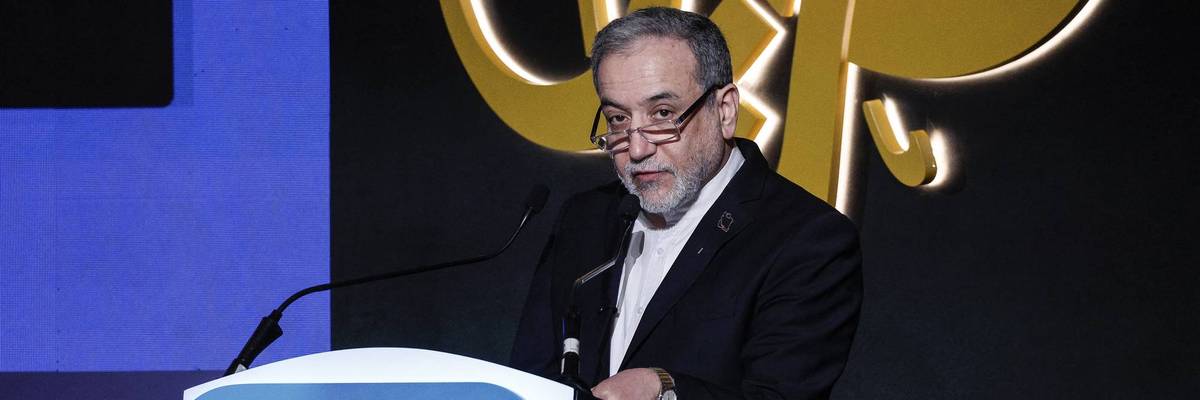
Iran's Foreign Minister Abbas Araghchi looks on as he speaks during the 17th edition of the Al-Jazeera Forum in Doha on February 7, 2026. Araghchi criticized what he said was a "doctrine of domination" that allows Israel to expand its military arsenal while pressuring other countries in the region to disarm.
The Middle East stands at a crossroads between endless war and comprehensive peace. A framework for peace does exist. Will the US finally seize it?
History occasionally presents moments when the truth about a conflict is stated plainly enough that it becomes impossible to ignore. Iranian Foreign Minister Abbas Araghchi’s February 7 address in Doha, Qatar (transcript here) should prove to be such a moment. His important and constructive remarks responded to the US call for comprehensive negotiations, and he laid out a sound proposal for peace across the Middle East.
Last week, US Secretary of State Marco Rubio called for comprehensive negotiations: "If the Iranians want to meet, we're ready." He proposed for talks to include the nuclear issue, Iran’s military capabilities, and its support for proxy groups around the region. On its surface, this sounds like a serious and constructive proposal. The Middle East’s security crises are interconnected, and diplomacy that isolates nuclear issues from broader regional dynamics is unlikely to endure.
On February 7, Iranian Foreign Minister Araghchi’s responded to the United States’ proposal for a comprehensive peace. In his speech at the Al Jazeera Forum, the foreign minister addressed the root cause of regional instability – “Palestine… is the defining question of justice in West Asia and beyond” and he proposed a path forward.
The Foreign Minister’s statement is correct. The failure to resolve the issue of Palestinian statehood has indeed fueled every major regional conflict since 1948. The Arab-Israeli wars, the rise of anti-Israel militancy, the regional polarization, and the repeated cycles of violence, all derive from the failure to create a State of Palestine alongside the State of Israel. Gaza represents the most devastating chapter in this conflict, where Israel’s brutal occupation of Palestine was followed by Hamas’s attack on Israel on October 7, 2023, and then by Israel’s genocide against the people of Gaza.
In his speech, Araghchi condemned Israel’s expansionist project “pursued under the banner of security.” He warned of the annexation of the West Bank, which Israeli government officials, as National Security Minister Ben Gvir, continually call for, and for which the Knesset has already passed a motion.
Araghchi also highlighted another fundamental dimension of Israeli strategy which is the pursuit of permanent military supremacy across the region. He said that Israel’s expansionist project requires that “neighboring countries be weakened—militarily, technologically, economically, and socially—so that the Israeli regime permanently enjoys the upper hand.” This is indeed the Clean Break doctrine of Prime Minister Netanyahu, dating back 30 years. It has been avidly supported by the US through 100 billion dollars in military assistance to Israel since 2000, diplomatic cover at the UN via repeated vetoes, and the consistent US rejection of accountability measures for Israel’s violations of international humanitarian law.
Israel’s impunity has destabilized the region, fueling arms races, proxy wars, and cycles of revenge. It has also corroded what remains of the international legal order. The abuse of international law by the US and Israel with much of Europe remaining silent, has gravely weakened the UN Charter, leaving the UN close to collapse.
In the concluding remarks of his speech, he offered the US a political solution and path forward. “The path to stability is clear: justice for Palestine, accountability for crimes, an end to occupation and apartheid, and a regional order built on sovereignty, equality, and cooperation. If the world wants peace, it must stop rewarding aggression. If the world wants stability, it must stop enabling expansionism.”
This is a valid and constructive response to Rubio’s call for comprehensive diplomacy.
This framework could address all the interlocking dimensions of the region’s conflict. The end of Israel’s expansion and occupation of Palestine, and Israel’s return to the borders of June 4, 1967, would bring an end to outside funding and arming of proxy groups in the region. The creation of a Palestinian state alongside the state of Israel would enhance Israel’s security as well as that of its neighbors. A renewed nuclear agreement with Iran, strictly limiting Iran to peaceful nuclear activities and paired with the lifting of US and EU sanctions, would add a crucial pillar of regional stability. Iran already agreed to such a nuclear framework a decade ago, in the Joint Comprehensive Plan of Action (JCPOA) that was adopted by the UN Security Council in Resolution 2231. It was the US during Trump's first term, not Iran, that withdrew from the agreement.
A comprehensive peace reflects the foundation of modern collective security doctrine, including the United Nations Charter itself. Durable peace requires mutual recognition of sovereignty, territorial integrity, and equal security guarantees for all states.
Regional security is the shared responsibility of all states in the region, and each of them faces a historic obligation. This comprehensive peace proposal is not new, it has been advocated for decades by the Organization of Islamic Cooperation (57 Muslim‑majority countries) and the League of Arab States (22 Arab States). Ever since the 2002 Arab Peace Initiative, all of these countries have endorsed, on a yearly basis, the framework of land-for-peace. All major Arab and Islamic states, allies of the US, have played a crucial role in facilitating the latest round of US-Iranian negotiations in Oman. Additionally, Saudi Arabia has clearly reminded the US that it will normalize relations with Israel only on the condition of the establishment of a Palestinian State.
The United States faces a moment of truth. Does it really want peace, or does it want to follow Israel’s extremism? For decades, the US has blindly followed Israeli misguided objectives. Domestic political pressures, powerful lobbying networks, strategic miscalculations, and perhaps a bit of blackmail lurking in the Epstein files (who knows?) have combined to subordinate American diplomacy to Israel’s regional ambitions.
The US subservience to Israel does not serve American interests. It has drawn the United States into repeated regional wars, undermined global trust in American foreign policy, and weakened the international legal order that Washington itself helped to construct after 1945.
A comprehensive peace offers the US a rare opportunity to correct course. By negotiating a comprehensive regional peace grounded in international law, the United States could reclaim genuine diplomacy and help to establish a stable regional security architecture that benefits all parties, including Israel and Palestine.
The Middle East stands at a crossroads between endless war and comprehensive peace. The framework for peace exists. It requires first and foremost Palestinian statehood, security guarantees for Israel and the rest of the region, a peaceful nuclear deal restoring the basic agreement adopted by the UN a decade ago, lifting of economic sanctions, the unbiased enforcement of international law, and a diplomatic architecture that replaces military force with security cooperation. The world should rally behind a comprehensive framework and take this historic opportunity to achieve regional peace.
Dear Common Dreams reader, It’s been nearly 30 years since I co-founded Common Dreams with my late wife, Lina Newhouser. We had the radical notion that journalism should serve the public good, not corporate profits. It was clear to us from the outset what it would take to build such a project. No paid advertisements. No corporate sponsors. No millionaire publisher telling us what to think or do. Many people said we wouldn't last a year, but we proved those doubters wrong. Together with a tremendous team of journalists and dedicated staff, we built an independent media outlet free from the constraints of profits and corporate control. Our mission has always been simple: To inform. To inspire. To ignite change for the common good. Building Common Dreams was not easy. Our survival was never guaranteed. When you take on the most powerful forces—Wall Street greed, fossil fuel industry destruction, Big Tech lobbyists, and uber-rich oligarchs who have spent billions upon billions rigging the economy and democracy in their favor—the only bulwark you have is supporters who believe in your work. But here’s the urgent message from me today. It's never been this bad out there. And it's never been this hard to keep us going. At the very moment Common Dreams is most needed, the threats we face are intensifying. We need your support now more than ever. We don't accept corporate advertising and never will. We don't have a paywall because we don't think people should be blocked from critical news based on their ability to pay. Everything we do is funded by the donations of readers like you. When everyone does the little they can afford, we are strong. But if that support retreats or dries up, so do we. Will you donate now to make sure Common Dreams not only survives but thrives? —Craig Brown, Co-founder |
History occasionally presents moments when the truth about a conflict is stated plainly enough that it becomes impossible to ignore. Iranian Foreign Minister Abbas Araghchi’s February 7 address in Doha, Qatar (transcript here) should prove to be such a moment. His important and constructive remarks responded to the US call for comprehensive negotiations, and he laid out a sound proposal for peace across the Middle East.
Last week, US Secretary of State Marco Rubio called for comprehensive negotiations: "If the Iranians want to meet, we're ready." He proposed for talks to include the nuclear issue, Iran’s military capabilities, and its support for proxy groups around the region. On its surface, this sounds like a serious and constructive proposal. The Middle East’s security crises are interconnected, and diplomacy that isolates nuclear issues from broader regional dynamics is unlikely to endure.
On February 7, Iranian Foreign Minister Araghchi’s responded to the United States’ proposal for a comprehensive peace. In his speech at the Al Jazeera Forum, the foreign minister addressed the root cause of regional instability – “Palestine… is the defining question of justice in West Asia and beyond” and he proposed a path forward.
The Foreign Minister’s statement is correct. The failure to resolve the issue of Palestinian statehood has indeed fueled every major regional conflict since 1948. The Arab-Israeli wars, the rise of anti-Israel militancy, the regional polarization, and the repeated cycles of violence, all derive from the failure to create a State of Palestine alongside the State of Israel. Gaza represents the most devastating chapter in this conflict, where Israel’s brutal occupation of Palestine was followed by Hamas’s attack on Israel on October 7, 2023, and then by Israel’s genocide against the people of Gaza.
In his speech, Araghchi condemned Israel’s expansionist project “pursued under the banner of security.” He warned of the annexation of the West Bank, which Israeli government officials, as National Security Minister Ben Gvir, continually call for, and for which the Knesset has already passed a motion.
Araghchi also highlighted another fundamental dimension of Israeli strategy which is the pursuit of permanent military supremacy across the region. He said that Israel’s expansionist project requires that “neighboring countries be weakened—militarily, technologically, economically, and socially—so that the Israeli regime permanently enjoys the upper hand.” This is indeed the Clean Break doctrine of Prime Minister Netanyahu, dating back 30 years. It has been avidly supported by the US through 100 billion dollars in military assistance to Israel since 2000, diplomatic cover at the UN via repeated vetoes, and the consistent US rejection of accountability measures for Israel’s violations of international humanitarian law.
Israel’s impunity has destabilized the region, fueling arms races, proxy wars, and cycles of revenge. It has also corroded what remains of the international legal order. The abuse of international law by the US and Israel with much of Europe remaining silent, has gravely weakened the UN Charter, leaving the UN close to collapse.
In the concluding remarks of his speech, he offered the US a political solution and path forward. “The path to stability is clear: justice for Palestine, accountability for crimes, an end to occupation and apartheid, and a regional order built on sovereignty, equality, and cooperation. If the world wants peace, it must stop rewarding aggression. If the world wants stability, it must stop enabling expansionism.”
This is a valid and constructive response to Rubio’s call for comprehensive diplomacy.
This framework could address all the interlocking dimensions of the region’s conflict. The end of Israel’s expansion and occupation of Palestine, and Israel’s return to the borders of June 4, 1967, would bring an end to outside funding and arming of proxy groups in the region. The creation of a Palestinian state alongside the state of Israel would enhance Israel’s security as well as that of its neighbors. A renewed nuclear agreement with Iran, strictly limiting Iran to peaceful nuclear activities and paired with the lifting of US and EU sanctions, would add a crucial pillar of regional stability. Iran already agreed to such a nuclear framework a decade ago, in the Joint Comprehensive Plan of Action (JCPOA) that was adopted by the UN Security Council in Resolution 2231. It was the US during Trump's first term, not Iran, that withdrew from the agreement.
A comprehensive peace reflects the foundation of modern collective security doctrine, including the United Nations Charter itself. Durable peace requires mutual recognition of sovereignty, territorial integrity, and equal security guarantees for all states.
Regional security is the shared responsibility of all states in the region, and each of them faces a historic obligation. This comprehensive peace proposal is not new, it has been advocated for decades by the Organization of Islamic Cooperation (57 Muslim‑majority countries) and the League of Arab States (22 Arab States). Ever since the 2002 Arab Peace Initiative, all of these countries have endorsed, on a yearly basis, the framework of land-for-peace. All major Arab and Islamic states, allies of the US, have played a crucial role in facilitating the latest round of US-Iranian negotiations in Oman. Additionally, Saudi Arabia has clearly reminded the US that it will normalize relations with Israel only on the condition of the establishment of a Palestinian State.
The United States faces a moment of truth. Does it really want peace, or does it want to follow Israel’s extremism? For decades, the US has blindly followed Israeli misguided objectives. Domestic political pressures, powerful lobbying networks, strategic miscalculations, and perhaps a bit of blackmail lurking in the Epstein files (who knows?) have combined to subordinate American diplomacy to Israel’s regional ambitions.
The US subservience to Israel does not serve American interests. It has drawn the United States into repeated regional wars, undermined global trust in American foreign policy, and weakened the international legal order that Washington itself helped to construct after 1945.
A comprehensive peace offers the US a rare opportunity to correct course. By negotiating a comprehensive regional peace grounded in international law, the United States could reclaim genuine diplomacy and help to establish a stable regional security architecture that benefits all parties, including Israel and Palestine.
The Middle East stands at a crossroads between endless war and comprehensive peace. The framework for peace exists. It requires first and foremost Palestinian statehood, security guarantees for Israel and the rest of the region, a peaceful nuclear deal restoring the basic agreement adopted by the UN a decade ago, lifting of economic sanctions, the unbiased enforcement of international law, and a diplomatic architecture that replaces military force with security cooperation. The world should rally behind a comprehensive framework and take this historic opportunity to achieve regional peace.
History occasionally presents moments when the truth about a conflict is stated plainly enough that it becomes impossible to ignore. Iranian Foreign Minister Abbas Araghchi’s February 7 address in Doha, Qatar (transcript here) should prove to be such a moment. His important and constructive remarks responded to the US call for comprehensive negotiations, and he laid out a sound proposal for peace across the Middle East.
Last week, US Secretary of State Marco Rubio called for comprehensive negotiations: "If the Iranians want to meet, we're ready." He proposed for talks to include the nuclear issue, Iran’s military capabilities, and its support for proxy groups around the region. On its surface, this sounds like a serious and constructive proposal. The Middle East’s security crises are interconnected, and diplomacy that isolates nuclear issues from broader regional dynamics is unlikely to endure.
On February 7, Iranian Foreign Minister Araghchi’s responded to the United States’ proposal for a comprehensive peace. In his speech at the Al Jazeera Forum, the foreign minister addressed the root cause of regional instability – “Palestine… is the defining question of justice in West Asia and beyond” and he proposed a path forward.
The Foreign Minister’s statement is correct. The failure to resolve the issue of Palestinian statehood has indeed fueled every major regional conflict since 1948. The Arab-Israeli wars, the rise of anti-Israel militancy, the regional polarization, and the repeated cycles of violence, all derive from the failure to create a State of Palestine alongside the State of Israel. Gaza represents the most devastating chapter in this conflict, where Israel’s brutal occupation of Palestine was followed by Hamas’s attack on Israel on October 7, 2023, and then by Israel’s genocide against the people of Gaza.
In his speech, Araghchi condemned Israel’s expansionist project “pursued under the banner of security.” He warned of the annexation of the West Bank, which Israeli government officials, as National Security Minister Ben Gvir, continually call for, and for which the Knesset has already passed a motion.
Araghchi also highlighted another fundamental dimension of Israeli strategy which is the pursuit of permanent military supremacy across the region. He said that Israel’s expansionist project requires that “neighboring countries be weakened—militarily, technologically, economically, and socially—so that the Israeli regime permanently enjoys the upper hand.” This is indeed the Clean Break doctrine of Prime Minister Netanyahu, dating back 30 years. It has been avidly supported by the US through 100 billion dollars in military assistance to Israel since 2000, diplomatic cover at the UN via repeated vetoes, and the consistent US rejection of accountability measures for Israel’s violations of international humanitarian law.
Israel’s impunity has destabilized the region, fueling arms races, proxy wars, and cycles of revenge. It has also corroded what remains of the international legal order. The abuse of international law by the US and Israel with much of Europe remaining silent, has gravely weakened the UN Charter, leaving the UN close to collapse.
In the concluding remarks of his speech, he offered the US a political solution and path forward. “The path to stability is clear: justice for Palestine, accountability for crimes, an end to occupation and apartheid, and a regional order built on sovereignty, equality, and cooperation. If the world wants peace, it must stop rewarding aggression. If the world wants stability, it must stop enabling expansionism.”
This is a valid and constructive response to Rubio’s call for comprehensive diplomacy.
This framework could address all the interlocking dimensions of the region’s conflict. The end of Israel’s expansion and occupation of Palestine, and Israel’s return to the borders of June 4, 1967, would bring an end to outside funding and arming of proxy groups in the region. The creation of a Palestinian state alongside the state of Israel would enhance Israel’s security as well as that of its neighbors. A renewed nuclear agreement with Iran, strictly limiting Iran to peaceful nuclear activities and paired with the lifting of US and EU sanctions, would add a crucial pillar of regional stability. Iran already agreed to such a nuclear framework a decade ago, in the Joint Comprehensive Plan of Action (JCPOA) that was adopted by the UN Security Council in Resolution 2231. It was the US during Trump's first term, not Iran, that withdrew from the agreement.
A comprehensive peace reflects the foundation of modern collective security doctrine, including the United Nations Charter itself. Durable peace requires mutual recognition of sovereignty, territorial integrity, and equal security guarantees for all states.
Regional security is the shared responsibility of all states in the region, and each of them faces a historic obligation. This comprehensive peace proposal is not new, it has been advocated for decades by the Organization of Islamic Cooperation (57 Muslim‑majority countries) and the League of Arab States (22 Arab States). Ever since the 2002 Arab Peace Initiative, all of these countries have endorsed, on a yearly basis, the framework of land-for-peace. All major Arab and Islamic states, allies of the US, have played a crucial role in facilitating the latest round of US-Iranian negotiations in Oman. Additionally, Saudi Arabia has clearly reminded the US that it will normalize relations with Israel only on the condition of the establishment of a Palestinian State.
The United States faces a moment of truth. Does it really want peace, or does it want to follow Israel’s extremism? For decades, the US has blindly followed Israeli misguided objectives. Domestic political pressures, powerful lobbying networks, strategic miscalculations, and perhaps a bit of blackmail lurking in the Epstein files (who knows?) have combined to subordinate American diplomacy to Israel’s regional ambitions.
The US subservience to Israel does not serve American interests. It has drawn the United States into repeated regional wars, undermined global trust in American foreign policy, and weakened the international legal order that Washington itself helped to construct after 1945.
A comprehensive peace offers the US a rare opportunity to correct course. By negotiating a comprehensive regional peace grounded in international law, the United States could reclaim genuine diplomacy and help to establish a stable regional security architecture that benefits all parties, including Israel and Palestine.
The Middle East stands at a crossroads between endless war and comprehensive peace. The framework for peace exists. It requires first and foremost Palestinian statehood, security guarantees for Israel and the rest of the region, a peaceful nuclear deal restoring the basic agreement adopted by the UN a decade ago, lifting of economic sanctions, the unbiased enforcement of international law, and a diplomatic architecture that replaces military force with security cooperation. The world should rally behind a comprehensive framework and take this historic opportunity to achieve regional peace.