SUBSCRIBE TO OUR FREE NEWSLETTER
Daily news & progressive opinion—funded by the people, not the corporations—delivered straight to your inbox.
5
#000000
#FFFFFF
To donate by check, phone, or other method, see our More Ways to Give page.
Daily news & progressive opinion—funded by the people, not the corporations—delivered straight to your inbox.
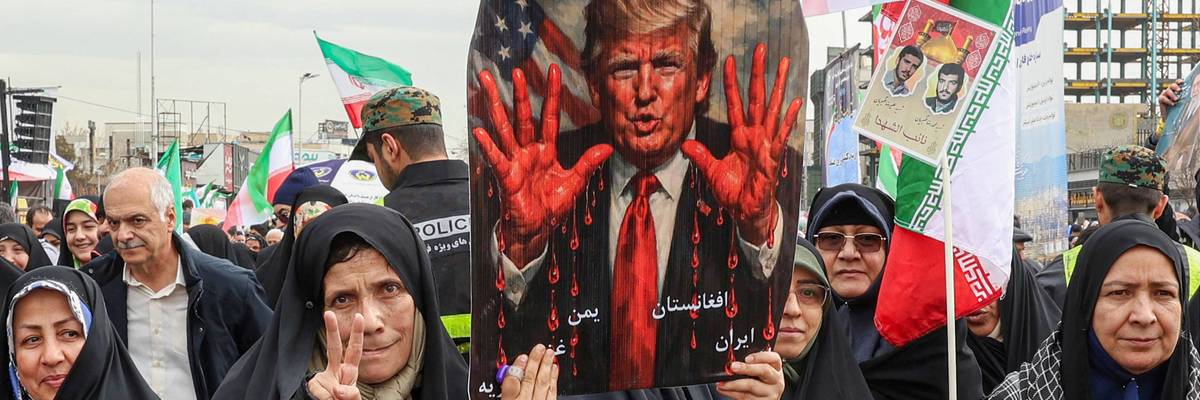
Women march with a sign depicting US President Donald Trump with bloodied hands in Tehran on February 11, 2026, during a rally marking the 47th anniversary of the 1979 Islamic revolution.
The current threat of an attack by the US did not begin with any failure by Iran to negotiate. On the contrary, it began with the United States’ repudiation of negotiations that had already succeeded.
Distinguished Members of the Security Council,
The President of the United States is issuing grave threats of force against the Islamic Republic of Iran if it does not accede to US demands. His actions risk a major regional war that would be devastating. Asked if he wanted regime change, he responded that it "seems like that would be the best thing that could happen." When asked why a second US aircraft carrier has been sent to the region, President Trump answered "in case we don't make a deal, we'll need it ... if we need it, we'll have it ready."
These threats are in violation of Article 2(4) of the UN Charter, which declares that “All Members shall refrain in their international relations from the threat or use of force against the territorial integrity or political independence of any state, or in any other manner inconsistent with the Purposes of the United Nations.”
These threats come in the context of Iran’s repeated calls for negotiations. Moreover, on February 7, Iran’s Foreign Minister delivered a speech in Doha proposing comprehensive negotiations for regional peace, following a round of talks in Oman supported by the diplomacy of the Arab states and Türkiye. Even as a second round of negotiations has been announced, the US is resorting to escalating threats of force.
Today, the world is in urgent need of a renewed commitment to diplomacy.
The issue facing the UN Security Council in these perilous days is whether any member state, by force or threat of force, may place itself above the United Nations Charter that governs us all. At stake is the integrity of the UN-based international system.
One of the crucial roles of the Security Council is to call on member states to settle disputes by peaceful means such as negotiation, mediation, arbitration, or judicial settlement, without the threat of force or resort to force. Today, the world is in urgent need of a renewed commitment to diplomacy.
The current threat of an attack by the US did not begin with any failure by Iran to negotiate. On the contrary, it began with the United States’ repudiation of negotiations that had already succeeded.
On July 14, 2015, after years of extensive diplomacy, Iran and the P5 countries plus Germany concluded the Joint Comprehensive Plan of Action (JCPOA) to ensure that Iran’s nuclear program would remain exclusively peaceful. In return, economic sanctions on Iran were to be lifted. The JCPOA placed Iran’s nuclear activities under strict and continuous scrutiny by the International Atomic Energy Agency and thereby ended the risk of a nuclear-arms breakout by Iran, a risk that Iran had consistently denied.
On July 20, 2015, the UNSC unanimously adopted Resolution 2231. That resolution “endorses the JCPOA” and calls upon all states to take the steps “necessary to support the implementation.” It terminated previous sanctions resolutions and incorporated the JCPOA into international law. The Security Council explicitly recognized Iran’s “right to develop nuclear energy for peaceful purposes” under the Non-Proliferation Treaty and established a robust verification regime.
Yet on May 8, 2018, three years after the successful UNSC Resolution, the United States unilaterally withdrew from the JCPOA. This withdrawal was actively lobbied for by the Israeli government. Since the late 1990s, Israel’s leadership has repeatedly, falsely, and hypocritically claimed that Iran was on the verge of obtaining a nuclear weapon, even as Israel itself had secretly acquired nuclear weapons outside the Treaty on the Non-Proliferation of Nuclear Weapons and has until today refused to join the treaty and subject itself to its controls.
When President Trump unilaterally withdrew the United States from the JCPOA, the US reimposed wide-ranging sanctions in direct contradiction of Resolution 2231 and launched a campaign of economic warfare designed to cripple Iran’s economy that continues to this day.
The current threats by the US are therefore part of a long-standing pattern of feigning interest in negotiations while in fact pursuing economic warfare and military force. In June 2025, following the renewal of negotiations earlier that year, the United States and Iran entered a sixth round of talks. The US had characterized the negotiations as constructive and positive. The sixth round was set for June 15, 2025. Yet on June 13, 2025, the US supported Israel’s bombing of Iran. A week after that, the US attacked Iran under Operation Midnight Hammer.
The US assault on the UN Charter has now escalated once again to the brink of war, with US threats of force and acts of economic warfare proceeding daily. The US has been escalating its military presence near Iran and has repeatedly threatened to launch an imminent attack.
The administration has also been candid about its strategy of economic warfare. On January 20, in an interview in Davos, US Treasury Secretary Scott Bessent described how the US had deliberately engineered the collapse of the Iranian currency, a dollar shortage, and a collapse of imports, all with the goal of fomenting economic suffering and mass unrest. Bessent described the resulting unrest as “moving in a very positive way here.”
The current threats by the US are therefore part of a long-standing pattern of feigning interest in negotiations while in fact pursuing economic warfare and military force.
The most striking aspect of the US campaign for regime change in Iran is the repeated US insistence that Iran must negotiate. Iran has negotiated, repeatedly. The JCPOA was negotiated and ratified by the UN Security Council. Even after Iran engaged in renewed negotiations last summer, it faced large‑scale air strikes on its territory. Now, the US openly avows the policy of economic collapse and regime change.
No country is safe if the United States can make brazen threats against Iran and indeed several other states in recent weeks, including Cuba, Denmark, and others.
It is both sad and poignant to recall that the United Nations was the brainchild of President Franklin D. Roosevelt. He envisioned an era of great-power cooperation and multilateralism under international law as the basis of international peace and security. His wife, Eleanor Roosevelt, oversaw the drafting and adoption of the Universal Declaration of Human Rights.
The US at that time envisioned an era in which diplomacy would prosper, and a time in which law and justice rather than brute force would prevail, a time when we would honor the words of the Prophet Isaiah inscribed on the wall on First Avenue facing the United Nations: “They shall beat their swords into plowshares, and their spears into pruning hooks. Nation shall not lift up sword against nation. Neither shall they learn war any more.”
To allow the UN Charter to be ruthlessly violated, no less by its host country, is to invite the return to global war, this time in the nuclear age. In other words, it is to invite humanity’s self-destruction. On behalf of We the Peoples, the UN Security Council carries the authority and heavy responsibility to keep the peace.
Sincerely yours,
Jeffrey D. Sachs
University Professor at Columbia University
Appendix. I humbly offer below an illustrative Draft Resolution by which the UNSC could fulfill its duty in the current context.
The Security Council,
Recalling the purposes and principles of the Charter of the United Nations, in particular the obligation of all Member States to refrain from the threat or use of force against the territorial integrity or political independence of any State, as set forth in Article 2(4) of the Charter,
Reaffirming that the maintenance of international peace and security rests upon respect for international law, the authority of the Security Council, and the peaceful settlement of disputes,
Recalling its resolution 2231 (2015), adopted unanimously on 20 July 2015, by which the Security Council endorsed the Joint Comprehensive Plan of Action (JCPOA) and called upon all Member States to take actions necessary to support its implementation,
Reaffirming its commitment to the Treaty on the Non-Proliferation of Nuclear Weapons, the need for all States Party to that Treaty to comply fully with their obligations, and recalling the right of States Party, in conformity with Articles I and II of that Treaty, to develop research, production and use of nuclear energy for peaceful purposes without discrimination
Acting under the Charter of the United Nations,
Dear Common Dreams reader, It’s been nearly 30 years since I co-founded Common Dreams with my late wife, Lina Newhouser. We had the radical notion that journalism should serve the public good, not corporate profits. It was clear to us from the outset what it would take to build such a project. No paid advertisements. No corporate sponsors. No millionaire publisher telling us what to think or do. Many people said we wouldn't last a year, but we proved those doubters wrong. Together with a tremendous team of journalists and dedicated staff, we built an independent media outlet free from the constraints of profits and corporate control. Our mission has always been simple: To inform. To inspire. To ignite change for the common good. Building Common Dreams was not easy. Our survival was never guaranteed. When you take on the most powerful forces—Wall Street greed, fossil fuel industry destruction, Big Tech lobbyists, and uber-rich oligarchs who have spent billions upon billions rigging the economy and democracy in their favor—the only bulwark you have is supporters who believe in your work. But here’s the urgent message from me today. It's never been this bad out there. And it's never been this hard to keep us going. At the very moment Common Dreams is most needed, the threats we face are intensifying. We need your support now more than ever. We don't accept corporate advertising and never will. We don't have a paywall because we don't think people should be blocked from critical news based on their ability to pay. Everything we do is funded by the donations of readers like you. When everyone does the little they can afford, we are strong. But if that support retreats or dries up, so do we. Will you donate now to make sure Common Dreams not only survives but thrives? —Craig Brown, Co-founder |
Distinguished Members of the Security Council,
The President of the United States is issuing grave threats of force against the Islamic Republic of Iran if it does not accede to US demands. His actions risk a major regional war that would be devastating. Asked if he wanted regime change, he responded that it "seems like that would be the best thing that could happen." When asked why a second US aircraft carrier has been sent to the region, President Trump answered "in case we don't make a deal, we'll need it ... if we need it, we'll have it ready."
These threats are in violation of Article 2(4) of the UN Charter, which declares that “All Members shall refrain in their international relations from the threat or use of force against the territorial integrity or political independence of any state, or in any other manner inconsistent with the Purposes of the United Nations.”
These threats come in the context of Iran’s repeated calls for negotiations. Moreover, on February 7, Iran’s Foreign Minister delivered a speech in Doha proposing comprehensive negotiations for regional peace, following a round of talks in Oman supported by the diplomacy of the Arab states and Türkiye. Even as a second round of negotiations has been announced, the US is resorting to escalating threats of force.
Today, the world is in urgent need of a renewed commitment to diplomacy.
The issue facing the UN Security Council in these perilous days is whether any member state, by force or threat of force, may place itself above the United Nations Charter that governs us all. At stake is the integrity of the UN-based international system.
One of the crucial roles of the Security Council is to call on member states to settle disputes by peaceful means such as negotiation, mediation, arbitration, or judicial settlement, without the threat of force or resort to force. Today, the world is in urgent need of a renewed commitment to diplomacy.
The current threat of an attack by the US did not begin with any failure by Iran to negotiate. On the contrary, it began with the United States’ repudiation of negotiations that had already succeeded.
On July 14, 2015, after years of extensive diplomacy, Iran and the P5 countries plus Germany concluded the Joint Comprehensive Plan of Action (JCPOA) to ensure that Iran’s nuclear program would remain exclusively peaceful. In return, economic sanctions on Iran were to be lifted. The JCPOA placed Iran’s nuclear activities under strict and continuous scrutiny by the International Atomic Energy Agency and thereby ended the risk of a nuclear-arms breakout by Iran, a risk that Iran had consistently denied.
On July 20, 2015, the UNSC unanimously adopted Resolution 2231. That resolution “endorses the JCPOA” and calls upon all states to take the steps “necessary to support the implementation.” It terminated previous sanctions resolutions and incorporated the JCPOA into international law. The Security Council explicitly recognized Iran’s “right to develop nuclear energy for peaceful purposes” under the Non-Proliferation Treaty and established a robust verification regime.
Yet on May 8, 2018, three years after the successful UNSC Resolution, the United States unilaterally withdrew from the JCPOA. This withdrawal was actively lobbied for by the Israeli government. Since the late 1990s, Israel’s leadership has repeatedly, falsely, and hypocritically claimed that Iran was on the verge of obtaining a nuclear weapon, even as Israel itself had secretly acquired nuclear weapons outside the Treaty on the Non-Proliferation of Nuclear Weapons and has until today refused to join the treaty and subject itself to its controls.
When President Trump unilaterally withdrew the United States from the JCPOA, the US reimposed wide-ranging sanctions in direct contradiction of Resolution 2231 and launched a campaign of economic warfare designed to cripple Iran’s economy that continues to this day.
The current threats by the US are therefore part of a long-standing pattern of feigning interest in negotiations while in fact pursuing economic warfare and military force. In June 2025, following the renewal of negotiations earlier that year, the United States and Iran entered a sixth round of talks. The US had characterized the negotiations as constructive and positive. The sixth round was set for June 15, 2025. Yet on June 13, 2025, the US supported Israel’s bombing of Iran. A week after that, the US attacked Iran under Operation Midnight Hammer.
The US assault on the UN Charter has now escalated once again to the brink of war, with US threats of force and acts of economic warfare proceeding daily. The US has been escalating its military presence near Iran and has repeatedly threatened to launch an imminent attack.
The administration has also been candid about its strategy of economic warfare. On January 20, in an interview in Davos, US Treasury Secretary Scott Bessent described how the US had deliberately engineered the collapse of the Iranian currency, a dollar shortage, and a collapse of imports, all with the goal of fomenting economic suffering and mass unrest. Bessent described the resulting unrest as “moving in a very positive way here.”
The current threats by the US are therefore part of a long-standing pattern of feigning interest in negotiations while in fact pursuing economic warfare and military force.
The most striking aspect of the US campaign for regime change in Iran is the repeated US insistence that Iran must negotiate. Iran has negotiated, repeatedly. The JCPOA was negotiated and ratified by the UN Security Council. Even after Iran engaged in renewed negotiations last summer, it faced large‑scale air strikes on its territory. Now, the US openly avows the policy of economic collapse and regime change.
No country is safe if the United States can make brazen threats against Iran and indeed several other states in recent weeks, including Cuba, Denmark, and others.
It is both sad and poignant to recall that the United Nations was the brainchild of President Franklin D. Roosevelt. He envisioned an era of great-power cooperation and multilateralism under international law as the basis of international peace and security. His wife, Eleanor Roosevelt, oversaw the drafting and adoption of the Universal Declaration of Human Rights.
The US at that time envisioned an era in which diplomacy would prosper, and a time in which law and justice rather than brute force would prevail, a time when we would honor the words of the Prophet Isaiah inscribed on the wall on First Avenue facing the United Nations: “They shall beat their swords into plowshares, and their spears into pruning hooks. Nation shall not lift up sword against nation. Neither shall they learn war any more.”
To allow the UN Charter to be ruthlessly violated, no less by its host country, is to invite the return to global war, this time in the nuclear age. In other words, it is to invite humanity’s self-destruction. On behalf of We the Peoples, the UN Security Council carries the authority and heavy responsibility to keep the peace.
Sincerely yours,
Jeffrey D. Sachs
University Professor at Columbia University
Appendix. I humbly offer below an illustrative Draft Resolution by which the UNSC could fulfill its duty in the current context.
The Security Council,
Recalling the purposes and principles of the Charter of the United Nations, in particular the obligation of all Member States to refrain from the threat or use of force against the territorial integrity or political independence of any State, as set forth in Article 2(4) of the Charter,
Reaffirming that the maintenance of international peace and security rests upon respect for international law, the authority of the Security Council, and the peaceful settlement of disputes,
Recalling its resolution 2231 (2015), adopted unanimously on 20 July 2015, by which the Security Council endorsed the Joint Comprehensive Plan of Action (JCPOA) and called upon all Member States to take actions necessary to support its implementation,
Reaffirming its commitment to the Treaty on the Non-Proliferation of Nuclear Weapons, the need for all States Party to that Treaty to comply fully with their obligations, and recalling the right of States Party, in conformity with Articles I and II of that Treaty, to develop research, production and use of nuclear energy for peaceful purposes without discrimination
Acting under the Charter of the United Nations,
Distinguished Members of the Security Council,
The President of the United States is issuing grave threats of force against the Islamic Republic of Iran if it does not accede to US demands. His actions risk a major regional war that would be devastating. Asked if he wanted regime change, he responded that it "seems like that would be the best thing that could happen." When asked why a second US aircraft carrier has been sent to the region, President Trump answered "in case we don't make a deal, we'll need it ... if we need it, we'll have it ready."
These threats are in violation of Article 2(4) of the UN Charter, which declares that “All Members shall refrain in their international relations from the threat or use of force against the territorial integrity or political independence of any state, or in any other manner inconsistent with the Purposes of the United Nations.”
These threats come in the context of Iran’s repeated calls for negotiations. Moreover, on February 7, Iran’s Foreign Minister delivered a speech in Doha proposing comprehensive negotiations for regional peace, following a round of talks in Oman supported by the diplomacy of the Arab states and Türkiye. Even as a second round of negotiations has been announced, the US is resorting to escalating threats of force.
Today, the world is in urgent need of a renewed commitment to diplomacy.
The issue facing the UN Security Council in these perilous days is whether any member state, by force or threat of force, may place itself above the United Nations Charter that governs us all. At stake is the integrity of the UN-based international system.
One of the crucial roles of the Security Council is to call on member states to settle disputes by peaceful means such as negotiation, mediation, arbitration, or judicial settlement, without the threat of force or resort to force. Today, the world is in urgent need of a renewed commitment to diplomacy.
The current threat of an attack by the US did not begin with any failure by Iran to negotiate. On the contrary, it began with the United States’ repudiation of negotiations that had already succeeded.
On July 14, 2015, after years of extensive diplomacy, Iran and the P5 countries plus Germany concluded the Joint Comprehensive Plan of Action (JCPOA) to ensure that Iran’s nuclear program would remain exclusively peaceful. In return, economic sanctions on Iran were to be lifted. The JCPOA placed Iran’s nuclear activities under strict and continuous scrutiny by the International Atomic Energy Agency and thereby ended the risk of a nuclear-arms breakout by Iran, a risk that Iran had consistently denied.
On July 20, 2015, the UNSC unanimously adopted Resolution 2231. That resolution “endorses the JCPOA” and calls upon all states to take the steps “necessary to support the implementation.” It terminated previous sanctions resolutions and incorporated the JCPOA into international law. The Security Council explicitly recognized Iran’s “right to develop nuclear energy for peaceful purposes” under the Non-Proliferation Treaty and established a robust verification regime.
Yet on May 8, 2018, three years after the successful UNSC Resolution, the United States unilaterally withdrew from the JCPOA. This withdrawal was actively lobbied for by the Israeli government. Since the late 1990s, Israel’s leadership has repeatedly, falsely, and hypocritically claimed that Iran was on the verge of obtaining a nuclear weapon, even as Israel itself had secretly acquired nuclear weapons outside the Treaty on the Non-Proliferation of Nuclear Weapons and has until today refused to join the treaty and subject itself to its controls.
When President Trump unilaterally withdrew the United States from the JCPOA, the US reimposed wide-ranging sanctions in direct contradiction of Resolution 2231 and launched a campaign of economic warfare designed to cripple Iran’s economy that continues to this day.
The current threats by the US are therefore part of a long-standing pattern of feigning interest in negotiations while in fact pursuing economic warfare and military force. In June 2025, following the renewal of negotiations earlier that year, the United States and Iran entered a sixth round of talks. The US had characterized the negotiations as constructive and positive. The sixth round was set for June 15, 2025. Yet on June 13, 2025, the US supported Israel’s bombing of Iran. A week after that, the US attacked Iran under Operation Midnight Hammer.
The US assault on the UN Charter has now escalated once again to the brink of war, with US threats of force and acts of economic warfare proceeding daily. The US has been escalating its military presence near Iran and has repeatedly threatened to launch an imminent attack.
The administration has also been candid about its strategy of economic warfare. On January 20, in an interview in Davos, US Treasury Secretary Scott Bessent described how the US had deliberately engineered the collapse of the Iranian currency, a dollar shortage, and a collapse of imports, all with the goal of fomenting economic suffering and mass unrest. Bessent described the resulting unrest as “moving in a very positive way here.”
The current threats by the US are therefore part of a long-standing pattern of feigning interest in negotiations while in fact pursuing economic warfare and military force.
The most striking aspect of the US campaign for regime change in Iran is the repeated US insistence that Iran must negotiate. Iran has negotiated, repeatedly. The JCPOA was negotiated and ratified by the UN Security Council. Even after Iran engaged in renewed negotiations last summer, it faced large‑scale air strikes on its territory. Now, the US openly avows the policy of economic collapse and regime change.
No country is safe if the United States can make brazen threats against Iran and indeed several other states in recent weeks, including Cuba, Denmark, and others.
It is both sad and poignant to recall that the United Nations was the brainchild of President Franklin D. Roosevelt. He envisioned an era of great-power cooperation and multilateralism under international law as the basis of international peace and security. His wife, Eleanor Roosevelt, oversaw the drafting and adoption of the Universal Declaration of Human Rights.
The US at that time envisioned an era in which diplomacy would prosper, and a time in which law and justice rather than brute force would prevail, a time when we would honor the words of the Prophet Isaiah inscribed on the wall on First Avenue facing the United Nations: “They shall beat their swords into plowshares, and their spears into pruning hooks. Nation shall not lift up sword against nation. Neither shall they learn war any more.”
To allow the UN Charter to be ruthlessly violated, no less by its host country, is to invite the return to global war, this time in the nuclear age. In other words, it is to invite humanity’s self-destruction. On behalf of We the Peoples, the UN Security Council carries the authority and heavy responsibility to keep the peace.
Sincerely yours,
Jeffrey D. Sachs
University Professor at Columbia University
Appendix. I humbly offer below an illustrative Draft Resolution by which the UNSC could fulfill its duty in the current context.
The Security Council,
Recalling the purposes and principles of the Charter of the United Nations, in particular the obligation of all Member States to refrain from the threat or use of force against the territorial integrity or political independence of any State, as set forth in Article 2(4) of the Charter,
Reaffirming that the maintenance of international peace and security rests upon respect for international law, the authority of the Security Council, and the peaceful settlement of disputes,
Recalling its resolution 2231 (2015), adopted unanimously on 20 July 2015, by which the Security Council endorsed the Joint Comprehensive Plan of Action (JCPOA) and called upon all Member States to take actions necessary to support its implementation,
Reaffirming its commitment to the Treaty on the Non-Proliferation of Nuclear Weapons, the need for all States Party to that Treaty to comply fully with their obligations, and recalling the right of States Party, in conformity with Articles I and II of that Treaty, to develop research, production and use of nuclear energy for peaceful purposes without discrimination
Acting under the Charter of the United Nations,