SUBSCRIBE TO OUR FREE NEWSLETTER
Daily news & progressive opinion—funded by the people, not the corporations—delivered straight to your inbox.
5
#000000
#FFFFFF
To donate by check, phone, or other method, see our More Ways to Give page.
Daily news & progressive opinion—funded by the people, not the corporations—delivered straight to your inbox.
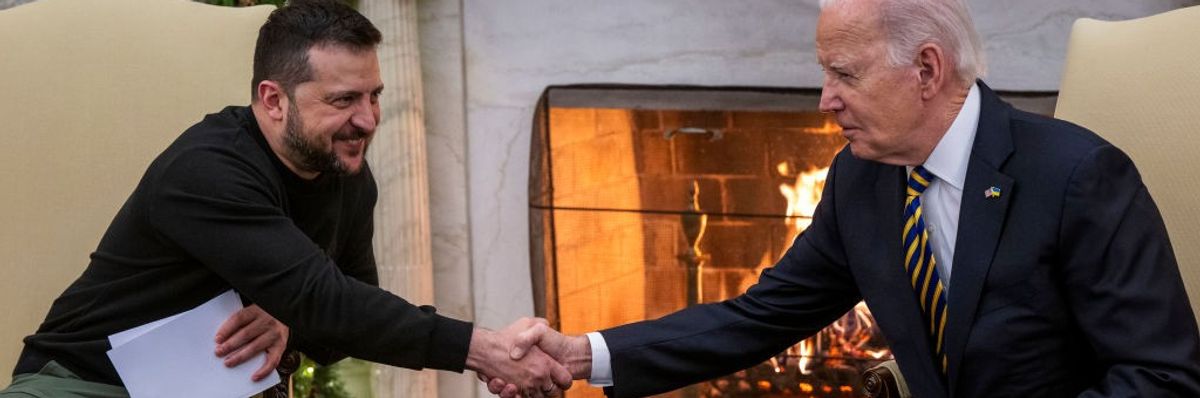
The U.S. and its NATO allies have declared that their goal in the war is to help Ukraine achieve a better position at the negotiating table. The truth is that Ukraine is unlikely ever to be in a better position than it is today.
In his press conference with President Zelensky on Tuesday evening, President Biden made one statement that was both entirely true, and is the potential basis for a new U.S. approach to the conflict in Ukraine. He said that Ukraine has already won a great victory in the war — by defeating the initial Russian plan to subjugate the whole of Ukraine.
If the Biden administration and Washington establishment could recognize the implications of this, they could craft a new narrative that would allow them, and the Ukrainian government, to present a compromise peace as a Ukrainian victory (albeit a qualified one) and a Russian defeat — though not a complete one.
In fact, the Ukrainian victory in 2022 was even greater than that. As things stand today, by preserving the independence and Western orientation of 80 percent of former Soviet Ukraine, the Ukrainian forces, with Western help, have reversed more than 300 years of history during which, in one way or another, Ukraine has been ruled from Russia.
Can anyone seriously think that future administrations will be able to procure such US aid next year, and the year after that, indefinitely?
As the distinguished Ukrainian historian Serhii Plokhy told the Quincy Institute on Tuesday, this achievement echoes that of the Finns during the Second World War, when their heroic resistance convinced Stalin that conquering the whole of Finland and turning it into a Communist state would be more trouble than it was worth. Finland was therefore the only part of the former Russian empire that was not incorporated into the Soviet Union or turned into a Communist client state.
Given the strength and unity of Ukrainian nationalism that this war has demonstrated, it is impossible to imagine that the whole of Ukraine could ever again be ruled for long by Moscow. However, Finnish survival as a democratic state did come at a price. Finland had to surrender a portion of its territory (including the historic city of Vyborg) and sign a treaty of neutrality. It should be obvious though that this was a vastly preferable alternative to sharing the fate of Poland, let alone the Baltic States.
In his own remarks to the press conference, President Zelensky categorically ruled out any cession of territory to Russia. Indeed it is very hard to imagine any Ukrainian government formally and legally agreeing to Russian annexation. On the other hand, bowing to military reality and the advice of his military commanders, President Zelensky has now ordered the Ukrainian army to go on the defensive and fortify its existing positions.
If this remains Ukrainian strategy, then by default the territory now held by Russia will remain under de facto Russian control; and given the disproportion of forces and resources between Ukraine and Russia, it is very difficult to see how a future Ukrainian offensive would succeed any more than this year’s has done.
Even if the Biden administration does persuade the Republicans in Congress to agree to another massive aid package for Ukraine, can anyone seriously think that future administrations will be able to procure such US aid next year, and the year after that, indefinitely? Yet that is what will be required if Ukraine is to sustain its fight. And when the aid stops, Ukraine will be defeated.
The Biden administration and its NATO allies have declared that their goal in the war is to help Ukraine achieve a better position at the negotiating table. But the truth is that Ukraine is unlikely ever to be in a better position than it is today. It could be much worse.
Finally, Biden said something that was probably just evasive phrasing, but could be spun into a new diplomatic approach. Asked about NATO membership for Ukraine, he said that “NATO will be part of Ukraine’s future.” NATO, for better or worse, will be part of all our futures. That does not mean that we will all become members of NATO.
Dear Common Dreams reader, It’s been nearly 30 years since I co-founded Common Dreams with my late wife, Lina Newhouser. We had the radical notion that journalism should serve the public good, not corporate profits. It was clear to us from the outset what it would take to build such a project. No paid advertisements. No corporate sponsors. No millionaire publisher telling us what to think or do. Many people said we wouldn't last a year, but we proved those doubters wrong. Together with a tremendous team of journalists and dedicated staff, we built an independent media outlet free from the constraints of profits and corporate control. Our mission has always been simple: To inform. To inspire. To ignite change for the common good. Building Common Dreams was not easy. Our survival was never guaranteed. When you take on the most powerful forces—Wall Street greed, fossil fuel industry destruction, Big Tech lobbyists, and uber-rich oligarchs who have spent billions upon billions rigging the economy and democracy in their favor—the only bulwark you have is supporters who believe in your work. But here’s the urgent message from me today. It's never been this bad out there. And it's never been this hard to keep us going. At the very moment Common Dreams is most needed, the threats we face are intensifying. We need your support now more than ever. We don't accept corporate advertising and never will. We don't have a paywall because we don't think people should be blocked from critical news based on their ability to pay. Everything we do is funded by the donations of readers like you. When everyone does the little they can afford, we are strong. But if that support retreats or dries up, so do we. Will you donate now to make sure Common Dreams not only survives but thrives? —Craig Brown, Co-founder |
In his press conference with President Zelensky on Tuesday evening, President Biden made one statement that was both entirely true, and is the potential basis for a new U.S. approach to the conflict in Ukraine. He said that Ukraine has already won a great victory in the war — by defeating the initial Russian plan to subjugate the whole of Ukraine.
If the Biden administration and Washington establishment could recognize the implications of this, they could craft a new narrative that would allow them, and the Ukrainian government, to present a compromise peace as a Ukrainian victory (albeit a qualified one) and a Russian defeat — though not a complete one.
In fact, the Ukrainian victory in 2022 was even greater than that. As things stand today, by preserving the independence and Western orientation of 80 percent of former Soviet Ukraine, the Ukrainian forces, with Western help, have reversed more than 300 years of history during which, in one way or another, Ukraine has been ruled from Russia.
Can anyone seriously think that future administrations will be able to procure such US aid next year, and the year after that, indefinitely?
As the distinguished Ukrainian historian Serhii Plokhy told the Quincy Institute on Tuesday, this achievement echoes that of the Finns during the Second World War, when their heroic resistance convinced Stalin that conquering the whole of Finland and turning it into a Communist state would be more trouble than it was worth. Finland was therefore the only part of the former Russian empire that was not incorporated into the Soviet Union or turned into a Communist client state.
Given the strength and unity of Ukrainian nationalism that this war has demonstrated, it is impossible to imagine that the whole of Ukraine could ever again be ruled for long by Moscow. However, Finnish survival as a democratic state did come at a price. Finland had to surrender a portion of its territory (including the historic city of Vyborg) and sign a treaty of neutrality. It should be obvious though that this was a vastly preferable alternative to sharing the fate of Poland, let alone the Baltic States.
In his own remarks to the press conference, President Zelensky categorically ruled out any cession of territory to Russia. Indeed it is very hard to imagine any Ukrainian government formally and legally agreeing to Russian annexation. On the other hand, bowing to military reality and the advice of his military commanders, President Zelensky has now ordered the Ukrainian army to go on the defensive and fortify its existing positions.
If this remains Ukrainian strategy, then by default the territory now held by Russia will remain under de facto Russian control; and given the disproportion of forces and resources between Ukraine and Russia, it is very difficult to see how a future Ukrainian offensive would succeed any more than this year’s has done.
Even if the Biden administration does persuade the Republicans in Congress to agree to another massive aid package for Ukraine, can anyone seriously think that future administrations will be able to procure such US aid next year, and the year after that, indefinitely? Yet that is what will be required if Ukraine is to sustain its fight. And when the aid stops, Ukraine will be defeated.
The Biden administration and its NATO allies have declared that their goal in the war is to help Ukraine achieve a better position at the negotiating table. But the truth is that Ukraine is unlikely ever to be in a better position than it is today. It could be much worse.
Finally, Biden said something that was probably just evasive phrasing, but could be spun into a new diplomatic approach. Asked about NATO membership for Ukraine, he said that “NATO will be part of Ukraine’s future.” NATO, for better or worse, will be part of all our futures. That does not mean that we will all become members of NATO.
In his press conference with President Zelensky on Tuesday evening, President Biden made one statement that was both entirely true, and is the potential basis for a new U.S. approach to the conflict in Ukraine. He said that Ukraine has already won a great victory in the war — by defeating the initial Russian plan to subjugate the whole of Ukraine.
If the Biden administration and Washington establishment could recognize the implications of this, they could craft a new narrative that would allow them, and the Ukrainian government, to present a compromise peace as a Ukrainian victory (albeit a qualified one) and a Russian defeat — though not a complete one.
In fact, the Ukrainian victory in 2022 was even greater than that. As things stand today, by preserving the independence and Western orientation of 80 percent of former Soviet Ukraine, the Ukrainian forces, with Western help, have reversed more than 300 years of history during which, in one way or another, Ukraine has been ruled from Russia.
Can anyone seriously think that future administrations will be able to procure such US aid next year, and the year after that, indefinitely?
As the distinguished Ukrainian historian Serhii Plokhy told the Quincy Institute on Tuesday, this achievement echoes that of the Finns during the Second World War, when their heroic resistance convinced Stalin that conquering the whole of Finland and turning it into a Communist state would be more trouble than it was worth. Finland was therefore the only part of the former Russian empire that was not incorporated into the Soviet Union or turned into a Communist client state.
Given the strength and unity of Ukrainian nationalism that this war has demonstrated, it is impossible to imagine that the whole of Ukraine could ever again be ruled for long by Moscow. However, Finnish survival as a democratic state did come at a price. Finland had to surrender a portion of its territory (including the historic city of Vyborg) and sign a treaty of neutrality. It should be obvious though that this was a vastly preferable alternative to sharing the fate of Poland, let alone the Baltic States.
In his own remarks to the press conference, President Zelensky categorically ruled out any cession of territory to Russia. Indeed it is very hard to imagine any Ukrainian government formally and legally agreeing to Russian annexation. On the other hand, bowing to military reality and the advice of his military commanders, President Zelensky has now ordered the Ukrainian army to go on the defensive and fortify its existing positions.
If this remains Ukrainian strategy, then by default the territory now held by Russia will remain under de facto Russian control; and given the disproportion of forces and resources between Ukraine and Russia, it is very difficult to see how a future Ukrainian offensive would succeed any more than this year’s has done.
Even if the Biden administration does persuade the Republicans in Congress to agree to another massive aid package for Ukraine, can anyone seriously think that future administrations will be able to procure such US aid next year, and the year after that, indefinitely? Yet that is what will be required if Ukraine is to sustain its fight. And when the aid stops, Ukraine will be defeated.
The Biden administration and its NATO allies have declared that their goal in the war is to help Ukraine achieve a better position at the negotiating table. But the truth is that Ukraine is unlikely ever to be in a better position than it is today. It could be much worse.
Finally, Biden said something that was probably just evasive phrasing, but could be spun into a new diplomatic approach. Asked about NATO membership for Ukraine, he said that “NATO will be part of Ukraine’s future.” NATO, for better or worse, will be part of all our futures. That does not mean that we will all become members of NATO.