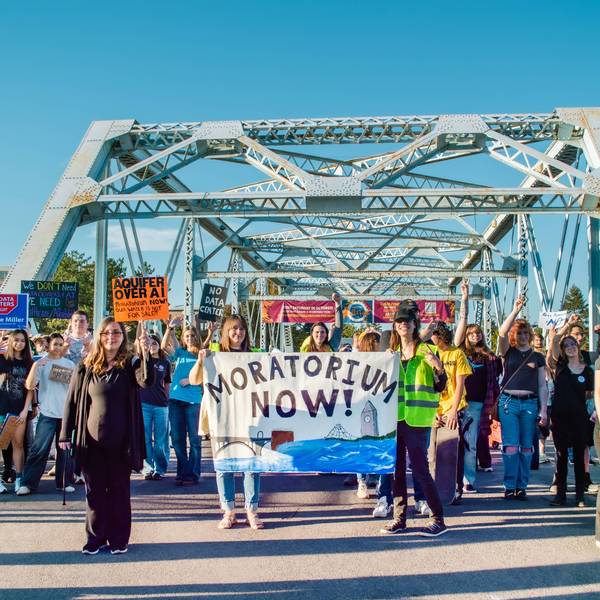

Rural Michigan residents rally against the $7 billion Stargate data center planned on southeast Michigan farm land in Saline, Michigan on December 1, 2025.
Your Town or City Can Be the Next to Pass a Data Center Moratorium!
Congress and the federal government have so far refused to meaningfully regulate the data centers cropping up across the country. So for now, state and local measures like the five-year moratorium passed in Lochbuie, Colorado represent the best tool to protect our communities.
I’m the Mayor of Lochbuie, Colorado, and my residents are worried about our water supply. So we passed a five-year moratorium on AI data centers. Your town can, too.
Like many other parts of the country, our state is facing a serious water-supply problem. Colorado’s water supply depends heavily on mountain snowpack, and our Colorado River system has been overburdened for years. This problem is exacerbated by reduced reservoir levels, population growth, and irrigation-intensive agriculture.
At the same time, climate change has led to record heat and droughts.
Our small town reflects communities across the country. According to a recent Gallup poll, over 70% of Americans oppose data centers in their local areas.
A single large-scale data center, depending on location and available resources, can use as much water as our entire town uses. Meanwhile data center energy use makes climate change worse, further endangering our shared future. Data center emissions are projected to skyrocket by 2035.
Water is a finite resource and can’t always replenish fast enough to meet growing demand. We don’t want hyperscale data centers coming into our town and overburdening our already stressed water resources—and polluting our air and groundwater while they’re at it.
Big data centers claim they bring jobs to communities. A closer look shows how flimsy these claims are. In reality, data centers create very few permanent jobs. Most data center jobs are temporary construction jobs, and most of those don’t go to local community members.
“I do want to see businesses in our community that create jobs, but I don’t see how a data center does that when it takes up so much land and produces so few jobs,” Shannon Donnelly, one of my constituents, told me. “We need a clear, evidence-based understanding of the costs and benefits before we make such big decisions that impact people’s lives.”
Shannon is not alone. I heard many comments like these at our town board meetings about water use, noise, and other pollution from data centers.
So I wrote up a proposal for a moratorium on AI data centers in Lochbuie. The ensuing public meeting drew more attendees than I had ever seen. They overwhelmingly supported a moratorium, and it passed easily.
What happened next reflects another troubling reality about how data centers are encroaching on unwilling communities: Brighton, which borders Lochbuie, announced a proposal for a data center there. A town boundary would not protect our water, air, animals, or residents.
“We’ll see the lights and hear the noise,” constituent Desirae Zima told me. “We’ll have to live with the traffic, the infrastructure demands, the industrial equipment, and the potential impacts to water and electricity resources. We will be the neighbors dealing with the impacts to our quality of life.”
Fortunately, opposition from Brighton residents was strong enough that the developer withdrew its application for the proposed data center and the city council voted to advance a one-year moratorium on any such construction. It awaits final approval.
Our small town reflects communities across the country. According to a recent Gallup poll, over 70% of Americans oppose data centers in their local areas. Nearly 500 cities, towns, and counties nationwide have enacted or are considering moratoria on data centers.
Congress and the federal government have so far refused to meaningfully regulate the data centers cropping up across the country. So for now, state and local measures like these represent the best tool to protect our communities.
Artificial Intelligence has not yet surpassed good old-fashioned human common sense.
We are at a crossroads
This country and this world are at a monumental crossroads. In a few short weeks, US voters will have an opportunity to beat back the forces of fascism and confront the billionaires who are rigging the economy, our media system, and our democracy, making it increasingly impossible for ordinary people to get by. We’re not just talking about the election. We’re talking about what must be done once these fascist elements are vanquished from power. We need a bolder set of solutions than what either major party has so far been willing to offer and a working-class movement ready to fight like hell for it. Trump didn't emerge from nowhere. The conditions that fueled MAGA authoritarianism were created by decades of radical neoliberal economic policies and a corrupt political system dominated by corporate interests. They slashed taxes on the super-rich, promising that the benefits would trickle down. They said giveaways to the corporate titans would make life more affordable for the rest of us. It was all bullshit. And when a bitter, betrayed populace searches for someone to blame, right-wing demagogues have little trouble finding scapegoats. People know when they're being lied to, but you won't hear any of this from the corporate media. Only independent journalism—powered and funded by people who believe in building a better world—can deliver truly trustworthy daily news. Our Fall Campaign is underway, and we need your help. To power our newsroom through the rest of the year, we need to raise $125,000 by midnight on October 31. So if you share our vision, please contribute whatever you can to sustain our work. |
I’m the Mayor of Lochbuie, Colorado, and my residents are worried about our water supply. So we passed a five-year moratorium on AI data centers. Your town can, too.
Like many other parts of the country, our state is facing a serious water-supply problem. Colorado’s water supply depends heavily on mountain snowpack, and our Colorado River system has been overburdened for years. This problem is exacerbated by reduced reservoir levels, population growth, and irrigation-intensive agriculture.
At the same time, climate change has led to record heat and droughts.
Our small town reflects communities across the country. According to a recent Gallup poll, over 70% of Americans oppose data centers in their local areas.
A single large-scale data center, depending on location and available resources, can use as much water as our entire town uses. Meanwhile data center energy use makes climate change worse, further endangering our shared future. Data center emissions are projected to skyrocket by 2035.
Water is a finite resource and can’t always replenish fast enough to meet growing demand. We don’t want hyperscale data centers coming into our town and overburdening our already stressed water resources—and polluting our air and groundwater while they’re at it.
Big data centers claim they bring jobs to communities. A closer look shows how flimsy these claims are. In reality, data centers create very few permanent jobs. Most data center jobs are temporary construction jobs, and most of those don’t go to local community members.
“I do want to see businesses in our community that create jobs, but I don’t see how a data center does that when it takes up so much land and produces so few jobs,” Shannon Donnelly, one of my constituents, told me. “We need a clear, evidence-based understanding of the costs and benefits before we make such big decisions that impact people’s lives.”
Shannon is not alone. I heard many comments like these at our town board meetings about water use, noise, and other pollution from data centers.
So I wrote up a proposal for a moratorium on AI data centers in Lochbuie. The ensuing public meeting drew more attendees than I had ever seen. They overwhelmingly supported a moratorium, and it passed easily.
What happened next reflects another troubling reality about how data centers are encroaching on unwilling communities: Brighton, which borders Lochbuie, announced a proposal for a data center there. A town boundary would not protect our water, air, animals, or residents.
“We’ll see the lights and hear the noise,” constituent Desirae Zima told me. “We’ll have to live with the traffic, the infrastructure demands, the industrial equipment, and the potential impacts to water and electricity resources. We will be the neighbors dealing with the impacts to our quality of life.”
Fortunately, opposition from Brighton residents was strong enough that the developer withdrew its application for the proposed data center and the city council voted to advance a one-year moratorium on any such construction. It awaits final approval.
Our small town reflects communities across the country. According to a recent Gallup poll, over 70% of Americans oppose data centers in their local areas. Nearly 500 cities, towns, and counties nationwide have enacted or are considering moratoria on data centers.
Congress and the federal government have so far refused to meaningfully regulate the data centers cropping up across the country. So for now, state and local measures like these represent the best tool to protect our communities.
Artificial Intelligence has not yet surpassed good old-fashioned human common sense.
- Rural New Jersey Town Moves to Ban All Data Centers After Community Revolts ›
- 'Strongest-in-the-Nation' Data Center Moratorium Proposed in NY ›
- 230+ Environmental Groups Call On Congress to Impose Moratorium on New AI Data Centers ›
- Alarmed by 'Rapid, Largely Unregulated Rise' of AI Data Centers, 500+ Groups Demand Congress Pass Moratorium ›
- With First-of-Its-Kind Bill, Sanders and AOC Propose Moratorium on New AI Data Centers ›
- 'We're Not a Company Town': Tech Hub Seattle Passes Data Center Moratorium ›