5
#000000
#FFFFFF
To donate by check, phone, or other method, see our More Ways to Give page.
Daily news & progressive opinion—funded by the people, not the corporations—delivered straight to your inbox.
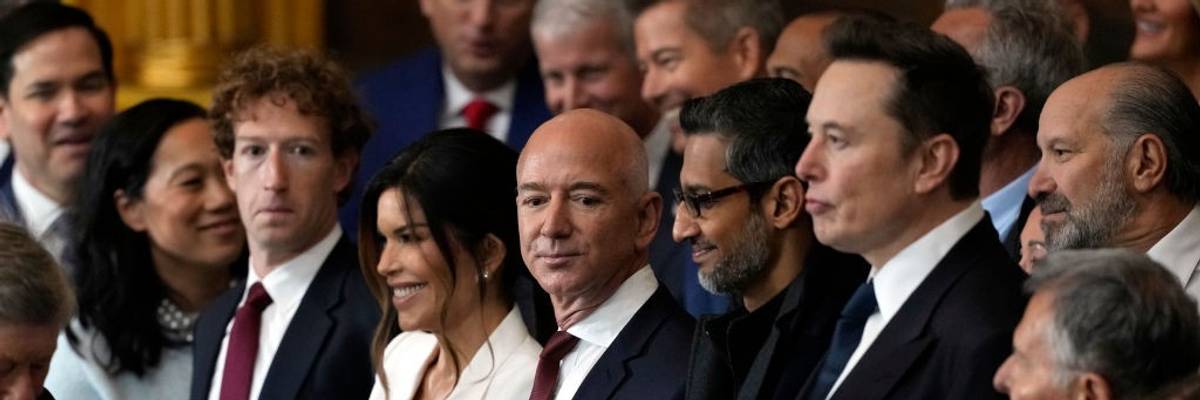
Guests including Mark Zuckerberg, Lauren Sanchez, Jeff Bezos, Sundar Pichai, and Elon Musk attend the Inauguration of Donald J. Trump in the US Capitol Rotunda on January 20, 2025 in Washington, DC.
How can government enact and enforce the necessary reforms if it’s under the control of a power elite that won’t permit them?
Behind this election’s dominant issue of affordability lies the record concentration of wealth at the top of America. The richest 0.001% of Americans—a handful of extraordinarily wealthy men—now control more of the nation’s wealth than at any time in modern history.
To be sure, wealth is not a zero-sum game in which the riches of those at the top necessarily come at the expense of everyone else. But power is a zero-sum game, because the more of it that is held by some people, the less of it is held by others.
Wealth cannot be separated from power. Great wealth becomes great power through campaign contributions, media ownership, the ability to buy off opposition, the capacity to wage pubic relations campaigns, and the resources to deploy armies of lawyers who litigate on your behalf. Recent years provide abundant illustration of all this.
This massive power shift is even more starkly illustrated by the billionaires, financial mavens, and tech bros who put Trump in power, who refuse to slow climate change, and who are now deciding on the future of AI and therefore humanity.
In these ways, great power also becomes great wealth. It buys changes in laws, regulations, and court decisions that bestow even more wealth on those with the power to alter the system to their benefit—and to siphon off resources from everyone else.
This power shift has also become clearly evident in recent years. In the Trump era it has taken the form of blatant corruption. But the political bribes, billionaire media ownership, PR campaigns, and well-financed litigation predated President Donald Trump.
For many years (with the notable exception of the Biden administration), antitrust enforcement has been defanged to make it easier for big firms to monopolize. Among the most widely discussed findings about the US economy is the rise of corporate concentration since the 1980s. The biggest firms, their top executives, and their major shareholders have all done wonderfully well. Consumers and employees, however, have faced higher prices, lower paychecks, and fewer choices.
At the same time, labor laws have been altered to make it more difficult to organize unions. In the 1950s, more than a third of private-sector workers were unionized. Now, fewer than 6% are.
Tax laws have been changed to reduce the rates and amounts paid by the super-wealthy, to the point where many pay no taxes at all—even though they have more wealth than ever.
This massive power shift is even more starkly illustrated by the billionaires, financial mavens, and tech bros who put Trump in power, who refuse to slow climate change, and who are now deciding on the future of AI and therefore humanity.
The question I keep coming back to is whether this can be reversed.
There is historic precedent. After the first Gilded Age—which ran from the 1890s to the start of World War I, and which featured wide inequalities of income, wealth, and political power—America reacted in what came to be known as the Progressive Era.
Starting under Theodore Roosevelt, monopolies were busted up, corporations were regulated, a progressive income tax was enacted, and corporate political donations (bribes) were barred. Then, starting in 1933, under Teddy Roosevelt’s fifth cousin, power continued to be shifted to what became the largest middle class in world history.
Then came the 1970s and 1980s, when the process began to go in reverse.
The challenge is arguably much greater today because wealth and power are more concentrated than in the first Gilded Age, creating a chicken-and-egg paradox: How can government enact and enforce the necessary reforms if it’s under the control of a power elite that won’t permit them?
Now, just four weeks from what could be a major political victory for the Democrats in taking back at least one chamber of Congress, this paradox should soon be the center of our national debate.
Dear Common Dreams reader, It’s been nearly 30 years since I co-founded Common Dreams with my late wife, Lina Newhouser. We had the radical notion that journalism should serve the public good, not corporate profits. It was clear to us from the outset what it would take to build such a project. No paid advertisements. No corporate sponsors. No millionaire publisher telling us what to think or do. Many people said we wouldn't last a year, but we proved those doubters wrong. Together with a tremendous team of journalists and dedicated staff, we built an independent media outlet free from the constraints of profits and corporate control. Our mission has always been simple: To inform. To inspire. To ignite change for the common good. Building Common Dreams was not easy. Our survival was never guaranteed. When you take on the most powerful forces—Wall Street greed, fossil fuel industry destruction, Big Tech lobbyists, and uber-rich oligarchs who have spent billions upon billions rigging the economy and democracy in their favor—the only bulwark you have is supporters who believe in your work. But here’s the urgent message from me today. It's never been this bad out there. And it's never been this hard to keep us going. At the very moment Common Dreams is most needed, the threats we face are intensifying. We need your support now more than ever. We don't accept corporate advertising and never will. We don't have a paywall because we don't think people should be blocked from critical news based on their ability to pay. Everything we do is funded by the donations of readers like you. When everyone does the little they can afford, we are strong. But if that support retreats or dries up, so do we. Will you donate now to make sure Common Dreams not only survives but thrives? —Craig Brown, Co-founder |
Behind this election’s dominant issue of affordability lies the record concentration of wealth at the top of America. The richest 0.001% of Americans—a handful of extraordinarily wealthy men—now control more of the nation’s wealth than at any time in modern history.
To be sure, wealth is not a zero-sum game in which the riches of those at the top necessarily come at the expense of everyone else. But power is a zero-sum game, because the more of it that is held by some people, the less of it is held by others.
Wealth cannot be separated from power. Great wealth becomes great power through campaign contributions, media ownership, the ability to buy off opposition, the capacity to wage pubic relations campaigns, and the resources to deploy armies of lawyers who litigate on your behalf. Recent years provide abundant illustration of all this.
This massive power shift is even more starkly illustrated by the billionaires, financial mavens, and tech bros who put Trump in power, who refuse to slow climate change, and who are now deciding on the future of AI and therefore humanity.
In these ways, great power also becomes great wealth. It buys changes in laws, regulations, and court decisions that bestow even more wealth on those with the power to alter the system to their benefit—and to siphon off resources from everyone else.
This power shift has also become clearly evident in recent years. In the Trump era it has taken the form of blatant corruption. But the political bribes, billionaire media ownership, PR campaigns, and well-financed litigation predated President Donald Trump.
For many years (with the notable exception of the Biden administration), antitrust enforcement has been defanged to make it easier for big firms to monopolize. Among the most widely discussed findings about the US economy is the rise of corporate concentration since the 1980s. The biggest firms, their top executives, and their major shareholders have all done wonderfully well. Consumers and employees, however, have faced higher prices, lower paychecks, and fewer choices.
At the same time, labor laws have been altered to make it more difficult to organize unions. In the 1950s, more than a third of private-sector workers were unionized. Now, fewer than 6% are.
Tax laws have been changed to reduce the rates and amounts paid by the super-wealthy, to the point where many pay no taxes at all—even though they have more wealth than ever.
This massive power shift is even more starkly illustrated by the billionaires, financial mavens, and tech bros who put Trump in power, who refuse to slow climate change, and who are now deciding on the future of AI and therefore humanity.
The question I keep coming back to is whether this can be reversed.
There is historic precedent. After the first Gilded Age—which ran from the 1890s to the start of World War I, and which featured wide inequalities of income, wealth, and political power—America reacted in what came to be known as the Progressive Era.
Starting under Theodore Roosevelt, monopolies were busted up, corporations were regulated, a progressive income tax was enacted, and corporate political donations (bribes) were barred. Then, starting in 1933, under Teddy Roosevelt’s fifth cousin, power continued to be shifted to what became the largest middle class in world history.
Then came the 1970s and 1980s, when the process began to go in reverse.
The challenge is arguably much greater today because wealth and power are more concentrated than in the first Gilded Age, creating a chicken-and-egg paradox: How can government enact and enforce the necessary reforms if it’s under the control of a power elite that won’t permit them?
Now, just four weeks from what could be a major political victory for the Democrats in taking back at least one chamber of Congress, this paradox should soon be the center of our national debate.
Behind this election’s dominant issue of affordability lies the record concentration of wealth at the top of America. The richest 0.001% of Americans—a handful of extraordinarily wealthy men—now control more of the nation’s wealth than at any time in modern history.
To be sure, wealth is not a zero-sum game in which the riches of those at the top necessarily come at the expense of everyone else. But power is a zero-sum game, because the more of it that is held by some people, the less of it is held by others.
Wealth cannot be separated from power. Great wealth becomes great power through campaign contributions, media ownership, the ability to buy off opposition, the capacity to wage pubic relations campaigns, and the resources to deploy armies of lawyers who litigate on your behalf. Recent years provide abundant illustration of all this.
This massive power shift is even more starkly illustrated by the billionaires, financial mavens, and tech bros who put Trump in power, who refuse to slow climate change, and who are now deciding on the future of AI and therefore humanity.
In these ways, great power also becomes great wealth. It buys changes in laws, regulations, and court decisions that bestow even more wealth on those with the power to alter the system to their benefit—and to siphon off resources from everyone else.
This power shift has also become clearly evident in recent years. In the Trump era it has taken the form of blatant corruption. But the political bribes, billionaire media ownership, PR campaigns, and well-financed litigation predated President Donald Trump.
For many years (with the notable exception of the Biden administration), antitrust enforcement has been defanged to make it easier for big firms to monopolize. Among the most widely discussed findings about the US economy is the rise of corporate concentration since the 1980s. The biggest firms, their top executives, and their major shareholders have all done wonderfully well. Consumers and employees, however, have faced higher prices, lower paychecks, and fewer choices.
At the same time, labor laws have been altered to make it more difficult to organize unions. In the 1950s, more than a third of private-sector workers were unionized. Now, fewer than 6% are.
Tax laws have been changed to reduce the rates and amounts paid by the super-wealthy, to the point where many pay no taxes at all—even though they have more wealth than ever.
This massive power shift is even more starkly illustrated by the billionaires, financial mavens, and tech bros who put Trump in power, who refuse to slow climate change, and who are now deciding on the future of AI and therefore humanity.
The question I keep coming back to is whether this can be reversed.
There is historic precedent. After the first Gilded Age—which ran from the 1890s to the start of World War I, and which featured wide inequalities of income, wealth, and political power—America reacted in what came to be known as the Progressive Era.
Starting under Theodore Roosevelt, monopolies were busted up, corporations were regulated, a progressive income tax was enacted, and corporate political donations (bribes) were barred. Then, starting in 1933, under Teddy Roosevelt’s fifth cousin, power continued to be shifted to what became the largest middle class in world history.
Then came the 1970s and 1980s, when the process began to go in reverse.
The challenge is arguably much greater today because wealth and power are more concentrated than in the first Gilded Age, creating a chicken-and-egg paradox: How can government enact and enforce the necessary reforms if it’s under the control of a power elite that won’t permit them?
Now, just four weeks from what could be a major political victory for the Democrats in taking back at least one chamber of Congress, this paradox should soon be the center of our national debate.