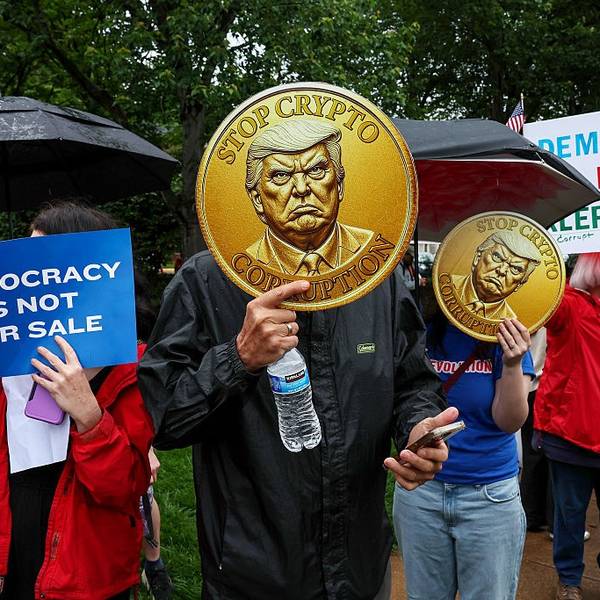

Protesters gather outside the US Supreme Court as Sen. Chuck Schumer (D-NY) speaks during a press conference July 30, 2019 in Washington, DC.
States Have Found a Way to Fight Back Against Citizens United
Federal attempts to overturn the ruling by amending the US Constitution or legislating against corporate spending have repeatedly failed. But now several states are experimenting with new ways to get this flood of corporate money out of politics.
More than 15 years ago, the Supreme Court removed limits on corporate political spending in its notorious Citizens United decision, ushering in an era of unprecedented influence by moneyed interests.
As a result, a small group of ultra-wealthy donors have skewed the political system to their advantage—and today, social scientists link the growing gap between rich and poor to that seminal 2010 decision.
Federal attempts to overturn the ruling by amending the US Constitution or legislating against corporate spending have repeatedly failed. But now several states are experimenting with new ways to get this flood of corporate money out of politics.
The state of Hawaii just passed a first-of-its-kind law redefining corporations as entities that aren’t allowed to spend money in elections anywhere within the state. The effort could kick off a powerful state-by-state pushback that succeeds where federal efforts failed.
Curtailing corporate influence on the political system is essential at a time when corporations are thriving while ordinary Americans struggle to make ends meet.
This simple idea is the brainchild of Tom Moore, senior fellow for democracy policy at the Center for American Progress. “It’s not regulation; it’s redefinition,” Moore told me. “States create corporations, and they give powers to all the corporations that operate within their states.”
So if the federal government and the Supreme Court enable corporations to influence elections, states can counter that merely by changing the definition of a corporation. And that’s precisely what Hawaii did. Effective starting July 2027, corporations doing business in the state are redefined to “not include the power to spend money or contribute anything of value to influence elections or ballot measures.”
The novel approach is well-protected against legal challenges. Moore explained, “The Supreme Court has said consistently for 200 years that [the power to define corporations] is a matter of state law, that the federal courts don’t have anything to do with that.”
The impact of this on Hawaii’s politics are likely to be monumental. “Basically, in Hawaii politics, local, state, and federal, every dollar that’s spent will be from an individual human being,” said Moore. “It’ll be disclosed, it’ll be voluntary. And that is a gigantic difference from what we have right now.”
Hawaii’s law doesn’t overturn Citizens United—it makes the 2010 ruling meaningless within its borders.
Residents of Montana are pushing a similar effort. Activists there are gathering signatures to place a measure on the November ballot to similarly redefine corporations so they can’t spend money in elections. If the measure passes, it will go into effect in January 2027, six months before Hawaii’s law takes effect.
In fact, according to Moore, Hawaii’s legislators borrowed the language for their bill from Montana’s ballot measure and sped it through their legislative process, pleasantly surprising advocates. Moore is confident the Montana effort will succeed. “They’re in very, very good shape, they’re incredibly well-organized,” he said.
At least 14 states, including New York and California, are currently considering similar bills, and Hawaii’s new law prompted interested lawmakers from two other states to contact Moore. “We’ve had outreach from folks in almost every state,” he said. Given the fact that it’s been less than a year since Moore first published his idea, the speed at which it’s caught on has been remarkable.
Curtailing corporate influence on the political system is essential at a time when corporations are thriving while ordinary Americans struggle to make ends meet. “At the end of the day, corporations don’t actually work for their shareholders, they work for us because we create them through our legislatures, through our laws,” said Moore.
“And if corporations are doing something in our state that we don’t like, we have the power as citizens and working through our legislators to do something about that."
We are at a crossroads
This country and this world are at a monumental crossroads. In a few short weeks, US voters will have an opportunity to beat back the forces of fascism and confront the billionaires who are rigging the economy, our media system, and our democracy, making it increasingly impossible for ordinary people to get by. We’re not just talking about the election. We’re talking about what must be done once these fascist elements are vanquished from power. We need a bolder set of solutions than what either major party has so far been willing to offer and a working-class movement ready to fight like hell for it. Trump didn't emerge from nowhere. The conditions that fueled MAGA authoritarianism were created by decades of radical neoliberal economic policies and a corrupt political system dominated by corporate interests. They slashed taxes on the super-rich, promising that the benefits would trickle down. They said giveaways to the corporate titans would make life more affordable for the rest of us. It was all bullshit. And when a bitter, betrayed populace searches for someone to blame, right-wing demagogues have little trouble finding scapegoats. People know when they're being lied to, but you won't hear any of this from the corporate media. Only independent journalism—powered and funded by people who believe in building a better world—can deliver truly trustworthy daily news. Our Fall Campaign is underway, and we need your help. To power our newsroom through the rest of the year, we need to raise $125,000 by midnight on October 31. So if you share our vision, please contribute whatever you can to sustain our work. |
More than 15 years ago, the Supreme Court removed limits on corporate political spending in its notorious Citizens United decision, ushering in an era of unprecedented influence by moneyed interests.
As a result, a small group of ultra-wealthy donors have skewed the political system to their advantage—and today, social scientists link the growing gap between rich and poor to that seminal 2010 decision.
Federal attempts to overturn the ruling by amending the US Constitution or legislating against corporate spending have repeatedly failed. But now several states are experimenting with new ways to get this flood of corporate money out of politics.
The state of Hawaii just passed a first-of-its-kind law redefining corporations as entities that aren’t allowed to spend money in elections anywhere within the state. The effort could kick off a powerful state-by-state pushback that succeeds where federal efforts failed.
Curtailing corporate influence on the political system is essential at a time when corporations are thriving while ordinary Americans struggle to make ends meet.
This simple idea is the brainchild of Tom Moore, senior fellow for democracy policy at the Center for American Progress. “It’s not regulation; it’s redefinition,” Moore told me. “States create corporations, and they give powers to all the corporations that operate within their states.”
So if the federal government and the Supreme Court enable corporations to influence elections, states can counter that merely by changing the definition of a corporation. And that’s precisely what Hawaii did. Effective starting July 2027, corporations doing business in the state are redefined to “not include the power to spend money or contribute anything of value to influence elections or ballot measures.”
The novel approach is well-protected against legal challenges. Moore explained, “The Supreme Court has said consistently for 200 years that [the power to define corporations] is a matter of state law, that the federal courts don’t have anything to do with that.”
The impact of this on Hawaii’s politics are likely to be monumental. “Basically, in Hawaii politics, local, state, and federal, every dollar that’s spent will be from an individual human being,” said Moore. “It’ll be disclosed, it’ll be voluntary. And that is a gigantic difference from what we have right now.”
Hawaii’s law doesn’t overturn Citizens United—it makes the 2010 ruling meaningless within its borders.
Residents of Montana are pushing a similar effort. Activists there are gathering signatures to place a measure on the November ballot to similarly redefine corporations so they can’t spend money in elections. If the measure passes, it will go into effect in January 2027, six months before Hawaii’s law takes effect.
In fact, according to Moore, Hawaii’s legislators borrowed the language for their bill from Montana’s ballot measure and sped it through their legislative process, pleasantly surprising advocates. Moore is confident the Montana effort will succeed. “They’re in very, very good shape, they’re incredibly well-organized,” he said.
At least 14 states, including New York and California, are currently considering similar bills, and Hawaii’s new law prompted interested lawmakers from two other states to contact Moore. “We’ve had outreach from folks in almost every state,” he said. Given the fact that it’s been less than a year since Moore first published his idea, the speed at which it’s caught on has been remarkable.
Curtailing corporate influence on the political system is essential at a time when corporations are thriving while ordinary Americans struggle to make ends meet. “At the end of the day, corporations don’t actually work for their shareholders, they work for us because we create them through our legislatures, through our laws,” said Moore.
“And if corporations are doing something in our state that we don’t like, we have the power as citizens and working through our legislators to do something about that."
- Supreme Court Upholds Citizens United; Tightens Corporate Stranglehold on Campaign Finance ›
- Virginia Becomes the 22nd State to Support an Amendment to Overturn Citizens United ›
- In Delaware, Corporations Can Now Vote. Are We Insane? ›
- 'We Must End Citizens United,' Progressives Say as Ruling Turns 15 Amid 'Growing Oligarchy' ›
- ‘Big News’: Hawaii Targets Citizens United With Law Clarifying Corporations Are Not People ›
- 'Democracy for All': House Dems Introduce Bill to Overturn Citizens United ›
- 'Montana Plan' Targeting Corporate Money in Politics Secures Enough Signatures for Ballot | Common Dreams ›