SUBSCRIBE TO OUR FREE NEWSLETTER
Daily news & progressive opinion—funded by the people, not the corporations—delivered straight to your inbox.
5
#000000
#FFFFFF
To donate by check, phone, or other method, see our More Ways to Give page.

Fat is now phat, at least according to Robert F. Kennedy Jr.
When President Donald Trump’s Health and Human Services (HHS) secretary unveiled new federal dietary guidelines this January, he declared: “We are ending the war on saturated fats.” Seconding Kennedy was Food and Drug Administration Commissioner Marty Makary, who promised that children and schools will no longer need to “tiptoe” around fat.
Kennedy’s exaltation of fat comes complete with a new upside-down guidelines pyramid where a thick cut of steak and a wedge of cheese share top billing with fruit and vegetables. This prime placement of a prime cut is the strongest endorsement for consuming red meat since the government first issued dietary guidelines in 1980.
The endorsement reverses decades of advisories, which the US Department of Agriculture (USDA) and HHS jointly issue every five years, to limit red meat consumption issued under both Democratic and Republican administrations given the strong evidence that eating less of it lowers the risk of cardiovascular disease. Multiple studies over the last decade have linked red and processed meats not only to cardiovascular disease, but also to colon polyps, colorectal cancer, diabetes, diverticulosis, pneumonia, and even premature death.
Given the scientific evidence, we should intensify the war against saturated fats, not call it off.
The new dietary guidelines even contradict those issued under the first Trump administration just five years ago, warning Americans not to eat too much saturated fat. “There is little room,” those guidelines stated, “to include additional saturated fat in a healthy dietary pattern.” A significant percentage of saturated fat comes from red meat. Americans, who account for only 4% of the people on the planet, consume 21% of the world’s beef.
Kennedy’s fatmania even extends to beef tallow and butter, which the new pyramid identifies—along with olive oil—as “healthy fats” for cooking. In fact, beef tallow is 50% saturated fat. Butter is nearly 70%. Olive oil, meanwhile, is just 14% saturated fat and is, indeed, healthy.
This rendering of recommended fats muddles a message that could have been stunningly refreshing, given the Trump administration’s penchant for meddling with science. Some of the new pyramid’s recommendations were applauded by mainstream health advocacy groups, particularly one advising Americans to consume no more than 10 grams of added sugar per meal and others, as Kennedy pointed out, calling for people to “prioritize whole, nutrient-dense foods—protein, dairy, vegetables, fruits, healthy fats, and whole grains—and dramatically reduce highly processed foods.”
But such wholesomeness could easily be wasted if Americans increase their meat consumption. That would not, as Kennedy professes, make America healthy again. Given the scientific evidence, we should intensify the war against saturated fats, not call it off.
The 420-page report by the Dietary Guidelines Advisory Committee prepared in 2024 for the USDA and HHS found that more than 80% of Americans consume more than the recommended daily limit of saturated fat, which is about 20 grams—10% of a 2,000 calorie-per-day diet. The report concluded that replacing butter with plant-based oils and spreads higher in unsaturated fat is associated with lower cardiovascular disease risk and eating plant-based foods instead of meat is “associated with favorable cardiovascular outcomes.”
A March 2025 peer-reviewed study in JAMA Internal Medicine came to a similar conclusion. It found that eating more butter was associated with a higher risk of cardiovascular disease and cancer. Using plant-based oils instead of butter, the researcher found, was associated with a 17% lower risk of death. Such a reduction in mortality, according to study co-author Dr. Daniel Wang, means “a substantial number of deaths from cancer or from other chronic diseases … could be prevented” by replacing butter with such plant-based oils as soybean or olive oil.
What does a “substantial” number of deaths look like? Heart disease is the No. 1 killer in the United States, and heart disease and stroke kill more people than all cancers and accidents combined. The annual number of American deaths tied to cardiovascular disease is creeping toward the million mark. According to the American Heart Association (AHA), it killed more than 940,000 people in 2022.
Over the next 25 years, AHA projects that the incidence of high blood pressure among adults will increase from 50% today to 61%, obesity rates will jump from 43% to 60% and diabetes will afflict nearly 27% of Americans compared to 16% today. Reducing mortality by 17% for those and other related health problems would go a long way to make Americans healthier.
A good place to begin reducing food-related mortality is by cutting highly processed foods out of the American diet. That would require a drastic change in eating habits for a lot of people. A July 2022 study found that nearly 60% of calories in the average American diet comes from ultra-processed foods, which have been linked to cancer, cardiovascular disease, depression, diabetes, and obesity.
One of the main culprits is fast food. A January 2025 study of the six most popular fast-food chains in the country—Chick-fil-A, Domino’s Pizza, McDonald’s, Starbucks, Subway and Taco Bell—found that 85% of their menu items were ultra-processed. And, according to a 2018 study, more than a third of US adults dine at a fast-food chain on any given day, including nearly half of those aged 20 to 39.
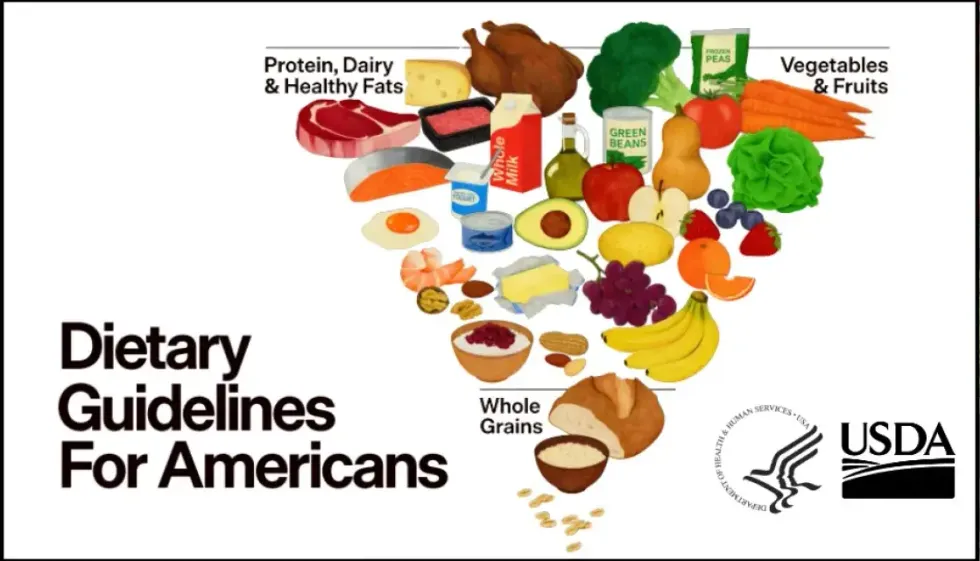 The new federal dietary guidelines reverse decades of advisories that recommended limiting red meat consumption. (Illustration: HHS/USDA)
Our overreliance on fast food presents a huge conundrum. US food systems are structured in a way that it is unlikely you can tell people to cut processed foods and eat more meat at the same time. Hamburgers and processed deli meat are among the main ways Americans consume red meat. And given the blizzard of TV ads for junk food and fast-food joints, which have proliferated across the country and especially in low-income food deserts—it is also unlikely that many people will use the new guidelines to comb through their local grocer’s meat department for the leanest (and often most expensive) cut of beef.
According to the University of Connecticut’s Rudd Center for Food Policy and Health, food, beverage, and restaurant companies spend $14 billion a year on advertising in the United States. More than 80% of those ad buys are for fast food, sugary drinks, candy, and unhealthy snacks. That $14 billion is also 10 times more than the $1.4 billion fiscal year 2024 budget for chronic disease and health promotion at the Centers for Disease Control and Prevention. And don’t expect the CDC to get into an arms race with junk food advertisers any time soon. Kennedy slashed the CDC staff by more than 25%, from 13,500 to below 10,000.
All of this adds up to the probability that Americans will see the new guidelines’ recommendation to eat red meat as a green light to gorge on even more burgers and other fast-food, ultra-processed meat.
The new guidelines’ green light for consuming red meat and saturated fats is particularly vexing given the guidelines produced five years ago during Trump’s first term did not promote them. Why the about-face?
During the run-up to Trump’s second term, the agribusiness industry went into overdrive to install Trump in the White House and more Republicans in Congress. In 2016, agribusinesses gave Trump $4.6 million for his campaign, nearly double what it gave Hillary Clinton. But in 2024, they gave Trump $24.2 million, five times what it gave Kamala Harris. Agribusinesses also donated $1 million to Kennedy’s failed 2024 campaign, making him the fourth-biggest recipient among all presidential candidates during that election cycle.
Robert F. Kennedy Jr. is nowhere near making America healthy again by declaring in his new food pyramid that red meat is as healthy as broccoli, tomatoes, and beans.
Despite claiming he wanted dietary guidelines “free from ideological bias, institutional conflicts, or predetermined conclusions,” Kennedy rejected the recommendations of the Dietary Guidelines Advisory Committee and turned over the nation’s dietary data to 9 review authors, at least 6 of whom had financial ties to the beef, dairy, infant-formula, or weight-loss industry.
Three of them have received either research grant funding, honoraria, or consulting fees from the National Cattlemen’s Beef Association, which is known for funding dubious research downplaying or dismissing independent scientific findings that show read meat to be threat to public health and the environment. In 2024, the trade group gave nearly all of its $1.1 million in campaign contributions to Republican committees and candidates.
Kim Brackett, an Idaho rancher and vice president of the beef industry trade group, hailed the new guidelines, claiming “it is easy to incorporate beef into a balanced, heart-healthy diet.”
Perhaps, but the grim reality is most Americans do not follow a balanced, heart-healthy diet. Four out of five of us are already consuming more than the recommended daily limit of saturated fat and we are well on our way to a 60% obesity rate.
So, Robert F. Kennedy Jr. is nowhere near making America healthy again by declaring in his new food pyramid that red meat is as healthy as broccoli, tomatoes, and beans. Beholden to Big Beef, he is driving us full speed ahead on the road to a collective heart attack.
This article first appeared at the Money Trail blog and is reposted here at Common Dreams with permission.
Fat is now phat, at least according to Robert F. Kennedy Jr.
When President Donald Trump’s Health and Human Services (HHS) secretary unveiled new federal dietary guidelines this January, he declared: “We are ending the war on saturated fats.” Seconding Kennedy was Food and Drug Administration Commissioner Marty Makary, who promised that children and schools will no longer need to “tiptoe” around fat.
Kennedy’s exaltation of fat comes complete with a new upside-down guidelines pyramid where a thick cut of steak and a wedge of cheese share top billing with fruit and vegetables. This prime placement of a prime cut is the strongest endorsement for consuming red meat since the government first issued dietary guidelines in 1980.
The endorsement reverses decades of advisories, which the US Department of Agriculture (USDA) and HHS jointly issue every five years, to limit red meat consumption issued under both Democratic and Republican administrations given the strong evidence that eating less of it lowers the risk of cardiovascular disease. Multiple studies over the last decade have linked red and processed meats not only to cardiovascular disease, but also to colon polyps, colorectal cancer, diabetes, diverticulosis, pneumonia, and even premature death.
Given the scientific evidence, we should intensify the war against saturated fats, not call it off.
The new dietary guidelines even contradict those issued under the first Trump administration just five years ago, warning Americans not to eat too much saturated fat. “There is little room,” those guidelines stated, “to include additional saturated fat in a healthy dietary pattern.” A significant percentage of saturated fat comes from red meat. Americans, who account for only 4% of the people on the planet, consume 21% of the world’s beef.
Kennedy’s fatmania even extends to beef tallow and butter, which the new pyramid identifies—along with olive oil—as “healthy fats” for cooking. In fact, beef tallow is 50% saturated fat. Butter is nearly 70%. Olive oil, meanwhile, is just 14% saturated fat and is, indeed, healthy.
This rendering of recommended fats muddles a message that could have been stunningly refreshing, given the Trump administration’s penchant for meddling with science. Some of the new pyramid’s recommendations were applauded by mainstream health advocacy groups, particularly one advising Americans to consume no more than 10 grams of added sugar per meal and others, as Kennedy pointed out, calling for people to “prioritize whole, nutrient-dense foods—protein, dairy, vegetables, fruits, healthy fats, and whole grains—and dramatically reduce highly processed foods.”
But such wholesomeness could easily be wasted if Americans increase their meat consumption. That would not, as Kennedy professes, make America healthy again. Given the scientific evidence, we should intensify the war against saturated fats, not call it off.
The 420-page report by the Dietary Guidelines Advisory Committee prepared in 2024 for the USDA and HHS found that more than 80% of Americans consume more than the recommended daily limit of saturated fat, which is about 20 grams—10% of a 2,000 calorie-per-day diet. The report concluded that replacing butter with plant-based oils and spreads higher in unsaturated fat is associated with lower cardiovascular disease risk and eating plant-based foods instead of meat is “associated with favorable cardiovascular outcomes.”
A March 2025 peer-reviewed study in JAMA Internal Medicine came to a similar conclusion. It found that eating more butter was associated with a higher risk of cardiovascular disease and cancer. Using plant-based oils instead of butter, the researcher found, was associated with a 17% lower risk of death. Such a reduction in mortality, according to study co-author Dr. Daniel Wang, means “a substantial number of deaths from cancer or from other chronic diseases … could be prevented” by replacing butter with such plant-based oils as soybean or olive oil.
What does a “substantial” number of deaths look like? Heart disease is the No. 1 killer in the United States, and heart disease and stroke kill more people than all cancers and accidents combined. The annual number of American deaths tied to cardiovascular disease is creeping toward the million mark. According to the American Heart Association (AHA), it killed more than 940,000 people in 2022.
Over the next 25 years, AHA projects that the incidence of high blood pressure among adults will increase from 50% today to 61%, obesity rates will jump from 43% to 60% and diabetes will afflict nearly 27% of Americans compared to 16% today. Reducing mortality by 17% for those and other related health problems would go a long way to make Americans healthier.
A good place to begin reducing food-related mortality is by cutting highly processed foods out of the American diet. That would require a drastic change in eating habits for a lot of people. A July 2022 study found that nearly 60% of calories in the average American diet comes from ultra-processed foods, which have been linked to cancer, cardiovascular disease, depression, diabetes, and obesity.
One of the main culprits is fast food. A January 2025 study of the six most popular fast-food chains in the country—Chick-fil-A, Domino’s Pizza, McDonald’s, Starbucks, Subway and Taco Bell—found that 85% of their menu items were ultra-processed. And, according to a 2018 study, more than a third of US adults dine at a fast-food chain on any given day, including nearly half of those aged 20 to 39.
The new federal dietary guidelines reverse decades of advisories that recommended limiting red meat consumption. (Illustration: HHS/USDA)
Our overreliance on fast food presents a huge conundrum. US food systems are structured in a way that it is unlikely you can tell people to cut processed foods and eat more meat at the same time. Hamburgers and processed deli meat are among the main ways Americans consume red meat. And given the blizzard of TV ads for junk food and fast-food joints, which have proliferated across the country and especially in low-income food deserts—it is also unlikely that many people will use the new guidelines to comb through their local grocer’s meat department for the leanest (and often most expensive) cut of beef.
According to the University of Connecticut’s Rudd Center for Food Policy and Health, food, beverage, and restaurant companies spend $14 billion a year on advertising in the United States. More than 80% of those ad buys are for fast food, sugary drinks, candy, and unhealthy snacks. That $14 billion is also 10 times more than the $1.4 billion fiscal year 2024 budget for chronic disease and health promotion at the Centers for Disease Control and Prevention. And don’t expect the CDC to get into an arms race with junk food advertisers any time soon. Kennedy slashed the CDC staff by more than 25%, from 13,500 to below 10,000.
All of this adds up to the probability that Americans will see the new guidelines’ recommendation to eat red meat as a green light to gorge on even more burgers and other fast-food, ultra-processed meat.
The new guidelines’ green light for consuming red meat and saturated fats is particularly vexing given the guidelines produced five years ago during Trump’s first term did not promote them. Why the about-face?
During the run-up to Trump’s second term, the agribusiness industry went into overdrive to install Trump in the White House and more Republicans in Congress. In 2016, agribusinesses gave Trump $4.6 million for his campaign, nearly double what it gave Hillary Clinton. But in 2024, they gave Trump $24.2 million, five times what it gave Kamala Harris. Agribusinesses also donated $1 million to Kennedy’s failed 2024 campaign, making him the fourth-biggest recipient among all presidential candidates during that election cycle.
Robert F. Kennedy Jr. is nowhere near making America healthy again by declaring in his new food pyramid that red meat is as healthy as broccoli, tomatoes, and beans.
Despite claiming he wanted dietary guidelines “free from ideological bias, institutional conflicts, or predetermined conclusions,” Kennedy rejected the recommendations of the Dietary Guidelines Advisory Committee and turned over the nation’s dietary data to 9 review authors, at least 6 of whom had financial ties to the beef, dairy, infant-formula, or weight-loss industry.
Three of them have received either research grant funding, honoraria, or consulting fees from the National Cattlemen’s Beef Association, which is known for funding dubious research downplaying or dismissing independent scientific findings that show read meat to be threat to public health and the environment. In 2024, the trade group gave nearly all of its $1.1 million in campaign contributions to Republican committees and candidates.
Kim Brackett, an Idaho rancher and vice president of the beef industry trade group, hailed the new guidelines, claiming “it is easy to incorporate beef into a balanced, heart-healthy diet.”
Perhaps, but the grim reality is most Americans do not follow a balanced, heart-healthy diet. Four out of five of us are already consuming more than the recommended daily limit of saturated fat and we are well on our way to a 60% obesity rate.
So, Robert F. Kennedy Jr. is nowhere near making America healthy again by declaring in his new food pyramid that red meat is as healthy as broccoli, tomatoes, and beans. Beholden to Big Beef, he is driving us full speed ahead on the road to a collective heart attack.
This article first appeared at the Money Trail blog and is reposted here at Common Dreams with permission.
Fat is now phat, at least according to Robert F. Kennedy Jr.
When President Donald Trump’s Health and Human Services (HHS) secretary unveiled new federal dietary guidelines this January, he declared: “We are ending the war on saturated fats.” Seconding Kennedy was Food and Drug Administration Commissioner Marty Makary, who promised that children and schools will no longer need to “tiptoe” around fat.
Kennedy’s exaltation of fat comes complete with a new upside-down guidelines pyramid where a thick cut of steak and a wedge of cheese share top billing with fruit and vegetables. This prime placement of a prime cut is the strongest endorsement for consuming red meat since the government first issued dietary guidelines in 1980.
The endorsement reverses decades of advisories, which the US Department of Agriculture (USDA) and HHS jointly issue every five years, to limit red meat consumption issued under both Democratic and Republican administrations given the strong evidence that eating less of it lowers the risk of cardiovascular disease. Multiple studies over the last decade have linked red and processed meats not only to cardiovascular disease, but also to colon polyps, colorectal cancer, diabetes, diverticulosis, pneumonia, and even premature death.
Given the scientific evidence, we should intensify the war against saturated fats, not call it off.
The new dietary guidelines even contradict those issued under the first Trump administration just five years ago, warning Americans not to eat too much saturated fat. “There is little room,” those guidelines stated, “to include additional saturated fat in a healthy dietary pattern.” A significant percentage of saturated fat comes from red meat. Americans, who account for only 4% of the people on the planet, consume 21% of the world’s beef.
Kennedy’s fatmania even extends to beef tallow and butter, which the new pyramid identifies—along with olive oil—as “healthy fats” for cooking. In fact, beef tallow is 50% saturated fat. Butter is nearly 70%. Olive oil, meanwhile, is just 14% saturated fat and is, indeed, healthy.
This rendering of recommended fats muddles a message that could have been stunningly refreshing, given the Trump administration’s penchant for meddling with science. Some of the new pyramid’s recommendations were applauded by mainstream health advocacy groups, particularly one advising Americans to consume no more than 10 grams of added sugar per meal and others, as Kennedy pointed out, calling for people to “prioritize whole, nutrient-dense foods—protein, dairy, vegetables, fruits, healthy fats, and whole grains—and dramatically reduce highly processed foods.”
But such wholesomeness could easily be wasted if Americans increase their meat consumption. That would not, as Kennedy professes, make America healthy again. Given the scientific evidence, we should intensify the war against saturated fats, not call it off.
The 420-page report by the Dietary Guidelines Advisory Committee prepared in 2024 for the USDA and HHS found that more than 80% of Americans consume more than the recommended daily limit of saturated fat, which is about 20 grams—10% of a 2,000 calorie-per-day diet. The report concluded that replacing butter with plant-based oils and spreads higher in unsaturated fat is associated with lower cardiovascular disease risk and eating plant-based foods instead of meat is “associated with favorable cardiovascular outcomes.”
A March 2025 peer-reviewed study in JAMA Internal Medicine came to a similar conclusion. It found that eating more butter was associated with a higher risk of cardiovascular disease and cancer. Using plant-based oils instead of butter, the researcher found, was associated with a 17% lower risk of death. Such a reduction in mortality, according to study co-author Dr. Daniel Wang, means “a substantial number of deaths from cancer or from other chronic diseases … could be prevented” by replacing butter with such plant-based oils as soybean or olive oil.
What does a “substantial” number of deaths look like? Heart disease is the No. 1 killer in the United States, and heart disease and stroke kill more people than all cancers and accidents combined. The annual number of American deaths tied to cardiovascular disease is creeping toward the million mark. According to the American Heart Association (AHA), it killed more than 940,000 people in 2022.
Over the next 25 years, AHA projects that the incidence of high blood pressure among adults will increase from 50% today to 61%, obesity rates will jump from 43% to 60% and diabetes will afflict nearly 27% of Americans compared to 16% today. Reducing mortality by 17% for those and other related health problems would go a long way to make Americans healthier.
A good place to begin reducing food-related mortality is by cutting highly processed foods out of the American diet. That would require a drastic change in eating habits for a lot of people. A July 2022 study found that nearly 60% of calories in the average American diet comes from ultra-processed foods, which have been linked to cancer, cardiovascular disease, depression, diabetes, and obesity.
One of the main culprits is fast food. A January 2025 study of the six most popular fast-food chains in the country—Chick-fil-A, Domino’s Pizza, McDonald’s, Starbucks, Subway and Taco Bell—found that 85% of their menu items were ultra-processed. And, according to a 2018 study, more than a third of US adults dine at a fast-food chain on any given day, including nearly half of those aged 20 to 39.
The new federal dietary guidelines reverse decades of advisories that recommended limiting red meat consumption. (Illustration: HHS/USDA)
Our overreliance on fast food presents a huge conundrum. US food systems are structured in a way that it is unlikely you can tell people to cut processed foods and eat more meat at the same time. Hamburgers and processed deli meat are among the main ways Americans consume red meat. And given the blizzard of TV ads for junk food and fast-food joints, which have proliferated across the country and especially in low-income food deserts—it is also unlikely that many people will use the new guidelines to comb through their local grocer’s meat department for the leanest (and often most expensive) cut of beef.
According to the University of Connecticut’s Rudd Center for Food Policy and Health, food, beverage, and restaurant companies spend $14 billion a year on advertising in the United States. More than 80% of those ad buys are for fast food, sugary drinks, candy, and unhealthy snacks. That $14 billion is also 10 times more than the $1.4 billion fiscal year 2024 budget for chronic disease and health promotion at the Centers for Disease Control and Prevention. And don’t expect the CDC to get into an arms race with junk food advertisers any time soon. Kennedy slashed the CDC staff by more than 25%, from 13,500 to below 10,000.
All of this adds up to the probability that Americans will see the new guidelines’ recommendation to eat red meat as a green light to gorge on even more burgers and other fast-food, ultra-processed meat.
The new guidelines’ green light for consuming red meat and saturated fats is particularly vexing given the guidelines produced five years ago during Trump’s first term did not promote them. Why the about-face?
During the run-up to Trump’s second term, the agribusiness industry went into overdrive to install Trump in the White House and more Republicans in Congress. In 2016, agribusinesses gave Trump $4.6 million for his campaign, nearly double what it gave Hillary Clinton. But in 2024, they gave Trump $24.2 million, five times what it gave Kamala Harris. Agribusinesses also donated $1 million to Kennedy’s failed 2024 campaign, making him the fourth-biggest recipient among all presidential candidates during that election cycle.
Robert F. Kennedy Jr. is nowhere near making America healthy again by declaring in his new food pyramid that red meat is as healthy as broccoli, tomatoes, and beans.
Despite claiming he wanted dietary guidelines “free from ideological bias, institutional conflicts, or predetermined conclusions,” Kennedy rejected the recommendations of the Dietary Guidelines Advisory Committee and turned over the nation’s dietary data to 9 review authors, at least 6 of whom had financial ties to the beef, dairy, infant-formula, or weight-loss industry.
Three of them have received either research grant funding, honoraria, or consulting fees from the National Cattlemen’s Beef Association, which is known for funding dubious research downplaying or dismissing independent scientific findings that show read meat to be threat to public health and the environment. In 2024, the trade group gave nearly all of its $1.1 million in campaign contributions to Republican committees and candidates.
Kim Brackett, an Idaho rancher and vice president of the beef industry trade group, hailed the new guidelines, claiming “it is easy to incorporate beef into a balanced, heart-healthy diet.”
Perhaps, but the grim reality is most Americans do not follow a balanced, heart-healthy diet. Four out of five of us are already consuming more than the recommended daily limit of saturated fat and we are well on our way to a 60% obesity rate.
So, Robert F. Kennedy Jr. is nowhere near making America healthy again by declaring in his new food pyramid that red meat is as healthy as broccoli, tomatoes, and beans. Beholden to Big Beef, he is driving us full speed ahead on the road to a collective heart attack.
This article first appeared at the Money Trail blog and is reposted here at Common Dreams with permission.