SUBSCRIBE TO OUR FREE NEWSLETTER
Daily news & progressive opinion—funded by the people, not the corporations—delivered straight to your inbox.
5
#000000
#FFFFFF
To donate by check, phone, or other method, see our More Ways to Give page.
Daily news & progressive opinion—funded by the people, not the corporations—delivered straight to your inbox.
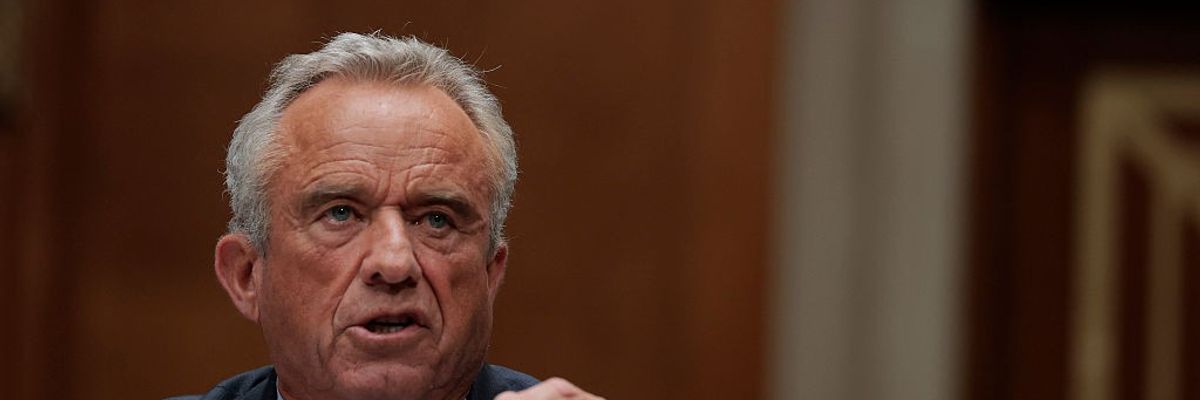
US Secretary of Health and Human Services Robert F. Kennedy Jr. testifies before the Senate Committee on Health, Education, Labor, and Pensions on May 14, 2025 in Washington, DC.
Kennedy has "made a habit of throwing good money after bad" by promoting "junk science and fringe beliefs."
A scathing editorial published Friday in one of the world's most prestigious medical journals took US Health and Human Services Secretary Robert F. Kennedy Jr. to task for what it described as "one year of failure."
In its editorial, the Lancet began by listing off several of the broken promises Kennedy made during his first speech after being confirmed to lead the US Health and Human Services Department (HHS), such as his vow to have "open and honest engagement with everyone willing to work towards making the USA healthy again" and usher in "a new era of unbiased science without hidden conflicts of interest, secrecy, or profiteering."
In fact, the Lancet found that it took Kennedy less than two weeks to break a key promise.
"Ten days after his speech about trust and openness," the journal noted, "HHS rescinded a 54-year-old policy of soliciting public comments for new rules and regulations, silencing the voices of many of the stakeholders he pledged to serve."
Things have only gotten worse since then, the editorial continued, as Kennedy has shelved research into mRNA vaccines and "made a habit of throwing good money after bad" by promoting "junk science and fringe beliefs."
The editorial concluded by warning "the destruction that Kennedy has wrought in one year might take generations to repair, and there is little hope for US health and science while he remains at the helm." The journal urged the US Congress to "hold Kennedy accountable for his record, or else accept responsibility for endorsing President Trump's decision to let him 'run wild on health.'"
The Lancet editorial drew a range of reactions from medical experts and academics.
Scott Forbes, an ecologist at the University of Winnipeg, explained the significance of a journal such as the Lancet publishing such an overtly political editorial.
"For context, the Lancet is one of the two most important medical journals on the planet," he wrote in a social media post. "When they put this on their front cover, it is only because there is something seriously wrong. That something is RFK Jr. He is a notorious crank and charlatan. But that's par for the course in the Trump regime."
Forbes' point was echoed by Krutika Kuppalli, associate professor at UT Southwestern Medical Center's Department of Internal Medicine.
"When a leading medical journal uses language like this, it’s not rhetoric," she wrote. "It’s a warning the world should take seriously."
Pediatrician Vincent Iannelli took the Lancet to task for publishing a since-retracted study in 1998 that falsely linked vaccination with the development of autism, which subsequently helped the anti-vaccination movement gain currency.
"Let's not forget that Wakefield's fraudulent paper that was published in the Lancet helped get us on this road," Iannelli said. "RFK Jr. was influenced by mothers who blamed vaccines for their child's autism."
Dear Common Dreams reader, It’s been nearly 30 years since I co-founded Common Dreams with my late wife, Lina Newhouser. We had the radical notion that journalism should serve the public good, not corporate profits. It was clear to us from the outset what it would take to build such a project. No paid advertisements. No corporate sponsors. No millionaire publisher telling us what to think or do. Many people said we wouldn't last a year, but we proved those doubters wrong. Together with a tremendous team of journalists and dedicated staff, we built an independent media outlet free from the constraints of profits and corporate control. Our mission has always been simple: To inform. To inspire. To ignite change for the common good. Building Common Dreams was not easy. Our survival was never guaranteed. When you take on the most powerful forces—Wall Street greed, fossil fuel industry destruction, Big Tech lobbyists, and uber-rich oligarchs who have spent billions upon billions rigging the economy and democracy in their favor—the only bulwark you have is supporters who believe in your work. But here’s the urgent message from me today. It's never been this bad out there. And it's never been this hard to keep us going. At the very moment Common Dreams is most needed, the threats we face are intensifying. We need your support now more than ever. We don't accept corporate advertising and never will. We don't have a paywall because we don't think people should be blocked from critical news based on their ability to pay. Everything we do is funded by the donations of readers like you. When everyone does the little they can afford, we are strong. But if that support retreats or dries up, so do we. Will you donate now to make sure Common Dreams not only survives but thrives? —Craig Brown, Co-founder |
A scathing editorial published Friday in one of the world's most prestigious medical journals took US Health and Human Services Secretary Robert F. Kennedy Jr. to task for what it described as "one year of failure."
In its editorial, the Lancet began by listing off several of the broken promises Kennedy made during his first speech after being confirmed to lead the US Health and Human Services Department (HHS), such as his vow to have "open and honest engagement with everyone willing to work towards making the USA healthy again" and usher in "a new era of unbiased science without hidden conflicts of interest, secrecy, or profiteering."
In fact, the Lancet found that it took Kennedy less than two weeks to break a key promise.
"Ten days after his speech about trust and openness," the journal noted, "HHS rescinded a 54-year-old policy of soliciting public comments for new rules and regulations, silencing the voices of many of the stakeholders he pledged to serve."
Things have only gotten worse since then, the editorial continued, as Kennedy has shelved research into mRNA vaccines and "made a habit of throwing good money after bad" by promoting "junk science and fringe beliefs."
The editorial concluded by warning "the destruction that Kennedy has wrought in one year might take generations to repair, and there is little hope for US health and science while he remains at the helm." The journal urged the US Congress to "hold Kennedy accountable for his record, or else accept responsibility for endorsing President Trump's decision to let him 'run wild on health.'"
The Lancet editorial drew a range of reactions from medical experts and academics.
Scott Forbes, an ecologist at the University of Winnipeg, explained the significance of a journal such as the Lancet publishing such an overtly political editorial.
"For context, the Lancet is one of the two most important medical journals on the planet," he wrote in a social media post. "When they put this on their front cover, it is only because there is something seriously wrong. That something is RFK Jr. He is a notorious crank and charlatan. But that's par for the course in the Trump regime."
Forbes' point was echoed by Krutika Kuppalli, associate professor at UT Southwestern Medical Center's Department of Internal Medicine.
"When a leading medical journal uses language like this, it’s not rhetoric," she wrote. "It’s a warning the world should take seriously."
Pediatrician Vincent Iannelli took the Lancet to task for publishing a since-retracted study in 1998 that falsely linked vaccination with the development of autism, which subsequently helped the anti-vaccination movement gain currency.
"Let's not forget that Wakefield's fraudulent paper that was published in the Lancet helped get us on this road," Iannelli said. "RFK Jr. was influenced by mothers who blamed vaccines for their child's autism."
A scathing editorial published Friday in one of the world's most prestigious medical journals took US Health and Human Services Secretary Robert F. Kennedy Jr. to task for what it described as "one year of failure."
In its editorial, the Lancet began by listing off several of the broken promises Kennedy made during his first speech after being confirmed to lead the US Health and Human Services Department (HHS), such as his vow to have "open and honest engagement with everyone willing to work towards making the USA healthy again" and usher in "a new era of unbiased science without hidden conflicts of interest, secrecy, or profiteering."
In fact, the Lancet found that it took Kennedy less than two weeks to break a key promise.
"Ten days after his speech about trust and openness," the journal noted, "HHS rescinded a 54-year-old policy of soliciting public comments for new rules and regulations, silencing the voices of many of the stakeholders he pledged to serve."
Things have only gotten worse since then, the editorial continued, as Kennedy has shelved research into mRNA vaccines and "made a habit of throwing good money after bad" by promoting "junk science and fringe beliefs."
The editorial concluded by warning "the destruction that Kennedy has wrought in one year might take generations to repair, and there is little hope for US health and science while he remains at the helm." The journal urged the US Congress to "hold Kennedy accountable for his record, or else accept responsibility for endorsing President Trump's decision to let him 'run wild on health.'"
The Lancet editorial drew a range of reactions from medical experts and academics.
Scott Forbes, an ecologist at the University of Winnipeg, explained the significance of a journal such as the Lancet publishing such an overtly political editorial.
"For context, the Lancet is one of the two most important medical journals on the planet," he wrote in a social media post. "When they put this on their front cover, it is only because there is something seriously wrong. That something is RFK Jr. He is a notorious crank and charlatan. But that's par for the course in the Trump regime."
Forbes' point was echoed by Krutika Kuppalli, associate professor at UT Southwestern Medical Center's Department of Internal Medicine.
"When a leading medical journal uses language like this, it’s not rhetoric," she wrote. "It’s a warning the world should take seriously."
Pediatrician Vincent Iannelli took the Lancet to task for publishing a since-retracted study in 1998 that falsely linked vaccination with the development of autism, which subsequently helped the anti-vaccination movement gain currency.
"Let's not forget that Wakefield's fraudulent paper that was published in the Lancet helped get us on this road," Iannelli said. "RFK Jr. was influenced by mothers who blamed vaccines for their child's autism."