SUBSCRIBE TO OUR FREE NEWSLETTER
Daily news & progressive opinion—funded by the people, not the corporations—delivered straight to your inbox.
5
#000000
#FFFFFF
To donate by check, phone, or other method, see our More Ways to Give page.
Daily news & progressive opinion—funded by the people, not the corporations—delivered straight to your inbox.
Secretary Rollins praises American farmers’ independence while advancing policies that strip them of market protections and empower their largest competitors.
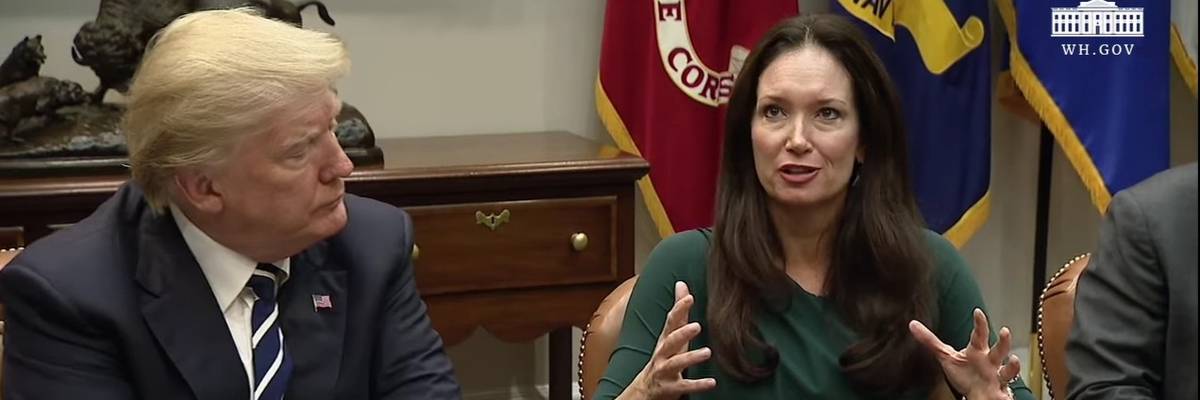
Agriculture Secretary Brooke Rollins, in her recent USA Today and Newsweek opinion pieces, has worked hard to present herself as a champion of American farmers and a steward of healthier food options. Alongside Health Secretary Robert F. Kennedy Jr., she spoke of the values these farmers embody—independence, grit, patriotism—and celebrated a $700 million regenerative agriculture initiative as proof that this administration is delivering for rural America.
But if you pull back the curtain on Secretary Rollins and the US Department of Agriculture (USDA), the narrative changes. What looks like a bold vision for “regeneration” quickly reveals itself as a political performance designed to distract from the USDA’s business-as-usual that props up industrial agriculture, not family farmers.
Secretary Rollins held up Alexandre Family Farm as the face of America’s regenerative future. But the truth: The farm is under scrutiny for animal abuse so severe it stands in direct contradiction to everything regenerative agriculture represents.
A USDA investigation obtained through the Freedom of Information Act documented multiple violations of organic and animal-welfare standards. The company has since admitted to serious abuses—including cows dragged with machinery, horn-tipping without pain relief, a teat cut off an animal with mastitis, diesel poured on animals, and animals dying after being left without adequate feed and care. No amount of marketing can turn that into regeneration. It is factory farming with better lighting.
A healthy America requires new, bold regenerative policies, not branding.
Choosing that farm as the model for USDA’s regenerative agenda signals to large industrial livestock companies that even amid serious animal cruelty, the USDA will still hand them a spotlight—and, in many cases, more public dollars. It also sends a message to the farmers Secretary Rollins claims to represent: Their government will not reward those who do the hard, unglamorous work of true regenerative agriculture. Instead, it will reward those who invest in scale, branding, and access, not better practices.
Secretary Rollins frequently praised states as “laboratories of innovation,” a sentiment that should have encouraged rural communities. Yet she is pushing the EATS Act and its twin, the Save Our Bacon Act—federal preemption bills that would wipe out states’ ability to regulate for safer, healthier, and more humane agricultural products sold within their borders. Notably, EATS and SOBA face bipartisan opposition from more than 200 senators and representatives in Congress.
You cannot celebrate state innovation while trying to make it illegal.
Backed by the factory-farm-aligned National Pork Producers Council, both bills would undermine more than 1,000 state health, safety, and animal-welfare laws. These bills would give the largest global agribusinesses the power to override local standards and flood American markets with cheap, low-welfare meat. And they would directly undercut the regenerative and higher-welfare family farms she claims to support.
The USDA’s $700 million regenerative package reveals the same pattern. In reality, it is a drop in the bucket. For decades, federal policy has pumped tens of billions of dollars into the nation’s largest factory farms. From 2018 to 2023 alone, the top 10,000 livestock feeding operations—mostly CAFOs—captured more than $12 billion in federal aid. The largest 10% of producers now take nearly 80% of subsidies, while small and midsize farms receive nothing.
Secretary Rollins knows this—yet her policies do nothing to change it.
The contradiction is glaring: She praises American farmers’ independence while advancing policies that strip them of market protections and empower their largest competitors. She leads an agency that celebrates rural resilience while continuing to concentrate power and resources in the hands of giant corporations.
True regenerative agriculture—the kind practiced by real farm families—requires pasture, biodiversity, humane animal treatment, and a financial landscape where independent farmers can survive. But these farmers are forced to compete against industrial operations that are more heavily subsidized and are now welcomed to call themselves “regenerative” regardless of their animal handling and herd-management practices.
Across the United States, regenerative ranchers, pasture-based dairies, higher-welfare hog farmers, and diversified small producers are already showing what a healthier and more resilient US food system can look like. Consumers want this shift. States are supporting it. Rural communities depend on it. Yet the USDA continues to position factory farming as the American standard—and now as the regenerative standard.
If this administration truly wants to protect American farmers, the path forward is clear.
Stop calling industrial operations regenerative when they are not. Stop pushing federal legislation that handcuffs states and abandons small producers. Stop directing billions toward industrial livestock giants while offering pennies to the people doing the real work of regeneration. And start listening—to independent farmers fighting consolidation, rural communities bearing the cost of industrial expansion, and consumers demanding humane treatment of animals.
A healthy America requires new, bold regenerative policies, not branding. We welcome Secretary Rollins to bring forward those types of policies.
Dear Common Dreams reader, It’s been nearly 30 years since I co-founded Common Dreams with my late wife, Lina Newhouser. We had the radical notion that journalism should serve the public good, not corporate profits. It was clear to us from the outset what it would take to build such a project. No paid advertisements. No corporate sponsors. No millionaire publisher telling us what to think or do. Many people said we wouldn't last a year, but we proved those doubters wrong. Together with a tremendous team of journalists and dedicated staff, we built an independent media outlet free from the constraints of profits and corporate control. Our mission has always been simple: To inform. To inspire. To ignite change for the common good. Building Common Dreams was not easy. Our survival was never guaranteed. When you take on the most powerful forces—Wall Street greed, fossil fuel industry destruction, Big Tech lobbyists, and uber-rich oligarchs who have spent billions upon billions rigging the economy and democracy in their favor—the only bulwark you have is supporters who believe in your work. But here’s the urgent message from me today. It's never been this bad out there. And it's never been this hard to keep us going. At the very moment Common Dreams is most needed, the threats we face are intensifying. We need your support now more than ever. We don't accept corporate advertising and never will. We don't have a paywall because we don't think people should be blocked from critical news based on their ability to pay. Everything we do is funded by the donations of readers like you. When everyone does the little they can afford, we are strong. But if that support retreats or dries up, so do we. Will you donate now to make sure Common Dreams not only survives but thrives? —Craig Brown, Co-founder |
Agriculture Secretary Brooke Rollins, in her recent USA Today and Newsweek opinion pieces, has worked hard to present herself as a champion of American farmers and a steward of healthier food options. Alongside Health Secretary Robert F. Kennedy Jr., she spoke of the values these farmers embody—independence, grit, patriotism—and celebrated a $700 million regenerative agriculture initiative as proof that this administration is delivering for rural America.
But if you pull back the curtain on Secretary Rollins and the US Department of Agriculture (USDA), the narrative changes. What looks like a bold vision for “regeneration” quickly reveals itself as a political performance designed to distract from the USDA’s business-as-usual that props up industrial agriculture, not family farmers.
Secretary Rollins held up Alexandre Family Farm as the face of America’s regenerative future. But the truth: The farm is under scrutiny for animal abuse so severe it stands in direct contradiction to everything regenerative agriculture represents.
A USDA investigation obtained through the Freedom of Information Act documented multiple violations of organic and animal-welfare standards. The company has since admitted to serious abuses—including cows dragged with machinery, horn-tipping without pain relief, a teat cut off an animal with mastitis, diesel poured on animals, and animals dying after being left without adequate feed and care. No amount of marketing can turn that into regeneration. It is factory farming with better lighting.
A healthy America requires new, bold regenerative policies, not branding.
Choosing that farm as the model for USDA’s regenerative agenda signals to large industrial livestock companies that even amid serious animal cruelty, the USDA will still hand them a spotlight—and, in many cases, more public dollars. It also sends a message to the farmers Secretary Rollins claims to represent: Their government will not reward those who do the hard, unglamorous work of true regenerative agriculture. Instead, it will reward those who invest in scale, branding, and access, not better practices.
Secretary Rollins frequently praised states as “laboratories of innovation,” a sentiment that should have encouraged rural communities. Yet she is pushing the EATS Act and its twin, the Save Our Bacon Act—federal preemption bills that would wipe out states’ ability to regulate for safer, healthier, and more humane agricultural products sold within their borders. Notably, EATS and SOBA face bipartisan opposition from more than 200 senators and representatives in Congress.
You cannot celebrate state innovation while trying to make it illegal.
Backed by the factory-farm-aligned National Pork Producers Council, both bills would undermine more than 1,000 state health, safety, and animal-welfare laws. These bills would give the largest global agribusinesses the power to override local standards and flood American markets with cheap, low-welfare meat. And they would directly undercut the regenerative and higher-welfare family farms she claims to support.
The USDA’s $700 million regenerative package reveals the same pattern. In reality, it is a drop in the bucket. For decades, federal policy has pumped tens of billions of dollars into the nation’s largest factory farms. From 2018 to 2023 alone, the top 10,000 livestock feeding operations—mostly CAFOs—captured more than $12 billion in federal aid. The largest 10% of producers now take nearly 80% of subsidies, while small and midsize farms receive nothing.
Secretary Rollins knows this—yet her policies do nothing to change it.
The contradiction is glaring: She praises American farmers’ independence while advancing policies that strip them of market protections and empower their largest competitors. She leads an agency that celebrates rural resilience while continuing to concentrate power and resources in the hands of giant corporations.
True regenerative agriculture—the kind practiced by real farm families—requires pasture, biodiversity, humane animal treatment, and a financial landscape where independent farmers can survive. But these farmers are forced to compete against industrial operations that are more heavily subsidized and are now welcomed to call themselves “regenerative” regardless of their animal handling and herd-management practices.
Across the United States, regenerative ranchers, pasture-based dairies, higher-welfare hog farmers, and diversified small producers are already showing what a healthier and more resilient US food system can look like. Consumers want this shift. States are supporting it. Rural communities depend on it. Yet the USDA continues to position factory farming as the American standard—and now as the regenerative standard.
If this administration truly wants to protect American farmers, the path forward is clear.
Stop calling industrial operations regenerative when they are not. Stop pushing federal legislation that handcuffs states and abandons small producers. Stop directing billions toward industrial livestock giants while offering pennies to the people doing the real work of regeneration. And start listening—to independent farmers fighting consolidation, rural communities bearing the cost of industrial expansion, and consumers demanding humane treatment of animals.
A healthy America requires new, bold regenerative policies, not branding. We welcome Secretary Rollins to bring forward those types of policies.
Agriculture Secretary Brooke Rollins, in her recent USA Today and Newsweek opinion pieces, has worked hard to present herself as a champion of American farmers and a steward of healthier food options. Alongside Health Secretary Robert F. Kennedy Jr., she spoke of the values these farmers embody—independence, grit, patriotism—and celebrated a $700 million regenerative agriculture initiative as proof that this administration is delivering for rural America.
But if you pull back the curtain on Secretary Rollins and the US Department of Agriculture (USDA), the narrative changes. What looks like a bold vision for “regeneration” quickly reveals itself as a political performance designed to distract from the USDA’s business-as-usual that props up industrial agriculture, not family farmers.
Secretary Rollins held up Alexandre Family Farm as the face of America’s regenerative future. But the truth: The farm is under scrutiny for animal abuse so severe it stands in direct contradiction to everything regenerative agriculture represents.
A USDA investigation obtained through the Freedom of Information Act documented multiple violations of organic and animal-welfare standards. The company has since admitted to serious abuses—including cows dragged with machinery, horn-tipping without pain relief, a teat cut off an animal with mastitis, diesel poured on animals, and animals dying after being left without adequate feed and care. No amount of marketing can turn that into regeneration. It is factory farming with better lighting.
A healthy America requires new, bold regenerative policies, not branding.
Choosing that farm as the model for USDA’s regenerative agenda signals to large industrial livestock companies that even amid serious animal cruelty, the USDA will still hand them a spotlight—and, in many cases, more public dollars. It also sends a message to the farmers Secretary Rollins claims to represent: Their government will not reward those who do the hard, unglamorous work of true regenerative agriculture. Instead, it will reward those who invest in scale, branding, and access, not better practices.
Secretary Rollins frequently praised states as “laboratories of innovation,” a sentiment that should have encouraged rural communities. Yet she is pushing the EATS Act and its twin, the Save Our Bacon Act—federal preemption bills that would wipe out states’ ability to regulate for safer, healthier, and more humane agricultural products sold within their borders. Notably, EATS and SOBA face bipartisan opposition from more than 200 senators and representatives in Congress.
You cannot celebrate state innovation while trying to make it illegal.
Backed by the factory-farm-aligned National Pork Producers Council, both bills would undermine more than 1,000 state health, safety, and animal-welfare laws. These bills would give the largest global agribusinesses the power to override local standards and flood American markets with cheap, low-welfare meat. And they would directly undercut the regenerative and higher-welfare family farms she claims to support.
The USDA’s $700 million regenerative package reveals the same pattern. In reality, it is a drop in the bucket. For decades, federal policy has pumped tens of billions of dollars into the nation’s largest factory farms. From 2018 to 2023 alone, the top 10,000 livestock feeding operations—mostly CAFOs—captured more than $12 billion in federal aid. The largest 10% of producers now take nearly 80% of subsidies, while small and midsize farms receive nothing.
Secretary Rollins knows this—yet her policies do nothing to change it.
The contradiction is glaring: She praises American farmers’ independence while advancing policies that strip them of market protections and empower their largest competitors. She leads an agency that celebrates rural resilience while continuing to concentrate power and resources in the hands of giant corporations.
True regenerative agriculture—the kind practiced by real farm families—requires pasture, biodiversity, humane animal treatment, and a financial landscape where independent farmers can survive. But these farmers are forced to compete against industrial operations that are more heavily subsidized and are now welcomed to call themselves “regenerative” regardless of their animal handling and herd-management practices.
Across the United States, regenerative ranchers, pasture-based dairies, higher-welfare hog farmers, and diversified small producers are already showing what a healthier and more resilient US food system can look like. Consumers want this shift. States are supporting it. Rural communities depend on it. Yet the USDA continues to position factory farming as the American standard—and now as the regenerative standard.
If this administration truly wants to protect American farmers, the path forward is clear.
Stop calling industrial operations regenerative when they are not. Stop pushing federal legislation that handcuffs states and abandons small producers. Stop directing billions toward industrial livestock giants while offering pennies to the people doing the real work of regeneration. And start listening—to independent farmers fighting consolidation, rural communities bearing the cost of industrial expansion, and consumers demanding humane treatment of animals.
A healthy America requires new, bold regenerative policies, not branding. We welcome Secretary Rollins to bring forward those types of policies.