
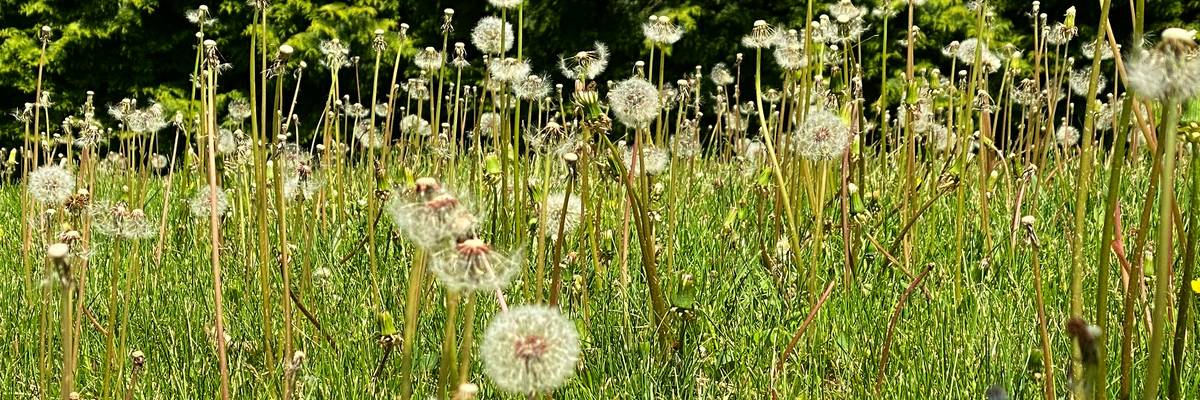
Dandelion flowers grow in the grass of a backyard on May 2, 2024 in North Haledon, New Jersey.
How Can We Resist the Indifference to life?
What if we started collectively seeing weeds and discarded plastic straws not as simply an assault on our sense of order—clean sidewalks!—but as minute particles of the living planet?
What does mowing the lawn have to do with world events?
Well, one of my life skills is the ability to make minimal and possibly absurd connections, linking the trivial and the profound. Thus, a few years back (when I still mowed my own lawn), I wrote this poem. It’s called “Buddha’s Lawn”:
I mow the lawn and feel gratitude
my neighbors
haven’t pigeonholed me as a crazy old coot.
I’m stalled in my transition
from a lifestyle and sense of order based on
killing things,
like weeds, mice, whatever,
to one based on reverence for all stuff,
however weird.
It’s a cool day but
I work up a sweat.
On the lawn, I pick up a shred
of burst red balloon, a used napkin,
a transparent plastic juice container.
This stuff is all just litter
and the weeds are still weeds.
If I really let myself
see them differently,
I’d be the crazy neighbor, right?
You know, value everything, including the disposables of life. I guess I’ve always had this wacky inner protest going on, not against order and cleanliness per se, but against the clank of the trash can: “throwing stuff away,” then assuming it’s permanently gone from our universe, rather than floating in a river somewhere or buried in a landfill.
Is it possible, I quietly (secretly) ask myself, to actually value... somehow... trash, weeds, mice, bugs, or anything—everything—else that doesn’t fit into a properly civilized, middle-class universe? This secret question is mixed with confusion, even shame, because, well, I’m sort of a slob, indifferent to dust and disorder and the like, but also, at the same time, a participant in and benefactor of humanity’s exploitation of Planet Earth.
So, I tell myself: Just mow the damn lawn, toss out (or maybe recycle) the litter, and do your best to fit in. I try, I try, but my strange, soul-deep uncertainty persists. And a larger, far more troubling question quickly emerges. Where do we draw the line between valuing and dismissing... whatever?
And my uncertainties turn social. They turn political. I grew up in the Christian church, and heard its values espoused: “Do unto others as you would have them do un o you.” And, oh yeah: “Love your enemies and pray for those who persecute you.”
Could anything resonate more clearly? This was deep, unyielding: Don’t submit to simplistic anger but dig, when you are hurt and offended, for understanding, for healing. Love is not a simple concept—a sploosh of kumbaya and the problem’s solved. It may well be life’s deepest challenge.
But as Christianity became a world religion, its cross got turned upside down and became a sword. And along came the Crusades. Let’s retake the Holy Land, man! Loving thy enemy apparently meant killing him—and his family, his children. Millions of people died. And the wars rolled on and on. Conquest and dehumanization became fully embedded as the religious values of the powerful. Human ingenuity—scientific progress—mostly fed the urge for war, culminating in the creation, and use, of the atomic bomb. And 12,000 or so nuclear bombs now sit here and there around the planet, continually upgraded, patiently waiting to end the world.
But even as ending the world remains on hold, non-nuclear wars continue, making the news virtually unbearable to read. For instance, over 50,000 Palestinians,—maybe 100,000 or more—have died in Israel’s genocidal assault.
And, as Truthout reports:
Many Palestinians say that the starvation is even worse than Israel’s bombardments, having been starved by varying levels of Israel’s blockade for 19 months and with food costs constantly on the rise. The total aid blockade ushered in the worst conditions of the genocide so far; one Palestinian reporter said in March that children in the region are so hungry that they’re drawing pictures of food in the sand.
...According to an assessment by the United Nations-backed Integrated Food Security Phase Classification, nearly 71,000 children are expected to experience acute malnutrition in the next year due to Israel’s blockade.
This is humanity’s flow of indifference to much—or all?—of life. I can’t let go of it. And I can’t stop noticing it at the miniscule level of “weeds” and “litter” and every other aspect of nature that doesn’t matter. What I’m saying is not, oh gosh, be good to the weeds, be good to the discarded cigarette butts and plastic straws—but rather, notice them and ponder, with deep wonderment, the meaning of nature, the meaning of life.
What if we started collectively seeing that discarded plastic straw not as simply an assault on our sense of order—clean sidewalks!—but as a minute particle of the living planet? How far upward might this awareness flow?
An Urgent Message From Our Co-Founder
Dear Common Dreams reader, It’s been nearly 30 years since I co-founded Common Dreams with my late wife, Lina Newhouser. We had the radical notion that journalism should serve the public good, not corporate profits. It was clear to us from the outset what it would take to build such a project. No paid advertisements. No corporate sponsors. No millionaire publisher telling us what to think or do. Many people said we wouldn't last a year, but we proved those doubters wrong. Together with a tremendous team of journalists and dedicated staff, we built an independent media outlet free from the constraints of profits and corporate control. Our mission has always been simple: To inform. To inspire. To ignite change for the common good. Building Common Dreams was not easy. Our survival was never guaranteed. When you take on the most powerful forces—Wall Street greed, fossil fuel industry destruction, Big Tech lobbyists, and uber-rich oligarchs who have spent billions upon billions rigging the economy and democracy in their favor—the only bulwark you have is supporters who believe in your work. But here’s the urgent message from me today. It's never been this bad out there. And it's never been this hard to keep us going. At the very moment Common Dreams is most needed, the threats we face are intensifying. We need your support now more than ever. We don't accept corporate advertising and never will. We don't have a paywall because we don't think people should be blocked from critical news based on their ability to pay. Everything we do is funded by the donations of readers like you. When everyone does the little they can afford, we are strong. But if that support retreats or dries up, so do we. Will you donate now to make sure Common Dreams not only survives but thrives? —Craig Brown, Co-founder |
What does mowing the lawn have to do with world events?
Well, one of my life skills is the ability to make minimal and possibly absurd connections, linking the trivial and the profound. Thus, a few years back (when I still mowed my own lawn), I wrote this poem. It’s called “Buddha’s Lawn”:
I mow the lawn and feel gratitude
my neighbors
haven’t pigeonholed me as a crazy old coot.
I’m stalled in my transition
from a lifestyle and sense of order based on
killing things,
like weeds, mice, whatever,
to one based on reverence for all stuff,
however weird.
It’s a cool day but
I work up a sweat.
On the lawn, I pick up a shred
of burst red balloon, a used napkin,
a transparent plastic juice container.
This stuff is all just litter
and the weeds are still weeds.
If I really let myself
see them differently,
I’d be the crazy neighbor, right?
You know, value everything, including the disposables of life. I guess I’ve always had this wacky inner protest going on, not against order and cleanliness per se, but against the clank of the trash can: “throwing stuff away,” then assuming it’s permanently gone from our universe, rather than floating in a river somewhere or buried in a landfill.
Is it possible, I quietly (secretly) ask myself, to actually value... somehow... trash, weeds, mice, bugs, or anything—everything—else that doesn’t fit into a properly civilized, middle-class universe? This secret question is mixed with confusion, even shame, because, well, I’m sort of a slob, indifferent to dust and disorder and the like, but also, at the same time, a participant in and benefactor of humanity’s exploitation of Planet Earth.
So, I tell myself: Just mow the damn lawn, toss out (or maybe recycle) the litter, and do your best to fit in. I try, I try, but my strange, soul-deep uncertainty persists. And a larger, far more troubling question quickly emerges. Where do we draw the line between valuing and dismissing... whatever?
And my uncertainties turn social. They turn political. I grew up in the Christian church, and heard its values espoused: “Do unto others as you would have them do un o you.” And, oh yeah: “Love your enemies and pray for those who persecute you.”
Could anything resonate more clearly? This was deep, unyielding: Don’t submit to simplistic anger but dig, when you are hurt and offended, for understanding, for healing. Love is not a simple concept—a sploosh of kumbaya and the problem’s solved. It may well be life’s deepest challenge.
But as Christianity became a world religion, its cross got turned upside down and became a sword. And along came the Crusades. Let’s retake the Holy Land, man! Loving thy enemy apparently meant killing him—and his family, his children. Millions of people died. And the wars rolled on and on. Conquest and dehumanization became fully embedded as the religious values of the powerful. Human ingenuity—scientific progress—mostly fed the urge for war, culminating in the creation, and use, of the atomic bomb. And 12,000 or so nuclear bombs now sit here and there around the planet, continually upgraded, patiently waiting to end the world.
But even as ending the world remains on hold, non-nuclear wars continue, making the news virtually unbearable to read. For instance, over 50,000 Palestinians,—maybe 100,000 or more—have died in Israel’s genocidal assault.
And, as Truthout reports:
Many Palestinians say that the starvation is even worse than Israel’s bombardments, having been starved by varying levels of Israel’s blockade for 19 months and with food costs constantly on the rise. The total aid blockade ushered in the worst conditions of the genocide so far; one Palestinian reporter said in March that children in the region are so hungry that they’re drawing pictures of food in the sand.
...According to an assessment by the United Nations-backed Integrated Food Security Phase Classification, nearly 71,000 children are expected to experience acute malnutrition in the next year due to Israel’s blockade.
This is humanity’s flow of indifference to much—or all?—of life. I can’t let go of it. And I can’t stop noticing it at the miniscule level of “weeds” and “litter” and every other aspect of nature that doesn’t matter. What I’m saying is not, oh gosh, be good to the weeds, be good to the discarded cigarette butts and plastic straws—but rather, notice them and ponder, with deep wonderment, the meaning of nature, the meaning of life.
What if we started collectively seeing that discarded plastic straw not as simply an assault on our sense of order—clean sidewalks!—but as a minute particle of the living planet? How far upward might this awareness flow?
What does mowing the lawn have to do with world events?
Well, one of my life skills is the ability to make minimal and possibly absurd connections, linking the trivial and the profound. Thus, a few years back (when I still mowed my own lawn), I wrote this poem. It’s called “Buddha’s Lawn”:
I mow the lawn and feel gratitude
my neighbors
haven’t pigeonholed me as a crazy old coot.
I’m stalled in my transition
from a lifestyle and sense of order based on
killing things,
like weeds, mice, whatever,
to one based on reverence for all stuff,
however weird.
It’s a cool day but
I work up a sweat.
On the lawn, I pick up a shred
of burst red balloon, a used napkin,
a transparent plastic juice container.
This stuff is all just litter
and the weeds are still weeds.
If I really let myself
see them differently,
I’d be the crazy neighbor, right?
You know, value everything, including the disposables of life. I guess I’ve always had this wacky inner protest going on, not against order and cleanliness per se, but against the clank of the trash can: “throwing stuff away,” then assuming it’s permanently gone from our universe, rather than floating in a river somewhere or buried in a landfill.
Is it possible, I quietly (secretly) ask myself, to actually value... somehow... trash, weeds, mice, bugs, or anything—everything—else that doesn’t fit into a properly civilized, middle-class universe? This secret question is mixed with confusion, even shame, because, well, I’m sort of a slob, indifferent to dust and disorder and the like, but also, at the same time, a participant in and benefactor of humanity’s exploitation of Planet Earth.
So, I tell myself: Just mow the damn lawn, toss out (or maybe recycle) the litter, and do your best to fit in. I try, I try, but my strange, soul-deep uncertainty persists. And a larger, far more troubling question quickly emerges. Where do we draw the line between valuing and dismissing... whatever?
And my uncertainties turn social. They turn political. I grew up in the Christian church, and heard its values espoused: “Do unto others as you would have them do un o you.” And, oh yeah: “Love your enemies and pray for those who persecute you.”
Could anything resonate more clearly? This was deep, unyielding: Don’t submit to simplistic anger but dig, when you are hurt and offended, for understanding, for healing. Love is not a simple concept—a sploosh of kumbaya and the problem’s solved. It may well be life’s deepest challenge.
But as Christianity became a world religion, its cross got turned upside down and became a sword. And along came the Crusades. Let’s retake the Holy Land, man! Loving thy enemy apparently meant killing him—and his family, his children. Millions of people died. And the wars rolled on and on. Conquest and dehumanization became fully embedded as the religious values of the powerful. Human ingenuity—scientific progress—mostly fed the urge for war, culminating in the creation, and use, of the atomic bomb. And 12,000 or so nuclear bombs now sit here and there around the planet, continually upgraded, patiently waiting to end the world.
But even as ending the world remains on hold, non-nuclear wars continue, making the news virtually unbearable to read. For instance, over 50,000 Palestinians,—maybe 100,000 or more—have died in Israel’s genocidal assault.
And, as Truthout reports:
Many Palestinians say that the starvation is even worse than Israel’s bombardments, having been starved by varying levels of Israel’s blockade for 19 months and with food costs constantly on the rise. The total aid blockade ushered in the worst conditions of the genocide so far; one Palestinian reporter said in March that children in the region are so hungry that they’re drawing pictures of food in the sand.
...According to an assessment by the United Nations-backed Integrated Food Security Phase Classification, nearly 71,000 children are expected to experience acute malnutrition in the next year due to Israel’s blockade.
This is humanity’s flow of indifference to much—or all?—of life. I can’t let go of it. And I can’t stop noticing it at the miniscule level of “weeds” and “litter” and every other aspect of nature that doesn’t matter. What I’m saying is not, oh gosh, be good to the weeds, be good to the discarded cigarette butts and plastic straws—but rather, notice them and ponder, with deep wonderment, the meaning of nature, the meaning of life.
What if we started collectively seeing that discarded plastic straw not as simply an assault on our sense of order—clean sidewalks!—but as a minute particle of the living planet? How far upward might this awareness flow?