SUBSCRIBE TO OUR FREE NEWSLETTER
Daily news & progressive opinion—funded by the people, not the corporations—delivered straight to your inbox.
5
#000000
#FFFFFF
To donate by check, phone, or other method, see our More Ways to Give page.
Daily news & progressive opinion—funded by the people, not the corporations—delivered straight to your inbox.
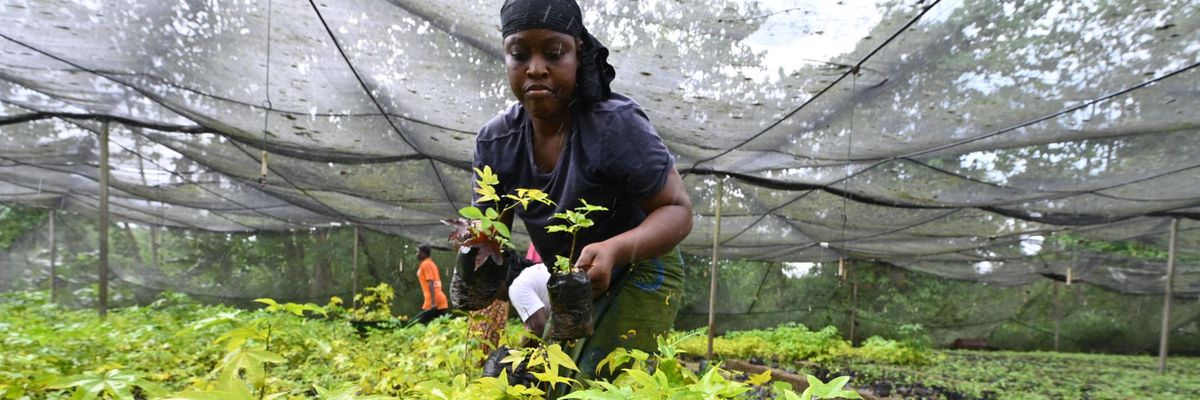
A woman prepares cuttings for reforestation near Oume, in southwestern Ivory Coast--a region affected by deforestation due to cocao cultivation--on May 19, 2021.
New research shows that a mix of natural forest regrowth and tree planting could remove up to 10 times more carbon at $20 per metric ton than previously estimated by the IPCC.
Trees are allies in the struggle against climate change, and regrowing forests to capture carbon may be cheaper than we thought. According to new research published in Nature Climate Change, a strategic mix of natural regrowth and tree planting could be the most cost-effective way to capture carbon.
Researchers analyzed reforestation projects in 138 low- and middle-income countries to compare the costs of different reforestation approaches. They found it’s possible to remove 10 times more carbon at $20 per metric ton, and almost three times more at $50, compared to what the Intergovernmental Panel on Climate Change (IPCC) had previously estimated.
"It's exciting that the opportunity for low-cost reforestation appears much more plentiful than previously thought."
Neither natural regeneration nor tree planting consistently outperforms the other. Instead, the most cost-effective method varies depending on local conditions. Natural regeneration, which involves letting forests regrow on their own, is cheaper in about 46% of suitable areas. Tree planting, on the other hand, is more cost-effective in 54% of areas.
“Natural regeneration is more cost-effective in areas where tree planting is expensive, regrowing forests accumulate carbon more quickly, or timber infrastructure is distant,” said lead author Jonah Busch, who conducted the study while working for Conservation International. “On the other hand, plantations outperform in areas far from natural seed sources, or where more of the carbon from harvested wood is stored in long-lasting products.”
The research team estimates that by using the cheapest method in each location, we could remove a staggering 31.4 billion metric tons of carbon dioxide from the atmosphere over 30 years, at a cost of less than $50 per metric ton. This is about 40% more carbon removal than if only one method was used universally.
“It’s exciting that the opportunity for low-cost reforestation appears much more plentiful than previously thought; this suggests reforestation projects are worth a second look by communities that might have prejudged them to be cost prohibitive,” said Busch. “While reforestation can’t be the only solution to climate change, our findings suggest it should be a bigger piece of the puzzle than previously thought.”
To reach these conclusions, the research team gathered data from hundreds of reforestation projects and used machine-learning techniques to map costs across different areas at a 1-kilometer (0.6-mile) resolution. This detailed approach allowed them to consider crucial factors such as tree growth rates and potential species in different regions.
Ecologist Robin Chazdon, who wasn’t involved in the research, praised the comprehensive approach but highlighted important considerations beyond cost-effectiveness.
“These eye-opening findings add nuance and complexity to our understanding of the net costs of carbon storage for naturally regenerating forests and monoculture plantations,” Chazdon said. However, she emphasized that “the relative costs of carbon storage should not be the only factor to consider regarding spatial planning of reforestation.”
Chazdon pointed out some of the ecological trade-offs involved in different reforestation methods. Monoculture tree plantations, while potentially cost-effective in certain areas, often create excessive water demand and provide poor opportunities for native biodiversity conservation. In contrast, naturally regenerating forests typically offer a wider range of ecosystem services and better support local biodiversity.
“Ultimately, these environmental costs and benefits — which can be difficult to monetize — need to be incorporated in decisions regarding how and where to grow plantations or foster natural regeneration,” Chazdon said.
The study’s authors acknowledge these limitations and suggest several directions for future research. They propose extending the analysis to high-income countries and exploring other forms of reforestation, such as agroforestry or planting patches of trees and allowing the rest of an area to regrow naturally.
Additionally, the researchers emphasize the need to integrate their findings on cost-effectiveness with data on biodiversity, livelihoods and other societal needs to guide reforestation efforts in different contexts.
While the study’s findings are promising, the researchers caution that reforestation alone won’t solve the climate crisis. Even at its maximum potential, reforestation would only remove as much carbon dioxide in 30 years as eight months of current global emissions.
Reforestation is very important, but it won’t solve climate change on its own, Busch said. Ultimately, “we still need to reduce emissions from fossil fuels.”
Dear Common Dreams reader, It’s been nearly 30 years since I co-founded Common Dreams with my late wife, Lina Newhouser. We had the radical notion that journalism should serve the public good, not corporate profits. It was clear to us from the outset what it would take to build such a project. No paid advertisements. No corporate sponsors. No millionaire publisher telling us what to think or do. Many people said we wouldn't last a year, but we proved those doubters wrong. Together with a tremendous team of journalists and dedicated staff, we built an independent media outlet free from the constraints of profits and corporate control. Our mission has always been simple: To inform. To inspire. To ignite change for the common good. Building Common Dreams was not easy. Our survival was never guaranteed. When you take on the most powerful forces—Wall Street greed, fossil fuel industry destruction, Big Tech lobbyists, and uber-rich oligarchs who have spent billions upon billions rigging the economy and democracy in their favor—the only bulwark you have is supporters who believe in your work. But here’s the urgent message from me today. It's never been this bad out there. And it's never been this hard to keep us going. At the very moment Common Dreams is most needed, the threats we face are intensifying. We need your support now more than ever. We don't accept corporate advertising and never will. We don't have a paywall because we don't think people should be blocked from critical news based on their ability to pay. Everything we do is funded by the donations of readers like you. When everyone does the little they can afford, we are strong. But if that support retreats or dries up, so do we. Will you donate now to make sure Common Dreams not only survives but thrives? —Craig Brown, Co-founder |
Trees are allies in the struggle against climate change, and regrowing forests to capture carbon may be cheaper than we thought. According to new research published in Nature Climate Change, a strategic mix of natural regrowth and tree planting could be the most cost-effective way to capture carbon.
Researchers analyzed reforestation projects in 138 low- and middle-income countries to compare the costs of different reforestation approaches. They found it’s possible to remove 10 times more carbon at $20 per metric ton, and almost three times more at $50, compared to what the Intergovernmental Panel on Climate Change (IPCC) had previously estimated.
"It's exciting that the opportunity for low-cost reforestation appears much more plentiful than previously thought."
Neither natural regeneration nor tree planting consistently outperforms the other. Instead, the most cost-effective method varies depending on local conditions. Natural regeneration, which involves letting forests regrow on their own, is cheaper in about 46% of suitable areas. Tree planting, on the other hand, is more cost-effective in 54% of areas.
“Natural regeneration is more cost-effective in areas where tree planting is expensive, regrowing forests accumulate carbon more quickly, or timber infrastructure is distant,” said lead author Jonah Busch, who conducted the study while working for Conservation International. “On the other hand, plantations outperform in areas far from natural seed sources, or where more of the carbon from harvested wood is stored in long-lasting products.”
The research team estimates that by using the cheapest method in each location, we could remove a staggering 31.4 billion metric tons of carbon dioxide from the atmosphere over 30 years, at a cost of less than $50 per metric ton. This is about 40% more carbon removal than if only one method was used universally.
“It’s exciting that the opportunity for low-cost reforestation appears much more plentiful than previously thought; this suggests reforestation projects are worth a second look by communities that might have prejudged them to be cost prohibitive,” said Busch. “While reforestation can’t be the only solution to climate change, our findings suggest it should be a bigger piece of the puzzle than previously thought.”
To reach these conclusions, the research team gathered data from hundreds of reforestation projects and used machine-learning techniques to map costs across different areas at a 1-kilometer (0.6-mile) resolution. This detailed approach allowed them to consider crucial factors such as tree growth rates and potential species in different regions.
Ecologist Robin Chazdon, who wasn’t involved in the research, praised the comprehensive approach but highlighted important considerations beyond cost-effectiveness.
“These eye-opening findings add nuance and complexity to our understanding of the net costs of carbon storage for naturally regenerating forests and monoculture plantations,” Chazdon said. However, she emphasized that “the relative costs of carbon storage should not be the only factor to consider regarding spatial planning of reforestation.”
Chazdon pointed out some of the ecological trade-offs involved in different reforestation methods. Monoculture tree plantations, while potentially cost-effective in certain areas, often create excessive water demand and provide poor opportunities for native biodiversity conservation. In contrast, naturally regenerating forests typically offer a wider range of ecosystem services and better support local biodiversity.
“Ultimately, these environmental costs and benefits — which can be difficult to monetize — need to be incorporated in decisions regarding how and where to grow plantations or foster natural regeneration,” Chazdon said.
The study’s authors acknowledge these limitations and suggest several directions for future research. They propose extending the analysis to high-income countries and exploring other forms of reforestation, such as agroforestry or planting patches of trees and allowing the rest of an area to regrow naturally.
Additionally, the researchers emphasize the need to integrate their findings on cost-effectiveness with data on biodiversity, livelihoods and other societal needs to guide reforestation efforts in different contexts.
While the study’s findings are promising, the researchers caution that reforestation alone won’t solve the climate crisis. Even at its maximum potential, reforestation would only remove as much carbon dioxide in 30 years as eight months of current global emissions.
Reforestation is very important, but it won’t solve climate change on its own, Busch said. Ultimately, “we still need to reduce emissions from fossil fuels.”
Trees are allies in the struggle against climate change, and regrowing forests to capture carbon may be cheaper than we thought. According to new research published in Nature Climate Change, a strategic mix of natural regrowth and tree planting could be the most cost-effective way to capture carbon.
Researchers analyzed reforestation projects in 138 low- and middle-income countries to compare the costs of different reforestation approaches. They found it’s possible to remove 10 times more carbon at $20 per metric ton, and almost three times more at $50, compared to what the Intergovernmental Panel on Climate Change (IPCC) had previously estimated.
"It's exciting that the opportunity for low-cost reforestation appears much more plentiful than previously thought."
Neither natural regeneration nor tree planting consistently outperforms the other. Instead, the most cost-effective method varies depending on local conditions. Natural regeneration, which involves letting forests regrow on their own, is cheaper in about 46% of suitable areas. Tree planting, on the other hand, is more cost-effective in 54% of areas.
“Natural regeneration is more cost-effective in areas where tree planting is expensive, regrowing forests accumulate carbon more quickly, or timber infrastructure is distant,” said lead author Jonah Busch, who conducted the study while working for Conservation International. “On the other hand, plantations outperform in areas far from natural seed sources, or where more of the carbon from harvested wood is stored in long-lasting products.”
The research team estimates that by using the cheapest method in each location, we could remove a staggering 31.4 billion metric tons of carbon dioxide from the atmosphere over 30 years, at a cost of less than $50 per metric ton. This is about 40% more carbon removal than if only one method was used universally.
“It’s exciting that the opportunity for low-cost reforestation appears much more plentiful than previously thought; this suggests reforestation projects are worth a second look by communities that might have prejudged them to be cost prohibitive,” said Busch. “While reforestation can’t be the only solution to climate change, our findings suggest it should be a bigger piece of the puzzle than previously thought.”
To reach these conclusions, the research team gathered data from hundreds of reforestation projects and used machine-learning techniques to map costs across different areas at a 1-kilometer (0.6-mile) resolution. This detailed approach allowed them to consider crucial factors such as tree growth rates and potential species in different regions.
Ecologist Robin Chazdon, who wasn’t involved in the research, praised the comprehensive approach but highlighted important considerations beyond cost-effectiveness.
“These eye-opening findings add nuance and complexity to our understanding of the net costs of carbon storage for naturally regenerating forests and monoculture plantations,” Chazdon said. However, she emphasized that “the relative costs of carbon storage should not be the only factor to consider regarding spatial planning of reforestation.”
Chazdon pointed out some of the ecological trade-offs involved in different reforestation methods. Monoculture tree plantations, while potentially cost-effective in certain areas, often create excessive water demand and provide poor opportunities for native biodiversity conservation. In contrast, naturally regenerating forests typically offer a wider range of ecosystem services and better support local biodiversity.
“Ultimately, these environmental costs and benefits — which can be difficult to monetize — need to be incorporated in decisions regarding how and where to grow plantations or foster natural regeneration,” Chazdon said.
The study’s authors acknowledge these limitations and suggest several directions for future research. They propose extending the analysis to high-income countries and exploring other forms of reforestation, such as agroforestry or planting patches of trees and allowing the rest of an area to regrow naturally.
Additionally, the researchers emphasize the need to integrate their findings on cost-effectiveness with data on biodiversity, livelihoods and other societal needs to guide reforestation efforts in different contexts.
While the study’s findings are promising, the researchers caution that reforestation alone won’t solve the climate crisis. Even at its maximum potential, reforestation would only remove as much carbon dioxide in 30 years as eight months of current global emissions.
Reforestation is very important, but it won’t solve climate change on its own, Busch said. Ultimately, “we still need to reduce emissions from fossil fuels.”