SUBSCRIBE TO OUR FREE NEWSLETTER
Daily news & progressive opinion—funded by the people, not the corporations—delivered straight to your inbox.
5
#000000
#FFFFFF
To donate by check, phone, or other method, see our More Ways to Give page.
Daily news & progressive opinion—funded by the people, not the corporations—delivered straight to your inbox.
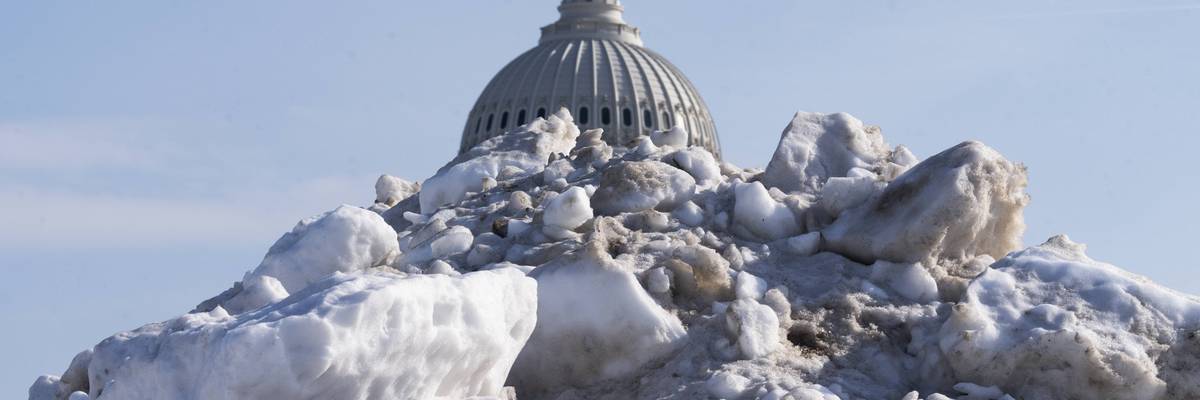
The US Capitol dome is seen over snow and ice that is piled near the Capitol Reflecting Pool on Tuesday, February 3, 2026, over a week after a storm passed over the area.
In the end, the question is not whether a single post is offensive—it is whether we allow cycles of warranted outrage to consume the very attention required for collective survival.
The recent posted image by President Donald Trump depicting the Obamas as primates is unsurprising. This image represents what is believed, what is undoubtedly said behind closed doors. What remains unreal to me is that a sitting president flagrantly posted this. If the Republican Party does not denounce this, they are proclaiming what they truly value. Perhaps that's just as well: The racism has truly not been covert for some time. For so many, this is just another day at the office—another way racist ideology within the Republican Party asserts itself. In posting this, one must question whether the president is unhinged and strategic at the same time. I believe that, surely, he is laughing about just how much he is able to get away with, as befits his temperament and historically documented pattern of behavior.
Already, the White House defends the indefensible: White House press secretary Karoline Leavitt has publicly defended the president’s sharing of the video by framing it as a meme inspired by The Lion King—saying critics should stop what she calls “fake outrage” and focus on more important issues. The White House has repeatedly expressed that the imagery was taken from an internet meme meant to depict the president as “King of the Jungle” and Democrats as animal characters, not intended as racist content.
This disgusting portrayal is distraction while simultaneously challenging the masses to disbelieve what they see with their own eyes. Fascist politics often relies on propaganda and media spectacle to distract the public, undermine shared reality, and redirect attention away from policy consequences toward emotionally charged narratives (Stanley, 2018). This pushes any thinking person to ask, about what are the masses being distracted?
Advancements to curtail Immigration and Customs Enforcement seems the most apt and logical answer. Indeed, politicians must remain steadfast and resolved in their efforts to contain ICE. However, as an education environmental researcher, I am convicted to take a step back to examine the broader landscape and the long-term trends.
If distraction is the strategy, then sustained attention is resistance.
The planetary boundaries framework reminds us that Earth’s stability is shaped by interconnected systems—climate, biodiversity, water, land, and chemical cycles—whose disruption increases the risk of large-scale ecological destabilization. Seen in this light, the severe and lingering cold snaps recently experienced in the US Northeast do not contradict global warming but rather illustrate the volatility of a climate system pushed beyond its historical range of variability. As scientists note, destabilizing the climate system can intensify extremes across seasons, producing not only heatwaves but also disrupted jet streams, polar air incursions, and unusual persistence of cold events. Situating a regional cold spell within this broader planetary context reframes it from an isolated anomaly to a symptom of systemic strain: local weather variability unfolding against a backdrop of transgressed ecological limits. In other words, the discomfort and disruption of a harsh winter can be read as a lived reminder that Earth’s regulatory systems are under pressure, and that climatic instability—whether expressed as heat, cold, drought, or flood—is part of the same planetary story.
Despite overwhelming scientific consensus that climate change is real and accelerating, the current White House under President Trump has repeatedly signaled opposition to aggressive climate mitigation, undercutting efforts to address the crisis while publicly downplaying its urgency. At the United Nations General Assembly in September 2025, Trump referred to climate change as “the greatest con job ever perpetrated on the world,” dismissing expert predictions and climate science in broad terms even as global averages continue to rise and impacts intensify. Domestically, his administration has pursued policies that limit federal engagement in climate leadership—such as rescinding foundational greenhouse gas regulations by challenging the Environmental Protection Agency’s scientific endangerment finding and refusing to send senior officials to the COP30 climate summit—and rolling back environmental protections while promoting expanded fossil fuel extraction.
These actions illustrate a pattern of rhetoric and policymaking that accepts the existence of environmental change but rejects concerted governmental action to confront the climate crisis at the scale scientists say is necessary.
Unchecked climate change is already reshaping Earth’s systems in ways that pose severe risks to human and ecological well-being, often in counterintuitive ways. In the northeastern United States, unseasonably severe cold spells have contributed to fatalities and widespread disruption, reflecting how a destabilized climate system can produce more extreme and erratic weather patterns even as the planet warms overall. Scientific assessments show that critical components of the climate system—such as the Atlantic Meridional Overturning Circulation (AMOC), a major ocean current system that redistributes heat around the globe—are showing signs of disruption associated with warming and freshwater influx from melting ice, with potential large-scale impacts on regional climates, precipitation patterns, and food security if thresholds are crossed. Researchers warn that such a weakening of ocean currents could intensify weather extremes and disrupt agricultural systems and ecosystems worldwide, compounding other alarming indicators like mass species loss and coral reef die-off under thermal stress.
Reflecting the convergence of climate change, geopolitical tension, and emerging technological risks, the Bulletin of the Atomic Scientists has moved the symbolic Doomsday Clock closer to midnight than at any point in its history, signaling growing vulnerability to existential threats driven by human actions and inaction. As of the latest update, the clock stood at a historically high proximity to midnight—indicating an elevated sense of global peril tied in part to the accelerating impacts of climate change alongside nuclear and disruptive technologies—underscoring that societies worldwide have not yet mounted an adequate policy or governance response to the mounting evidence of planetary destabilization.
Far from being speculative or alarmist rhetoric, these warnings are grounded in measurable scientific trends that reveal cascading risks to ecosystems and societies, even as elites prepare for worst-case futures: Reports describe wealthy investors and defense planners expanding private bunkers and survival retreats in anticipation of climatic and geopolitical disruption, while the broader public’s attention is often diverted to the latest political scandal rather than sustained policy engagement with structural risks.
There is circumstantial evidence that the current White House is using distraction as a communication strategy, one consistent with well-studied political diversion tactics, but there is no direct proof that this is an intentionally orchestrated White House policy without formal investigation. Analysts and critics of Project 2025—the extensive conservative policy blueprint authored by the Heritage Foundation and many associates of this administration—have raised alarms about proposals that would restructure media oversight, diminish independent journalism, and alter technology and communications policies in ways that could reduce scrutiny of executive power, a move some see as creating fertile terrain for distraction over accountability.
Political commentators have documented how sensational statements and provocative posts often dominate headlines at the expense of in-depth coverage of systemic risks like climate change or immigration enforcement priorities, consistent with agenda-setting research showing how political actors can shift public attention.
Additionally, scholars studying messaging patterns around scandals suggest that shifts in provocative communications often occur simultaneously with increased media focus on crisis narratives, although establishing intentional coordination by an administration would require formal oversight or committee inquiry, not journalistic inference alone. In short, critics interpret these developments as strategic distraction tactics, but distinguishing intent from effect is a matter for official investigation and evidence beyond public reporting.
In the end, the question is not whether a single post is offensive—it is whether we allow cycles of warranted outrage to consume the very attention required for collective survival. Racism must be named and opposed wherever it appears, especially when amplified by the highest office, but we must also recognize when spectacle functions to fracture public focus. The climate crisis does not pause for political theater, nor do ecological thresholds wait for electoral cycles. If distraction is the strategy, then sustained attention is resistance. The work before us is to hold moral clarity and planetary reality together, refusing to let either be eclipsed by the churn of the news cycle, and insisting that democratic accountability includes safeguarding the conditions for life itself.
Dear Common Dreams reader, It’s been nearly 30 years since I co-founded Common Dreams with my late wife, Lina Newhouser. We had the radical notion that journalism should serve the public good, not corporate profits. It was clear to us from the outset what it would take to build such a project. No paid advertisements. No corporate sponsors. No millionaire publisher telling us what to think or do. Many people said we wouldn't last a year, but we proved those doubters wrong. Together with a tremendous team of journalists and dedicated staff, we built an independent media outlet free from the constraints of profits and corporate control. Our mission has always been simple: To inform. To inspire. To ignite change for the common good. Building Common Dreams was not easy. Our survival was never guaranteed. When you take on the most powerful forces—Wall Street greed, fossil fuel industry destruction, Big Tech lobbyists, and uber-rich oligarchs who have spent billions upon billions rigging the economy and democracy in their favor—the only bulwark you have is supporters who believe in your work. But here’s the urgent message from me today. It's never been this bad out there. And it's never been this hard to keep us going. At the very moment Common Dreams is most needed, the threats we face are intensifying. We need your support now more than ever. We don't accept corporate advertising and never will. We don't have a paywall because we don't think people should be blocked from critical news based on their ability to pay. Everything we do is funded by the donations of readers like you. When everyone does the little they can afford, we are strong. But if that support retreats or dries up, so do we. Will you donate now to make sure Common Dreams not only survives but thrives? —Craig Brown, Co-founder |
The recent posted image by President Donald Trump depicting the Obamas as primates is unsurprising. This image represents what is believed, what is undoubtedly said behind closed doors. What remains unreal to me is that a sitting president flagrantly posted this. If the Republican Party does not denounce this, they are proclaiming what they truly value. Perhaps that's just as well: The racism has truly not been covert for some time. For so many, this is just another day at the office—another way racist ideology within the Republican Party asserts itself. In posting this, one must question whether the president is unhinged and strategic at the same time. I believe that, surely, he is laughing about just how much he is able to get away with, as befits his temperament and historically documented pattern of behavior.
Already, the White House defends the indefensible: White House press secretary Karoline Leavitt has publicly defended the president’s sharing of the video by framing it as a meme inspired by The Lion King—saying critics should stop what she calls “fake outrage” and focus on more important issues. The White House has repeatedly expressed that the imagery was taken from an internet meme meant to depict the president as “King of the Jungle” and Democrats as animal characters, not intended as racist content.
This disgusting portrayal is distraction while simultaneously challenging the masses to disbelieve what they see with their own eyes. Fascist politics often relies on propaganda and media spectacle to distract the public, undermine shared reality, and redirect attention away from policy consequences toward emotionally charged narratives (Stanley, 2018). This pushes any thinking person to ask, about what are the masses being distracted?
Advancements to curtail Immigration and Customs Enforcement seems the most apt and logical answer. Indeed, politicians must remain steadfast and resolved in their efforts to contain ICE. However, as an education environmental researcher, I am convicted to take a step back to examine the broader landscape and the long-term trends.
If distraction is the strategy, then sustained attention is resistance.
The planetary boundaries framework reminds us that Earth’s stability is shaped by interconnected systems—climate, biodiversity, water, land, and chemical cycles—whose disruption increases the risk of large-scale ecological destabilization. Seen in this light, the severe and lingering cold snaps recently experienced in the US Northeast do not contradict global warming but rather illustrate the volatility of a climate system pushed beyond its historical range of variability. As scientists note, destabilizing the climate system can intensify extremes across seasons, producing not only heatwaves but also disrupted jet streams, polar air incursions, and unusual persistence of cold events. Situating a regional cold spell within this broader planetary context reframes it from an isolated anomaly to a symptom of systemic strain: local weather variability unfolding against a backdrop of transgressed ecological limits. In other words, the discomfort and disruption of a harsh winter can be read as a lived reminder that Earth’s regulatory systems are under pressure, and that climatic instability—whether expressed as heat, cold, drought, or flood—is part of the same planetary story.
Despite overwhelming scientific consensus that climate change is real and accelerating, the current White House under President Trump has repeatedly signaled opposition to aggressive climate mitigation, undercutting efforts to address the crisis while publicly downplaying its urgency. At the United Nations General Assembly in September 2025, Trump referred to climate change as “the greatest con job ever perpetrated on the world,” dismissing expert predictions and climate science in broad terms even as global averages continue to rise and impacts intensify. Domestically, his administration has pursued policies that limit federal engagement in climate leadership—such as rescinding foundational greenhouse gas regulations by challenging the Environmental Protection Agency’s scientific endangerment finding and refusing to send senior officials to the COP30 climate summit—and rolling back environmental protections while promoting expanded fossil fuel extraction.
These actions illustrate a pattern of rhetoric and policymaking that accepts the existence of environmental change but rejects concerted governmental action to confront the climate crisis at the scale scientists say is necessary.
Unchecked climate change is already reshaping Earth’s systems in ways that pose severe risks to human and ecological well-being, often in counterintuitive ways. In the northeastern United States, unseasonably severe cold spells have contributed to fatalities and widespread disruption, reflecting how a destabilized climate system can produce more extreme and erratic weather patterns even as the planet warms overall. Scientific assessments show that critical components of the climate system—such as the Atlantic Meridional Overturning Circulation (AMOC), a major ocean current system that redistributes heat around the globe—are showing signs of disruption associated with warming and freshwater influx from melting ice, with potential large-scale impacts on regional climates, precipitation patterns, and food security if thresholds are crossed. Researchers warn that such a weakening of ocean currents could intensify weather extremes and disrupt agricultural systems and ecosystems worldwide, compounding other alarming indicators like mass species loss and coral reef die-off under thermal stress.
Reflecting the convergence of climate change, geopolitical tension, and emerging technological risks, the Bulletin of the Atomic Scientists has moved the symbolic Doomsday Clock closer to midnight than at any point in its history, signaling growing vulnerability to existential threats driven by human actions and inaction. As of the latest update, the clock stood at a historically high proximity to midnight—indicating an elevated sense of global peril tied in part to the accelerating impacts of climate change alongside nuclear and disruptive technologies—underscoring that societies worldwide have not yet mounted an adequate policy or governance response to the mounting evidence of planetary destabilization.
Far from being speculative or alarmist rhetoric, these warnings are grounded in measurable scientific trends that reveal cascading risks to ecosystems and societies, even as elites prepare for worst-case futures: Reports describe wealthy investors and defense planners expanding private bunkers and survival retreats in anticipation of climatic and geopolitical disruption, while the broader public’s attention is often diverted to the latest political scandal rather than sustained policy engagement with structural risks.
There is circumstantial evidence that the current White House is using distraction as a communication strategy, one consistent with well-studied political diversion tactics, but there is no direct proof that this is an intentionally orchestrated White House policy without formal investigation. Analysts and critics of Project 2025—the extensive conservative policy blueprint authored by the Heritage Foundation and many associates of this administration—have raised alarms about proposals that would restructure media oversight, diminish independent journalism, and alter technology and communications policies in ways that could reduce scrutiny of executive power, a move some see as creating fertile terrain for distraction over accountability.
Political commentators have documented how sensational statements and provocative posts often dominate headlines at the expense of in-depth coverage of systemic risks like climate change or immigration enforcement priorities, consistent with agenda-setting research showing how political actors can shift public attention.
Additionally, scholars studying messaging patterns around scandals suggest that shifts in provocative communications often occur simultaneously with increased media focus on crisis narratives, although establishing intentional coordination by an administration would require formal oversight or committee inquiry, not journalistic inference alone. In short, critics interpret these developments as strategic distraction tactics, but distinguishing intent from effect is a matter for official investigation and evidence beyond public reporting.
In the end, the question is not whether a single post is offensive—it is whether we allow cycles of warranted outrage to consume the very attention required for collective survival. Racism must be named and opposed wherever it appears, especially when amplified by the highest office, but we must also recognize when spectacle functions to fracture public focus. The climate crisis does not pause for political theater, nor do ecological thresholds wait for electoral cycles. If distraction is the strategy, then sustained attention is resistance. The work before us is to hold moral clarity and planetary reality together, refusing to let either be eclipsed by the churn of the news cycle, and insisting that democratic accountability includes safeguarding the conditions for life itself.
The recent posted image by President Donald Trump depicting the Obamas as primates is unsurprising. This image represents what is believed, what is undoubtedly said behind closed doors. What remains unreal to me is that a sitting president flagrantly posted this. If the Republican Party does not denounce this, they are proclaiming what they truly value. Perhaps that's just as well: The racism has truly not been covert for some time. For so many, this is just another day at the office—another way racist ideology within the Republican Party asserts itself. In posting this, one must question whether the president is unhinged and strategic at the same time. I believe that, surely, he is laughing about just how much he is able to get away with, as befits his temperament and historically documented pattern of behavior.
Already, the White House defends the indefensible: White House press secretary Karoline Leavitt has publicly defended the president’s sharing of the video by framing it as a meme inspired by The Lion King—saying critics should stop what she calls “fake outrage” and focus on more important issues. The White House has repeatedly expressed that the imagery was taken from an internet meme meant to depict the president as “King of the Jungle” and Democrats as animal characters, not intended as racist content.
This disgusting portrayal is distraction while simultaneously challenging the masses to disbelieve what they see with their own eyes. Fascist politics often relies on propaganda and media spectacle to distract the public, undermine shared reality, and redirect attention away from policy consequences toward emotionally charged narratives (Stanley, 2018). This pushes any thinking person to ask, about what are the masses being distracted?
Advancements to curtail Immigration and Customs Enforcement seems the most apt and logical answer. Indeed, politicians must remain steadfast and resolved in their efforts to contain ICE. However, as an education environmental researcher, I am convicted to take a step back to examine the broader landscape and the long-term trends.
If distraction is the strategy, then sustained attention is resistance.
The planetary boundaries framework reminds us that Earth’s stability is shaped by interconnected systems—climate, biodiversity, water, land, and chemical cycles—whose disruption increases the risk of large-scale ecological destabilization. Seen in this light, the severe and lingering cold snaps recently experienced in the US Northeast do not contradict global warming but rather illustrate the volatility of a climate system pushed beyond its historical range of variability. As scientists note, destabilizing the climate system can intensify extremes across seasons, producing not only heatwaves but also disrupted jet streams, polar air incursions, and unusual persistence of cold events. Situating a regional cold spell within this broader planetary context reframes it from an isolated anomaly to a symptom of systemic strain: local weather variability unfolding against a backdrop of transgressed ecological limits. In other words, the discomfort and disruption of a harsh winter can be read as a lived reminder that Earth’s regulatory systems are under pressure, and that climatic instability—whether expressed as heat, cold, drought, or flood—is part of the same planetary story.
Despite overwhelming scientific consensus that climate change is real and accelerating, the current White House under President Trump has repeatedly signaled opposition to aggressive climate mitigation, undercutting efforts to address the crisis while publicly downplaying its urgency. At the United Nations General Assembly in September 2025, Trump referred to climate change as “the greatest con job ever perpetrated on the world,” dismissing expert predictions and climate science in broad terms even as global averages continue to rise and impacts intensify. Domestically, his administration has pursued policies that limit federal engagement in climate leadership—such as rescinding foundational greenhouse gas regulations by challenging the Environmental Protection Agency’s scientific endangerment finding and refusing to send senior officials to the COP30 climate summit—and rolling back environmental protections while promoting expanded fossil fuel extraction.
These actions illustrate a pattern of rhetoric and policymaking that accepts the existence of environmental change but rejects concerted governmental action to confront the climate crisis at the scale scientists say is necessary.
Unchecked climate change is already reshaping Earth’s systems in ways that pose severe risks to human and ecological well-being, often in counterintuitive ways. In the northeastern United States, unseasonably severe cold spells have contributed to fatalities and widespread disruption, reflecting how a destabilized climate system can produce more extreme and erratic weather patterns even as the planet warms overall. Scientific assessments show that critical components of the climate system—such as the Atlantic Meridional Overturning Circulation (AMOC), a major ocean current system that redistributes heat around the globe—are showing signs of disruption associated with warming and freshwater influx from melting ice, with potential large-scale impacts on regional climates, precipitation patterns, and food security if thresholds are crossed. Researchers warn that such a weakening of ocean currents could intensify weather extremes and disrupt agricultural systems and ecosystems worldwide, compounding other alarming indicators like mass species loss and coral reef die-off under thermal stress.
Reflecting the convergence of climate change, geopolitical tension, and emerging technological risks, the Bulletin of the Atomic Scientists has moved the symbolic Doomsday Clock closer to midnight than at any point in its history, signaling growing vulnerability to existential threats driven by human actions and inaction. As of the latest update, the clock stood at a historically high proximity to midnight—indicating an elevated sense of global peril tied in part to the accelerating impacts of climate change alongside nuclear and disruptive technologies—underscoring that societies worldwide have not yet mounted an adequate policy or governance response to the mounting evidence of planetary destabilization.
Far from being speculative or alarmist rhetoric, these warnings are grounded in measurable scientific trends that reveal cascading risks to ecosystems and societies, even as elites prepare for worst-case futures: Reports describe wealthy investors and defense planners expanding private bunkers and survival retreats in anticipation of climatic and geopolitical disruption, while the broader public’s attention is often diverted to the latest political scandal rather than sustained policy engagement with structural risks.
There is circumstantial evidence that the current White House is using distraction as a communication strategy, one consistent with well-studied political diversion tactics, but there is no direct proof that this is an intentionally orchestrated White House policy without formal investigation. Analysts and critics of Project 2025—the extensive conservative policy blueprint authored by the Heritage Foundation and many associates of this administration—have raised alarms about proposals that would restructure media oversight, diminish independent journalism, and alter technology and communications policies in ways that could reduce scrutiny of executive power, a move some see as creating fertile terrain for distraction over accountability.
Political commentators have documented how sensational statements and provocative posts often dominate headlines at the expense of in-depth coverage of systemic risks like climate change or immigration enforcement priorities, consistent with agenda-setting research showing how political actors can shift public attention.
Additionally, scholars studying messaging patterns around scandals suggest that shifts in provocative communications often occur simultaneously with increased media focus on crisis narratives, although establishing intentional coordination by an administration would require formal oversight or committee inquiry, not journalistic inference alone. In short, critics interpret these developments as strategic distraction tactics, but distinguishing intent from effect is a matter for official investigation and evidence beyond public reporting.
In the end, the question is not whether a single post is offensive—it is whether we allow cycles of warranted outrage to consume the very attention required for collective survival. Racism must be named and opposed wherever it appears, especially when amplified by the highest office, but we must also recognize when spectacle functions to fracture public focus. The climate crisis does not pause for political theater, nor do ecological thresholds wait for electoral cycles. If distraction is the strategy, then sustained attention is resistance. The work before us is to hold moral clarity and planetary reality together, refusing to let either be eclipsed by the churn of the news cycle, and insisting that democratic accountability includes safeguarding the conditions for life itself.