SUBSCRIBE TO OUR FREE NEWSLETTER
Daily news & progressive opinion—funded by the people, not the corporations—delivered straight to your inbox.
5
#000000
#FFFFFF
To donate by check, phone, or other method, see our More Ways to Give page.
Daily news & progressive opinion—funded by the people, not the corporations—delivered straight to your inbox.
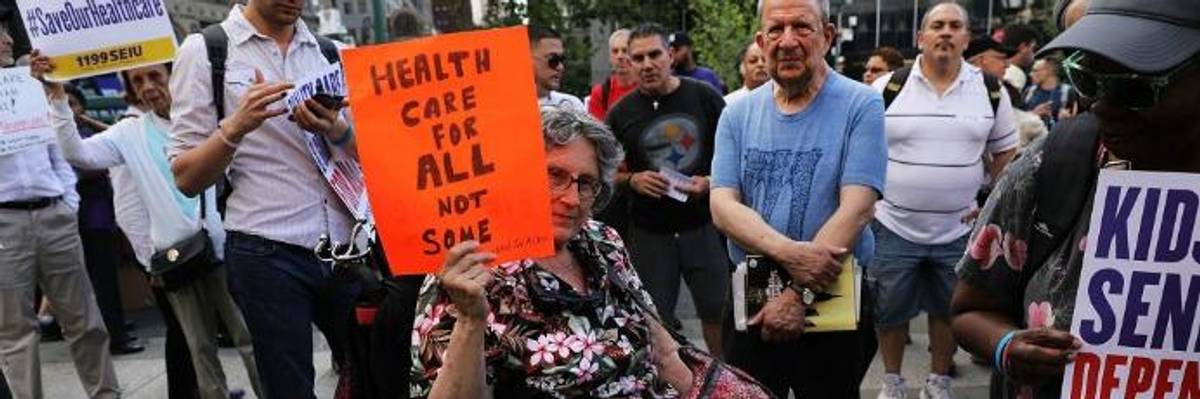
Jean Ryan from Disabled in Action joins others in protesting against the Senate healthcare bill on June 28, 2017 in New York City.
A lack of investment in home- and community-based services and the low wages that result threaten to turn back the clock due to a severe national shortage of direct support professionals.
To think about it a different way, it was only 25 years ago that our nation codified its rejection of the warehousing of human beings in large, state-run institutions, isolated from their families and from opportunities to enjoy independence and autonomy.
The two plaintiffs in the Olmstead case, Lois Curtis and Elaine Wilson, cycled through numerous institutions and hospitals through their childhoods due to their disabilities before they ended up at the state-run Georgia Regional Hospital. Doctors decided both women were ready to transition to community-based treatment that would offer greater independence, but the state stopped the women from moving, confining them to the institution several years beyond what was necessary.
Olmstead and the ADA were milestones meant to ensure the civil and human rights of people with disabilities, and we must protect them against the possibility of going backward.
The lawsuit these women filed against the state declared that the unjustified isolation they suffered as the result of their disability was discrimination under Title II of the Americans with Disabilities Act of 1990 (ADA).
Like the ADA, which will celebrate its own anniversary later this month, the court’s Olmstead decision came with a promise: It is “appropriate and required” that individuals with disabilities receive the support they need to thrive in our communities.
Since these landmark human rights victories, we have made significant progress. But a quarter-century later, a lack of investment in home- and community-based services and the low wages that result threaten to turn back the clock due to a severe national shortage of direct support professionals, or DSPs, who are the backbone of the disability service delivery system.
In fact, a survey of hundreds of disability service providers across the country in 2023 found that severe staffing challenges had them facing impossible choices. More than 3 in 4 providers reported that they are no longer accepting new referrals, while 63% were forced to close programs. Meanwhile, nearly a half a million people nationally are languishing on waiting lists for services.
DSPs support people with intellectual and developmental disabilities (I/DD) to carry out activities of daily living, find and maintain employment, develop and sustain meaningful relationships, and so much more.
One of us, Doug, is a DSP whose interest in supporting others dates back to childhood. When I was 10 years old, I often babysat a little boy with Down syndrome. Even at my young age, I was aware of how his family struggled to find resources for their son, cover mounting costs, and make ends meet.
But throughout my tenure as a DSP, I’ve only seen things get worse. The people I support see skyrocketing costs for everyday essentials. Whereas I used to be able to open my wallet to help with these costs from time to time, I’m finding my own finances stretched thinner and thinner. I recently agreed to begin supporting a second person, thinking it would help me bring in more income. Instead, the additional bills mean I’m only falling farther behind.
Nevertheless, I will continue committing to this work because of the impact I know I’m having in the lives of those I support. One of the people I work with is a 65-year-old disabled trans person. When we first started working together, he experienced debilitating anxiety, had no support from family or other natural networks, and felt completely ostracized from his community. By building trust, connecting him with local support groups, and supporting him to find safe spaces, he developed the courage to come out as trans and begin his transition.
The other one of us, Barbara, leads a national association representing thousands of disability service providers like those that employ outstanding DSPs like Doug. Our entire service delivery system rests on the civil rights promises made possible through legal landmarks like Olmstead. But without increased funding for these services to improve DSP wages, more people with I/DD will struggle to find—and keep—people like Doug committed to person-centered support. And that means longer waits for services and a higher risk of unnecessary institutionalization.
Olmstead and the ADA were milestones meant to ensure the civil and human rights of people with disabilities, and we must protect them against the possibility of going backward. Both state and federal leaders have the power to do just that, but they must be willing to commit to the long-term sustainability of the DSP workforce.
Dear Common Dreams reader, It’s been nearly 30 years since I co-founded Common Dreams with my late wife, Lina Newhouser. We had the radical notion that journalism should serve the public good, not corporate profits. It was clear to us from the outset what it would take to build such a project. No paid advertisements. No corporate sponsors. No millionaire publisher telling us what to think or do. Many people said we wouldn't last a year, but we proved those doubters wrong. Together with a tremendous team of journalists and dedicated staff, we built an independent media outlet free from the constraints of profits and corporate control. Our mission has always been simple: To inform. To inspire. To ignite change for the common good. Building Common Dreams was not easy. Our survival was never guaranteed. When you take on the most powerful forces—Wall Street greed, fossil fuel industry destruction, Big Tech lobbyists, and uber-rich oligarchs who have spent billions upon billions rigging the economy and democracy in their favor—the only bulwark you have is supporters who believe in your work. But here’s the urgent message from me today. It's never been this bad out there. And it's never been this hard to keep us going. At the very moment Common Dreams is most needed, the threats we face are intensifying. We need your support now more than ever. We don't accept corporate advertising and never will. We don't have a paywall because we don't think people should be blocked from critical news based on their ability to pay. Everything we do is funded by the donations of readers like you. When everyone does the little they can afford, we are strong. But if that support retreats or dries up, so do we. Will you donate now to make sure Common Dreams not only survives but thrives? —Craig Brown, Co-founder |
To think about it a different way, it was only 25 years ago that our nation codified its rejection of the warehousing of human beings in large, state-run institutions, isolated from their families and from opportunities to enjoy independence and autonomy.
The two plaintiffs in the Olmstead case, Lois Curtis and Elaine Wilson, cycled through numerous institutions and hospitals through their childhoods due to their disabilities before they ended up at the state-run Georgia Regional Hospital. Doctors decided both women were ready to transition to community-based treatment that would offer greater independence, but the state stopped the women from moving, confining them to the institution several years beyond what was necessary.
Olmstead and the ADA were milestones meant to ensure the civil and human rights of people with disabilities, and we must protect them against the possibility of going backward.
The lawsuit these women filed against the state declared that the unjustified isolation they suffered as the result of their disability was discrimination under Title II of the Americans with Disabilities Act of 1990 (ADA).
Like the ADA, which will celebrate its own anniversary later this month, the court’s Olmstead decision came with a promise: It is “appropriate and required” that individuals with disabilities receive the support they need to thrive in our communities.
Since these landmark human rights victories, we have made significant progress. But a quarter-century later, a lack of investment in home- and community-based services and the low wages that result threaten to turn back the clock due to a severe national shortage of direct support professionals, or DSPs, who are the backbone of the disability service delivery system.
In fact, a survey of hundreds of disability service providers across the country in 2023 found that severe staffing challenges had them facing impossible choices. More than 3 in 4 providers reported that they are no longer accepting new referrals, while 63% were forced to close programs. Meanwhile, nearly a half a million people nationally are languishing on waiting lists for services.
DSPs support people with intellectual and developmental disabilities (I/DD) to carry out activities of daily living, find and maintain employment, develop and sustain meaningful relationships, and so much more.
One of us, Doug, is a DSP whose interest in supporting others dates back to childhood. When I was 10 years old, I often babysat a little boy with Down syndrome. Even at my young age, I was aware of how his family struggled to find resources for their son, cover mounting costs, and make ends meet.
But throughout my tenure as a DSP, I’ve only seen things get worse. The people I support see skyrocketing costs for everyday essentials. Whereas I used to be able to open my wallet to help with these costs from time to time, I’m finding my own finances stretched thinner and thinner. I recently agreed to begin supporting a second person, thinking it would help me bring in more income. Instead, the additional bills mean I’m only falling farther behind.
Nevertheless, I will continue committing to this work because of the impact I know I’m having in the lives of those I support. One of the people I work with is a 65-year-old disabled trans person. When we first started working together, he experienced debilitating anxiety, had no support from family or other natural networks, and felt completely ostracized from his community. By building trust, connecting him with local support groups, and supporting him to find safe spaces, he developed the courage to come out as trans and begin his transition.
The other one of us, Barbara, leads a national association representing thousands of disability service providers like those that employ outstanding DSPs like Doug. Our entire service delivery system rests on the civil rights promises made possible through legal landmarks like Olmstead. But without increased funding for these services to improve DSP wages, more people with I/DD will struggle to find—and keep—people like Doug committed to person-centered support. And that means longer waits for services and a higher risk of unnecessary institutionalization.
Olmstead and the ADA were milestones meant to ensure the civil and human rights of people with disabilities, and we must protect them against the possibility of going backward. Both state and federal leaders have the power to do just that, but they must be willing to commit to the long-term sustainability of the DSP workforce.
To think about it a different way, it was only 25 years ago that our nation codified its rejection of the warehousing of human beings in large, state-run institutions, isolated from their families and from opportunities to enjoy independence and autonomy.
The two plaintiffs in the Olmstead case, Lois Curtis and Elaine Wilson, cycled through numerous institutions and hospitals through their childhoods due to their disabilities before they ended up at the state-run Georgia Regional Hospital. Doctors decided both women were ready to transition to community-based treatment that would offer greater independence, but the state stopped the women from moving, confining them to the institution several years beyond what was necessary.
Olmstead and the ADA were milestones meant to ensure the civil and human rights of people with disabilities, and we must protect them against the possibility of going backward.
The lawsuit these women filed against the state declared that the unjustified isolation they suffered as the result of their disability was discrimination under Title II of the Americans with Disabilities Act of 1990 (ADA).
Like the ADA, which will celebrate its own anniversary later this month, the court’s Olmstead decision came with a promise: It is “appropriate and required” that individuals with disabilities receive the support they need to thrive in our communities.
Since these landmark human rights victories, we have made significant progress. But a quarter-century later, a lack of investment in home- and community-based services and the low wages that result threaten to turn back the clock due to a severe national shortage of direct support professionals, or DSPs, who are the backbone of the disability service delivery system.
In fact, a survey of hundreds of disability service providers across the country in 2023 found that severe staffing challenges had them facing impossible choices. More than 3 in 4 providers reported that they are no longer accepting new referrals, while 63% were forced to close programs. Meanwhile, nearly a half a million people nationally are languishing on waiting lists for services.
DSPs support people with intellectual and developmental disabilities (I/DD) to carry out activities of daily living, find and maintain employment, develop and sustain meaningful relationships, and so much more.
One of us, Doug, is a DSP whose interest in supporting others dates back to childhood. When I was 10 years old, I often babysat a little boy with Down syndrome. Even at my young age, I was aware of how his family struggled to find resources for their son, cover mounting costs, and make ends meet.
But throughout my tenure as a DSP, I’ve only seen things get worse. The people I support see skyrocketing costs for everyday essentials. Whereas I used to be able to open my wallet to help with these costs from time to time, I’m finding my own finances stretched thinner and thinner. I recently agreed to begin supporting a second person, thinking it would help me bring in more income. Instead, the additional bills mean I’m only falling farther behind.
Nevertheless, I will continue committing to this work because of the impact I know I’m having in the lives of those I support. One of the people I work with is a 65-year-old disabled trans person. When we first started working together, he experienced debilitating anxiety, had no support from family or other natural networks, and felt completely ostracized from his community. By building trust, connecting him with local support groups, and supporting him to find safe spaces, he developed the courage to come out as trans and begin his transition.
The other one of us, Barbara, leads a national association representing thousands of disability service providers like those that employ outstanding DSPs like Doug. Our entire service delivery system rests on the civil rights promises made possible through legal landmarks like Olmstead. But without increased funding for these services to improve DSP wages, more people with I/DD will struggle to find—and keep—people like Doug committed to person-centered support. And that means longer waits for services and a higher risk of unnecessary institutionalization.
Olmstead and the ADA were milestones meant to ensure the civil and human rights of people with disabilities, and we must protect them against the possibility of going backward. Both state and federal leaders have the power to do just that, but they must be willing to commit to the long-term sustainability of the DSP workforce.