SUBSCRIBE TO OUR FREE NEWSLETTER
Daily news & progressive opinion—funded by the people, not the corporations—delivered straight to your inbox.
5
#000000
#FFFFFF
To donate by check, phone, or other method, see our More Ways to Give page.
Daily news & progressive opinion—funded by the people, not the corporations—delivered straight to your inbox.
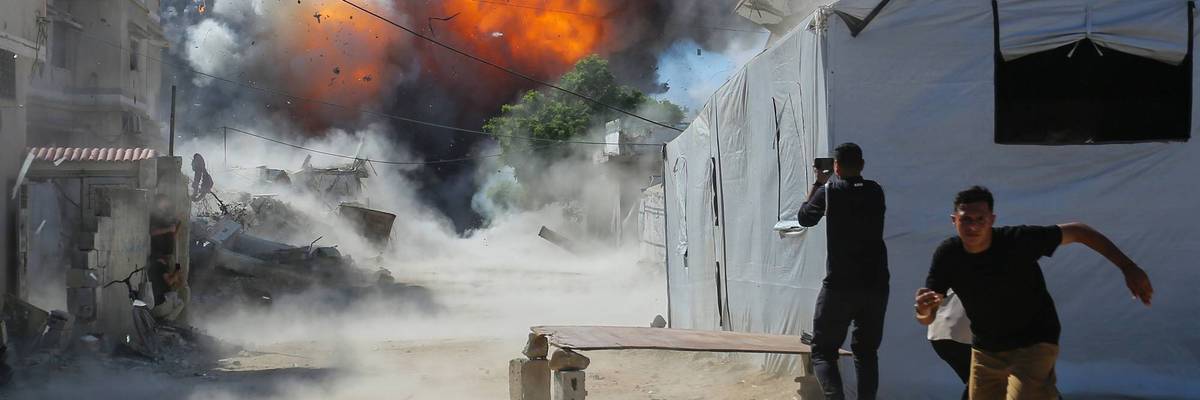
Smoke from an explosion can be seen after an Israeli attack on July 12, 2026 in Gaza City, Gaza.
Three years have passed. Much has changed, and far more has been destroyed. But the question that existed on October 6 did not disappear on October 7, and all the war that followed has not erased it: When will Palestinians live freely on their own land?
Three years have passed since October 7, 2023, yet much of the world still begins the story on that morning.
As if Palestinians suddenly woke up that day and decided to enter history.
As if Gaza had not already been under blockade. As if the West Bank and East Jerusalem had not already been under occupation. As if settlements, checkpoints, arrests, home demolitions, and land confiscation had not already been part of everyday Palestinian life.
Three years later, what has happened in Gaza can no longer be reduced to the word “response.”
I am not writing today to justify the killing of civilians, Palestinian or Israeli.
A civilian life does not need a nationality to be worthy of protection.
But I refuse to accept October 7 as an eraser—wiping away everything that came before it and becoming an open-ended justification for everything that followed.
When an Israeli is killed, we are told to go back to October 7.
When a Palestinian is killed, we are told: Remember October 7.
When Gaza is destroyed, its people displaced, and its children killed, the answer is the same: October 7.
But if we are asked to remember that day, then we should also be allowed to ask a simple question: What was there on October 6?
There were millions of Palestinians already living under occupation.
More than 2 million Palestinians in Gaza had been living under blockade for years.
In the West Bank, Palestinians lived among checkpoints and settlements, without freedom of movement on their own land, while Israeli settlers moved through the same territory with rights and protection denied to the Palestinians who live there.
There were prisoners in Israeli jails. Homes were being demolished. Land was being confiscated.
None of this began on October 7.
Palestinians carry the memory of the Nakba of 1948, the occupation of 1967, and decades of settlement expansion, displacement, and blockade.
That history does not make the killing of civilians acceptable. But neither does it make acceptable the claim that this conflict began on October 7.
There is a difference between condemning an act and using that act to erase everything that came before it.
Three years later, what has happened in Gaza can no longer be reduced to the word “response.”
A response cannot be a blank check. October 7 cannot become a permanent justification for killing, destruction, displacement, and hunger, or for making an entire people pay the price year after year.
Even the ceasefire announced in October 2025 did not end the tragedy. The devastation remained. Families continued searching beneath the rubble for the bodies of their loved ones. And the killing did not stop entirely.
At the same time, the occupation in the West Bank did not pause and wait for the war in Gaza to end. Land continued to be confiscated. Settlements continued to expand. Checkpoints continued to cut Palestinians off from one another.
And this is where the heart of the matter lies.
Palestinians are not asking for a privilege denied to others.
They want to live freely on their own land. To move through it without needing permission from an occupying soldier. To feel that their homes, their land, and their children’s future are safe.
These are not extraordinary demands.
They are the ordinary conditions of life that most people in the world enjoy without ever having to think about them.
So, three years later, it is not enough to ask: What happened on October 7?
We must also ask: What was done to Palestinians before that day, and what is being done to them now?
The world is not being asked to choose between Palestinian blood and Israeli blood, or to find excuses for the killing of civilians by either side.
It is being asked to stop reversing the relationship between the occupier and the occupied.
Palestinians are not a people occupying another people’s land.
Palestinians are the people living under occupation.
That is not an emotional statement. It is a fact that cannot be removed from any serious reading of what happened before October 7, on October 7, or after it.
Three years have passed. Much has changed, and far more has been destroyed. But the question that existed on October 6 did not disappear on October 7, and all the war that followed has not erased it: When will Palestinians live freely on their own land?
So if the world truly does not want to see another October 7, it is not enough to remember what happened on that day.
It must also remember what existed the day before.
What had existed for decades before that.
And what still exists at this very moment.
The occupation.
Dear Common Dreams reader, It’s been nearly 30 years since I co-founded Common Dreams with my late wife, Lina Newhouser. We had the radical notion that journalism should serve the public good, not corporate profits. It was clear to us from the outset what it would take to build such a project. No paid advertisements. No corporate sponsors. No millionaire publisher telling us what to think or do. Many people said we wouldn't last a year, but we proved those doubters wrong. Together with a tremendous team of journalists and dedicated staff, we built an independent media outlet free from the constraints of profits and corporate control. Our mission has always been simple: To inform. To inspire. To ignite change for the common good. Building Common Dreams was not easy. Our survival was never guaranteed. When you take on the most powerful forces—Wall Street greed, fossil fuel industry destruction, Big Tech lobbyists, and uber-rich oligarchs who have spent billions upon billions rigging the economy and democracy in their favor—the only bulwark you have is supporters who believe in your work. But here’s the urgent message from me today. It's never been this bad out there. And it's never been this hard to keep us going. At the very moment Common Dreams is most needed, the threats we face are intensifying. We need your support now more than ever. We don't accept corporate advertising and never will. We don't have a paywall because we don't think people should be blocked from critical news based on their ability to pay. Everything we do is funded by the donations of readers like you. When everyone does the little they can afford, we are strong. But if that support retreats or dries up, so do we. Will you donate now to make sure Common Dreams not only survives but thrives? —Craig Brown, Co-founder |
Three years have passed since October 7, 2023, yet much of the world still begins the story on that morning.
As if Palestinians suddenly woke up that day and decided to enter history.
As if Gaza had not already been under blockade. As if the West Bank and East Jerusalem had not already been under occupation. As if settlements, checkpoints, arrests, home demolitions, and land confiscation had not already been part of everyday Palestinian life.
Three years later, what has happened in Gaza can no longer be reduced to the word “response.”
I am not writing today to justify the killing of civilians, Palestinian or Israeli.
A civilian life does not need a nationality to be worthy of protection.
But I refuse to accept October 7 as an eraser—wiping away everything that came before it and becoming an open-ended justification for everything that followed.
When an Israeli is killed, we are told to go back to October 7.
When a Palestinian is killed, we are told: Remember October 7.
When Gaza is destroyed, its people displaced, and its children killed, the answer is the same: October 7.
But if we are asked to remember that day, then we should also be allowed to ask a simple question: What was there on October 6?
There were millions of Palestinians already living under occupation.
More than 2 million Palestinians in Gaza had been living under blockade for years.
In the West Bank, Palestinians lived among checkpoints and settlements, without freedom of movement on their own land, while Israeli settlers moved through the same territory with rights and protection denied to the Palestinians who live there.
There were prisoners in Israeli jails. Homes were being demolished. Land was being confiscated.
None of this began on October 7.
Palestinians carry the memory of the Nakba of 1948, the occupation of 1967, and decades of settlement expansion, displacement, and blockade.
That history does not make the killing of civilians acceptable. But neither does it make acceptable the claim that this conflict began on October 7.
There is a difference between condemning an act and using that act to erase everything that came before it.
Three years later, what has happened in Gaza can no longer be reduced to the word “response.”
A response cannot be a blank check. October 7 cannot become a permanent justification for killing, destruction, displacement, and hunger, or for making an entire people pay the price year after year.
Even the ceasefire announced in October 2025 did not end the tragedy. The devastation remained. Families continued searching beneath the rubble for the bodies of their loved ones. And the killing did not stop entirely.
At the same time, the occupation in the West Bank did not pause and wait for the war in Gaza to end. Land continued to be confiscated. Settlements continued to expand. Checkpoints continued to cut Palestinians off from one another.
And this is where the heart of the matter lies.
Palestinians are not asking for a privilege denied to others.
They want to live freely on their own land. To move through it without needing permission from an occupying soldier. To feel that their homes, their land, and their children’s future are safe.
These are not extraordinary demands.
They are the ordinary conditions of life that most people in the world enjoy without ever having to think about them.
So, three years later, it is not enough to ask: What happened on October 7?
We must also ask: What was done to Palestinians before that day, and what is being done to them now?
The world is not being asked to choose between Palestinian blood and Israeli blood, or to find excuses for the killing of civilians by either side.
It is being asked to stop reversing the relationship between the occupier and the occupied.
Palestinians are not a people occupying another people’s land.
Palestinians are the people living under occupation.
That is not an emotional statement. It is a fact that cannot be removed from any serious reading of what happened before October 7, on October 7, or after it.
Three years have passed. Much has changed, and far more has been destroyed. But the question that existed on October 6 did not disappear on October 7, and all the war that followed has not erased it: When will Palestinians live freely on their own land?
So if the world truly does not want to see another October 7, it is not enough to remember what happened on that day.
It must also remember what existed the day before.
What had existed for decades before that.
And what still exists at this very moment.
The occupation.
Three years have passed since October 7, 2023, yet much of the world still begins the story on that morning.
As if Palestinians suddenly woke up that day and decided to enter history.
As if Gaza had not already been under blockade. As if the West Bank and East Jerusalem had not already been under occupation. As if settlements, checkpoints, arrests, home demolitions, and land confiscation had not already been part of everyday Palestinian life.
Three years later, what has happened in Gaza can no longer be reduced to the word “response.”
I am not writing today to justify the killing of civilians, Palestinian or Israeli.
A civilian life does not need a nationality to be worthy of protection.
But I refuse to accept October 7 as an eraser—wiping away everything that came before it and becoming an open-ended justification for everything that followed.
When an Israeli is killed, we are told to go back to October 7.
When a Palestinian is killed, we are told: Remember October 7.
When Gaza is destroyed, its people displaced, and its children killed, the answer is the same: October 7.
But if we are asked to remember that day, then we should also be allowed to ask a simple question: What was there on October 6?
There were millions of Palestinians already living under occupation.
More than 2 million Palestinians in Gaza had been living under blockade for years.
In the West Bank, Palestinians lived among checkpoints and settlements, without freedom of movement on their own land, while Israeli settlers moved through the same territory with rights and protection denied to the Palestinians who live there.
There were prisoners in Israeli jails. Homes were being demolished. Land was being confiscated.
None of this began on October 7.
Palestinians carry the memory of the Nakba of 1948, the occupation of 1967, and decades of settlement expansion, displacement, and blockade.
That history does not make the killing of civilians acceptable. But neither does it make acceptable the claim that this conflict began on October 7.
There is a difference between condemning an act and using that act to erase everything that came before it.
Three years later, what has happened in Gaza can no longer be reduced to the word “response.”
A response cannot be a blank check. October 7 cannot become a permanent justification for killing, destruction, displacement, and hunger, or for making an entire people pay the price year after year.
Even the ceasefire announced in October 2025 did not end the tragedy. The devastation remained. Families continued searching beneath the rubble for the bodies of their loved ones. And the killing did not stop entirely.
At the same time, the occupation in the West Bank did not pause and wait for the war in Gaza to end. Land continued to be confiscated. Settlements continued to expand. Checkpoints continued to cut Palestinians off from one another.
And this is where the heart of the matter lies.
Palestinians are not asking for a privilege denied to others.
They want to live freely on their own land. To move through it without needing permission from an occupying soldier. To feel that their homes, their land, and their children’s future are safe.
These are not extraordinary demands.
They are the ordinary conditions of life that most people in the world enjoy without ever having to think about them.
So, three years later, it is not enough to ask: What happened on October 7?
We must also ask: What was done to Palestinians before that day, and what is being done to them now?
The world is not being asked to choose between Palestinian blood and Israeli blood, or to find excuses for the killing of civilians by either side.
It is being asked to stop reversing the relationship between the occupier and the occupied.
Palestinians are not a people occupying another people’s land.
Palestinians are the people living under occupation.
That is not an emotional statement. It is a fact that cannot be removed from any serious reading of what happened before October 7, on October 7, or after it.
Three years have passed. Much has changed, and far more has been destroyed. But the question that existed on October 6 did not disappear on October 7, and all the war that followed has not erased it: When will Palestinians live freely on their own land?
So if the world truly does not want to see another October 7, it is not enough to remember what happened on that day.
It must also remember what existed the day before.
What had existed for decades before that.
And what still exists at this very moment.
The occupation.